Saturday, 26 November 2016

OF MORSE AND MURDERS: OXFORD

 
Inspector Morse was a highly successful TV series based on the Chief Inspector Morse novels of Colin Dexter and set in and around Oxford.  The series, which ran from 1987 to 2000, gained international acclaim for its convoluted story lines and attractive locations, and international broacasting rights for the series were sold to 200 countries, making it the most exported TV series in the history of British television.  Viewers worldwide despaired at the behaviour of the irascible Inspector Morse, played by the late actor John Thaw, with his habit of taking every opportunity for a drink during the course of his investigations, his series of thwarted love affairs and his dismissive treatment of those around him, not least his sidekick the long-suffering Lewis, played by Kevin Whately.  
Inspector Morse was a real ale fanatic, so many scenes in the series were filmed in Oxford's historic pubs.  The Bear Inn featured in the "Death Is Now My Neighbour" episode in which Morse visits the pub for a beer during the course of a murder enquiry.  In "The Dead of Jericho", Morse has a drink with a fellow choir member - one of his many doomed romances - in the White Horse, Broad Street, after choir practice.  The Turf Tavern, an ancient inn nestled among a labyrinth of narrow lanes, was used in a number of Morse episodes, for example "The Daughters of Cain".   The Eagle And Child (currently closed) – a favourite haunt of J. R. Tolkien - was visited regularly by Colin Dexter and also featured in the series.
File:The Eagle and Child (Oxford).jpg
The Eagle and Child (Oxford). Photo by manray3, via Wikimedia Commons.
Apart from beer, another of Morse's passions is classical music, particularly opera, and as with the ale, this was an enthusiasm well catered for in Oxford.  He is often to be found attending concerts in the city.  In "Twilight Of The Gods", one of Morse's opera idols, the mezzo-soprano Gwladys Probert, is shot by a sniper.  Earlier in the episode she is seen giving a master-class at the Holywell Music Room.  The shooting takes place as a procession is making its way to the Sheldonian TheatreThis handsome building, started in 1664, is renowned both for its distinctive rounded exterior, topped by an eight-sided cupola, and for its beautiful galleried interior.
File:Sheldonian Theatre (5649724219).jpg
Sheldonian Theatre (5649724219). Photo by Tony Hisgett, via Wikimedia Commons.
Naturally for a city such as Oxford, many of the Morse episodes had an academic flavour to them, with the colleges of the University playing a pivotal role.  In "The Last Enemy", the real identity of the fictional college called Beaumont College was Corpus Christi College.  Morse visits his old friend Sir Alexander Reece at the college, and Reece asks him to investigate the disappearance of the Deputy Master.   In "The Infernal Serpent" senior fellow of Beaufort College Dr Julian Dear is attacked and dies of a heart attack.  His funeral, which supposedly takes place at Beaufort College, was actually filmed in the chapel of University College and in Oriel College.  Oriel College was used in several other episodes, including "Deadly Slumber", "Twilight Of The Gods" and "Death Is Now My Neighbour".  Lonsdale College is another fictional college which features in a number of Morse episodes.  Brasenose College is the real-life college which was used to depict Lonsdale, while New College was used for the fictional St Saviour's.
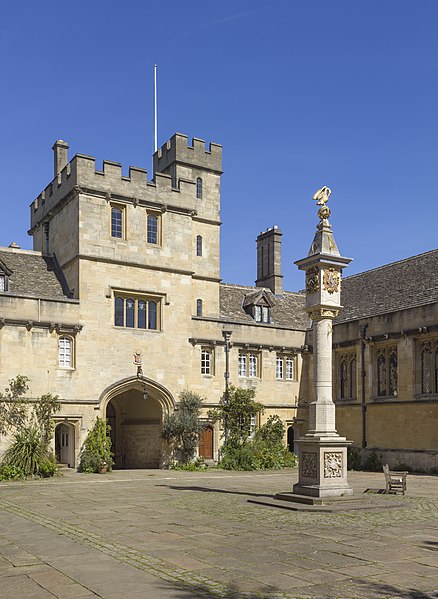
File:UK-2014-Oxford-Corpus Christi College 02.jpg
UK-2014-Oxford-Corpus Christi College 02. Photo by Godot13, via Wikimedia Commons.

Continuing the learned theme, several of Oxford's museums and gardens have featured in the Morse series.  The title of "The Wolvercote Tongue" refers to a priceless piece of medieval jewellery belonging to a visiting tourist which vanishes.  An expert on the piece from the Ashmolean Museum, to which the tourist was going to donate the item, is found dead.  In "The Daughters Of Cain" a knife-wielding murderer steals his weapon from Pitt Rivers Museum.  The marksman who shoots Gwladys Probert in "Twilight Of The Gods" does the evil deed from a vantage point in the Bodleian Library, the main research library of the University of Oxford, and one of the oldest libraries in Europe.  The adjoining Radcliffe Camera, a beautiful circular building started in 1737, often appears in the background during Morse's strolls through the city, for example in "The Last Enemy" when he is seen walking past it with Lewis.  The Botanic Gardens, founded in 1621 under the auspices of the University, features in "The Settling Of The Sun".

File:Oxford - Bodleian Library - Radcliffe Camera - tree.JPG
Oxford - Bodleian Library - Radcliffe Camera - tree. Photo by Remi Mathis, via Wikimedia Commons.

The beauty of the architecture in central Oxford as well as the bucolic countryside surrounding the city has made it one of south-east England's most used locations in film and TV productions.  Films made in the city include Shadowlands, a film about C. S. Lewis, played by Anthony Hopkins, Harry Potter and the Philosopher’s Stone, featuring the Bodleian Library, X-Men: First Class, which includes scenes shot around the University buildings, and the 2006 film The History Boys.  On the small screen, the series Lewis, a spin-off from the Inspector Morse series, as well as another about the young Morse called Endeavour, were filmed in and around the city.

Oxford is a highly cosmopolitan city, where the mix of academic types and the more working class element has led to the use of the phrase “town and gown”.  This mixed population had led to a highly diverse range of attractions and entertainment, with something for everyone.  The city centre is a jumble of venerable old colleges, chapels, churches and museums, many open to visitors, plus a wide variety of restaurants and pubs.  Not surprisingly, the city offers Morse-themed tours of the city.  Or you could just go it alone and go on a Morse-themed pub crawl!

Map of the city.


Thursday, 27 October 2016

HALLOWEEN SPECIAL: THE VILLAGE OF THE DAMNED/LETCHMORE HEATH


There are few things creepier than a bunch of children with luminous staring eyes and impassive faces roaming around the place, especially when the place in question is an idyllic English village surrounded by a pastoral landscape with flocks of sheep.  The village which witnessed these disturbing scenes was Midwich, the focal point of the classic British horror movie The Village of the Damned. 

But how did Midwich reach this point?  The opening scenes of the film depict a man falling asleep mid-phone conversation, accompanied by his snoozing dog.  All over the village people are being plunged into a mysterious slumber, and when they wake up the women face a double whammy: all women of child-bearing age have become pregnant, and they all give birth at the same time to the aforementioned spooky children.  The children grow up very fast and to add to their unnatural demeanour they all have platinum blonde hair, and they are capable of communicating with each other telepathically.  The ensuing mayhem includes a plane crash caused by the pilot of a military reconnaissance plane sent to investigate the events falling asleep at the controls as he enters the sphere of influence of the village.

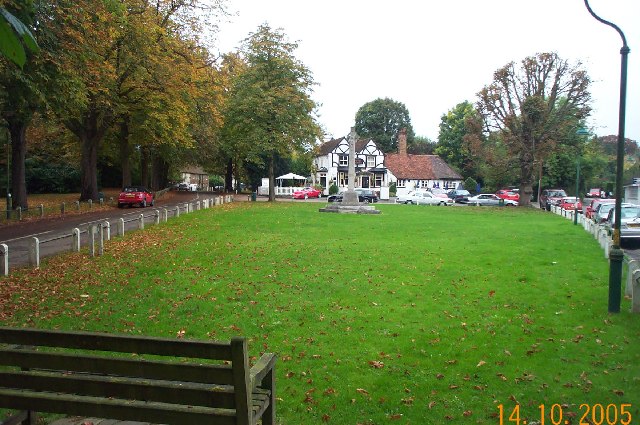
The real-life version of Midwich is the village of Letchmore  Heath near Watford, named after the original Old Saxon “leche mere” meaning muddy pond.  The present-day pond is just to the south of the fetching village green, and adjacent to the green is the Three Horseshoes pub, which was used in the filming.  Another building seen in the film was the Post Office and General Stores, occupying a charming village house also facing the green.  The building has hardly changed in appearance, although it no longer serves its original purpose.  Letchmore Heath is no stranger to filming, being close to both the MGM British Studios, which produced this horror masterpiece, and also the Elstree Studios.  In fact, so many TV series from the 60s and 70s were filmed around here that the area has been dubbed Avengerland, after the famous Avengers TV series.

File:Letchmore Heath - geograph.org.uk - 65207.jpg
Letchmore Heath - geograph.org.uk - 65207. Photo by Nigel Cox, via Wikimedia Commons.

Sadly, George Sanders, who played Professor Gordon Zellaby in the film, is no longer with us, having died in 1972.  However, his screen wife Anthea Zellaby (Barbara Shelley) and their son David (Martin Stephens) are still alive, and in 2013 they were reunited with other cast members, along with fans of the film, for a visit to the former film set and a lunch at the Three Horseshoes.   

Thursday, 6 October 2016

AHOY, ME HEARTIES: BRISTOL'S TREASURE ISLAND PUBS


In Bristol’s historic core, alongside a number of attractive waterfronts, there is an area encompassing the elegant Queen Square and the 17th century King Street.  Tucked away in this appealing part of the city are two pubs which contributed to one of the most famous works of English literature: Treasure Island by Robert Louis Stevenson. 

There are many attractive historic buildings in King Street, but the one which immediately draws the eye of visitors is the rickety-looking half-timbered inn which was called the Llandoger Trow – a trow being a kind of flat-bottomed barge - sadly now closed.  The pub is reputedly the inspiration for the Admiral Benbow in Treasure Island, although the latter was not actually in Bristol in the story.  The Admiral Benbow is the backdrop to the opening scene in the story, which centres around the adventures of Jim Hawkins, who was intent on finding the buried treasure of pirate Captain Flint.   The inn was owned by Hawkins’ parents, and the story starts with the appearance of a mysterious stranger who warns Hawkins to keep a lookout for a one-legged man, an event which eventually leads to the discovery of the map showing the location of the buried treasure.  Incidentally, the Llandoger Trow is allegedly where another famous author Daniel Defoe met a Scottish sailor called Alexander Selkirk, who had spent four years marooned on an uninhabited island in the South Pacific Ocean.  It is said that this chance encounter gave rise to Defoe’s novel Robinson Crusoe.  

Llandoger Trow June2010. Photo by NotFromUtrecht, via Wikimedia Commons.


Just off Queen Square is another pub dating from the same era called The Hole in the Wall, formerly the Coach and Horses.  The present name is a nod to the small spy hole which can be found on the side of the building, where people used to keep watch for any Customs men or Press Gangs so that they could warn the sailors drinking in the inn.  Treasure Island’s most famous character, Long John Silver, the prototype for the  familiar image of a pirate with a West Country accent and a parrot on his shoulder, was the landlord of The Spyglass Inn in the novel.  Jim Hawkins had orders to meet him there and, when he arrived he was shocked to find that the landlord was one-legged, fitting the description given by the aforementioned stranger.  Nevertheless, he describes the inn as “a bright enough little place of entertainment”.  There are many pubs claiming to be the inspiration for The Spyglass Inn, but The Hole in the Wall is the one most closely matching the description, not least because as well as the spy-hole, it occupies a quayside position in line with the fictional pub: Hawkins was told to follow the line of the docks.  The inn was also described in the novel as having a street on each side, which also fits, as the Hole in the Wall has the quayside on one side and a street leading into Queen Square on the other.  

The Hole In The Wall, Bristol.


Bristol is one of Britain’s most appealing cities.  Well connected by road and rail, it also has an international airport.  There is always something going on, particularly during the summer months, and there are plenty of other intriguing watering holes to investigate by the Harbourside and around the city.  


Map of the area.


Wednesday, 3 August 2016

GHOSTLY OCCURRENCES ON THE COTSWOLD WAY: THE LIVING AND THE DEAD


For walkers following the Cotswold Way on the approach to Bath, the ups and downs of the northern part of the Cotswolds give way to a rolling plateau just to the north of the M4 motorway.  One of the points of interest on this stretch of the trail is Horton Court, a National Trust property (now turned into a holiday cottage) which is a honey-coloured manor house built on the site of a Norman hall.  This property recently graced our TV screens in The Living And The Dead as Shepzoy House, the home of a young couple whose marriage is threatened by all manner of supernatural horrors going on around them, and by the husband’s descent into madness over the death of his son Gabriel, who died from drowning, a tragedy for which he blames himself.  The series is set in Somerset in the late 19th century, but Horton is in South Gloucestershire near Chipping Sodbury, between Stroud and Bath, a rural area where the brooding woodlands and swaying grasses of the fields create a suitably spooky atmosphere, prompting some to refer to the series as a kind of Gothic Thomas Hardy.  

File:Horton Court.jpg
Horton Court. Photo by Marion Dutcher, via Wikimedia Commons.

The main subject of the story, Nathan Appleby (‘Merlin’ with a beard aka Colin Morgan), is a psychologist who returns from London to the family home after the death of his mother and with his young wife Charlotte (Charlotte Spender) takes over the running of the farm there. The locals are like something from a bygone age with their ancient rituals and superstitions, something akin to the community encountered by Edward Woodward in The Wicker Man.  As for Nathan, he finds it hard to shake off his psychological calling, and starts investigating the case of a possessed local girl called Harriet, which unleashes a series of sinister phenomena and apparitions.  Harriet’s party piece is mimicking the voice of the late Gabriel, which tests Nathan’s sanity to the limit.  The sinister atmosphere and tension continue to build up in subsequent episodes, and the final episode is full of surprises, which I won’t go into in case anyone hasn’t seen it yet. 

File:West from Highfield Lane near Horton Court - geograph.org.uk - 1001174.jpg
West from Highfield Lane near Horton Court - geograph.org.uk - 1001174. Photo by Maurice Pullin, via Wikimedia Commons.
 
According to the Cotswold Way Trail Guide, Horton Court is probably the oldest property along the trail, being based on a single-storey hall house from the 12th century.  The adjoining church is the parish church of St James the Elder, built around 1300 on the site of the previous Norman church.  The manor itself, which lies alongside the hall, was built around 1521 by the Rev. William Knight, the future Bishop of Bath and Wells.  The most charming feature of the gardens is a 16th century Italianate loggia.  Although ramblers following the Cotswold Way are unable to enter the manor house at this time, the church is still up and running for those wanting to relive the atmosphere surrounding the drama series, and of course there is the bucolic countryside to wander through.

File:Horton church in South Gloucestershire England arp.jpg
Horton church in South Gloucestershire England arp. Photo by Adrian Pingstone, via Wikimedia Commons.


Map of the area.


Sunday, 10 July 2016

GOING FOR GOLD: CHARIOTS OF FIRE, ST ANDREWS


It seems hard to believe that four years have gone past since the nation and the world witnessed the stirring spectacle of the London 2012 opening ceremony.  The most memorable part of the ceremony was the spine-tingling sequence representing Britain’s Industrial Revolution, but prior to that there was a comedy sketch involving British comedian Rowan Atkinson playing a pianist with a repetitive role in a performance of the theme music to Chariots of Fire, a film made in 1981 but re-released in 2012 prior to the London Olympics, which tells the story of two athletes who, after years of training, are accepted to compete in the 1924 Paris Olympics.  The film triumphed at the 1982 Oscars, winning four awards including Best Picture.  The music also earned its Greek composer Vangelis an Oscar for Best Original Score. 

Anyone who has seen the film will remember the scene near the beginning where, with the theme music as a backdrop, the athletes raced along a glorious sandy beach in their white period racing gear, their feet splashing in the shallows.  In the 2012 opening ceremony Rowan Atkinson’s mind wanders off during his boring part of the musical performance and he starts fantasising about being a part of the beach scene.  Some clever camera trickery is used to superimpose him on the scene alongside the original actors.  Ben Cross, who played Jewish athlete Harold Abrahams in the film, described the act of running along the sand as ‘hell’.  Worth enduring though, for what has come to be one of the most iconic scenes in British film, so much so that people can often be spotted recreating the scene on the beach.  

So where was this beach?  Well in the film it was meant to be Broadstairs, but in fact, the scene was shot at West Sands in St Andrews, Scotland’s answer to Oxford, famous for its university and the fact that the Duke and Duchess of Cambridge met there.  Famous also for its fine golf courses, one of which was founded in 1754 and is regarded as the home of golf.  St Andrews was chosen as a cost-saving measure, due to the fact that other scenes were being filmed elsewhere in Scotland.  Filming on a beach is not without its problems: the story goes that the crew were forced to return to the location to film the sequence again because sand had got into the camera the first time round, damaging the negatives.

File:West Sands Beach, St Andrews - geograph.org.uk - 1803950.jpg
West Sands Beach, St Andrews - geograph.org.uk - 1803950. Photo by Stephen Sweeney, via Wikimedia Commons

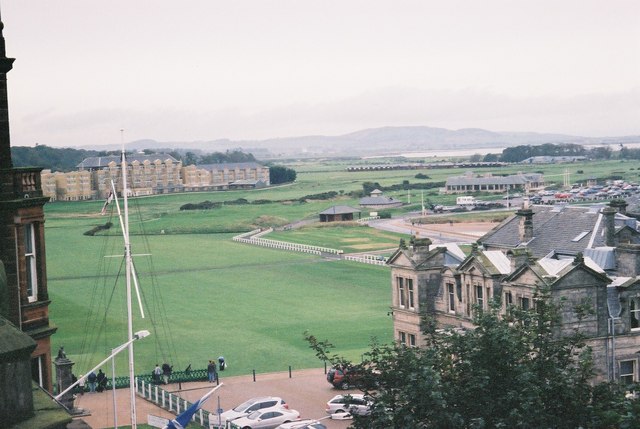
The production crew had to change the outward appearance of some of the city’s newer buildings to make them look more in keeping with the period.  Towards the end of the beach sequence an imposing building can be seen near the golf course, with the name Carlton Hotel on it.  The building was used as a University residence at the time but was relabelled for the film.  Sean Connery reportedly joined the film’s producer David Puttnam at a screening of the film, and when the building came into view he tapped Puttnam on the shoulder and said “That’s not the Carlton Hotel, that’s St Andrews”.  Apparently a lot of the extras used in the filming were recruited the night before from the local bars.  

File:St Andrews Golf Links from The Scores - geograph.org.uk - 305228.jpg
St Andrews Golf Links from The Scores - geograph.org.uk - 305228. Photo by Rob Bishop, via Wikimedia Commons

Although the city did not form a part of the film’s story and, Connery aside, many people would not have recognised it in the beach scene, St Andrews is evidently determined not to forget its role in the film, with a plaque commemorating the filming and a hotel bar called Chariots.  There is also an annual Chariots of Fire fun run on the beach, giving fans of the film a chance to relive the scene.

Map of the area.