Showing posts with label National Trust. Show all posts

Saturday, 3 October 2026

THREE LOCATIONS USED IN THE FILM NAPOLEON


Directed by Ridley Scott and starring the Oscar-winning actor Joaquin Phoenix, a collaboration earlier seen in the film Gladiator, the epic movie Napoleon promised to be a cinema classic.  Released in 2023, the film charts the rise and fall of Napoleon Bonaparte and the troubled relationship with the Empress Josephine, played by Vanessa Kirby (of The Crown fame).  One would think that the majority of the locations used in the production would have been in France, but due to the rich array of 18th century properties here in the UK, the team did much of the filming in this country.


First up, the production team needed somewhere suitably Gallic looking to depict Napoleon’s Chateau, and in Boughton House they found the perfect candidate.   The house was selected from a host of 18th century piles visited by the team.  Boughton House lies in Boughton Park, Kettering, Northamptonshire and is open to visitors, who can book online.  There are tours of the house available, visiting some of the best preserved baroque state rooms in the country, with an array of fine art, furniture and tapestries on display.


Boughton House - geograph.org.uk - 4111875. Photo by Philip Halling, via Wikimedia Commons.


With its French-style interiors, Petworth House in West Sussex was chosen for some of the most pivotal scenes in the film, not least the scene depicting the Victim’s Ball, where Napoleon meets Josephine for the first time.  The National Trust, which manages the property, has a page devoted to the role of the house in the filming on its website, listing the Beauty Room, Marble Hall, Carved Room, Little Dining Room and Grand Staircase as the main parts of the house used in the ball scene.


Grand Staircase, Petworth House 2026-03-03 (2). Photo by Andy Li, via Wikimedia Commons.


For our third location, no film about Napoleon would be complete without a depiction of the Battle of Waterloo.  Once again, the team chose to film the battle scenes in a British location.  The location they chose was Churn Farm, Blewbury, Oxfordshire, which forms part of James Dyson’s countrywide Dyson Farming Estate.  Locals in the area were warned that cannons and gunfire would be used in the filming of the battle scene, and a footpath used by dog walkers had to be diverted for the duration.  For fans of the film wanting to soak up the surroundings of the battle scenes, the Estate offers a self-catering cottage for eight in the Blewbury part of the Dyson Farming Estate.


Thursday, 20 November 2025

A SCRIBE'S SUSSEX HIDEAWAY: BATEMAN'S/RUDYARD KIPLING

When Rudyard Kipling moved into the 17th century Jacobean house Bateman’s with his wife Carrie in 1902, he was already an established author, with The Jungle Book and Kim under his belt, to name just two.  For his subsequent works, he drew much inspiration from the house and its charming surroundings, particularly the Dudwell Valley, where the house is located.  The Kiplings fell in love with the property at first sight, declaring that “we entered and felt her Spirit - her Feng Shui - to be good”.  The garden Kipling created was a place of solace for him after he lost his son to World War I.  The poem My Boy Jack was a product of this tragic loss.

Bateman's - geograph.org.uk - 2594587. Photo by Josie Campbell, via Wikimedia Commons.


Bateman’s lies in the heart of the Sussex countryside, a few miles to the north-west of Hastings.  The date above the front door says 1634, although parts of the house are even older.  Not much is known about the owners preceding the Kiplings.  Rudyard’s wife left the property to the National Trust on her death in 1939, three years after Rudyard died.


Map of the area.


Monday, 3 November 2025

A REGENCY RESORT: THE SOMERSET COAST AND DYRHAM PARK/SANDITON

Sanditon is based on a novel by Jane Austen about a seaside town which is being developed into a resort by entrepreneur Tom Parker.  Unlike other dramatisations of Jane Austen novels, this one was never finished by Austen, giving the screenwriters free rein to develop the characters and storyline in the latter stages.

Episode four of the series had some of the characters going for a walk in the dunes of an extensive sandy beach, with one character collapsing from heatstroke in the dunes. We also see Sidney Parker surveying the beach from above in search of the errant Georgiana.  These scenes were filmed at Brean, one of the lesser known of the sweeping sandy beaches to grace the coast along the Bristol Channel, adjacent to the west Somerset resort of Burnham-On-Sea.  The better-known resort of Weston-Super-Mare was used for the bathing scenes, which were filmed in the Marine Lake.


Aside from Brean, other seafront scenes in the series were filmed at the small Somerset town of Clevedon.  Clevedon also has a marine lake but is best known for its graceful pier, which opened in 1869.  The pier can be glimpsed in Sanditon, which is a bit unfortunate because no such pier existed in Jane Austen’s day.


The seafront at Clevedon, Somerset - geograph.org.uk - 1867050. Photo by Anthony O'Neil, via Wikimedia Commons.

Moving away from the coast, another notable location seen in Sanditon is Dyrham Park, which we last encountered in this blog as Darlington Hall in The Remains of the Day.  In Sanditon the estate plays the role of Lady Denham’s home Sanditon House.  Managed by the National Trust, Dyrham Park is in South Gloucestershire, a few miles to the north of Bath.  We owe its existence to William Blathwayt and the fruits of the Empire, specifically the Colonies in North America, providing for its creation in the 17th century.  As well as the house there are extensive grounds, including a deer park.


Dyrham Park lower park. Photo by Rwendland, via Wikimedia Commons.


Tuesday, 7 October 2025

AN ECCLESIASTICAL EDUCATION: FOUNTAINS ABBEY/THE HISTORY BOYS

The film adaptation of Alan Bennett’s play The History Boys, which tells the story of a group of schoolboys preparing for acceptance at Oxford University, was shot in a number of Yorkshire locations, as well as a couple of schools in Watford.  The most striking location used is Fountains Abbey, which is where the boys are taken on a history field trip. 

Fountains Abbey 02 2005-08-27. Photo by Klaus with K, via Wikimedia Commons.

The ruins of the Cistercian Fountains Abbey are run by the National Trust and lie in the Nidderdale National Landscape to the south-west of Ripon in North Yorkshire.  The National Trust site also includes the water gardens of Studley Royal.  The abbey was founded in 1132 and was one of the wealthiest in the country until Henry VIII did his worst in 1539.

Friday, 13 June 2025

OF MICE AND BUNNIES: NEAR SAWREY, CUMBRIA/BEATRIX POTTER

Beatrix Potter, who died in 1943, is best known for her children’s books featuring an array of charming animal characters, with illustrations depicting the characters in human clothing.  Benjamin Bunny, Mrs Tiggy-Winkle, Squirrel Nutkin and their friends were brought together a few years ago as a collection of special 50P pieces, a testament to their enduring popularity.

Potter’s obvious affection for the animal world must in part stem from the fact that she made her home in the Lake District with all its natural wonders.  Her house, Hill Top, now managed by the National Trust, is in the village of Near Sawrey, near the west shore of Lake Windermere.  Some of her favourite possessions can be viewed in the house, while the garden, in the style of the English cottage-garden, displays scenes from her books.


Hill Top Near Sawrey 120510w. Photo by Strobilomyces, via Wikimedia Commons.


On the other side of Lake Windermere, in Bowness-on-Windermere there is an attraction aimed at families called The World of Beatrix Potter with displays featuring the characters in Potter’s books.  I have not visited, but it seems to get the thumbs-up on Tripadvisor.


Map of Near Sawrey.


Sunday, 13 October 2024

THREE LOCATIONS USED IN THE 2018 FILM MARY QUEEN OF SCOTS

 There have been a number of films made over the years about the relationship between Queen Elizabeth I and her first cousin once removed Mary Stuart, better known as Mary Queen of Scots.  One of the more recent films stars Saoirse Ronan as Mary and Margot Robbie as Elizabeth.  Here are three of the locations used in the film.

The film opens with Mary’s return to Scotland from France, where she had briefly been Queen, but her reign ended with the death of her husband Francis.  The ship carrying Mary landed at Leith on the outskirts of Edinburgh in 1561.  The beach used in this scene in the film is Seacliff Beach, North Berwick, a pleasant seaside town in East Lothian, a bit further south.

After landing at Leith Mary makes her way to Holyrood House in Edinburgh.  The exterior of Holyrood in the film was shot at Blackness Castle near Linlithgow.  Situated on a promontory on the south bank of the River Forth, just upstream from the Forth Road Bridge, Blackness Castle is a 15th century castle owned by Historic Environment Scotland and is open to visitors year round.  The castle was originally built as a residence for the Crichtons, one of Scotland’s most powerful families at the time. 

Blackness Castle - geograph.org.uk - 1238628. Photo by Mike Pennington, via Wikimedia Commons.


Meanwhile, Elizabeth is based at Hampton Court Palace on the outskirts of London.  The exterior of the palace in the film was represented by the magnificent Hardwick Hall near Chesterfield in Derbyshire.  We see the tall facade of the building and the formal garden fronting it.  Hardwick Hall is owned by the National Trust, and among its treasures are some fine tapestries.  The cafe downstairs offers a range of tasty meals, coffees, teas and cakes. The property is fully open until the end of October, and partially open thereafter.

Hardwick Hall - geograph.org.uk - 3339472. Photo by Chris Heaton, via Wikimedia Commons.


Wednesday, 17 January 2024

THE EXQUISITE WORLD OF ELIZABETH BENNET: PRIDE AND PREJUDICE 2005

Back in 2013, I did a piece about Lyme Park in Cheshire, which was where the famous ‘lake scene’ was filmed for the 1995 TV production of Pride and Prejudice, with Colin Firth as Mr Darcy emerging from the lake with diaphanous wet-through clothing.  This Christmas TV viewers have had the opportunity to see the 2005 film of this classic tale by Jane Austen, starring Keira Knightley as Elizabeth Bennet and Matthew Macfadyen as Mr Darcy.

The action kicks off with Elizabeth strolling towards the Bennet family home, Longbourn.  This scene was filmed at Groombridge Place, a moated manor house near Tunbridge Wells, Kent.  Inside the home, the family are discussing the new occupant of nearby Netherfield Park, Mr Bingley.  Later on the Bennets pay a visit to Netherfield, and as they depart we catch sight of its imposing exterior.  The real-life property standing in for Netherfield is Basildon Park, Berkshire. 

Basildon Park (4739480359). Photo by Jim Bowen, via Wikimedia Commons.

There are a number of scenes involving the local village of Meryton, including the one in which soldiers arriving in the area go marching down the street, to the delight of the  young women of the village.  These scenes were filmed in the picturesque market town of Stamford, Lincolnshire.  During the filming horses used as part of the marching scene were seen outside the Arts Centre, while the churchyard in the square was filled with sheep. .Near Stamford is another imposing property, Burghley House, which is used in the film for Rosings Park, home of the de Bourgh family.  Anne de Bourgh is expected to marry Darcy.

The clergyman Mr. Collins, a distant cousin of Mr. Bennett who has designs on Elizabeth, lives in a vicarage which in real life is in the village of Weekley in Northamptonshire.  Haddon Hall near Bakewell in Derbyshire also puts in an appearance, with the banqueting hall acting as the interior of the Inn at Lambton. 

Naturally, the most imposing property of all in the story is Pemberley, the home of Mr Darcy.  The Chatsworth estate in Derbyshire is used for Pemberley in the 2005 film.  This is not the first time Chatsworth has played the role of Pemberley.  The TV drama Death Comes To Pemberley  also made use of Chatsworth.  Meanwhile, Pemberley’s drawing room was filmed at Wilton House near Salisbury.

Chatsworth House, Derbyshire - geograph.org.uk - 2481560. Photo by Christine Matthews, via Wikimedia Commons.

Finally, there are a couple of outside scenes of note.  The scene which has Elizabeth standing on a precipice was filmed at Stanage Edge in Derbyshire.  Meanwhile, way down to the south, the stunning gardens of Stourhead in Wiltshire feature in the scene in which, in pouring rain, Mr Darcy first proposes to Elizabeth and is sharply rebuffed.  This scene takes place at a folly in the grounds known as the Temple of Apollo.

Stourhead Gardens - geograph.org.uk - 32663. Photo by Nigel Freeman, via Wikimedia Commons.

Groombridge Place is currently closed for renovation so cannot be visited by the public.  Basildon Park, an 18th century estate near the River Thames between Reading and Goring, is run by the National Trust and is open to visitors year round.  Burghley House is currently closed for the winter, but is due to reopen in March 2024.  Haddon Hall is open daily during the main season, and on selected dates in November and December.  Chatsworth House and its park are open year round, and is especially appealilng in the run up to Christmas.  

Stanage Edge lies in the Peak District, a couple of miles north of Hathersage, and is a gritstone escarpment popular with climbers.  The Temple of Apollo in Stourhead Gardens is a fine example of classical buildings known as 'follies' which were erected in the estates of the landed gentry of times gone by.  The gardens are run by the National Trust and are open year round.


Thursday, 7 September 2023

VIRGINIA SEES THE LIGHT: TO THE LIGHTHOUSE/GODREVY, CORNWALL

 The writer Virginia Woolf was born in London, the daughter of Leslie and Julia Stephens.  Although the family lived in London, during the 1880s and 1890s, for three months of every year, they would decamp to St Ives, staying at Talland House.  Anyone who has been to St Ives will be well aware of the magnificent views along the coastline.  One notable feature on the horizon is Godrevy Lighthouse, just offshore a few miles up the coast from St Ives at the eastern end of St Ives Bay.  The lighthouse was clearly visible from the family’s holiday home, which sat above Porthminster Beach.

Talland House, St Ives, Cornwall - May 2022. Photo by Mutney, via Wikimedia Commons.


The lighthouse formed the inspiration for the story Virginia considered her best, ‘To The Lighthouse’, which was actually set on Skye in a location visited by the Ramsay family, for whom the lighthouse was an ever-present draw.  Virginia describes the lighthouse as ‘hoary’ and ‘austere’, and she refers to the ‘green sand dunes with the wild flowing grasses on them’.  This is a good description of the coast surrounding Godrevy Lighthouse, which is dominated by the sand dunes of Gwithian, and which is managed by the National Trust..

Talland House is on Albert Road, above the railway station which forms the terminus of a delightful short branch line from St Erth.  The house is not open to visitors, but there is a  blue plaque commemorating its association with Woolf and her family.

Godrevy Lighthouse has an octagonal tower 26 metres high, designed by architect James Walker and opened on 1st March 1859.  It was built on Godrevy Island,which lies 300 metres off Godrevy Head.  The lighthouse is well placed for protecting shipping from the hazardous Stones Reef.  The light was deactivated in 2012 and replaced with an LED light mounted on the rocks on a platform, but the lighthouse tower is still retained by Trinity House as a daymark.  There are boat trips out to the lighthouse from St Ives.

Map of St Ives.


Godrevy Lighthouse by Barbara Ashley.


Sunday, 19 March 2023

DALLIANCES IN DORSET: EMMA (1996)


One thing is guaranteed when it comes to film adaptations of Jane Austen novels: that they will be a feast for the eyes.  Not only for the dashing young men with their flowing locks and sexy boots, and the English roses with heaving bosoms vying for their attention, but also for the idyllic English town and country scenes, which invariably include a range of stately homes.  The 1996 film Emma, starring Gwyneth Paltrow as compulsive matchmaker Emma and Toni Collette as friend Harriet Smith, is no exception, with a variety of charming locations mainly in Dorset.

The first big property to feature in the film is Hartfield, home of Emma Woodhouse and her family, where Emma is seen discussing a wedding with her father.  The location used as the exterior of Hartfield is mostly Came House in the village of Winterbourne Came, Dorset.  However, some of the interior scenes were filmed entirely elsewhere.  The dinner party scene in which Emma introduces Mr Elton (Alan Cumming) to Harriet was filmed at Stratfield Saye House in Hampshire, while Hartfield’s book-lined gallery was filmed in the Long Gallery of Syon House, west London.

Came House (2) - geograph.org.uk - 855736. Photo by Mike Searle, via Wikimedia Commons.


Another imposing property in Dorset used in the filming of Emma is Crichel House near the village of Moor Crichel, to the north of Wimborne.  In the film the property plays the part of Donwell Abbey, home of a local landowner called George Knightley.  A lake on the estate features in a lakeside archery scene.  Meanwhile, another property, Claydon House in Middle Claydon near Aylesbury, Buckinghamshire, lends its elaborate North Hall for the filming of the grand dance, in which Harriet is snubbed but subsequently rescued by Knightley.  Another local man made good, Mr Weston, who married Emma’s former governess (played by Greta Scacchi) occupies a grand property called Randalls.  This honey-coloured property in real life is Mapperton, home of the Earl and Duchess of Sandwich, which is located a short distance to the east of Beaminster, Dorset.

Mapperton House - geograph.org.uk - 517671. Photo by Chris Downer, via Wikimedia Commons.


Aside from the sumptuous residences seen in the film, there are picturesque street scenes depicting the local village Highbury (Surrey), where Mr Elton is the vicar.  The street scenes used in the film were filmed in the Dorset village of Evershot, about 7 miles south of Yeovil.  The Old Manor House in the village is used as the schoolhouse, while the post office building is used for the haberdashery store.  In order to make the street scenes more authentic for the period, the main street, Fore Street,  was festooned with sheep pens and straw for the filming.  The filming is transferred to the neighbouring county of Somerset for the scene in which Emma visits a sick lady, Mrs Clark.  The venue for this scene is the Helyar Almshouses in the village of East Coker about 3 miles south of Yeovil.

Evershot, Tess Cottage and the church - geograph.org.uk - 447131. Photo by Chris Downer, via Wikimedia Commons.


Came House was built for John Damer in 1754 from a handsome light-coloured stone.  Lying about a mile south-east of Dorchester, nowadays the house is, appropriately enough, used as a wedding venue.  Stratfield Saye House in Hampshire, about 5 miles south of Reading, has been home to the Dukes of Wellington since 1817 and is open for pre-booked tours only.  Syon House, across the River Thames from Kew Gardens, has been used extensively in filming.  Forming part of Syon Park, the house has been the home of the Dukes of Northumberland for over 400 years.  The house and gardens are open to the public, with a mix of guided and self-guided tours of the house.

Crichel House is a Classical Revival country house built for the Napier family.  The property and grounds are not open to the public apart from specific events.  Claydon House is a National Trust property and is open to the public from April.  The North Hall is a riot of rococo in yellow and white.  Mapperton House originates from the 11th century, but a Tudor manor house was built on the site by Robert Morgan in the 1540s, and rebuilt the following century by Richard Brodrepp.  The property is now the  home of the Earl and Duchess of Sandwich. The Gardens and cafe are open from March, and the house from April.

Evershot is the second highest village in Dorset and the source of the River Frome.  The village featured heavily in Thomas Hardy’s works, most notably Tess of the D’Urbervilles.  East Coker lies over the county border in Somerset, and has a history stretching back to Roman times: a Roman villa was discovered there in the 18th century.  The Helyar Almshouses were built in the mid-17th century by the Archdeacon of Barnstaple.  The construction took twenty years due to an enforced interruption brought about by the Great Plague.


Wednesday, 24 March 2021

SUMMONING THE PAST IN SUFFOLK: THE DIG

 There are many interesting places to visit in Suffolk, as we discovered on a long weekend break a few years ago, but one place that particularly stands out in my memory is the site of the archaeological dig at Sutton Hoo and its museum full of replicas of Anglo-Saxon treasures.  The initial finds were made by amateur archaeologist Basil Brown on land owned by widow Edith Pretty.  Brown made the extraordinary discovery of a 7th century ship burial, but a Cambridge archaeologist took over the excavation on realising its significance and Basil was left somewhat sidelined.  This is the subject of the Netflix film The Dig, starring Carey Mulligan as Edith Pretty and Ralph Fiennes as Basil Brown. 

Sutton Hoo ship-burial model. Photo by Steven J. Plunkett, via Wikimedia Commons.

The Suffolk coast, particularly the southern part of it, is characterised by a series of estuaries, and it is the River Deben that runs alongside the Sutton Hoo site.  In the opening scene of the film we see Basil taking his bike on a foot ferry across the River Deben – this was actually filmed on the Butley Foot Ferry on the Butley River near Orford.   Other coastal locations used in the filming include Thorpeness Beach, just up the coast from Aldeburgh, and Shingle Street, a hamlet midway between Orford and Felixstowe (which also featured heavily in Daughters-in-Law by Joanna Trollope, covered elsewhere in this blog). 


Butley Ferry - geograph.org.uk - 1303087. Photo by Keith Evans, via Wikimedia Commons.

Two wildlife reserves make an appearance: the Boyton Marsh RSPB site and Snape Marshes, run by the Suffolk Wildlife Trust.  Boyton Marsh is where we see the ruined house where Peggy Piggott (Lily James) has a fling with Edith Pretty’s cousin Rory Lomax (Johnny Flynn).  Snape Marshes is used for the scene in which Basil is seen smoking his pipe while sitting on the banks of the River Alde after making his first significant find, and a restored 19th century sailing barge called the Cygnet is seen appearing before him. 


Boyton Marshes - geograph.org.uk - 1298304. Photo by Keith Evans, via Wikimedia Commons.

Pretty’s house, which in real life was part of the Sutton Hoo estate, and is now a museum, was actually in Surrey in the film, represented by a property called Norney Grange near Shackleford, which was used for both interior and exterior scenes.  The scenes of the actual dig were also shot near here.  As for the village scenes, the post office in Diss was played by the village shop in the village of Shackleford, and the hamlet of Hambleden in Buckinghamshire was used for the scenes of the inquest in Sutton.


The real-life Sutton Hoo site is run by the National Trust.  The objects on display are replicas; the real items are now housed in the British Museum.  Tranmer House , where Edith Pretty lived, houses a museum telling the story of the discoveries and her role in them.  Norney Grange is not open to the public, but a history of the property can be found on the Shackleford website.

The Butley ferry is currently closed, but is due to reopen on Easter weekend.

Map of Sutton Hoo.

Sunday, 7 March 2021

A POOR MAN'S JANE AUSTEN RICH IN LOCATIONS: BRIDGERTON


When fans of the Regency period in general, and Jane Austen in particular, got wind of the imminent arrival of the Netflix series Bridgerton they were no doubt salivating at the anticipation of the prospect of flirtations between cleavage-bursting young women and dashing young men sporting sideburns and knee-high boots.  However, as the series got underway opinions were deeply divided between those who found the series embarrassingly lightweight (with plenty of dark mutterings about ‘wokeness’) and those who thought it was a wonderfully entertaining tonic for these dark covid times.  One thing that cannot be denied, though, is the splendour of the locations used in the series.

I have previously blogged about Bath and its Jane Austen connections, and this handsome, honey-coloured city in the west of England plays a large part in Bridgerton.  The Royal Crescent puts in an appearance with number 1 serving as the Baron Featherington household, with digital enhancements on the facade.  Filming also took place at the Assembly Rooms and Trim Street is where we see the exterior of Gunter’s Tea Shop.

Royal Crescent, Bath. Photo by MontanNito, via Wikimedia Commons.

The stately piles occupied by the various families involved in the story are played by photogenic properties scattered around the country.  An art museum in Greenwich called Ranger’s House was used for the Bridgerton family home, with the addition of wisteria and ivy to the facade to make it look more homely.  The property belonging to the dashing Duke of Hastings was represented by three different properties: Wilton House near Salisbury for interior and exterior shots, with further interior work done at Syon House in Middlesex and Badminton House, Gloucestershire, which we last encountered as Darlington Hall in The Remains Of The Day.  Badminton House and Wilton House were also used for some of the interior scenes depicting the home of Lady Danbury, who acts as a kind of mother figure to the Duke.  The exterior of Lady Danbury’s house, meanwhile, was shot at the Holburne Museum of Art, taking us back to Bath.

Wilton-House-02-2004-gje. Photo by Gerd Eichmann, via Wikimedia  Commons.


Soaring up to the heights of Regency society, we encounter Queen Charlotte, whose residence in the series is an actual palace in real life, namely Hampton Court Palace.  Wilton House pops up again here, with some of its interiors used in the filming, along with those of Lancaster House in London. 

For the marital home of a certain pair of newly-weds we are whisked to the north of England, to Castle Howard, 15 miles north of York, where the exterior scenes were filmed, while Wilton House and Badminton House are once again used for interiors, along with North Mymms Park, a wedding venue south of Hatfield, Hertfordshire.  Staying in Hatfield, Hatfield House, a property which has been used in numerous previous productions, provided some of the interior shots of the Featherington residence.

Castle Howard and garden. Photo by Pwojdacz (talk), via Wikimedia Commons.


The city of Bath nestles in a dip in the Somerset countryside with the River Avon running through it.  Jane Austen once lived there, and as a reminder of this time there is an annual Jane Austen Festival.  Visitors who are feeling a bit flush and who want to immerse themselves in the Bridgerton experience can stay at the Royal Crescent Hotel, the city’s finest, although the less moneyed can make do with a visit to No. 1, which is a heritage museum.  The Holburne Museum of Art is next to Sydney Gardens on the east side of the city.  The Assembly Rooms are run by the National Trust and are a short distance to the east of the Royal Crescent.  For visitors coming from outside the UK the nearest international airport is Bristol Airport. 

For Bridgerton fans visiting the London area, Ranger’s House, which lies on the boundary between Greenwich Park and Blackheath, is run by English Heritage and is home to the Wernher Collection.   Syon House to the west of London is across the Thames from Kew Gardens and is the London home of the Duke of Northumberland.  The house forms part of the wider Syon Park, which is open to visitors.  Hampton Court Palace is further upstream and is famous for having been the seat of Henry VIII.  Lancaster House is near St James’s Palace and is managed by the Foreign and Commonwealth Office. 

Further afield, North Mymms Park is just off the A1 (M) south of Hatfield and offers wedding and events services, while Hatfield House forms part of Hatfield Park, both of which are open to visitors, and is a short distance to the east of Hatfield.  Heading further west, Wilton House, just outside Salisbury, is home to the Earl and Countess of Pembroke, but is open to visitors.  Badminton House is part of Badminton Estate and has been the main seat of the Dukes of Beaufort since the 17th century.  The Estate is open to visitors for house tours and garden visits.  Finally, to Yorkshire and Castle Howard, 15 miles north-east of York just off the A64 Scarborough road, which belongs to the Howard family, going back several generations.  The house and gardens are open to visitors. 

Sunday, 31 January 2021

AN ELIZABETHAN SAGA IN CORNWALL: THE GROVE OF EAGLES/FALMOUTH


The late Winston Graham is best known for the Poldark books, not least given the latest dramatisation of the series on the TV.  However, I recently read another excellent work by him set earlier in time, during the reign of Queen Elizabeth I.  I have always been fascinated by this period in the country’s history, characterised by such a strong female monarch, the discovery of the New World and the triumph over the Spanish Armada.  My mother’s side of my family came from Mousehole, which bore the brunt of an invasion by the Spanish during this time, and I often wonder whether I have a trace of Spanish blood coursing through my veins from the raping and pillaging that went on there.


The invasion of Mousehole and West Cornwall is the subject of one of the most dramatic sections of The Grove of Eagles, but it is the estuary town of Falmouth which forms the main geographical focus of the story.  The main character, Maugan Killigrew, is the illegitimate son of John Killigrew who lives at Arwenack House in what is now Falmouth, and who was the Governor of Pendennis Castle.  He becomes involved in the war against the Spanish, spending time as a prisoner in Spain, followed by a spell as secretary to Sir Walter Raleigh once back on British soil.  Arwenack House can still be found in Falmouth today, just across the way from Discovery Quay, home to the National Maritime Museum. 


Arwenack Falmouth Cornwall. Photo by Steve Barnes, via Wikimedia Commons.

In those days Penryn, just up the Fal from the present-day Falmouth, was the main port in the area, and some of the early action of the story takes place here, with Maugan getting into trouble with the locals.  The Elizabethan manor house Trerice also features in the early part of the story, being the home of John Arundell, who also served as a Governor of Pendennis Castle.  


Pendennis Castle. Photo by Willhsmit, via Wikimedia Commons.

The most enduring feature of Maugan Killigrew’s story is his love for Sue Reskymer, who he loses touch with when he goes to Spain, and who marries and moves to West Penwith.  The pair are reunited when the far west of Cornwall is invaded by the Spanish and Maugan goes in search of her.  As mentioned before, this is one of the most dramatic episodes of the story, with the local men converging on Mousehole, Penzance and the surrounding areas in search of the invaders.

The Fal estuary


Trerice is a short distance inland from Newquay, and is nowadays run by the National Trust.  Pendennis Castle, which occupies a commanding position overlooking the mouth of the Fal estuary, is run by English Heritage.

Map of Falmouth.

Saturday, 7 November 2020

ISLES OF INTRIGUE: VERA/THE FARNES


As I mentioned in a previous piece, the crime series Vera takes us on a tour of a variety of locations in the north-east of England.  In episode 1 of season 7 (Natural Selection) the action centres around Ternstone Island, a magnet for birdwatchers, with some of the rangers quizzed as potential suspects in the murder of one of their own.  The real-life location used for Ternstone Island was one of the Farne Islands, a bird sanctuary owned by the National Trust and accessible via boat trips from Seahouses on the Northumberland coast. 


                                  Farne Islands. Photo by MiloDenn, via Wikimedia Commons.

The tiny harbour seen in this episode of Vera, however, is actually that of Craster, and the ruins of nearby Dunstanburgh Castle are glimpsed in a couple of the scenes.  In real life, there are no trips to the islands from Craster, and although an island is visible on the horizon in the filming, the footage must have been doctored, because there is no such island visible from Craster.  Meanwhile, some of the Farne Islands scenes, including those depicting the Visitor Centre, were filmed further south at Souter Lighthouse in Tyne and Wear. 


                             Craster (9815022296). Photo by Dave_S, via Wikimedia Commons.

There are numerous boat trips out to the Farnes from Seahouses, with different variations available, including a Sunset Cruise and an All Day Bird Watch Trip. Some trips run from April to October, while others have a more restricted timetable.  I personally found the month of June the best time to visit, not only for the puffins frequenting the island and flitting around offshore, but also for the thrill of dodging the arctic terns nesting on the island.  Remember your hats for protection when they swoop down on you from above!


Craster, a few miles down the coast from Seahouses, is a small harbourside village with a cosy pub, a fishmonger specialising in smoked fish and a wonderful coastal path leading up to the ruins of Dunstanburgh Castle.  Souter Lighthouse is run by the National Trust and is a short distance to the south of South Shields.  It is a classic red and white lighthouse, opened in 1871 and designed for the use of alternating electric current, a world first.  The other claim to fame of this lighthouse is that it is haunted, allegedly by the ghost of Grace Darling’s niece Isobella.

Map of Northumberland.

Monday, 22 June 2020

ANOTHER DOSE OF CYMRU NOIR: HIDDEN/NORTH WALES


Six years ago I blogged about a Welsh crime series called Hinterland, which was compared at the time to some of the ‘nordic noir’ series from Scandinavia such as The Killing, and was filmed mainly in the West Wales county of Ceredigion.  With Hidden we get another dose of ‘Cymru noir’.  This series, starring Sian Reese-Williams as DI Cadi John and Sion Alun Davies as DS Owen Vaughan, takes us a bit further north to Bangor and Snowdonia, which provides a suitably chilling backdrop to many of the scenes in the series.  For this piece I am concentrating on series 1, first shown in 2018.

The series kicks off, predictably, with the discovery of a woman’s body, but the locations used for this part are further south than Snowdonia.  The crime which led to this discovery is committed at the scene of the highest waterfall in Wales, Henrhyd Falls, which is further south than the fictional location in the series, in the Brecon Beacons.  The waterfall plunges into the Graig Llech Gorge at the southern edge of the Brecon Beacons National Park in the county of Powys.  The viaduct visible in the scene where the discovery of the body takes place is also further south.  The Pontsarn Viaduct near Merthyr Tydfil was built in the 1860s to carry the Brecon and Merthyr Railway over the Taf Fechan river.

Henrhyd falls (9165). Photo by Nilfanion, via Wikimedia Commons.


Back in Snowdonia, one beautiful sight which appears again and again in the series is the wonderful Menai Strait with its two bridges.  The Menai Strait, which is 25 Km long, separates the Welsh mainland from the charming island of Anglesey.  The island is linked  to the mainland by two bridges, the Menai Suspension Bridge, opened in 1826, and the Britannia Bridge, opened in 1850.  The city of Bangor lies on the mainland side of the strait, and is the location of a university which was founded in 1884.  The university features heavily in the storyline of Hidden, as one of the main characters, the self-harming Megan Ruddock (Gwyneth Keyworth), is an undergraduate there.   

Interwoven with the crime story is the story of Cadi’s family with its trials and tribulations, including her worries about her terminally ill father.  The location of the house her father lives in is provided by Ynys Castell, a home on a tiny island in the Menai Strait.  For around four hours twice each day the island can only be reached by boat as it is cut off from the mainland.

File:Ynys Castell - geograph.org.uk - 586428.jpg
Ynys Castell - geograph.org.uk - 586428. Photo by Eric Jones, via Wikimedia Commons.

North Wales, like most beautiful and touristy parts of Britain, is an area of haves and have-nots, and this comes across in the series with some of the characters living in poor, run-down looking villages and estates, albeit with the ever-present backdrop of Snowdonia. The Maes Padarn estate in Llanberis is a typical example which features heavily in the series.  The estate is on the outskirts of a touristy town with a number of attractions for visitors, such as the Llanberis Lake Railway and the Electric Mountain hydroelectric power station visitor centre.

However, the most depressing and menacing property seen in the series is the remote cottage surrounded by dark woodland occupied by suspect Dylan Harris (Rhodri Meilir) and his mother Iona (Gillian Elisa).  The house was actually purpose-built for the series and its location is a secret, however Dylan’s workplace was filmed at the Llechwedd Slate Caverns. The cafe where Dylan meets an almost-victim is the former Eric Jones Cafe and Campsite outside Tremadog, now closed but turned into a drive-thru.

Llechwedd Slate Caverns 002. Photo by MatÄ›j BaÅ¥ha, via Wikimedia Commons. 


Tuesday, 9 June 2020

A SLICE OF HEAVEN IN DEVON: SENSE AND SENSIBILITY


Whenever there is an adaptation of a Jane Austen novel on the big or small screen, one thing can be certain: the locations will inevitably feature some of Britain’s finest stately properties. 

The property which kicks off the story in the 1995 film adaptation of Sense and Sensibility, directed by Ang Lee, is the fictional Norland Park in Sussex, which is left by a dying father to his son, but due to the rules of inheritance the three daughters Elinor, Marianne and Margaret and their mother (Emma Thompson, Kate Winslet, Emilie Francois and Gemma Jones) are left with next to nothing.  Worse still, they are forced to move out of their lovely family home, while the son and his wife John and Fanny (James Fleet and Harriet Walter) move in.  The mother and daughters are offered accommodation by a cousin, but it is a bit of a come-down, being just a ‘cottage’ in the depths of Devon, albeit in a heavenly rural setting near the coast.

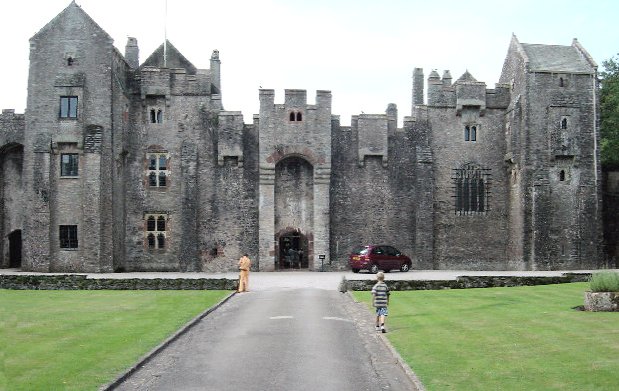
The real-life version of Norland Park is Saltram House near Plymouth, a Grade I listed George II era mansion, while the cottage, Barton Cottage in the story, is Efford House on the Flete Estate, which actually is in Devon in real life, again near Plymouth.  The waterside scenes set near the cottage were also filmed in Devon, at the mouth of the River Erme.  However, the exterior of Barton Park, the wider estate where the cottage is located, is actually further east in Wiltshire, where the scenes were shot at Trafalgar Park, between the city of Salisbury and the northern edge of the New Forest.


File:Efford House - geograph.org.uk - 292694.jpg
Efford House - geograph.org.uk - 292694. Photo by Derek Harper, via Wikimedia Commons.


Another striking property in Devon, which is seen at a distance as a large grey mass of architectural splendour surrounded by sloping green fields, is the Combe Magna estate, owned by love interest John Willoughby (Greg Wise).  In real life this is a fortified manor house called Compton Castle near the resorts of Torbay.  The manor house dates from the 1400s and was connected to Sir Walter Raleigh.  Still in Devon, the wedding scene at the end was filmed at St Mary’s Church in the village of Berry Pomeroy near Totnes.

File:Compton Castle in Devon enh.jpg
Compton Castle in Devon enh. Photo by Smalljim, via Wikimedia Commons.

One of the most dramatic scenes in the film comes towards the end, when Marianne suffers a life-threatening illness, to the distress of Captain Colonel Brandon (Alan Rickman), who has developed a soft spot for her.  She falls ill while visiting the estate owned by a couple in the Dashwoods’ social circle called the Palmers (Imelda Staunton and Hugh Laurie).  This magnificent property is the real-life Montacute House near Yeovil in Somerset, a late Elizabethan mansion with manicured lawns and gardens.


                                                                      Montacute House. 

Mid-way through the film we are transported to London, where many well-to-do people in Jane Austen’s time had their “London base” in addition to their country properties.  The London abode of the dreadful Fanny Dashwood and her husband John is represented by a house in Adam Street, WC2, while Chandos House in Queen Anne Street is the home of the Palmers.  However, the Chelsea home of the ebullient Mrs Jennings (Elizabeth Spriggs) is not in London, but in Salisbury, in reality the 18th century Mompesson House in the Cathedral Close.

Most of the properties featured in the film are open to visitors.  Saltram, Compton Castle, Montacute House and Mompesson House are run by the National Trust.  Trafalgar Park is privately owned, but can be used for events and weddings.  Meanwhile, for anyone wanting to immerse themselves fully in the Dashwoods’ idyllic life in Devon, Efford House is available as a holiday let.