Showing posts with label Christmas. Show all posts

Monday, 23 December 2019

SHERE CHRISTMAS ROMANCE: THE HOLIDAY


Shere is the sort of village that automatically comes to mind when people think of rural England.  So it is no surprise that it has been used in films on several occasions.  As well as Bridget Jones, The Edge of Reason and Four Weddings and a Funeral, Shere was one of several picturesque locations featured in the Christmas romantic comedy The Holiday, in which two women, one American (Cameron Diaz  as Amanda) and one British (Kate Winslet as Iris) swap houses for the Christmas period to get over their respective broken hearts and find new love.


Shere lies in the Vale of Holmesdale between Guildford and Dorking in Surrey at the foot of the North Downs, and consists of an assortment of pretty cottages, two pubs, a church, a tearoom and a small museum.  A stream running through it with ducks completes the idyllic picture.  The cottage Iris lives in was built specially for the film on a hillside overlooking Shere, but it was inspired by a real one much further away.  Of course, no Christmas romantic comedy would be complete without a covering of snow, so the village is seen in the film with its white winter coat on (disregarding the fact that southern England very rarely gets snow over Christmas).

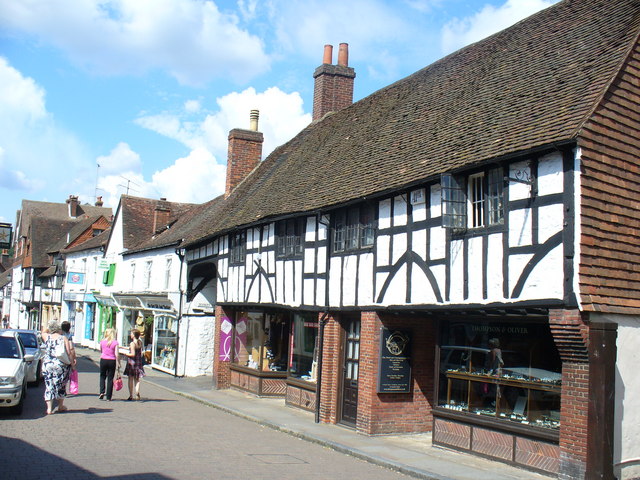
Church Hill, Shere - geograph.org.uk - 535227. Photo by Colin Smith, via Wikimedia Commons.


As well as Shere, the nearby town of Godalming is seen in some of the village scenes plus the railway station scene.  Church Street is seen adorned with Christmas decorations and snow as Amanda heads into town to do some shopping.  Bigger than Shere, but almost as picturesque, Godalming lies to the south of the River Wey, four miles from Guildford.  

File:Church Street, Godalming - geograph.org.uk - 1380443.jpg
Church Street, Godalming - geograph.org.uk - 1380443. Photo by Colin Smith, via Wikimedia Commons
Map of the area

Friday, 22 December 2017

FOOLS' GOLD: THE ONLY FOOLS AND HORSES CHRISTMAS SPECIALS


During the ten years (1981 to 1991) that the popular comedy series Only Fools and Horses dominated our TV screens, the show’s Christmas specials were invariably a highlight of the festive period.  For this Christmas special I have picked out three of them, for which a variety of locations around the country were used in the filming.


Our first Christmas special, ‘To Hull and Back’, was first shown in 1985, and quite a few scenes were actually filmed in Hull.  In the story, Del, who is supposed to be acting as courier for a consignment of diamonds from Amsterdam, unwittingly ends up in Hull after hiding in Denzel’s van in order to evade Chief Inspector Slater.  From there, he and Rodney hire a boat and put their trust in Uncle Albert’s naval background to guide them to Amsterdam.  Two of Hull’s docks feature in the episode: St Andrew’s Dock, where Del crosses the road in front of Denzil, and Albert Dock, where the motley crew set off for Holland.  Denzil is seen catching some fresh air on the Spurn Nature Reserve, on the end of Spurn Head at the mouth of the River Humber.  The Humber Bridge also puts in an appearance, with Rodney attempting to use the toll without the correct change.  Two of the city’s streets are seen: Charles Street where the market scene was filmed, and John Street, where Del and Rodney park outside a cafe.


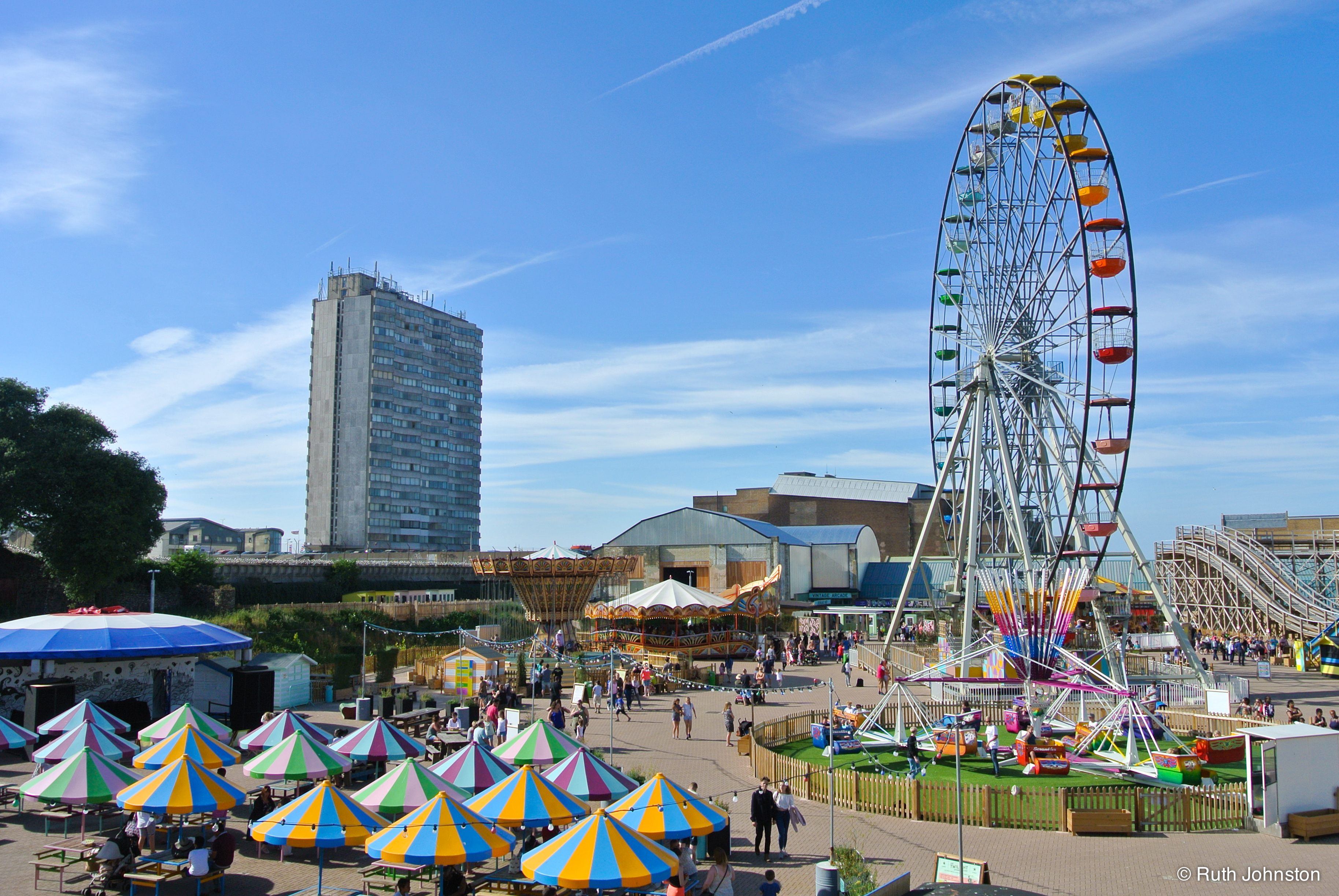
In 1989 the Christmas special saw Del, Rod and their friends from the Nag’s Head travelling down to Margate in The Jolly Boys’ Outing, not for Christmas but on an August Bank Holiday weekend.  Margate has long been a favourite with daytrippers from London, the most notorious visitors being the Mods and Rockers who used to gather there in the early 1960s, causing mayhem wherever they went.  One of the main attractions, especially with families, is the Dreamland amusement park, which was closed for a while but has since been redeveloped.  The park, which featured in the Christmas special, held an “Only Fools and Horses” exhibition last year, which was well received by the folks on Tripadvisor. 

The Harbour Arm in Margate is where Del and Rodney are seen discussing an “Eels on Wheels” business.  Cliftonville, to the east of Margate, was used for a couple of the scenes, with the hotel the lads were staying in being filmed at Dalby Square.  The Coachway at Prince’s Walk was the scene of high drama when the coach exploded.  The exterior of Cassandra’s flat was shot in Richard Court, Lower Northdown Avenue.  Further afield, on the way to Margate the daytrippers make a pitstop at a pub.  The pub in question is the Roman Galley, at the turnoff to Reculver on the A299, sadly, like so many other pubs, now closed and turned into ‘luxury apartments’.  The Wyevale Garden Centre at Ramsgate, formerly a greyhound stadium, was used for the market scene, and the police station which featured in the episode was at Broadstairs, but has since closed.

File:Midweek Birthday Margate Mini-Break-3220160816 (29052138755).jpg
Midweek Birthday Margate Mini-Break-3220160816 (29052138755). Photo by Ruth Johnston, via Wikimedia Commons

Finally, my personal favourite Christmas special was ‘A Royal Flush’, which had Rodney hooking up with a member of the aristocracy and Del muscling in on the act, with predictably embarrassing results.  The Theatre Royal in Drury Lane, London, is where Del brings his tarty girlfriend along to a performance of Carmen, where she proceeds to show everyone up by throwing up over the person in front after overindulging in sweets, and where Del announces “I know this one!” and sings along loudly to one of the production’s best known songs.  Later in the episode, the action moves to the stately home where Rodney’s new girlfriend lives, and where Del joins them for a spot of clay pigeon shooting and pretty much destroys Rodney’s chances with her father by getting obnoxiously drunk.  The scene of all this mayhem was Clarendon Park near Salisbury, Wiltshire, a grade I listed building and estate.  The house was completed in 1737 and is privately owned.  In the episode, Del visits a gentlemen’s outfitters to get kitted up for the occasion, and this was filmed in Salisbury at a premises in New Canal.

File:Theatre Royal Drury Lane 2007.jpg
Theatre Royal Drury Lane 2007. Photo by Andy Roberts, via Wikimedia Commons


Tuesday, 16 December 2014

GHOSTS OF CHRISTMAS PAST IN LONDON: A CHRISTMAS CAROL


During his long and prolific writing career, Charles Dickens wrote many Christmas stories, but the best known one must surely be A Christmas Carol, first published in 1843.  The main character of the story is Ebenezer Scrooge, a man whose penny-pinching and mean spiritedness was such that his surname  has become synonymous with mendacity in the English language.  You will often hear people say things like "Oh, he's a right old Scrooge".  During the course of a series of chapters, or staves, Scrooge is visited by a series of ghostly apparitions who take him to see a variety of Christmas scenes designed to make him change his ways, the most heartbreaking of which is when the Ghost of Christmas Yet to Come shows him a time in the future when Tiny Tim, the son of Scrooge's long-suffering and poorly paid clerk Bob Cratchit, has died because Cratchit's pay is insufficient to look after his sickly son properly.  By the end of all this, Scrooge undergoes a transformation, his new-found largesse leading him to donate a Christmas turkey to the Cratchit family.

The opening paragraph includes a reference to 'Change.  This was how the Victorians referred to the Royal Exchange, a London centre of commerce founded in the 16th century by the merchant Thomas Gresham.  The building was devastated by the Great Fire of London, and suffered another fire in 1838, but has been returned to its former glory.  Commerce is still alive and kicking today at the building, which is next to the Bank of England: it is now a luxury shopping centre with designer stores and smart restaurants.  The building's grand facade, with the appearance of an ancient Greek temple, is as pretty as a picture at this time of year, with its columns all lit up and a huge Christmas tree in front.

File:The Royal Exchange - geograph.org.uk - 863444.jpg
The Royal Exchange - geograph.org.uk - 863444. Photo by Peter McDermott, via Wikimedia Commons

As for Scrooge's hangouts, his counting house lay in an alley in the heart of the City, off Cornhill, which runs east from the Bank underground station.  Dickens describes the building as facing an ancient church tower, "whose gruffold bell was always peeping down at Scrooge out of a Gothic window in the wall".  His house was at 45 Lime Street, off Leadenhall Street, "a gloomy suite of rooms", where the yard was so dark that even Scrooge, who lived there, "was fain to grope with his hands".  The well-known Leadenhall Market (known as much as anything for its role in the Harry Potter films) lies nearby, and may well have been where Scrooge went to get the turkey for the Cratchits.  Today, Lime Street is home to the futuristic Lloyds Insurance building, on the site of the former East India House. 

The wretched Bob Cratchit and his family lived in Camden Town, which in those days was a filthy slum.  The area around Agar Grove in the east part of Camden is described by Dickens as "a complete bog of mud and filth".  Hard to believe today, since Camden Town is now an achingly hip and trendy part of London, most famous for its amazing market which is guaranteed to be heaving on weekends.  Another place referred to in the novel is Mansion House in Walbrook, the Lord Mayor's official residence.  This neoclassical house was built by George Dance in 1753 and it has its own court and prison cells.  Dickens recounts how the fifty cooks and butlers were ordered to "keep Christmas as a Lord Mayor's household should".  

File:Starbucks at Camden Market.jpg
Starbucks at Camden Market. Photo by CherryX, via Wikimedia Commons

Charles Dickens fans visiting London who want to explore the areas featured in the novel can join an A Christmas Carol walking tour.  The Charles Dickens Museum at 48 Doughty Street in Holborn occupies the house where Dickens lived from 1837 to 1839.

Map of the area around Lime Street.