Showing posts with label Sussex. Show all posts

Thursday, 20 November 2025

A SCRIBE'S SUSSEX HIDEAWAY: BATEMAN'S/RUDYARD KIPLING

When Rudyard Kipling moved into the 17th century Jacobean house Bateman’s with his wife Carrie in 1902, he was already an established author, with The Jungle Book and Kim under his belt, to name just two.  For his subsequent works, he drew much inspiration from the house and its charming surroundings, particularly the Dudwell Valley, where the house is located.  The Kiplings fell in love with the property at first sight, declaring that “we entered and felt her Spirit - her Feng Shui - to be good”.  The garden Kipling created was a place of solace for him after he lost his son to World War I.  The poem My Boy Jack was a product of this tragic loss.

Bateman's - geograph.org.uk - 2594587. Photo by Josie Campbell, via Wikimedia Commons.


Bateman’s lies in the heart of the Sussex countryside, a few miles to the north-west of Hastings.  The date above the front door says 1634, although parts of the house are even older.  Not much is known about the owners preceding the Kiplings.  Rudyard’s wife left the property to the National Trust on her death in 1939, three years after Rudyard died.


Map of the area.


Friday, 25 December 2020

WHEN IS CORNWALL NOT CORNWALL? REBECCA 2020


I read Daphne Du Maurier’s Rebecca for the first time this year during lockdown.  I wasn’t sure what to expect, but I found it to be one of the most amazing stories ever written.  Inevitably, such a famous novel found its way to the big and small screen, most famously in 1940 with Laurence Olivier playing the tragic Mr de Winter and Joan Fontaine playing his socially awkward second wife, struggling to step into the footsteps of the first Mrs de Winter, the Rebecca of the title. Shortly after I read the novel I learned that a new version was to be released, with Armie Hammer playing opposite Lily James, and with Kristin Scott Thomas as the forbidding head housekeeper Danvers.


I rushed to watch this new version, in anticipation of seeing some familiar scenes from my native Cornwall,  However, it turns out that just about anywhere other than Cornwall was used for the locations (at least the film used UK locations, unlike the 1940 version, which was largely filmed in California). 


As in the original, the film kicks off in the South of France, but the hotel suite occupied by the dreadful Mrs Van Hopper and the “new Mrs de Winter-to-be” is not in France at all, but was filmed at Waddesdon Manor in Buckinghamshire, which has a suitably chateau-like appearance.  The Manor was built by Baron Ferdinand de Rothschild in 1877 as a summer bolt-hole for entertaining.


                                  Waddesdonterrace. Photo by Giano, via Wikimedia Commons.

The first glimpse of Manderley as the newly weds drive up to the property was filmed at Cranborne Manor, midway between Wimborne Minster and Salisbury.  The great entrance hall where the couple are greeted by the servants was filmed at Hatfield House, Hertfordshire, which was also used for a pivotal point in the story when Mrs de Winter mark 2 is tricked into choosing an ill-advised costume for the summer ball she and Max are hosting at Manderley.  The painting which provides the inspiration for the outfit is in real life a portrait of Mrs Hugh Hammersley, which is to be found in Hatfield House.  The Persian rugs and wood panelled walls seen in the interior scenes were also from Hatfield.    


Cranborne Manor - geograph.org.uk - 1223951.  Photo by Mike Searle, via Wikimedia Commons.

As Mrs de Winter is seen exploring Manderley, there are many works of art in view.  Some of these are from the interior of Petworth House, West Sussex, which was used for some of the scenes.  Meanwhile, for Rebecca’s wing of Manderley, which has been kept as a shrine to her by Danvers, we are transported to Dorset, to Mapperton House, which is also where the accident with the precious porcelain was filmed.  The East Wing bedrooms, however, are from Loseley House near Guildford.

In the ‘downstairs’ part of Manderley, where the servants hang out, we see the basement kitchen and the corridors leading to and from it.  The kitchen area of Osterley House in the London Borough of Hounslow was used for these scenes, with some crockery and food items added in to complete the scene.  Osterley House also provided the stables for the scene in which Mrs de Winter was persuaded to try her hand at horse riding by Rebecca’s cousin, Jack Favell (Sam Riley). 


                                 Osterley Park 800. Photo by Sannse, via Wikimedia Commons.

For me, the biggest disappointment of the filming locations, given the gorgeousness of the Cornish coast, is that the coastal scenes were filmed outside the county, specifically at Hartland Quay, North Devon, recognisable from its unusual rock formations.


                Hartland Quay - panoramio (3). Photo by Matt Prosser, via Wikimedia Commons.

Waddesdon Manor is about five miles north-west of Aylesbury and is open to visitors, with advance booking only during the coronavirus pandemic.  The beautiful grounds include an aviary housing a range of exotic birds.  The house is a repository for an extensive collection of art, in particular 18th century French pieces, this being a favourite period of the Rothschilds. 

Cranborne Manor, just outside the village of Cranborne, is notable for its gardens, originally from a design by John Tradescant in the 17th century and rediscovered in the 19th century, then replanted in the Arts and Crafts style a century later.  Visitors to the gardens also have access to a cafe and a shop.  Hatfield House, dating from 1611 and owned by the Cecil family for 400 years, has been used extensively in filming.  The house and gardens are open to visitors except for the winter season, when only the park and woodland walks, the cafe and shops are open. 

Petworth House is on the edge of the small town of Petworth, West Sussex.  This vast 17th century house and its grounds are run by the National Trust.  Works of art on display in the state rooms include paintings by Van Dyck, Turner, Reynolds and Gainsborough.  Mapperton House is near Beaminster in Dorset and is the home of the Earl and Countess of Sandwich.  Both the house and gardens are open to visitors.  Loseley Park lies just beyond the southern edge of Guildford, Surrey.  The gardens are open to visitors in the summer, and the property is also available for weddings.  In normal, non-covid, times the house can be visited on guided tours.

Osterley Park and House, run by the National Trust, lies between the M4 and the Great West Road just a few miles east of Heathrow Airport.  The house is in the neo-classical style, designed by Robert Adam and is surrounded by landscaped parklands and gardens.  Hartland Quay is at the western extreme of the North Devon coast, known for its rough seas during the winter months, which have been responsible for many shipwrecks over the years.  The distinctive layered rocks seen in the film are sedimentary rocks deposited during the Carboniferous period.

Monday, 24 July 2017

SUMMER SPECIAL: BEACHES ON THE BIG AND SMALL SCREEN


Summer’s here and it’s time to head for the beach, but in between leaping into the waves and sunning yourself, why not stop to consider all the wonderful film and TV scenes produced over the years featuring the nation’s stunning beaches.  Here is a baker’s dozen of British beaches which have featured on the big and small screen.

Holywell Beach, Cornwall

In the third series of Poldark Geoffrey Charles, stepson of George Warleggan, is seen visiting a beautiful beach and declaring it the best beach in Cornwall.  In another episode the same beach forms the backdrop for the romantic reunion of Geoffrey Charles’ governess Morwenna and Demelza’s brother Drake.  The beach in question is the one at Holywell Bay, easily recognisable from the two pointy islets just offshore known as Gull Rocks.  This is not the first time the beach has been seen on screen: it appears on the big screen in Summer In February, the 2013 film about an Edwardian artists’ colony in Cornwall, in which Gilbert Evans and Alfred Munnings are seen riding together on horseback and discussing the love interest, the fragrant Florence Carter-Wood.  The bay’s name derives from St Cubert’s Holy Well, which is to be found in Holywell Cave, accessible at low tide.  The cave features in one of the above-mentioned Poldark episodes, when Drake leads Geoffrey Charles and Morwenna to it.

On a much grimmer note, in 2002 the beach was transformed into a North Korean battlefield for the opening scenes of the  James Bond film Die Another Day, although apart from a brief glimpse of Gull Rocks you would never recognise it.  The lifeguard hut was turned into a pill box and barbed wire was arranged all over in order to achieve the desired effect.

File:Dunes at Holywell Bay (6124).jpg
Dunes at Holywell Bay (6124). Photo by Nilfanion, via Wikimedia Commons

West Bay, Dorset

The distinctive orange-hued cliffs backing the beach at West Bay will be forever remembered by Broadchurch fans as the place where the Latimers’ son Danny was found dead on the beach, a tragic event which formed the central focus of the first series and continued to weave its way through the two subsequent series.  The beach is repeatedly seen thereafter, often with dramatic waves crashing onto the shore.  The rocks forming the cliffs date from the Early Jurassic age and consist of Bridport Sand Formation and Inferior Oolite.  There are also frequent glimpses of the harbour adjacent to the beach in the series.

Brighton, East Sussex

Brighton Beach has featured in many productions over the years.  Among the most memorable scenes is the one in Quadrophenia in which the central character Jimmy is sitting on the shingle after an eventful night out gazing pensively out to sea, accompanied by the strains of  The Who’s ‘Love, Reign O’er Me’.  Then there is the scene from Mona Lisa, in which Bob Hoskins and Cathy Tyson are seen larking about in comedy sunglasses on the Palace Pier.  The beach and seafront also appeared in The Boat That Rocked about a 1960s pirate radio station, and of course both the 1947 and 2010 version of  Brighton Rock, based on the Graham Greene novel of the same name, featured the seafront, in particular the pier.  This is just a small selection of appearances by the film makers’ favourite resort.

File:20070813 brighton10.jpg
20070813 brighton10. Photo by Jean Housen, via Wikimedia Commons.

Camber  Sands, East Sussex

Camber Sands near Rye is a riot of dunes, a rarity in the south-east.  The makers of the Carry On film Follow That Camel evidently thought the beach resembled the Sahara Desert, only without the attendant heat and lack of infrastructure.  The sands were also seen in a beach scene in The Theory of Everything, about the life of Stephen Hawking.  But most of the appearances by the sands have been in war films.  The 1958 version of Dunkirk used the beach as the backdrop for a recreation of Operation Dynamo, and in the 1962 film The Longest Day it was used to depict the Normandy beaches, a role repeated in the more recent film The Monuments Men, starring George Clooney and Matt Damon, about an attempt to save art treasures from the Nazis. 

Holkham Beach, Norfolk

This sweeping mass of sand manages to upstage Gwyneth Paltrow in the final scene in Shakespeare in Love.  The actress is seen striding along the beach, meant to be Shakespeare’s Illyria, in a flowing gown while Joseph Fiennes as Shakespeare sings her praises in a voiceover.  More recently, the beach became “Area X” in a sci-fi film called Annihilation starring Natalie Portman.  Visitors to the beach will no doubt want to look in on the nearby Palladian masterpiece Holkham Hall, which has also been used a fair bit in filming.

Redcar, North Yorkshire

Like Camber Sands, Redcar’s beach has been used to depict the beach at Dunkirk, this time in the film version of Ian McEwan’s novel Atonement, starring Keira Knightley and James McAvoy.  The harrowing wartime scenes filmed at Redcar included local people who were brought in as extras to play the soldiers.  One of the excited inhabitants of the town commented that they wished they could put a price on what the film was worth to the town, quite justifiably, since visitor numbers jumped by some 70% during the filming.

Bamburgh, Northumberland

As well as being a stunning beach, Bamburgh has the added attraction of being overlooked by one of the country’s most impressive castles.  This has inevitably made it irresistible to film makers.  The castle and beach were used for the filming of the 1971 version of Macbeth, directed by Roman Polanski, and during the production of the 2015 version the cast and 200 extras were seen at the castle.  The castle also made an appearance in the 1998 film Elizabeth.  On the small screen, the castle served to depict Belleme Castle in Robin of Sherwood.  Another appearance on the small screen was in an episode of Most Haunted, a ghost hunting series best known for Yvette Fielding screaming her head off  and Derek Acorah speaking in tongues.  The ghosts in the castle reportedly include a stunningly beautiful “pink lady”.

File:Bamburgh MMB 39 Bamburgh Castle.jpg
Bamburgh MMB 39 Bamburgh Castle. Photo by mattbuck, via Wikimedia Commons.

St Andrews, Fife

The opening scene of the film Chariots of Fire, which tells the story of two athletes who, after years of training, are accepted to compete in the 1924 Paris Olympics, features a race along a beautiful sandy beach with the athletes dressed in their white period racing gear, their feet splashing in the shallows, with the stirring theme tune by Vangelis ringing out.   Towards the end of the scene the skyline of the university and cathedral city of St Andrews comes into the camera shot, revealing that the scene of the race is the city’s West Sands beach, backed by St Andrews Links, this being “the home of golf”.  The beach where the athletes trained was meant to be at Broadstairs, but the film makers chose St Andrews for the running scenes.

Camusdarach Beach, Arisaig, Highland

In the heartwarming film Local Hero, which tells the story of a rich American oil company’s efforts to buy a small Scottish coastal village for oil prospecting purposes, much of the action takes place on the east coast, in the village of Pennan.  However, one of the most beautiful locations used in the film was actually on the other side of Scotland at Camusdarach Beach, between Morar and Arisaig.  The beach is the setting of the amusing scene in which the local populace gather in the little church overlooking the beach to hold a meeting about the oil company's bid to exploit the area, while the oil men stand on the beach, oblivious to the line of people filing into the church.

File:Looking North up Camusdarach Beach - geograph.org.uk - 68305.jpg
Looking North up Camusdarach Beach - geograph.org.uk - 68305. Photo by David Crocker, via Wikimedia Commons.


Blackpool, Lancashire

Blackpool has made repeated appearances in the long-running soap opera Coronation Street.  From the early days in 1961, when Ena, Minnie and Martha took a trip up the Blackpool Tower, to 1985 when Bet Lynch declared that "Everybody's letting their hair down. You can cut smell of shrimps and best bitter with a knife."  Fast forward to 1989 when one of Coronation Street's worst villains, Alan Bradley, met his end at the hands of a Blackpool tram while stalking Rita Fairclough, who had moved to the town to escape from him.  Then there was the recent heart-rending scene involving Roy and Hayley Cropper who went to Blackpool to try to blot out Hayley's terminal cancer.  On the big screen, the resort is the focal point of the British comedy film Bhaji On The Beach about a group of women from the Indian subcontinent enjoying a day trip to see the famous Blackpool Illuminations. 

Freshwater West, Pembrokeshire

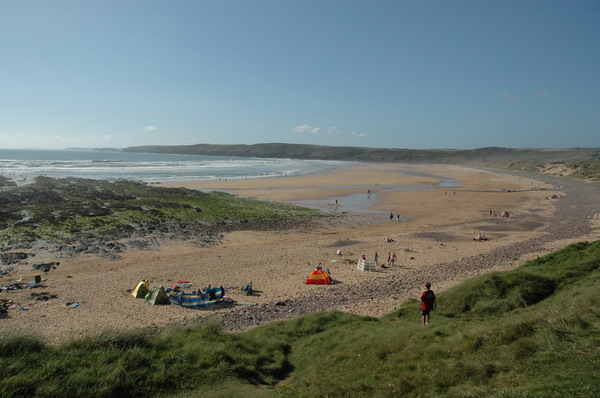
The year 2009 was a big one for filming on the spectacular beach at Freshwater West.  In May of that year the beach was taken over by the Harry Potter team, when filming took place for Harry Potter and the Deathly Hallows.  The most striking prop was Dobby's Shell Cottage, which is seen in the film with the dunes as a backdrop.  Then, the following month the production crew of Ridley Scott's Robin Hood arrived and put on a dazzling display for any casual onlookers as they filmed the scene depicting a battle against French invaders with Robin Hood (Russell Crowe) leading his men into the fray.  The scene was so massive that it involved 800 actors and 130 horses as well as dozens of the boats that were built for the filming.   
File:Freshwater West - geograph.org.uk - 239022.jpg
Freshwater West - geograph.org.uk - 239022. Photo by Jeremy Owen, via Wikimedia Commons.


Southerndown, Vale of Glamorgan

Many Doctor Who fans will have been touched by the relationship between the David Tennant version of the Doctor and his sidekick Rose Tyler (Billie Piper).  So the tearjerking scene in which the Doctor is about to declare his feelings for Rose when he suddenly dematerialises must have had them reaching for the tissues.  The scene of all this heartache was the beach at Southerndown in South Wales, meant to be Bad Wolf Bay in Norway in the series.  The production team evidently thought highly of the beach in question as a filming location: it was used in several other episodes including Journey's End, which saw Rose being joined by her successor Donna (Catherine Tate). 

Portstewart Strand, County Londonderry

One of the most magnificent beaches in Northern Ireland, and just one of a host of scenic coastal locations seen in Game of Thrones, which has just begun its seventh series, Portstewart Strand was where Jaime Lannister and Bronn were seen duelling with the Dornish guards in series 5.  The filming took place in August 2014, which was unfortunate, this being one of Northern Ireland’s most popular summer holiday spots, because the beach was completely closed for the filming.  The locals didn’t mind, though, considering the closure a small price to pay for the exposure given to Portstewart by its role in Game of Thrones.

File:A westerly view along The Strand, Portstewart - geograph.org.uk - 1312074.jpg
A westerly view along The Strand, Portstewart - geograph.org.uk - 1312074. Photo by Des Colhoun, via Wikimedia Commons.

Sunday, 12 June 2016

POOH TERRITORY: ASHDOWN FOREST, EAST SUSSEX


I have been a prolific reader ever since I can remember, and one of my fondest literary memories from my childhood is the series of books featuring an overweight, honey-guzzling bear called Winnie-the-Pooh, or Pooh.  The stories, by A. A. Milne and written in the 1920s, followed the adventures of Pooh and a host of other lovable animal characters, including the diminutive Piglet, the morose donkey Eeyore and the excitable Tigger.  The token human, Christopher Robin, was based on the author’s son Christopher Robin Milne, who grew up on the family farm in the village of Hartfield, between Royal Tunbridge Wells and East Grinstead. 

The scene of the action is Ashdown Forest adjoining Hartfield .  Within the forest is the Five Hundred Acre Wood, which features in the Pooh stories as ‘Hundred Acre Wood’ or ’100 Aker Wood’.  The characters frequent a number of locations within the wood, for example ‘Owl’s House’.  There is a car park on Gill’s Lap (Galleon’s Lap in the stories) where there is a map of the surrounding area showing some of the key locations from the stories.  

File:Ashdown Forest, Milne memorial, Gill's Lap 02.JPG
Ashdown Forest, Milne memorial, Gill's Lap 02. Photo by Poliphilo, via Wikimedia Commons

Hartfield itself is home to Pooh Corner, which runs an online shop selling Pooh merchandise, and there is also a tearoom there.  Nearby is a stream which eventually runs into the River Medway, and crossing the stream is the famous Poohsticks Bridge, where the game Poohsticks was invented by A A Milne for his son Christopher Robin.  The game involves people lining up on the bridge and dropping sticks into the water.  They then rush to the other side of the bridge and the owner of the first stick to emerge is  the winner.  The game is still kept alive today, and world championships in the 'sport' have been held.  

File:Goodnight Pooh - geograph.org.uk - 1048150.jpg
Goodnight Pooh - geograph.org.uk - 1048150. Photo by Ian Paterson, via Wikimedia Commons

At the south-east corner of the Hundred Acre Wood is a spot described as “rather boggy and sad”.  This is Eeyore’s Gloomy Place, where the sad old donkey lived in a stick house prone to falling down.  The Milne family kept a donkey called Jessica in a pasture, and it is thought that this provided the inspiration for Eeyore’s Gloomy Place.  Meanwhile, at the entrance to the farm itself is a walnut tree where Christopher Robin built a trap which ensnared the foot of the gardener’s wife.  This was the inspiration for the story about the Heffalump trap built by Pooh and Piglet to ensnare the mythical elephant-like beast.

Ashdown Forest was once a medieval hunting forest which was created soon after the Norman Conquest.  Today it is the largest area of open access land in the south-east, running at 9.5 acres of beech woods and open heath with wonderful views of the High Weald Area of Outstanding Natural Beauty, making it a popular destination for walkers.  As well as the resident sheep and horses, there is a large deer population and there are also ground nesting birds, so walkers need to keep any dogs under control.  

Map of the area.


Wednesday, 29 April 2015

REIGNING SUPREME: ARUNDEL CASTLE, THE YOUNG VICTORIA


Arundel Castle in West Sussex was one of a number of "wondrous places" (to quote Martin Scorsese's co-producer Graham King) chosen for The Young Victoria, a film based on a screenplay by Julian Fellowes, charting the formative years of this great British queen (played by Emily Blunt).  At the tender age of 20 Victoria displays remarkably strong will when faced with a domineering mother (Miranda Richardson) who, along with her aide (Mark Strong), attempts to force her daughter to sign papers declaring them as regents following the death of King William (Jim Broadbent).  Meanwhile, the German Prince Albert is being encouraged to court Victoria, and when he arrives in the country and meets her he finds himself becoming smitten, a feeling which appears to be mutual.  The film is beautifully shot and acted, and Arundel Castle looks good in its role as Windsor Castle (not for the first time, as it was also used in The Madness of King George).  In real life the castle was visited by Victoria and Albert, who spent a few days there in 1846.  The town made elaborate preparations for the visit, which caused much excitement among the local populace.  Victoria shared her impressions of the castle and its grounds in her diary, describing the garden as "very pretty and full of evergreens, which made Albert extremely jealous for Osborne House".

File:Arundel Castle - geograph.org.uk - 1765127.jpg
Arundel Castle - geograph.org.uk - 1765127. Photo by Brett Oliver, via Wikimedia Commons.
.

The Baron's Hall was used for the scene in the film depicting the grand banquet held for William IV's birthday, standing in for Windsor Castle's Great Hall.  Built on the site of the original Medieval Hall, the Baron's Hall, 130 feet in length, is a late Victorian structure which replaced the original octagonal great hall built by the Eleventh Duke.  The Fitzalan Chapel in the grounds of the castle was used to depict the Chapel Royal at St James's Palace where Victoria and Albert were married in 1840.  The chapel was founded in 1390 by the 4th Earl of Arundel and features gothic architecture with a carved timber roof and choir stalls.  Some of the external features of the castle can also be seen in the production, such as the Norman motte, which forms an impressive backdrop for the happy couple.

File:Arundel Castle - motte and quadrangle, England (18 April 2006).jpg
Arundel Castle - motte and quadrangle, England (18 April 2006). Photo by Luke van Grieken, via Wikimedia Commons.

As for the history of the castle, it was built high up on a hill overlooking the River Arun, which creates a gap in the surrounding dowland.  It was felt that this gap needed defending, which was how the castle came to be founded on Christmas Day 1067 by Roger de Montgomery, Earl of Arundel.  Many of the original features still survive, such as the crenellated Norman keep, the gatehouse and the barbican.  The living quarters, however, were almost completely rebuilt during the latter half of the 19th century, with Victorian architecture in the Gothic style.  There are a number of themed gardens in the grounds, and visitors can climb to the top of the Norman motte and keep from where there are magnificent views of the river and downlands.  The adjoining small town of Arundel is pleasant to wander around, with a range of enticing shops, restaurants and pubs.

Saturday, 6 April 2013

BRIGHTON ROCKS: QUADROPHENIA


People who complain about the youth of today should cast their minds back to Britain in the early to mid 1960s, when seaside towns such as Margate, Clacton and Brighton were terrorised by the opposing youth subcultures known as Mods and Rockers.  Bank holiday weekends were a particlar flashpoint, when hordes of Mods and Rockers would flood into these resorts on their favoured mode of transport and dressed in their preferred gear: motorbikes and leathers for Rockers, scooters and suits with parkas for Mods.  These occasions would inevitably end in open warfare between the two factions, who engaged in fighting in the cafes and on the beaches, sending terrified pensioners fleeing from their deckchairs.  Newspapers of the day were full of reports of incidents such as "fighting on the sands" (Margate), a "second Battle of Hastings", and a  "running battle with police" (Brighton).  This youth phenomenon is what forms the cultural backdrop to Quadrophenia, a film version of the rock opera written by The Who's Pete Townsend in 1973, and transferred to the big screen in 1979.

The troubled main character, Jimmy (Phil Daniels), lives in London, but the climax of the film occurs when he heads for Brighton on a Bank Holiday jaunt with his Mod friends, including Steph, played by Lesley Ash, the object of Jimmy's desires.  On their arrival in the resort, the Mods, together with their scooters and girlfriends, converge on Madeira Drive.  At one point, all heads turn at the sight of the god-like blonde-haired Ace Face, played by Sting, who oozes cool, riding into town accompanied by a posse of scooters.  Towards the end of the film he appears again looking rather less cool, dressed in a ridiculous bell-boy outfit, in his job as a porter at the Grand Hotel.  The exterior of the Brighton Sea Life Centre was used as the dance hall where Jimmy spends an eventful evening culminating in his ejection by the doormen after diving into the dancefloor crowds from the balcony.  The next morning finds Jimmy sitting pensively on the beach.  This is one of the most visually memorable scenes from the film: the sun shimmering on the sea, the waves crashing onto the shore, and the pier looking magnificent in the background, and all to the accompaniment of Love Rain O'er Me by The Who.  Later that day the big battle between the mods and rockers takes place, during which Jimmy and Steph escape to an alleyway, where he manages to consummate his passion for her.  The alleyway in question was just off East Street, and is at the back of what is now a fish restaurant.  

Palace Pier, Brighton - geograph.org.uk - 1590780. Photo by Stephen Richards, via Wikimedia Commons.


After the bank holiday episode, a series of unfortunate events contribute to Jimmy's descent into madness and his departure back to Brighton, where he spots Ace Face in his bellboy outfit and makes off with his scooter.  The shocking final scene has Jimmy roaring up to the top of Beachy Head on the stolen scooter and flinging himself and the scooter off the top of the white cliffs.

Beachy Head and Lighthouse from the track up to Belle Tout - geograph.org.uk - 756553. Photo by Simon Palmer, via Wikimedia Commons.


Brighton, the premier resort on Britain's south coast, has been described as London-on-sea, due to its relative proximity to the capital. The resort used to have two piers, the Palace Pier and the West Pier, but the West Pier burned down in 2003.  Madeira Drive is a raised seafront road which runs eastwards from Brighton Pier.  The Drive is used as the "finish line" for many road races involving a variety of vehicles such as veteran cars, motorcycles and cycles.  The Palace Pier, which started life as a Chain Pier in 1823 acting as a landing stage for passenger ships from Dieppe, is a classic example of its genre.  Seaside resorts all over Britain have piers like this, most of them built during Victorian times when visits to the seaside gained massively in popularity, helped along by the emerging railways.  The piers provided both entertainment and a chance for people to walk out over the sea without the hassle and worry of getting into a boat (which was a much bigger deal in those days than it is now).  Not surprisingly, given the unpredictable British climate, these structures have proven vulnerable to the elements, often suffering extensive damage as a result of storms.  The Palace Pier was battered by numerous storms in its early days, culminating in a monster storm in 1889 which caused such extensive damage that the pier had to be completely rebuilt.

The most famous of Brighton's many hotels is the Grand  Hotel.  The hotel has long enjoyed the status of grand old lady of the Brighton seafront.  Built in 1864 for moneyed visitors to the resort, one of its most notable features was a  "vertical omnibus" or hydraulically powered lift.  The hotel's darkest hour came in 1984, during a Conservative party conference, when the IRA bombed the hotel in an attempt to assassinate Margaret Thatcher.  She survived the attack, but five people died and several were injured, including Cabinet Minister Norman Tebbit.

Brighton's seafront is modern in appearance, but just behind it is the charming labyrinth of streets known as The Lanes.  Just to the east of the Lanes is Brighton’s most famous landmark, which looks as though it belongs not only to a different age, but to a far-flung country. The Brighton Royal Pavilion was started by John Nash in 1787 as a seaside home for the Prince Regent, and was made to look like an Indian palace, making it comically incongruous with its riot of domes and other exotic Indian features.  In the late 1800s, Magnus Volk, son of a German clockmaker, who was born in Brighton, built a tourist attraction which was a rival in eccentricity even for the Pavilion. Nicknamed the “Daddy Longlegs”, it was a “Seashore Electric Tramroad” consisting of a vehicle with 24-foot long legs, each with four wheels on the end, with two open decks, which could carry up to 150 passengers for 3 miles along the seafront to neighbouring Rottingdean. It was powered by electric cables which ran along a row of wooden poles. Sadly, this bizarre example of 19th century inventiveness was destroyed by a severe storm one week after opening, although it was rebuilt, only to close again in 1910. One of Volk’s earlier projects, however, was much more long-lived, in fact it still runs today: Volk's Electric Railway. During the summer months it is possible to travel on this eminent piece of engineering from the Aquarium to Black Rock.

The Royal Pavilion Brighton. Photo by Peter Greenhalgh, via Wikimedia Commons.

To the east of Brighton is Beachy Head, one of the most famous headlands on Britain’s south coast, with the highest chalk sea cliff in the country, rising to a height of 162m.  This is a place tinged with sadness, being a popular place for suicides and attempted suicides, reckoned to number on average 20 per year.  Add to that the loss of life from maritime accidents just offshore, and one shudders to think of the number of lives lost at the hands of Beachy Head.  A collision in 1889 between the British vessel Largo Bay and a steamer called the Glencoe resulted in 54 dead, more than half of them Chinese.  In 1912 the P & O liner Oceana collided with the German barque Pisagua resulting in 9 lost lives.  These are just two examples. Add to this the wartime toll, including the torpedoing of the steamer Haipolian in 1915, and it is hard to conjure up positive feelings about this headland.  One of Beachy Head's most famous features is the jaunty red-and-white striped lighthouse at the foot of the cliff.