Showing posts with label London. Show all posts

Friday, 25 July 2025

MURDER AT THE MANOR: WROTHAM PARK AND SYON HOUSE/GOSFORD PARK

A classic whodunnit in the style of Agatha Christie, Gosford Park sees a group of wealthy guests plus their servants gathering for a shooting weekend at Gosford Park, owned by Sir William McCordle (Michael Gambon).  During the course of the weekend, Sir William’s body is discovered slumped in his chair.  The rest is a familiar round of police questioning, with plenty of likely suspects.  

The gruesome event is offset by the sumptuous interiors of Sir William’s home, with most of the scenes filmed at Wrotham Park, Hertfordshire, for the downstairs and Syon House, West London, for the upstairs and bedrooms.  Near the start of the film we are shown the outside of the home of Lady Trentham, one of the guests.  This was filmed at Hall Barn, Buckinghamshire.


Wrotham Park 1820, courtesy of the British Library, via Wikimedia Commons.


Wrotham Park is to the south of Potters Bar in Hertfordshire.  The house dates from 1754 when it was designed for Admiral John Byng, and it is surrounded by a vast estate of 2,500 acres.  The house remains in the hands of the family to this day, and is not open to the public.  However, it is made available to film crews for filming, most recently being used for the ITV series Code of Silence.


Interior - Syon House - London, UK - DSC07437.  Photo by Daderot, via Wikimedia Commons.

Syon House, the London Home of the Duke of Northumberland, is near Hounslow in West London and is surrounded by Syon Park.  The house was built in the 16th century on a site originally occupied by Syon Abbey.  The house and park are open to visitors, who as well as the magnificent interior can marvel at the beauty of the Great Conservatory. Hall Barn is not normally open to the public, except for open-air theatre productions in the grounds.


Saturday, 28 June 2025

LITERARY PUBS: THE SPANIARDS INN, HAMPSTEAD


On the edge of Hampstead Heath is a handsome inn called The Spaniards, so named because it was built by two Spanish brothers, in the year 1585.  Our old friend Charles Dickens, who seems to pop up with uncanny frequency in these ‘literary pubs’, was one writer who frequented The Spaniards, which provided inspiration for ‘The Pickwick Papers’, but he was not the only one.

The attractive garden is said to have been where the poet John Keats wrote ‘Ode to a Nightingale’.  There is a Keats Room in the inn to commemorate the fact.  His contemporary Lord Byron also visited.  The inn also appears in Bram Stoker’s ‘Dracula’.  As a non-literary aside, the father of the highwayman Dick Turpin was once the landlord of the inn, and it was where Dick came into the world.


The Spaniards Inn 1585 AD and outbuilding - geograph.org.uk - 1131521. Photo by Mike Quinn, via Wikimedia Commons.


Monday, 15 July 2024

MINCING WORDS: THE KING'S SPEECH

The King’s Speech is an unusual film about a late member of the Royal Family, in that it focuses on one particular aspect of the monarch’s persona.  King George VI, aka Bertie, (played by Colin Firth, who won the Oscar for Best Actor), father of the late Queen Elizabeth II, suffered from a stammer, which being the King was a problem with all the speeches he was expected to make.  An Australian speech therapist called Lionel Logue (Geoffrey Rush) was engaged to help the King overcome this affliction, and this is the central theme of the film. Here are some of the locations used in three key scenes of the film.

The opening scene depicts the occasion of the closing ceremony of the Empire Exhibition at Wembley Stadium, which took place in 1925.  Bertie, still a Duke at this point, gives a speech which proves excruciating as he stammers his way through it, with his wife Elizabeth Bowes-Lyon (aka The Queen Mother, played by Helena Bonham Carter) looking on in distress for her husband.  I came across a lost recording of the actual 1925 speech, which, though not great, did not sound nearly as bad as Colin Firth’s version.  Anyhow, as to the location of the scene, it was filmed at Elland Road Stadium in Leeds, home of Leeds United football team, with some shots filmed at the Odsal Stadium, home of the Bradford Bulls rugby team.  The people of Leeds got an early look at the film when it featured in the 2010 Leeds International Film Festival.

Elland Road 2023 cropped. Photo by Arne Müseler, via Wikimedia Commons.
 

Following the death of his father, Bertie has to endure the occasion of his Coronation, which in real life took place in Westminster Abbey, but for the purposes of the film the Coronation scenes and the scenes of the preparation for the occasion were shot at Ely Cathedral in Cambridgeshire.  The cathedral has been used in a number of top films, including Elizabeth: The Golden Age, The Other Boleyn Girl and Macbeth, as well as the Netflix series The Crown.    

Ely Cathedral


With Bertie installed as King, war breaks out against Germany, and Bertie is faced with having to make a broadcast to the nation, and Lionel Logue is summoned to Buckingham Palace to prepare him for the broadcast.  The interior of Buckingham Palace was filmed at Lancaster House, a government-owned building in London, which was rented at a cost of £20,000 a day for the filming.

Lancaster House from St James's Park London. Photo by Ricardalovesmonuments, via Wikimedia Commons.

Elland Road Stadium lies to the south-west of Leeds, near the M621.  The venue offers behind-the-scenes tours and the opportunity to purchase club merchandise.  Odsal Stadium is to the south of Bradford, near the A6036.  As well as rugby matches, the stadium hosts live music events.  Ely is one of the country’s smallest cathedral cities, located in the Fenland district of Cambridgeshire, with a picturesque riverside on the banks of the River Great Ouse.  The cathedral dates back to the 11th century.  Lancaster House is run by the Foreign, Commonwealth and Development Office.  It was formerly known as York House, having been commissioned by the Duke of York in 1825.  Its sumptuous interior includes a Long Gallery, State Drawing Room and the Green Room.


Sunday, 17 December 2023

LITERARY PUBS: YE OLDE CHESHIRE CHEESE, LONDON

There are a number of pubs in London with Charles Dickens associations, but the one all Dickens fans should visit is Ye Olde Cheshire Cheese at 145 Fleet Street.  Not only did Dickens frequent this quaint and atompheric boozer during his time working in the city, but it had a role to play in one of his classics, ‘A Tale of Two Cities’, set before and after the French Revolution.  There is a scene in the novel in which two of the main characters, Charles Darnay and Sydney Carton, head to a tavern to dine.  Although the tavern is not named, its location on Fleet Street and access ‘up a covered way’ have led to universal acceptance that Ye Olde Cheshire Cheese is the inn in question.  The fare on offer is described as “a good plain dinner and good wine”.  I can back this up, based on a visit some years ago, when as far as I can recall I had a perfectly nice Ploughmans at a surprisingly reasonable price for London. 

Ye Olde Cheshire Cheese, Holborn, London. Photo by Adam Bruderer, via Wikimedia Commons.

Charles Dickens is not the only well-known literary figure to have frequented Ye Olde Cheshire Cheese.  Others include G. K. Chesterton, Mark Twain, Samuel Johnson, W. B. Yeats and Arthur Conan Doyle.  In 1927 another eminent writer, P. G. Wodehouse, told a friend that he had looked in at the Garrick (presumably either the theatre or the Garrick Arms) at lunchtime, “took one glance of loathing at the mob, and went off to lunch by myself at the Cheshire Cheese”.   

Cheshire Cheese Basement (15815848118). Photo by It's No Game, via Wikimedia Commons.

The original tavern was opened in 1538 on a site which formed part of a 13th century Carmelite monastery.  Like many of the capital’s inns of the time, it was destroyed by fire during the Great Fire of London in 1666, but was rebuilt the following year.  The authentic atmosphere inside the pub is enhanced by the sawdust on the floor, which is changed twice daily.  As well as the decent pub food, the bar dispenses beers and other drinks bearing the Samuel Smith label.

Map of the area.

Sunday, 19 March 2023

DALLIANCES IN DORSET: EMMA (1996)


One thing is guaranteed when it comes to film adaptations of Jane Austen novels: that they will be a feast for the eyes.  Not only for the dashing young men with their flowing locks and sexy boots, and the English roses with heaving bosoms vying for their attention, but also for the idyllic English town and country scenes, which invariably include a range of stately homes.  The 1996 film Emma, starring Gwyneth Paltrow as compulsive matchmaker Emma and Toni Collette as friend Harriet Smith, is no exception, with a variety of charming locations mainly in Dorset.

The first big property to feature in the film is Hartfield, home of Emma Woodhouse and her family, where Emma is seen discussing a wedding with her father.  The location used as the exterior of Hartfield is mostly Came House in the village of Winterbourne Came, Dorset.  However, some of the interior scenes were filmed entirely elsewhere.  The dinner party scene in which Emma introduces Mr Elton (Alan Cumming) to Harriet was filmed at Stratfield Saye House in Hampshire, while Hartfield’s book-lined gallery was filmed in the Long Gallery of Syon House, west London.

Came House (2) - geograph.org.uk - 855736. Photo by Mike Searle, via Wikimedia Commons.


Another imposing property in Dorset used in the filming of Emma is Crichel House near the village of Moor Crichel, to the north of Wimborne.  In the film the property plays the part of Donwell Abbey, home of a local landowner called George Knightley.  A lake on the estate features in a lakeside archery scene.  Meanwhile, another property, Claydon House in Middle Claydon near Aylesbury, Buckinghamshire, lends its elaborate North Hall for the filming of the grand dance, in which Harriet is snubbed but subsequently rescued by Knightley.  Another local man made good, Mr Weston, who married Emma’s former governess (played by Greta Scacchi) occupies a grand property called Randalls.  This honey-coloured property in real life is Mapperton, home of the Earl and Duchess of Sandwich, which is located a short distance to the east of Beaminster, Dorset.

Mapperton House - geograph.org.uk - 517671. Photo by Chris Downer, via Wikimedia Commons.


Aside from the sumptuous residences seen in the film, there are picturesque street scenes depicting the local village Highbury (Surrey), where Mr Elton is the vicar.  The street scenes used in the film were filmed in the Dorset village of Evershot, about 7 miles south of Yeovil.  The Old Manor House in the village is used as the schoolhouse, while the post office building is used for the haberdashery store.  In order to make the street scenes more authentic for the period, the main street, Fore Street,  was festooned with sheep pens and straw for the filming.  The filming is transferred to the neighbouring county of Somerset for the scene in which Emma visits a sick lady, Mrs Clark.  The venue for this scene is the Helyar Almshouses in the village of East Coker about 3 miles south of Yeovil.

Evershot, Tess Cottage and the church - geograph.org.uk - 447131. Photo by Chris Downer, via Wikimedia Commons.


Came House was built for John Damer in 1754 from a handsome light-coloured stone.  Lying about a mile south-east of Dorchester, nowadays the house is, appropriately enough, used as a wedding venue.  Stratfield Saye House in Hampshire, about 5 miles south of Reading, has been home to the Dukes of Wellington since 1817 and is open for pre-booked tours only.  Syon House, across the River Thames from Kew Gardens, has been used extensively in filming.  Forming part of Syon Park, the house has been the home of the Dukes of Northumberland for over 400 years.  The house and gardens are open to the public, with a mix of guided and self-guided tours of the house.

Crichel House is a Classical Revival country house built for the Napier family.  The property and grounds are not open to the public apart from specific events.  Claydon House is a National Trust property and is open to the public from April.  The North Hall is a riot of rococo in yellow and white.  Mapperton House originates from the 11th century, but a Tudor manor house was built on the site by Robert Morgan in the 1540s, and rebuilt the following century by Richard Brodrepp.  The property is now the  home of the Earl and Duchess of Sandwich. The Gardens and cafe are open from March, and the house from April.

Evershot is the second highest village in Dorset and the source of the River Frome.  The village featured heavily in Thomas Hardy’s works, most notably Tess of the D’Urbervilles.  East Coker lies over the county border in Somerset, and has a history stretching back to Roman times: a Roman villa was discovered there in the 18th century.  The Helyar Almshouses were built in the mid-17th century by the Archdeacon of Barnstaple.  The construction took twenty years due to an enforced interruption brought about by the Great Plague.


Wednesday, 9 November 2022

CRACKING THE CODES: THE IMITATION GAME/BUCKINGHAMSHIRE/SHERBORNE/LONDON


Bletchley Park in Buckinghamshire started out as a mansion in 1711, later to be pulled down.  The house which was subsequently built on the site was bought by MI6 in 1938 for use by intelligence personnel in the event of war, which turned out to be a wise investment as the centre proved to be a key factor in the country’s victory over Germany in World War Two.  During the War a young Cambridge graduate, Alan Turing, arrived at Bletchley Park and was put in charge of Hut 8, which dealt with German naval cryptanalysis.  While there, he became engaged to Joan Clarke, a fellow cryptanalyst, but they never married as Turing later came out as a homosexual. 

Bletchley Park Mansion. Photo by DeFacto, via Wikimedia Commons.

This story is played out in the film The Imitation Game, starring Benedict Cumberbatch as Turing and Keira Knightley as Joan, and Bletchley Park appears as itself in the interior shots.  For the exteriors Joyce Grove in Nettlebed, Oxfordshire, was used in the filming.   For the town of Bletchley itself, scenes were shot in Chesham, Buckinghamshire, where one of the buildings stood in as Joan’s lodgings.  The town was also used as the scene of a meeting with a possible Soviet spy, and a pillar box was erected opposite 68 Church Street for the scene. 

Church Street, Chesham - geograph.org.uk - 111011. Photo by Cathy Cox, via Wikimedia Commons.


During the film there are flashbacks to Turing’s schooldays, much of which were spent at Sherborne School.  The real-life school in this attractive small Dorset town was used for the school scenes in the film, with its lovely honey-hued stone buildings and arched cloisters much in evidence.

Naturally, any film about the intelligence services will have scenes shot in London.  The evacuation scenes were filmed at King’s Cross Station, while the interior of the MI6 Headquarters was filmed in the Lethaby Building on Southampton Row, seen in the scene where Joan turns up as the only female answering an advertisement for crossword solvers.  In one scene, Turing is seen cycling through a bombed out part of the city; heaps of rubble were dumped in Carey Street, Chancery Lane, for the filming of the scene.  In another throwback to the Blitz, the disused Aldwych Tube Station serves as an underground refuge for the populace. 

Bletchley Park, near Milton Keynes, has been turned into a museum commemorating its time as a code-breaking centre.  Guided tours are available, and the museum is open 6 days a week.  Joyce Grove, a country house built in the Jacobean style, is owned by the Sue Ryder charity.  Sherborne is a pleasant small town in north west Dorset, with its Abbey, founded in 705, as the focal point of the town.  Chesham is a market town 11 miles south east from Aylesbury in Buckinghamshire.

Sherborn Abbey.

Map of Bletchley Park and surrounding area.

Map of Sherborne

Sunday, 7 March 2021

A POOR MAN'S JANE AUSTEN RICH IN LOCATIONS: BRIDGERTON


When fans of the Regency period in general, and Jane Austen in particular, got wind of the imminent arrival of the Netflix series Bridgerton they were no doubt salivating at the anticipation of the prospect of flirtations between cleavage-bursting young women and dashing young men sporting sideburns and knee-high boots.  However, as the series got underway opinions were deeply divided between those who found the series embarrassingly lightweight (with plenty of dark mutterings about ‘wokeness’) and those who thought it was a wonderfully entertaining tonic for these dark covid times.  One thing that cannot be denied, though, is the splendour of the locations used in the series.

I have previously blogged about Bath and its Jane Austen connections, and this handsome, honey-coloured city in the west of England plays a large part in Bridgerton.  The Royal Crescent puts in an appearance with number 1 serving as the Baron Featherington household, with digital enhancements on the facade.  Filming also took place at the Assembly Rooms and Trim Street is where we see the exterior of Gunter’s Tea Shop.

Royal Crescent, Bath. Photo by MontanNito, via Wikimedia Commons.

The stately piles occupied by the various families involved in the story are played by photogenic properties scattered around the country.  An art museum in Greenwich called Ranger’s House was used for the Bridgerton family home, with the addition of wisteria and ivy to the facade to make it look more homely.  The property belonging to the dashing Duke of Hastings was represented by three different properties: Wilton House near Salisbury for interior and exterior shots, with further interior work done at Syon House in Middlesex and Badminton House, Gloucestershire, which we last encountered as Darlington Hall in The Remains Of The Day.  Badminton House and Wilton House were also used for some of the interior scenes depicting the home of Lady Danbury, who acts as a kind of mother figure to the Duke.  The exterior of Lady Danbury’s house, meanwhile, was shot at the Holburne Museum of Art, taking us back to Bath.

Wilton-House-02-2004-gje. Photo by Gerd Eichmann, via Wikimedia  Commons.


Soaring up to the heights of Regency society, we encounter Queen Charlotte, whose residence in the series is an actual palace in real life, namely Hampton Court Palace.  Wilton House pops up again here, with some of its interiors used in the filming, along with those of Lancaster House in London. 

For the marital home of a certain pair of newly-weds we are whisked to the north of England, to Castle Howard, 15 miles north of York, where the exterior scenes were filmed, while Wilton House and Badminton House are once again used for interiors, along with North Mymms Park, a wedding venue south of Hatfield, Hertfordshire.  Staying in Hatfield, Hatfield House, a property which has been used in numerous previous productions, provided some of the interior shots of the Featherington residence.

Castle Howard and garden. Photo by Pwojdacz (talk), via Wikimedia Commons.


The city of Bath nestles in a dip in the Somerset countryside with the River Avon running through it.  Jane Austen once lived there, and as a reminder of this time there is an annual Jane Austen Festival.  Visitors who are feeling a bit flush and who want to immerse themselves in the Bridgerton experience can stay at the Royal Crescent Hotel, the city’s finest, although the less moneyed can make do with a visit to No. 1, which is a heritage museum.  The Holburne Museum of Art is next to Sydney Gardens on the east side of the city.  The Assembly Rooms are run by the National Trust and are a short distance to the east of the Royal Crescent.  For visitors coming from outside the UK the nearest international airport is Bristol Airport. 

For Bridgerton fans visiting the London area, Ranger’s House, which lies on the boundary between Greenwich Park and Blackheath, is run by English Heritage and is home to the Wernher Collection.   Syon House to the west of London is across the Thames from Kew Gardens and is the London home of the Duke of Northumberland.  The house forms part of the wider Syon Park, which is open to visitors.  Hampton Court Palace is further upstream and is famous for having been the seat of Henry VIII.  Lancaster House is near St James’s Palace and is managed by the Foreign and Commonwealth Office. 

Further afield, North Mymms Park is just off the A1 (M) south of Hatfield and offers wedding and events services, while Hatfield House forms part of Hatfield Park, both of which are open to visitors, and is a short distance to the east of Hatfield.  Heading further west, Wilton House, just outside Salisbury, is home to the Earl and Countess of Pembroke, but is open to visitors.  Badminton House is part of Badminton Estate and has been the main seat of the Dukes of Beaufort since the 17th century.  The Estate is open to visitors for house tours and garden visits.  Finally, to Yorkshire and Castle Howard, 15 miles north-east of York just off the A64 Scarborough road, which belongs to the Howard family, going back several generations.  The house and gardens are open to visitors. 

Tuesday, 27 October 2020

LADIES ON THE WARPATH IN LONDON: SUFFRAGETTE


In 1912 the women of Britain were in the throes of an awakening.  Thanks to the fearless and feisty efforts of Emmeline Pankhurst and her daughters, and of Millicent Fawcett, the ladies of London and beyond were starting to realise the extent of the discrimination against them, in particular with regard to the vote.

The 2015 film Suffragette tells the story of a young married woman, Maud Watts (Carey Mulligan) who finds herself drawn into the struggle, with Meryl Streep putting in an appearance as Emmeline Pankhurst.  Much of the action takes place in London, however, not all the scenes were filmed in London.

Maud works at a laundry in Bethnal Green, a grim working environment with a misogynistic boss who is not above seeking sexual favours from female employees, some of them very young.  The exterior of the laundry building was filmed at Chatham Historic Dockyard in Kent, while the interior scenes were built at an educational establishment called the Highfield Oval in Harpenden, Hertfordshire.  In those days it was common for factory workers to live in purpose-built housing, and the red-brick tenements where Maud’s family live are on the Boundary Estate, Shoreditch.

In one scene, Maud is seen venturing to London’s West End, where she witnesses an attack on the shop fronts.  The West End is generally regarded as the area in Central London where the main shopping and entertainment areas are, but in the film it is the area known as Cornhill, a few hundred metres to the east of St Paul’s Cathedral, which is used to represent the West End.  The district falls within the City of London, the oldest part of the city.  It developed into the city’s financial centre, and the Bank of England can still be found nearby, on Threadneedle Street, while the Royal Exchange, a trading centre first established in Elizabethan times, is now a shopping centre. The shop coming under attack in the West End scene is at Smythson, 7 Royal Exchange Buildings.


                            London Royal Exchange. Photo by ÁWá, via Wikimedia Commons.

The most recognisable part of London seen in the film is Westminster, with Big Ben appearing in the scene in which Maud heads to the Palace of Westminster to give testimony before a Parliamentary committee tasked with looking into the question of women’s suffrage.  The Central Lobby with its distinctive octagonal shape features in the interior scenes depicting the committee’s enquiries, with Committee Room 16 acting as the scene of the hearing. 


               London - The Parliament - 2773. Photo by Jorge Royan, via Wikimedia Commons.

As Maud finds herself being drawn into the world of the suffragettes, we see her arrest and imprisonment in Holloway Prison, and ultimately the break-up of her marriage and the loss of her son, who is placed with another more ‘suitable’ family.  The interior of the prison is filmed far away in Wales in Ruthin Gaol (now a museum), Denbighshire, while the cells are taken from the former Clerkenwell House of Detention back in London (now converted to apartments, though the cells remain in the basement, in a part of the building known as the Clerkenwell Catacombs).  The prison gates, seen in the scene where Maud gets a medal for her first arrest, were filmed at Lincoln’s Inn Gate, Newman’s Row, Lincoln’s Inn Fields.  Maud is arrested again after listening to Emmeline Pankhurst giving a speech to the suffragettes – this took place at 18 Myddelton Square in Islington.


                     Ruthin Gaol - courtyard. Photo by Arwel Parry, via Wikimedia Commons.

These are just some of the chapters of the story of Maud and her fellow suffragettes, but before we go there is one final location which was used in the explosive and tragic scene where Maud’s friend Emily Davison (Natalie Press) throws herself under a galloping racehorse, resulting in her death and martyrdom for the suffragette cause.  The real-life event took place at Epsom Racecourse, but  Royal Windsor Racecourse stood in for Epsom in the film.

Chatham Historic Dockyard is open to the public, and the attractions there include visits to historic ships and a Victorian Ropery.  The Boundary Estate is just to the east of the A10, adjacent to Hackney.  The Royal Exchange shopping centre has a range of upscale dining options as well as some big name high end boutiques.  The Palace of Westminster is open to visitors, who can take a tour or watch debates and committees. 

Ruthin Gaol is beside the River Clwyd in this historic Welsh town, and has received the Visit Wales Hidden Gem award three times.  Lincoln’s Inn Fields is in the Holborn area of Central London, near the Holborn Underground Station.  Myddelton Square lies just south of the A501, to the west of Sadler’s Wells Theatre.  Royal Windsor Racecourse lies by the side of the A308 at the western edge of Windsor, Berkshire.

Map of London.

Monday, 13 July 2020

A TOUR OF ENGLAND'S FINEST CATHEDRALS: ELIZABETH AND ELIZABETH:THE GOLDEN AGE


Any film about events in English history will inevitably be chock-full of some of the finest examples of English heritage.  In the films Elizabeth (1998) and its sequel Elizabeth: The Golden Age (2007), both starring Cate Blanchett as Queen Elizabeth I, it is some of the country’s finest cathedrals that come to the fore among the locations used.

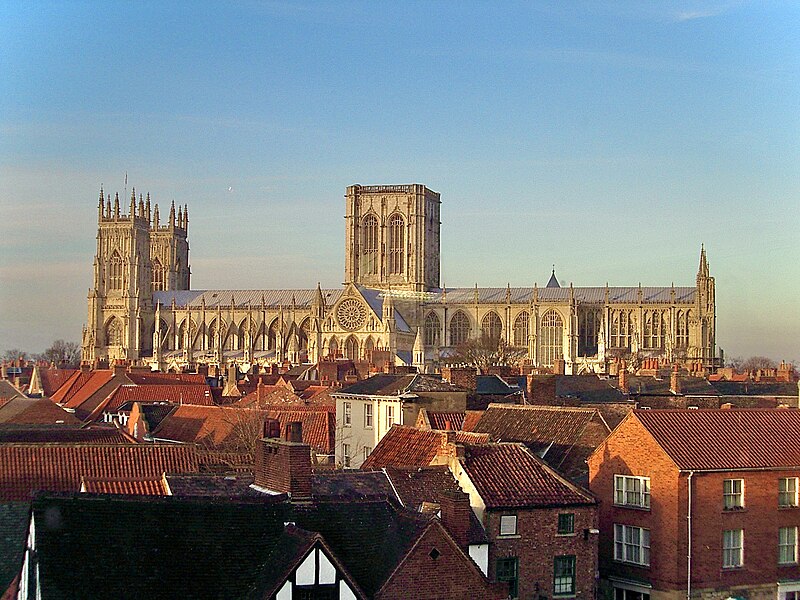
In Elizabeth, the coronation scene was filmed at York Minster, which proved a splendid substitute for Westminster Abbey, where the actual coronation took place on 15 January 1559.  The Minster lies in the centre of this historic city, and due to the flat terrain in the area surrounding it can be seen from miles around.  There has been a place of worship at this spot since the 7th century, but it was not until 732 that the first Archbishop of York was recognised by the Pope.  The present building took a massive 250 years to complete, starting in 1220 and ending in 1472.  The Minster brought shocking images to our TV screens in 1984 when a fire which started in the south transept raged out of control, and firefighters were forced to deliberately collapse the roof to save the rest of the building.

File:York Minster from M&S.JPG
York Minster from M&S. Photo by Matze Trier, via Wikimedia Commons.

The other cathedral which  makes an appearance in Elizabeth is Durham Cathedral.  The cathedral plays the part of the royal palace, and its distinctive pillars are seen in the scene where Elizabeth searches for Lord Robert after receiving a message.  Like York Minster, Durham Cathedral was preceded by a humbler place of worship known as the Saxon ‘White Church’.  The present-day building, which makes for a picturesque sight overlooking the River Wear, was built between 1093 and 1133, with further additions thereafter.

File:Durham Cathedral Nave.jpg
Durham Cathedral Nave. Photo by Michael D Beckwith, via Wikimedia  Commons.

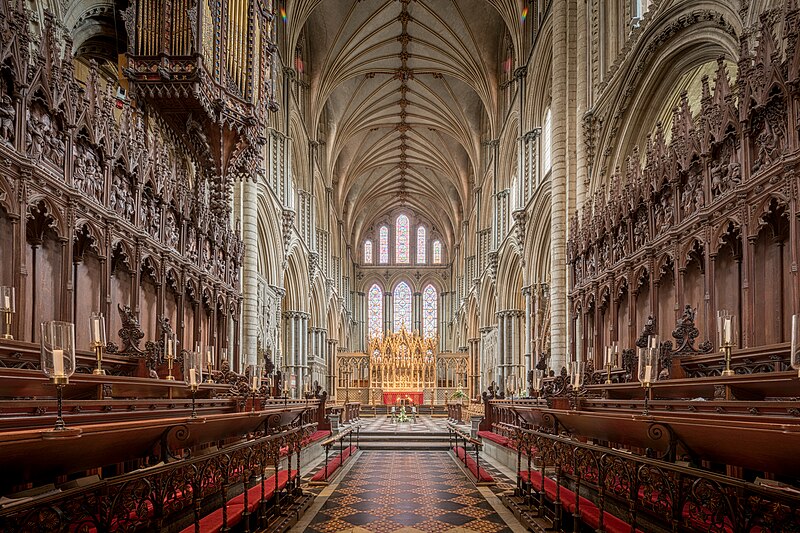
In Elizabeth: The Golden Age we are taken further south, with Ely Cathedral in Cambridgeshire playing an important role as the Palace of Whitehall, which in those days was the main residence of the monarchs of the day.  It is seen in a number of scenes, such as the one where Elizabeth confronts the Spanish Ambassador, and when Sir Walter Raleigh arrives bearing gifts from the New World.  Ely Cathedral is unusual in that, unlike most cathedral cities, Ely is the size of a small town.  In fact, the cathedral came before the town, which grew up around it.  There is a slate in the cathedral marking the location of a former shrine to Ethelreda, daughter of the King of East Anglia, who founded an abbey at the location of what is now the cathedral.  The building dates from 1083, and was granted cathedral status in 1109.

File:Ely Cathedral Choir East View.jpg
Ely Cathedral Choir East View. Photo by Michael D Beckwith, via Wikimedia Commons.

The sequel covers the period leading up to, and including the country’s spat with Spain, and Westminster Cathedral transports us over the water to the court of King Philip II, as it was where the scenes were filmed featuring the ranting king, plotting his invasion of England following the execution of Mary, Queen of Scots.  As a Roman Catholic cathedral, Westminster Cathedral was a good choice.  The cathedral is much younger than the others used in the two films, with construction completed in 1903.  Its main distinguishing feature is the striped appearance of its exterior, fashioned from layers of brick and stone.

File:Westminster.cathedral.frontview.london.arp.jpg
Westminster.cathedral.frontview.london.arp. Photo by Arpingstone, via Wikimedia Commons.

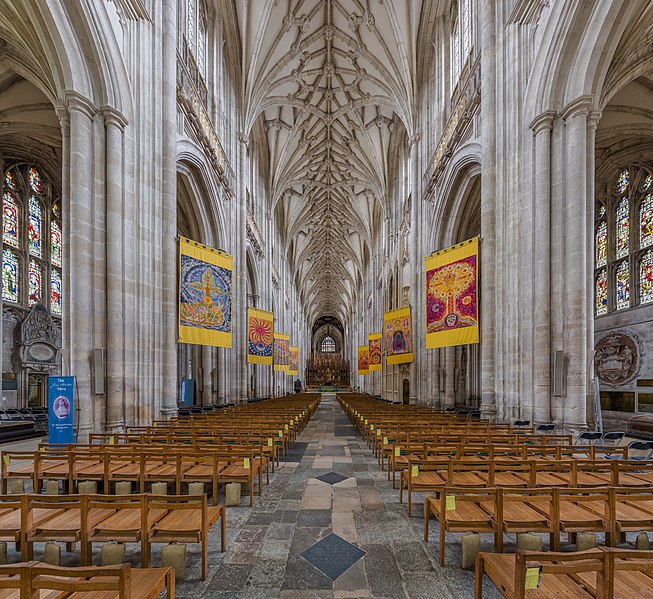
One of the most dramatic scenes in the sequel is the attempt on Queen Elizabeth’s life by Thomas Babington (Eddie Redmayne), an event which is pure fiction, since in reality this particular individual did not get anywhere near the Queen, although it is true that there was a plot to assassinate her.  The scene in question was filmed in Winchester Cathedral.  Originally founded in 642 and known as Old Minster, the present-day cathedral was started in 1079 at a site nearby, and the Old Minster was demolished in 1093.  The cathedral has the distinction of being one of the largest in Europe, and includes many notable features, such as the 17th century choir screen designed by Inigo Jones.

File:Winchester Cathedral Nave 1, Hampshire, UK - Diliff.jpg
Winchester Cathedral Nave 1, Hampshire, UK - Diliff. Photo by DAVID ILIFF, via  Wikimedia Commons.

Finally, for the main entrance to Whitehall Palace as seen in the sequel, the producers made use of Wells Cathedral, specifically the staircase linking the North Transept to Chapter House.  Like Ely, Wells is another unusually small cathedral city, nestling among the green fields of the Somerset countryside.  The cathedral was built to replace an earlier church which had occupied the site since 705, and construction spanned the period from 1176 to 1450.  One of the cathedral’s best known features is its astronomical clock dating from around 1325.

File:Wells cathedral chapter house brighter.JPG
Wells cathedral chapter house brighter. Photo by Lamiai, via Wikimedia Commons.


Tuesday, 9 June 2020

A SLICE OF HEAVEN IN DEVON: SENSE AND SENSIBILITY


Whenever there is an adaptation of a Jane Austen novel on the big or small screen, one thing can be certain: the locations will inevitably feature some of Britain’s finest stately properties. 

The property which kicks off the story in the 1995 film adaptation of Sense and Sensibility, directed by Ang Lee, is the fictional Norland Park in Sussex, which is left by a dying father to his son, but due to the rules of inheritance the three daughters Elinor, Marianne and Margaret and their mother (Emma Thompson, Kate Winslet, Emilie Francois and Gemma Jones) are left with next to nothing.  Worse still, they are forced to move out of their lovely family home, while the son and his wife John and Fanny (James Fleet and Harriet Walter) move in.  The mother and daughters are offered accommodation by a cousin, but it is a bit of a come-down, being just a ‘cottage’ in the depths of Devon, albeit in a heavenly rural setting near the coast.

The real-life version of Norland Park is Saltram House near Plymouth, a Grade I listed George II era mansion, while the cottage, Barton Cottage in the story, is Efford House on the Flete Estate, which actually is in Devon in real life, again near Plymouth.  The waterside scenes set near the cottage were also filmed in Devon, at the mouth of the River Erme.  However, the exterior of Barton Park, the wider estate where the cottage is located, is actually further east in Wiltshire, where the scenes were shot at Trafalgar Park, between the city of Salisbury and the northern edge of the New Forest.


File:Efford House - geograph.org.uk - 292694.jpg
Efford House - geograph.org.uk - 292694. Photo by Derek Harper, via Wikimedia Commons.


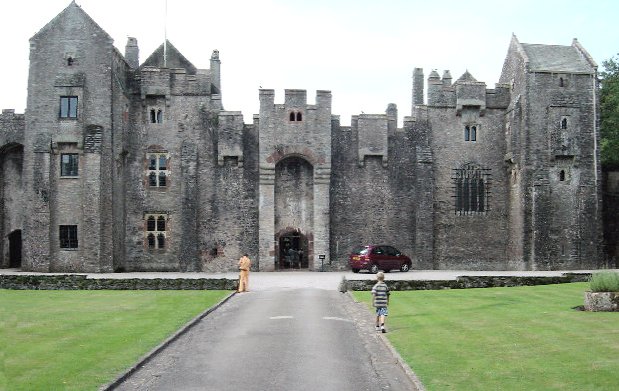
Another striking property in Devon, which is seen at a distance as a large grey mass of architectural splendour surrounded by sloping green fields, is the Combe Magna estate, owned by love interest John Willoughby (Greg Wise).  In real life this is a fortified manor house called Compton Castle near the resorts of Torbay.  The manor house dates from the 1400s and was connected to Sir Walter Raleigh.  Still in Devon, the wedding scene at the end was filmed at St Mary’s Church in the village of Berry Pomeroy near Totnes.

File:Compton Castle in Devon enh.jpg
Compton Castle in Devon enh. Photo by Smalljim, via Wikimedia Commons.

One of the most dramatic scenes in the film comes towards the end, when Marianne suffers a life-threatening illness, to the distress of Captain Colonel Brandon (Alan Rickman), who has developed a soft spot for her.  She falls ill while visiting the estate owned by a couple in the Dashwoods’ social circle called the Palmers (Imelda Staunton and Hugh Laurie).  This magnificent property is the real-life Montacute House near Yeovil in Somerset, a late Elizabethan mansion with manicured lawns and gardens.


                                                                      Montacute House. 

Mid-way through the film we are transported to London, where many well-to-do people in Jane Austen’s time had their “London base” in addition to their country properties.  The London abode of the dreadful Fanny Dashwood and her husband John is represented by a house in Adam Street, WC2, while Chandos House in Queen Anne Street is the home of the Palmers.  However, the Chelsea home of the ebullient Mrs Jennings (Elizabeth Spriggs) is not in London, but in Salisbury, in reality the 18th century Mompesson House in the Cathedral Close.

Most of the properties featured in the film are open to visitors.  Saltram, Compton Castle, Montacute House and Mompesson House are run by the National Trust.  Trafalgar Park is privately owned, but can be used for events and weddings.  Meanwhile, for anyone wanting to immerse themselves fully in the Dashwoods’ idyllic life in Devon, Efford House is available as a holiday let.


Friday, 1 May 2020

LOVELY SETTINGS FOR A LOVELESS MARRIAGE: THE DUCHESS


Lady Georgiana Spencer, an ancestor of Princess Diana, was born in Althorp, where the Princess is buried.  At the age of 17 she was married off to William Cavendish, 5th Duke of Devonshire, whereupon she became the Duchess of Devonshire.  On paper it sounds like a fairy tale for the young Georgiana, but unfortunately the Duke turned out to be a philanderer who was only interested in gaining a male heir.  Georgiana’s first two children, as sod’s law would have it, were female, but she finally managed a son the third time round.  Meanwhile, Georgiana became friendly with Lady Elizabeth Foster from Suffolk while on a visit to Bath.  Predictably, Elizabeth caught the roving eye of the Duke and she ended up in a ‘menage a trois’ with the pair of them, bearing two illegitimate children by him and finally becoming his wife three years after Georgiana’s death in 1806, only for the Duke to die two years later.  This saga is the subject of the 2008 film The Duchess, starring Keira Knightley as Georgiana and Ralph Fiennes as William. 

The scenes depicting Georgiana’s time at Althorp did not make use of the real-life Spencer family seat, but were filmed at Kedleston Hall in Derbyshire.   One twist to this whole sorry tale is that Georgiana fell madly in love with Charles Grey (played by Dominic Cooper), a Whig Party member who would later become Prime Minister, but in spite of William’s own infidelities he would not allow her to continue the liaison (which resulted in an illegitimate daughter).  In the film she is seen flirting with Charles, a scene filmed at the South Front of Kedleston Hall.  The scene in which her mother (Charlotte Rampling) is filmed meeting with William to persuade him of her daughter’s charms was filmed in the Library.  Another scene in which Georgiana’s hair catches fire was also filmed here, this time in the Marble Hall. 

File:Kedleston Hall 04.jpg
Kedleston Hall 04. Photo by Glen Bowman, via Wikimedia Commons.


The country estate of the Dukes of Devonshire is Chatsworth House, one of Britain’s best-known stately homes.  Chatsworth played itself in the film when the wedding scenes were filmed there.  However, the Dukes had another base in London called Devonshire House in London’s Piccadilly.  The scenes depicting Devonshire House made use of a number of locations for the interior and exterior shots.  The original building was demolished in 1924, so the film-makers had to find an alternative for the exterior, and Somerset House in The Strand proved the perfect choice.  The interior scenes were all over the place, making further use of Kedleston for some scenes, plus Clandon Hall, Guildford, with Holkham Hall in Norfolk used to depict the dining room. The streets of London, in which the newly-weds are filmed trundling along in their carriage being cheered by crowds of people, are actually the grounds of the Old Royal Naval College in Greenwich.

File:Chatsworth Bridge.jpg
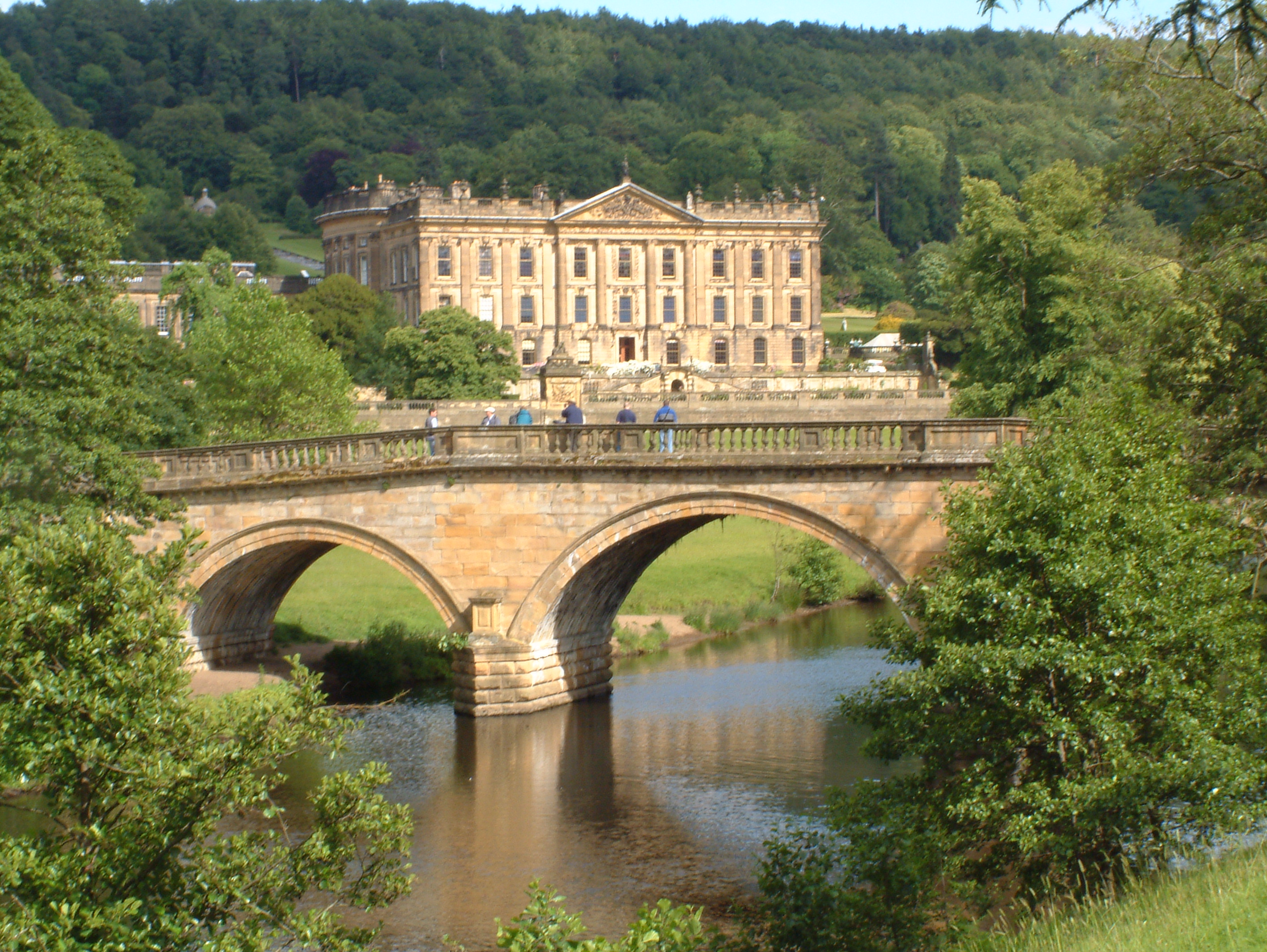
Chatsworth Bridge. Photo by Rob Bendall, via Wikimedia Commons.

In the scenes in which Georgiana goes to Bath to take the waters, this beautiful city gets to play itself, as the graceful Royal Crescent comes into view.  Another famous Bath landmark is the Assembly Rooms in Bennett Street.  The tea room forms the backdrop to the scene where Georgiana is presented to the throng and where she first meets Elizabeth.  However, the river scenes seen in this part of the film were not filmed in Bath, but back at Kedleston.

File:Royal Crescent, Bath 2014 04.jpg
Royal Crescent, Bath 2014 04. Photo by Mike Peel, via Wikimedia Commons.


Kedleston Hall, to the north-west of Derby, is an 18th century neo-classical house designed by Robert Adam and surrounded by sumptuous parkland.  The property is owned by the National Trust.  Chatsworth House, on the banks of the River Derwent near Bakewell, Derbyshire, is privately owned but open to visitors complete with retail and refreshment points.  The house was initially completed in 1708, with later additions the following century.  The extensive grounds include many interesting features, including fountains, a temple and a rectangular lake known as the Canal Pond.

Somerset House is a neo-classical building on the south side of The Strand in London.  It is been used for many purposes over the years, but its current role is principally as an arts centre.  The Old Royal Naval College dominates the banks of the River Thames in Greenwich.  A naval college since 1873, it forms part of the Maritime Greenwich UNESCO World Heritage Site.  The College has been used extensively in filming, proving useful to film-makers as a quieter alternative to Central London for street scenes, Clandon Park, to the north-east of Guildford, Surrey,  is owned by the National Trust, but unfortunately Clandon Hall itself was destroyed by a catastrophic fire in 2015 and still stands as a ruin today.  Holkham Hall is in Holkham in North Norfolk, famous for its vast sandy beach.  An 18th century house in the Palladian style surrounded by extensive parkland, it is privately owned but open to visitors.

The Royal Crescent in Bath was started in 1767 and consists of 30 Grade I listed terrace  houses.  For those wanting to immerse themselves in the Georgian spa town experience, part of the crescent has been given over to Bath’s poshest hotel, the Royal Crescent Hotel and Spa.  The Assembly Rooms, another National Trust property and designed in 1769, were the focal point of Georgian Bath’s social scene.  The building is used for functions and conferences, and can be visited when not in use.  There is also a Fashion Museum on the premises.  Both the Royal Crescent and The Assembly Rooms were designed by the architect John Wood, the Younger.

Wednesday, 14 February 2018

VALENTINE SPECIAL: LOVE ON PAGE AND SCREEN


With Valentine’s Day upon us, I have come over all soppy and decided to share some British locations associated with some of the many romantic moments featured in our nation’s works of film, TV and literature.  So get out the heart-shaped chocolates and enjoy.


Gunwalloe, Cornwall: Dwight marries Caroline in Poldark


I have already described some of the Poldark locations in an earlier post, including the location of Nampara, where Ross and Demelza build their life together.  I do not tear up easily, but one scene in series 3 even got me going, when Caroline Penvenen and Dr. Dwight Ennis, after a seemingly doomed relationship, finally tied the knot.  The church where the wedding was filmed was the charming and very Cornish Church of St Winwaloe, nestled among the dunes in Gunwalloe near the Lizard Peninsula.  Being of a ‘three hall’ design, the present day church is thought to date from the 15th century, although the original chancel and nave were probably 13th century, and there is a Norman font.  

St Winwaloe Church and Church Cove - geograph.org.uk - 981092. Photo by Rod Allday, via Wikimedia Commons.


Valency Valley, Cornwall: Thomas Hardy meets his first wife


Staying in Cornwall, but this time near the north coast, the Valency Valley is a lush hideaway just inland from the picturesque harbour village of Boscastle.  Set in an isolated position on the northern slopes of the valley is the Church of St Juliot.  In 1870 Thomas Hardy, who at the time was an aspiring architect, arrived at the church to perform work on its restoration following the death of the person originally hired to do the job.  While there he met and fell in love with his first wife Emma, the rector’s sister-in-law and their courtship inspired one of his works, the novel ‘A Pair of Blue Eyes’. 


Mapperton House, Dorset: Bathsheba and her triangle of suitors


Continuing the Hardy theme, Bathsheba Everdene in Hardy’s Far From The Madding Crowd must surely be one of English literature’s most fascinating and complex characters, a woman ahead of her time for her fierce independence.  When she inherits a farmhouse and takes up residence there she find herself pursued by a trio of suitors: Gabriel Oak, a shepherd from her past who asks her to marry him but is rejected – although he gets his girl in the end; Sergeant Francis Troy, who succeeds in wooing her but turns out to be really bad news; and the lonely farmer William Boldwood, who Bathsheba foolishly leads on with a Valentine saying “Marry me” but who eventually succeeds in gaining her hand in marriage only for it to end in tragedy through a fatal spat with Troy.  The 2015 film version of the story, starring Carey Mulligan as Bathsheba, captures all this wooing and wedding perfectly.  Bathsheba’s farmhouse in the film is portrayed by Mapperton House near Beaminster in the Hardy county of Dorset, a Jacobean manor house and home to the Earl and Countess of Sandwich.  The house is open to visitors on guided tours only.


Mapperton House - geograph.org.uk - 517671. Photo by Chris Downer, via Wikimedia Commons.

Apple Tree Yard, London


The scene of the al fresco knee trembler involving Yvonne Carmichael and her mysterious lover in the book and TV series of the same name actually exists as Apple Tree Yard in real life.  It is an insignificant alleyway behind Jermyn Street in Mayfair.  However, the makers of the TV production were unable to use the yard for the series because of building work going on there for a major redevelopment, so a similar alleyway in the City had to be used instead. 


Romantic locations galore in Four Weddings and a Funeral


The 1994 romantic comedy Four Weddings and a Funeral, starring Hugh Grant and Andi McDowell, takes us on a tour of romantic locations in south-east England for the wedding scenes.  Wedding No. 1 takes place in St Michael’s Church, Betchworth near Reigate, with the reception filmed at a property named Goldingtons in Sarratt, Hertfordshire, which went up for sale in 2015 for a cool £4.5m.  No. 2 is conducted at the Old Royal Naval College in Greenwich, with Luton Hoo Estate near Luton being used for the reception.  The third wedding service was supposed to take place in Perthshire in the film, but was actually filmed at Albury Park, Guildford, Surrey, with the reception at Rotherfield Park near Alton, Hampshire.  The final wedding is scheduled to take place at St Bartholomew-the-Great in Clerkenwell, but turns into a non-wedding when Charles has second thoughts.


A wealth of stately homes: Pride and Prejudice


The 1995 version of Pride and Prejudice has Mr Darcy sneering at everyone in a lavish ballroom, meant to be the Netherfield Ballroom.  His dance with Lizzie on this occasion  marks the beginning of their romance.  Netherfield Park, where the scene takes place, is the home of Mr Bingley, a wealthy gentleman from the city, and the exterior of the property is represented by Edgecote House in Northamptonshire, while the ballroom scene was shot in the ballroom of Brocket Hall in Hertfordshire.  Later on in the series Darcy has an awkward encounter with Lizzie dressed in wet underclothes following a swim in a lake on a hot day.  This scene, which was voted one of the best on British TV, was shot at Lyme Park in Cheshire.


Teversal Manor, Nottinghamshire: Lady Chatterley's Lover


The racy novel by D H Lawrence, Lady Chatterley’s Lover, is centred on the tragic couple Lady Constance Chatterley and her paralysed husband Clifford.  At night Constance creeps from their  home, Wragby Hall, to spend time with her lover Oliver Mellors the gamekeeper.  The house believed to have provided the inspiration for Wragby Hall was Teversal Manor, near Mansfield, Nottinghamshire, which was put up for sale in 2013 for £1m.


Stokesay Court, Shropshire: Atonement


The novel Atonement by Ian McEwen explores the ill-fated romance between Cecilia Tallis and Robbie Turner, the son of the family’s cleaning lady.  In 2007 the novel was made into a film, and the Tallis family home which was the scene of the beginning of the couple’s romance was represented by Stokesay Court in Onibury, Shropshire, built by Victorian merchant John Derby Allcroft.  Not to be confused with the much older Stokesay Castle, an English Heritage site to the north, just south of Craven Arms.


Blackpool: a very Coronation Street romance


The fictional Coronation Street couple Roy and Hayley Cropper were once described as the greatest soap couple of all time.  They were also possibly the most unusual, given that Hayley started out as a bloke and was the first transgender character in a British soap opera.  Unfortunately, the romance between the two comes to a sad end when Hayley is diagnosed with terminal cancer.  Following the diagnosis the couple head to Blackpool to try and grab some last happiness together, for example dancing in the Tower Ballroom. Following Hayley’s death, Roy scatters her ashes in the sea at Blackpool.


Carnforth Station: Brief Encounter.


One of the most memorable images from 1940s British cinema is that of Trevor Howard and Celia Johnson gazing meaningfully into each other's eyes in a station cafe in Brief Encounter.   Those who want to relive that romantic moment should head for Carnforth, because it was the cafe at Carnforth Station, now known as the Brief Encounter Refreshment Room, which was used in the film with the station acting as Milford Junction.  It is a fitting name, because at that time Carnforth was a major junction in the railway system of the north-west, and during the war thousands of servicemen passed through on the way to their overseas destinations.  However, Carnforth was a victim of the Beeching rail cuts in the 1960s, and the station was turned into a mere branch line station with a lot of the buildings from its heyday falling derelict.  Recent restoration work has resulted in the opening of the Carnforth Station Heritage Centre, incorporating that famous cafe.

File:Carnforth Station waiting room.jpg
Carnforth Station waiting room. Photo by Deben Dave, via Wikimedia Commons.


High Sunderland Hall, Yorkshire: Wuthering Heights


Wuthering Heights, the property at the heart of Emily Bronte’s novel of the same name, is the scene of a classic story of love and revenge, charting the doomed love affair between Catherine Earnshaw, the daughter of the property’s owner, and the dark and brooding Heathcliff, an orphan boy brought by Earnshaw to live with the family following a trip to Liverpool.  The inspiration for the exterior of Wuthering Heights is thought to be High Sunderland Hall near Halifax, while the location of the property is assumed to be Top Withens, the site of a ruined farmhouse near the Bronte family’s home village, Haworth.


Tretower Court, Powys: The Libertine


The Libertine, starring Johnny Depp, is a historical romp centred on a drunken, sex-mad poet called John Wilmot, or the Earl of Rochester, a friend of King Charles II.  Wilmot falls in love with an actress he has decided to make into a star.  Much of the film was made in the Isle of Man for tax purposes, but several key scenes were filmed at the 14th century Tretower Court, a medieval courtyard house and adjoining castle near Crickhowell, Powys.   Apparently Depp joined some of the locals for a drink at the Bear Hotel, where some of the crew members were staying.


Cumbernauld: Gregory's Girl.


Gregory’s Girl, released in 1981, is a romantic comedy with a Scottish accent which launched the film acting career of John Gordon Sinclair, who was just 19 at the time of filming.  Much of the action takes place in and around the New Town of Cumbernauld in North Lanarkshire.  The site was designated for a New Town in 1955, and the town has since grown to be the ninth most populated locality in Scotland.  Among the industries which have grown up around this population are the studios for the TV series Outlander, which makes much use of the surrounding area.