Showing posts with label Hertfordshire. Show all posts

Friday, 25 July 2025

MURDER AT THE MANOR: WROTHAM PARK AND SYON HOUSE/GOSFORD PARK

A classic whodunnit in the style of Agatha Christie, Gosford Park sees a group of wealthy guests plus their servants gathering for a shooting weekend at Gosford Park, owned by Sir William McCordle (Michael Gambon).  During the course of the weekend, Sir William’s body is discovered slumped in his chair.  The rest is a familiar round of police questioning, with plenty of likely suspects.  

The gruesome event is offset by the sumptuous interiors of Sir William’s home, with most of the scenes filmed at Wrotham Park, Hertfordshire, for the downstairs and Syon House, West London, for the upstairs and bedrooms.  Near the start of the film we are shown the outside of the home of Lady Trentham, one of the guests.  This was filmed at Hall Barn, Buckinghamshire.


Wrotham Park 1820, courtesy of the British Library, via Wikimedia Commons.


Wrotham Park is to the south of Potters Bar in Hertfordshire.  The house dates from 1754 when it was designed for Admiral John Byng, and it is surrounded by a vast estate of 2,500 acres.  The house remains in the hands of the family to this day, and is not open to the public.  However, it is made available to film crews for filming, most recently being used for the ITV series Code of Silence.


Interior - Syon House - London, UK - DSC07437.  Photo by Daderot, via Wikimedia Commons.

Syon House, the London Home of the Duke of Northumberland, is near Hounslow in West London and is surrounded by Syon Park.  The house was built in the 16th century on a site originally occupied by Syon Abbey.  The house and park are open to visitors, who as well as the magnificent interior can marvel at the beauty of the Great Conservatory. Hall Barn is not normally open to the public, except for open-air theatre productions in the grounds.


Thursday, 24 April 2025

A GRAND ABODE FOR A GRAND DECEPTION: THE SCAPEGOAT/KNEBWORTH HOUSE

The Scapegoat, a novel written by Daphne Du Maurier in 1957, concerns a man who one day by chance meets his double, an aristocrat beset with financial and family woes.  The aristocrat gets his new acquaintance drunk and persuades him to swap places, leading to an unfortunate chain of events as he meets the family and attempts to conceal the pretence.

The novel was set in France, and in 1959 a film adaptation was made, also set in France.  In 2012 a second film, starring Matthew Rhys as the two doubles, switched the action to Britain, starring Knebworth House as the aristocrat’s family home.  


Knebworth House - geograph.org.uk - 6582377. Photo by Jim Osley, via Wikimedia Commons.


Knebworth House dates from the 15th century, when Sir Robert Lytton, a close confidant of King Henry VII, purchased the Manor of Knebworth, which was probably a Saxon settlement previously, and set about building the original house.  Successive generations of Lyttons inherited the property.  In 1843 Sir Edward Bulwer Lytton transformed the property into the Tudor Gothic style which was fashionable at the time.  In more recent times the estate has got a name for itself as a concert venue, with such rock greats as Pink Floyd and Genesis playing there.


Knebworth House, which is located to the south-west of Stevenage in Hertfordshire, is open to the public on selected dates from March to September.  As well as the house and gardens, there is a Dinosaur Trail for the kids, and exhibitions on the Lyttons, filming locations and the concerts held there.


Monday, 5 June 2023

WINGS OVER THE SOUTH-EAST: BATTLE OF BRITAIN

 As I write this, it’s a Bank Holiday weekend, and predictably for such times there is a classic British war film on the TV: Battle of Britain (1969).  With a cast that reads like a Who’s Who of famous actors of the 60s – Sir Michael Caine, Sir Lawrence Olivier, Christopher Plummer, Kenneth More, Ian McShane, Suzannah York, the list goes on – the film does what it says on the tin, telling the story of the struggle for air superiority over the Germans during the Second World War, culminating in the battle of the title.  Not surprisingly, the filming locations which feature in the film are mostly former RAF air bases – and with a pub thrown in.  There are also aerial shots of the south coast, with the white cliffs putting in an appearance.

First up we have Duxford, a former RAF/RAAF airfield in Cambridgeshire.  Filming took place there in 1968, seven years after it ceased operations as a military airfield.  Construction of the buildings on the airfield started in 1918, carried out by German prisoners-of-war.  During the Second World War the airfield played a crucial role in repelling air attacks by the Germans in the real-life Battle of Britain.  During the filming of Battle of Britain, one of the original World War I hangars was blown up, apparently without the agreement of the Ministry of Defence.  Nowadays Duxford acts as an outpost of the Imperial War Museum, housing The Fighter Collection and the Historic Aircraft Collection.  It is also the location of the American Air Museum.

Duxford, Cambridgeshire - geograph.org.uk - 2603257. Photo by Brendan and Ruth McCartney, via Wikimedia Commons.

Moving across to Essex, we come to RAF Debden near Saffron Walden, opened in 1937, which housed an Operations Block for No. 11 Group during the Battle of Britain, when it came under attack several times.  Peter Townsend, one time beau of Princess Margaret, was commander of 85 Squadron during the Battle, and he wrote a book about it called “Duel of Eagles”.  Also in Essex is RAF North Weald, established in 1916 and an important fighter station during the Battle of Britain.  More recently, the airfield has been used as a base for the Air Ambulance and the National Police Air Service.  Like Duxford, the airfield has its own museum, telling the story of the people who worked there during the two world wars.

Leaving Essex, we head to Kent and RAF Hawkinge, another with its own museum, run by the Kent Battle of Britain Musem Trust.  The base had already been in existence for 20 years when the Battle of Britain began.  Hawkinge’s significance in the Battle lay in the fact that it was the nearest RAF station to occupied France, located just inland from Folkestone, just 6 minutes’ flying time from the French coast.  Another  base which put in an appearance in the film was Bovingdon, a former bomber airfield to the south-west of Hemel Hempstead.

Finally, we come to the pub.  There is a scene in the film involving Squadron Leader Colin Harvey (Christopher Plummer) and his wife Section Officer Maggie (Susannah York), in which they argue about Maggie’s relocating closer to Colin’s posting.  The scene takes place in The Jackdaw Inn in Denton, a few miles north of Folkestone, Kent.  The pub makes the most of its connection to the film with wartime RAF memorabilia and vintage posters such as the one declaring “Don’t Help the Enemy!  Careless Talk May Give Away Vital Secrets”, a poster which can be seen in the background in the film sequence.

Denton, The Jackdaw Inn (geograph 3228308). Photo by Helmut Zozmann, via Wikimedia Commons.


Sunday, 7 March 2021

A POOR MAN'S JANE AUSTEN RICH IN LOCATIONS: BRIDGERTON


When fans of the Regency period in general, and Jane Austen in particular, got wind of the imminent arrival of the Netflix series Bridgerton they were no doubt salivating at the anticipation of the prospect of flirtations between cleavage-bursting young women and dashing young men sporting sideburns and knee-high boots.  However, as the series got underway opinions were deeply divided between those who found the series embarrassingly lightweight (with plenty of dark mutterings about ‘wokeness’) and those who thought it was a wonderfully entertaining tonic for these dark covid times.  One thing that cannot be denied, though, is the splendour of the locations used in the series.

I have previously blogged about Bath and its Jane Austen connections, and this handsome, honey-coloured city in the west of England plays a large part in Bridgerton.  The Royal Crescent puts in an appearance with number 1 serving as the Baron Featherington household, with digital enhancements on the facade.  Filming also took place at the Assembly Rooms and Trim Street is where we see the exterior of Gunter’s Tea Shop.

Royal Crescent, Bath. Photo by MontanNito, via Wikimedia Commons.

The stately piles occupied by the various families involved in the story are played by photogenic properties scattered around the country.  An art museum in Greenwich called Ranger’s House was used for the Bridgerton family home, with the addition of wisteria and ivy to the facade to make it look more homely.  The property belonging to the dashing Duke of Hastings was represented by three different properties: Wilton House near Salisbury for interior and exterior shots, with further interior work done at Syon House in Middlesex and Badminton House, Gloucestershire, which we last encountered as Darlington Hall in The Remains Of The Day.  Badminton House and Wilton House were also used for some of the interior scenes depicting the home of Lady Danbury, who acts as a kind of mother figure to the Duke.  The exterior of Lady Danbury’s house, meanwhile, was shot at the Holburne Museum of Art, taking us back to Bath.

Wilton-House-02-2004-gje. Photo by Gerd Eichmann, via Wikimedia  Commons.


Soaring up to the heights of Regency society, we encounter Queen Charlotte, whose residence in the series is an actual palace in real life, namely Hampton Court Palace.  Wilton House pops up again here, with some of its interiors used in the filming, along with those of Lancaster House in London. 

For the marital home of a certain pair of newly-weds we are whisked to the north of England, to Castle Howard, 15 miles north of York, where the exterior scenes were filmed, while Wilton House and Badminton House are once again used for interiors, along with North Mymms Park, a wedding venue south of Hatfield, Hertfordshire.  Staying in Hatfield, Hatfield House, a property which has been used in numerous previous productions, provided some of the interior shots of the Featherington residence.

Castle Howard and garden. Photo by Pwojdacz (talk), via Wikimedia Commons.


The city of Bath nestles in a dip in the Somerset countryside with the River Avon running through it.  Jane Austen once lived there, and as a reminder of this time there is an annual Jane Austen Festival.  Visitors who are feeling a bit flush and who want to immerse themselves in the Bridgerton experience can stay at the Royal Crescent Hotel, the city’s finest, although the less moneyed can make do with a visit to No. 1, which is a heritage museum.  The Holburne Museum of Art is next to Sydney Gardens on the east side of the city.  The Assembly Rooms are run by the National Trust and are a short distance to the east of the Royal Crescent.  For visitors coming from outside the UK the nearest international airport is Bristol Airport. 

For Bridgerton fans visiting the London area, Ranger’s House, which lies on the boundary between Greenwich Park and Blackheath, is run by English Heritage and is home to the Wernher Collection.   Syon House to the west of London is across the Thames from Kew Gardens and is the London home of the Duke of Northumberland.  The house forms part of the wider Syon Park, which is open to visitors.  Hampton Court Palace is further upstream and is famous for having been the seat of Henry VIII.  Lancaster House is near St James’s Palace and is managed by the Foreign and Commonwealth Office. 

Further afield, North Mymms Park is just off the A1 (M) south of Hatfield and offers wedding and events services, while Hatfield House forms part of Hatfield Park, both of which are open to visitors, and is a short distance to the east of Hatfield.  Heading further west, Wilton House, just outside Salisbury, is home to the Earl and Countess of Pembroke, but is open to visitors.  Badminton House is part of Badminton Estate and has been the main seat of the Dukes of Beaufort since the 17th century.  The Estate is open to visitors for house tours and garden visits.  Finally, to Yorkshire and Castle Howard, 15 miles north-east of York just off the A64 Scarborough road, which belongs to the Howard family, going back several generations.  The house and gardens are open to visitors. 

Friday, 25 December 2020

WHEN IS CORNWALL NOT CORNWALL? REBECCA 2020


I read Daphne Du Maurier’s Rebecca for the first time this year during lockdown.  I wasn’t sure what to expect, but I found it to be one of the most amazing stories ever written.  Inevitably, such a famous novel found its way to the big and small screen, most famously in 1940 with Laurence Olivier playing the tragic Mr de Winter and Joan Fontaine playing his socially awkward second wife, struggling to step into the footsteps of the first Mrs de Winter, the Rebecca of the title. Shortly after I read the novel I learned that a new version was to be released, with Armie Hammer playing opposite Lily James, and with Kristin Scott Thomas as the forbidding head housekeeper Danvers.


I rushed to watch this new version, in anticipation of seeing some familiar scenes from my native Cornwall,  However, it turns out that just about anywhere other than Cornwall was used for the locations (at least the film used UK locations, unlike the 1940 version, which was largely filmed in California). 


As in the original, the film kicks off in the South of France, but the hotel suite occupied by the dreadful Mrs Van Hopper and the “new Mrs de Winter-to-be” is not in France at all, but was filmed at Waddesdon Manor in Buckinghamshire, which has a suitably chateau-like appearance.  The Manor was built by Baron Ferdinand de Rothschild in 1877 as a summer bolt-hole for entertaining.


                                  Waddesdonterrace. Photo by Giano, via Wikimedia Commons.

The first glimpse of Manderley as the newly weds drive up to the property was filmed at Cranborne Manor, midway between Wimborne Minster and Salisbury.  The great entrance hall where the couple are greeted by the servants was filmed at Hatfield House, Hertfordshire, which was also used for a pivotal point in the story when Mrs de Winter mark 2 is tricked into choosing an ill-advised costume for the summer ball she and Max are hosting at Manderley.  The painting which provides the inspiration for the outfit is in real life a portrait of Mrs Hugh Hammersley, which is to be found in Hatfield House.  The Persian rugs and wood panelled walls seen in the interior scenes were also from Hatfield.    


Cranborne Manor - geograph.org.uk - 1223951.  Photo by Mike Searle, via Wikimedia Commons.

As Mrs de Winter is seen exploring Manderley, there are many works of art in view.  Some of these are from the interior of Petworth House, West Sussex, which was used for some of the scenes.  Meanwhile, for Rebecca’s wing of Manderley, which has been kept as a shrine to her by Danvers, we are transported to Dorset, to Mapperton House, which is also where the accident with the precious porcelain was filmed.  The East Wing bedrooms, however, are from Loseley House near Guildford.

In the ‘downstairs’ part of Manderley, where the servants hang out, we see the basement kitchen and the corridors leading to and from it.  The kitchen area of Osterley House in the London Borough of Hounslow was used for these scenes, with some crockery and food items added in to complete the scene.  Osterley House also provided the stables for the scene in which Mrs de Winter was persuaded to try her hand at horse riding by Rebecca’s cousin, Jack Favell (Sam Riley). 


                                 Osterley Park 800. Photo by Sannse, via Wikimedia Commons.

For me, the biggest disappointment of the filming locations, given the gorgeousness of the Cornish coast, is that the coastal scenes were filmed outside the county, specifically at Hartland Quay, North Devon, recognisable from its unusual rock formations.


                Hartland Quay - panoramio (3). Photo by Matt Prosser, via Wikimedia Commons.

Waddesdon Manor is about five miles north-west of Aylesbury and is open to visitors, with advance booking only during the coronavirus pandemic.  The beautiful grounds include an aviary housing a range of exotic birds.  The house is a repository for an extensive collection of art, in particular 18th century French pieces, this being a favourite period of the Rothschilds. 

Cranborne Manor, just outside the village of Cranborne, is notable for its gardens, originally from a design by John Tradescant in the 17th century and rediscovered in the 19th century, then replanted in the Arts and Crafts style a century later.  Visitors to the gardens also have access to a cafe and a shop.  Hatfield House, dating from 1611 and owned by the Cecil family for 400 years, has been used extensively in filming.  The house and gardens are open to visitors except for the winter season, when only the park and woodland walks, the cafe and shops are open. 

Petworth House is on the edge of the small town of Petworth, West Sussex.  This vast 17th century house and its grounds are run by the National Trust.  Works of art on display in the state rooms include paintings by Van Dyck, Turner, Reynolds and Gainsborough.  Mapperton House is near Beaminster in Dorset and is the home of the Earl and Countess of Sandwich.  Both the house and gardens are open to visitors.  Loseley Park lies just beyond the southern edge of Guildford, Surrey.  The gardens are open to visitors in the summer, and the property is also available for weddings.  In normal, non-covid, times the house can be visited on guided tours.

Osterley Park and House, run by the National Trust, lies between the M4 and the Great West Road just a few miles east of Heathrow Airport.  The house is in the neo-classical style, designed by Robert Adam and is surrounded by landscaped parklands and gardens.  Hartland Quay is at the western extreme of the North Devon coast, known for its rough seas during the winter months, which have been responsible for many shipwrecks over the years.  The distinctive layered rocks seen in the film are sedimentary rocks deposited during the Carboniferous period.

Tuesday, 27 October 2020

LADIES ON THE WARPATH IN LONDON: SUFFRAGETTE


In 1912 the women of Britain were in the throes of an awakening.  Thanks to the fearless and feisty efforts of Emmeline Pankhurst and her daughters, and of Millicent Fawcett, the ladies of London and beyond were starting to realise the extent of the discrimination against them, in particular with regard to the vote.

The 2015 film Suffragette tells the story of a young married woman, Maud Watts (Carey Mulligan) who finds herself drawn into the struggle, with Meryl Streep putting in an appearance as Emmeline Pankhurst.  Much of the action takes place in London, however, not all the scenes were filmed in London.

Maud works at a laundry in Bethnal Green, a grim working environment with a misogynistic boss who is not above seeking sexual favours from female employees, some of them very young.  The exterior of the laundry building was filmed at Chatham Historic Dockyard in Kent, while the interior scenes were built at an educational establishment called the Highfield Oval in Harpenden, Hertfordshire.  In those days it was common for factory workers to live in purpose-built housing, and the red-brick tenements where Maud’s family live are on the Boundary Estate, Shoreditch.

In one scene, Maud is seen venturing to London’s West End, where she witnesses an attack on the shop fronts.  The West End is generally regarded as the area in Central London where the main shopping and entertainment areas are, but in the film it is the area known as Cornhill, a few hundred metres to the east of St Paul’s Cathedral, which is used to represent the West End.  The district falls within the City of London, the oldest part of the city.  It developed into the city’s financial centre, and the Bank of England can still be found nearby, on Threadneedle Street, while the Royal Exchange, a trading centre first established in Elizabethan times, is now a shopping centre. The shop coming under attack in the West End scene is at Smythson, 7 Royal Exchange Buildings.


                            London Royal Exchange. Photo by ÁWá, via Wikimedia Commons.

The most recognisable part of London seen in the film is Westminster, with Big Ben appearing in the scene in which Maud heads to the Palace of Westminster to give testimony before a Parliamentary committee tasked with looking into the question of women’s suffrage.  The Central Lobby with its distinctive octagonal shape features in the interior scenes depicting the committee’s enquiries, with Committee Room 16 acting as the scene of the hearing. 


               London - The Parliament - 2773. Photo by Jorge Royan, via Wikimedia Commons.

As Maud finds herself being drawn into the world of the suffragettes, we see her arrest and imprisonment in Holloway Prison, and ultimately the break-up of her marriage and the loss of her son, who is placed with another more ‘suitable’ family.  The interior of the prison is filmed far away in Wales in Ruthin Gaol (now a museum), Denbighshire, while the cells are taken from the former Clerkenwell House of Detention back in London (now converted to apartments, though the cells remain in the basement, in a part of the building known as the Clerkenwell Catacombs).  The prison gates, seen in the scene where Maud gets a medal for her first arrest, were filmed at Lincoln’s Inn Gate, Newman’s Row, Lincoln’s Inn Fields.  Maud is arrested again after listening to Emmeline Pankhurst giving a speech to the suffragettes – this took place at 18 Myddelton Square in Islington.


                     Ruthin Gaol - courtyard. Photo by Arwel Parry, via Wikimedia Commons.

These are just some of the chapters of the story of Maud and her fellow suffragettes, but before we go there is one final location which was used in the explosive and tragic scene where Maud’s friend Emily Davison (Natalie Press) throws herself under a galloping racehorse, resulting in her death and martyrdom for the suffragette cause.  The real-life event took place at Epsom Racecourse, but  Royal Windsor Racecourse stood in for Epsom in the film.

Chatham Historic Dockyard is open to the public, and the attractions there include visits to historic ships and a Victorian Ropery.  The Boundary Estate is just to the east of the A10, adjacent to Hackney.  The Royal Exchange shopping centre has a range of upscale dining options as well as some big name high end boutiques.  The Palace of Westminster is open to visitors, who can take a tour or watch debates and committees. 

Ruthin Gaol is beside the River Clwyd in this historic Welsh town, and has received the Visit Wales Hidden Gem award three times.  Lincoln’s Inn Fields is in the Holborn area of Central London, near the Holborn Underground Station.  Myddelton Square lies just south of the A501, to the west of Sadler’s Wells Theatre.  Royal Windsor Racecourse lies by the side of the A308 at the western edge of Windsor, Berkshire.

Map of London.

Friday, 15 May 2020

LONDON WITH A SCOTTISH ACCENT: BELGRAVIA


When Belgravia hit our screens recently, there were inevitable comparisons with Downton Abbey, both series being the work of Julian Fellowes and with the same team behind them.  There have been dark mutterings that Belgravia is “no Downton Abbey”, but in reality there is no reason why it should be.  Personally, I slightly prefer Belgravia,  as I think it has a more interesting storyline.  The one thing the two series do have in common is that they both make use of sumptuous period backdrops, both for the interior and exterior scenes.

Belgravia is a district of Central London where properties routinely sell for multi-million pound sums of money.  The area really began to move up in the world when George III moved into Buckingham House (better known as Buckingham Palace) and construction began of the elegant streets adjacent to the King’s gaff.  The series follows the story of the nouveau riche Trenchards (Philip Glenister and Tamsin Greig) and the upper class Brockenhursts (Harriet Walter and Tom Wilkinson), whose London base is in Belgravia.  The two families find they have something in common due to a secret from the past which has come to light.   

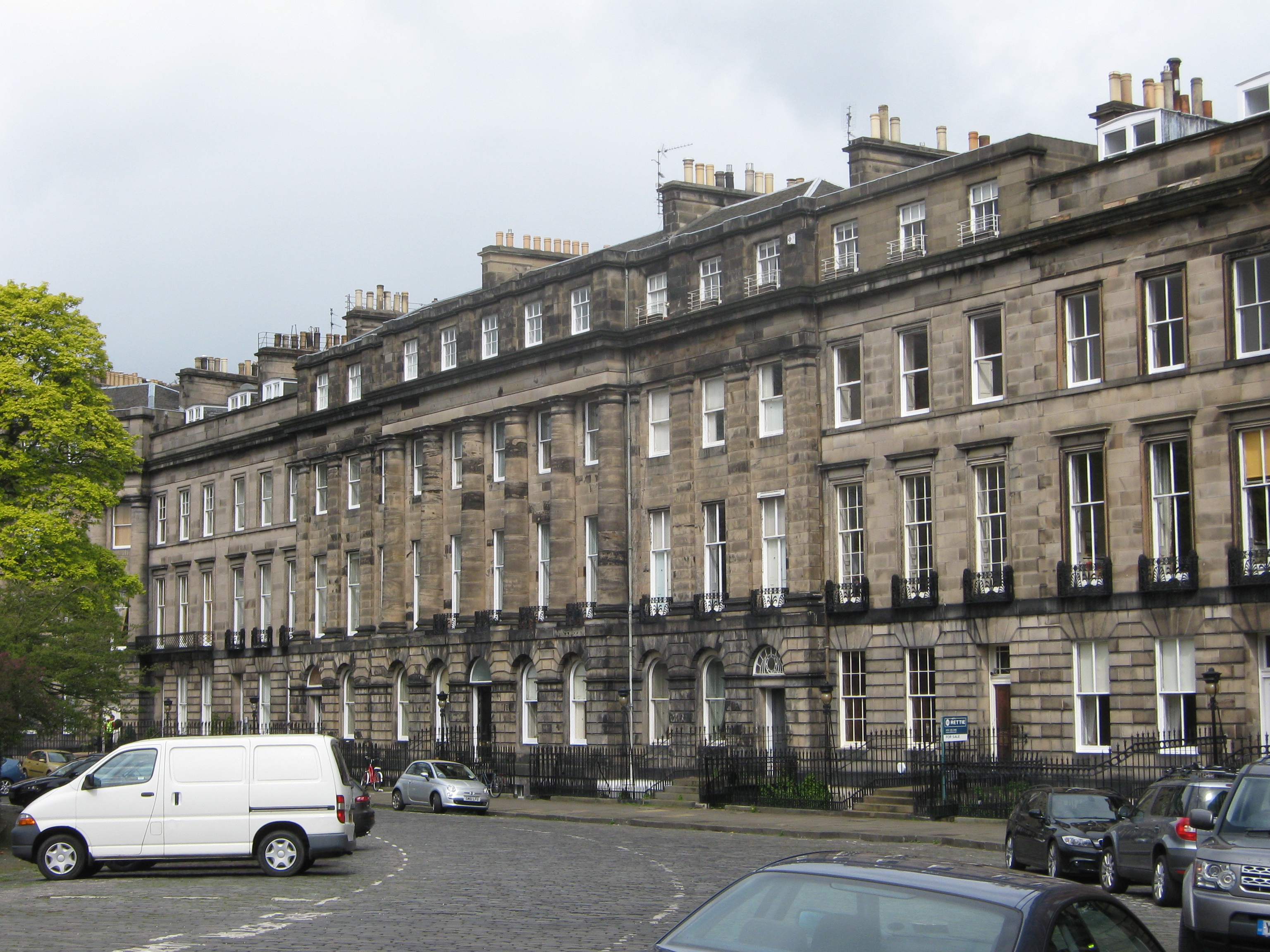
However, fans of the series who want to visit the location where the scenes depicting the streets of Belgravia were filmed will be disappointed if they head to London.  These scenes were in fact filmed in Edinburgh, in the New Town part of the city, in particular Moray Place.  The grand old houses of New Town make a good substitute for their London counterpart except that they are built from the kind of dull grey sandstone associated with this period in the Scottish capital.  The production team behind Belgravia overcame this discrepancy by the use of computer-generated imagery (CGI) to change the sandstone to the white exteriors seen in the real-life Belgravia.

File:Moray Place, Edinburgh 002.jpg
Moray Place, Edinburgh 002. Photo by Brian McNeil, via Wikimedia Commons.


Some of the interior shots featuring the homes of the Trenchards and the Brockenhursts were also filmed north of the border, making use of Manderston House near Duns in the Borders area of Scotland.  This elegant Edwardian country house, built on the site of an earlier house dating from the late 18th century, is now used as a wedding venue, and is open to groups of visitors by appointment.

Meanwhile, heading back down south, one property which particularly stands out is the one used as Lymington Park, Lady Brockenhurst’s country estate, where she and the Earl of Brockenhurst host weekend parties.  The real-life estate is another wedding venue, Wrotham Park, Hertfordshire.  The estate, to the north of Barnet, is a Palladian Mansion built in the 18th century by Admiral John Byng, and features a long, sweeping lawn leading from an ornamental lake to a light grey facade with a grand pillared entrance.

File:Wrotham Park, Middlesex by Brayley (1820).jpg
Wrotham Park, Middlesex by Brayley (1820).  Via Wikimedia Commons.

These are just some of the locations for fans of the series to seek out, demonstrating that there is much more to Belgravia than Belgravia.

Wednesday, 19 June 2019

BEAUTY IN A TIME OF COLD WAR: SUMMER OF ROCKETS/BENINGTON LORDSHIP


As was the case with its predecessor, Close To The Enemy, the latest Stephen Poliakoff TV drama, Summer Of Rockets, has come up trumps once again with its visual beauty and period touches.  Set in the Cold War period, in 1958, at a time when fears of a nuclear conflict were growing among the populace – hence the title – the focal point of the story is Russian émigré Samuel Petrukhin (Toby Stephens) who invents a clever tracking device and who is reluctantly sucked into the world of espionage, necessitating repeated visits to the beautiful home of a politician and his wife, Richard and Kathleen Shaw (Linus Roache and Keeley Hawes).  Another facet of the story is the desperate search by Kathleen for her son who has disappeared.


The Shaws hold many posh get-togethers at their home, and this is where much of the action takes place in the series.  The real-life property where these scenes were filmed is the curiously named Benington Lordship, a few kilometres east of Stevenage in Hertfordshire, a private family home which opens up its gardens to the public at certain times of the year, for instance in February for the snowdrops.  The gardens were created above an ancient fortified site dating from Saxon times.  The gatehouse seen in many of the scenes is a neo-norman folly completed in 1838.  The house itself was a manor house, originally started around 1700.  The west wing was added in 1905 by the present owners’ ancestors.

File:Benington Lordship 001 (8249305273).jpg
Benington Lordship 001 (8249305273).  Photo by Ozzy Delaney, via Wikimedia Commons.

The property has been used in a number of other productions, such as the BBC Just William production and series 1 and 2 of the Channel 4 drama Humans.  

Another location frequently seen in Summer Of Rockets is the airfield where the tracking device is put to the test.  This was filmed at the former RAF base Upper Heyford in Oxfordshire, an appropriate choice, having been used as a base for US forces based in Britain during the Cold War.

File:Benington Lordship-5279415003.jpg
Benington Lordship-5279415003. Photo by Rictor Norton and David Allen, via Wikimedia Commons.

Map of Benington Lordship and surrounding area.

Tuesday, 9 October 2018

AN AMERICAN BILLIONAIRE IN ESSEX: TRUST/AUDLEY END


The American-born oil tycoon and billionaire J. Paul Getty was born in Minnesota, but in later life transferred to England, setting up home in the sumptuous 16th century Tudor manor house Sutton Place near Guildford, Surrey, where he lived for the last 17 years of his life.  Getty was notorious for his sex drive, going through several wives, and even in his eighties there was a collection of what the New York Times described as “desperately hopeful women” hanging around his living quarters.  However, despite his enormous wealth and vast collection of art and antiques, he was less generous with his money than with his physical offerings, and the only female companion to receive more than a derisory amount in his will after his death was Penelope Kitson, an interior designer he developed a relationship with after hiring her for her decorating prowess. 

When Getty’s grandson John Paul Getty III was kidnapped in 1973 the mean side of his grandfather again came to light.  Believing that the kidnap was a ploy to extract money from him, he refused to pay a penny, not unreasonably since payment of a ransom in this case could have led to further kidnappings of members of the family. It was only the loss of an ear that finally moved grandfather Getty into action.  This is the backdrop of the stylish TV series Trust, with Donald Sutherland magnificently cast as J. Paul Getty and the elegantly turned out Anna Chancellor as Penelope Kitson.  Added to which, the role of Sutton Place is admirably played by the Essex property Audley End House near Saffron Walden, Essex.

File:AudleyEndHouse.JPG
AudleyEndHouse. Photo by Paul Wells, via Wikimedia Commons

The current owner of Sutton Place is a Russian oligarch, which meant the property could not be used for the filming, so the production team came up with Audley End as an alternative, and what a great choice it was.  In fact the production team are on record as believing that Audley End gave more gravitas to the filming than Sutton Place would have done.  Moreover, the extensive art collection contained in the property reflects the massive collection held by Getty at Sutton Place.

The property is a 17th-century Jacobean estate located a short distance to the west of the attractive market town Saffron Walden.  The estate is run by English Heritage and consists of the house itself, a third of its original size, and the gardens which were designed by Capability Brown.  Highlights of the house are the Great Hall, the state apartments, dressing rooms and libraries, as well as an 18th-century Gothic-style chapel.  One of the pivotal scenes in the series, in which Getty announces to the press that he will not pay the ransom, was shot in a long hall within the property.

However, not all the scenes were filmed at Audley End.  Some of the scenes, for example the scenes showing Getty dining with his bevy of ladies, were filmed at Hatfield House in Hertfordshire, a property which has been used many times for filming, for example in My Week With Marilyn (see my previous blog post).  The reason for the change in location was that the dining room at Audley End was considered too small to make the necessary impact.

File:Dining room at Hatfield House-19478173458.jpg
Dining room at Hatfield House-19478173458. Photo by Matt Brown, via Wikimedia Commons


Wednesday, 14 February 2018

VALENTINE SPECIAL: LOVE ON PAGE AND SCREEN


With Valentine’s Day upon us, I have come over all soppy and decided to share some British locations associated with some of the many romantic moments featured in our nation’s works of film, TV and literature.  So get out the heart-shaped chocolates and enjoy.


Gunwalloe, Cornwall: Dwight marries Caroline in Poldark


I have already described some of the Poldark locations in an earlier post, including the location of Nampara, where Ross and Demelza build their life together.  I do not tear up easily, but one scene in series 3 even got me going, when Caroline Penvenen and Dr. Dwight Ennis, after a seemingly doomed relationship, finally tied the knot.  The church where the wedding was filmed was the charming and very Cornish Church of St Winwaloe, nestled among the dunes in Gunwalloe near the Lizard Peninsula.  Being of a ‘three hall’ design, the present day church is thought to date from the 15th century, although the original chancel and nave were probably 13th century, and there is a Norman font.  

St Winwaloe Church and Church Cove - geograph.org.uk - 981092. Photo by Rod Allday, via Wikimedia Commons.


Valency Valley, Cornwall: Thomas Hardy meets his first wife


Staying in Cornwall, but this time near the north coast, the Valency Valley is a lush hideaway just inland from the picturesque harbour village of Boscastle.  Set in an isolated position on the northern slopes of the valley is the Church of St Juliot.  In 1870 Thomas Hardy, who at the time was an aspiring architect, arrived at the church to perform work on its restoration following the death of the person originally hired to do the job.  While there he met and fell in love with his first wife Emma, the rector’s sister-in-law and their courtship inspired one of his works, the novel ‘A Pair of Blue Eyes’. 


Mapperton House, Dorset: Bathsheba and her triangle of suitors


Continuing the Hardy theme, Bathsheba Everdene in Hardy’s Far From The Madding Crowd must surely be one of English literature’s most fascinating and complex characters, a woman ahead of her time for her fierce independence.  When she inherits a farmhouse and takes up residence there she find herself pursued by a trio of suitors: Gabriel Oak, a shepherd from her past who asks her to marry him but is rejected – although he gets his girl in the end; Sergeant Francis Troy, who succeeds in wooing her but turns out to be really bad news; and the lonely farmer William Boldwood, who Bathsheba foolishly leads on with a Valentine saying “Marry me” but who eventually succeeds in gaining her hand in marriage only for it to end in tragedy through a fatal spat with Troy.  The 2015 film version of the story, starring Carey Mulligan as Bathsheba, captures all this wooing and wedding perfectly.  Bathsheba’s farmhouse in the film is portrayed by Mapperton House near Beaminster in the Hardy county of Dorset, a Jacobean manor house and home to the Earl and Countess of Sandwich.  The house is open to visitors on guided tours only.


Mapperton House - geograph.org.uk - 517671. Photo by Chris Downer, via Wikimedia Commons.

Apple Tree Yard, London


The scene of the al fresco knee trembler involving Yvonne Carmichael and her mysterious lover in the book and TV series of the same name actually exists as Apple Tree Yard in real life.  It is an insignificant alleyway behind Jermyn Street in Mayfair.  However, the makers of the TV production were unable to use the yard for the series because of building work going on there for a major redevelopment, so a similar alleyway in the City had to be used instead. 


Romantic locations galore in Four Weddings and a Funeral


The 1994 romantic comedy Four Weddings and a Funeral, starring Hugh Grant and Andi McDowell, takes us on a tour of romantic locations in south-east England for the wedding scenes.  Wedding No. 1 takes place in St Michael’s Church, Betchworth near Reigate, with the reception filmed at a property named Goldingtons in Sarratt, Hertfordshire, which went up for sale in 2015 for a cool £4.5m.  No. 2 is conducted at the Old Royal Naval College in Greenwich, with Luton Hoo Estate near Luton being used for the reception.  The third wedding service was supposed to take place in Perthshire in the film, but was actually filmed at Albury Park, Guildford, Surrey, with the reception at Rotherfield Park near Alton, Hampshire.  The final wedding is scheduled to take place at St Bartholomew-the-Great in Clerkenwell, but turns into a non-wedding when Charles has second thoughts.


A wealth of stately homes: Pride and Prejudice


The 1995 version of Pride and Prejudice has Mr Darcy sneering at everyone in a lavish ballroom, meant to be the Netherfield Ballroom.  His dance with Lizzie on this occasion  marks the beginning of their romance.  Netherfield Park, where the scene takes place, is the home of Mr Bingley, a wealthy gentleman from the city, and the exterior of the property is represented by Edgecote House in Northamptonshire, while the ballroom scene was shot in the ballroom of Brocket Hall in Hertfordshire.  Later on in the series Darcy has an awkward encounter with Lizzie dressed in wet underclothes following a swim in a lake on a hot day.  This scene, which was voted one of the best on British TV, was shot at Lyme Park in Cheshire.


Teversal Manor, Nottinghamshire: Lady Chatterley's Lover


The racy novel by D H Lawrence, Lady Chatterley’s Lover, is centred on the tragic couple Lady Constance Chatterley and her paralysed husband Clifford.  At night Constance creeps from their  home, Wragby Hall, to spend time with her lover Oliver Mellors the gamekeeper.  The house believed to have provided the inspiration for Wragby Hall was Teversal Manor, near Mansfield, Nottinghamshire, which was put up for sale in 2013 for £1m.


Stokesay Court, Shropshire: Atonement


The novel Atonement by Ian McEwen explores the ill-fated romance between Cecilia Tallis and Robbie Turner, the son of the family’s cleaning lady.  In 2007 the novel was made into a film, and the Tallis family home which was the scene of the beginning of the couple’s romance was represented by Stokesay Court in Onibury, Shropshire, built by Victorian merchant John Derby Allcroft.  Not to be confused with the much older Stokesay Castle, an English Heritage site to the north, just south of Craven Arms.


Blackpool: a very Coronation Street romance


The fictional Coronation Street couple Roy and Hayley Cropper were once described as the greatest soap couple of all time.  They were also possibly the most unusual, given that Hayley started out as a bloke and was the first transgender character in a British soap opera.  Unfortunately, the romance between the two comes to a sad end when Hayley is diagnosed with terminal cancer.  Following the diagnosis the couple head to Blackpool to try and grab some last happiness together, for example dancing in the Tower Ballroom. Following Hayley’s death, Roy scatters her ashes in the sea at Blackpool.


Carnforth Station: Brief Encounter.


One of the most memorable images from 1940s British cinema is that of Trevor Howard and Celia Johnson gazing meaningfully into each other's eyes in a station cafe in Brief Encounter.   Those who want to relive that romantic moment should head for Carnforth, because it was the cafe at Carnforth Station, now known as the Brief Encounter Refreshment Room, which was used in the film with the station acting as Milford Junction.  It is a fitting name, because at that time Carnforth was a major junction in the railway system of the north-west, and during the war thousands of servicemen passed through on the way to their overseas destinations.  However, Carnforth was a victim of the Beeching rail cuts in the 1960s, and the station was turned into a mere branch line station with a lot of the buildings from its heyday falling derelict.  Recent restoration work has resulted in the opening of the Carnforth Station Heritage Centre, incorporating that famous cafe.

File:Carnforth Station waiting room.jpg
Carnforth Station waiting room. Photo by Deben Dave, via Wikimedia Commons.


High Sunderland Hall, Yorkshire: Wuthering Heights


Wuthering Heights, the property at the heart of Emily Bronte’s novel of the same name, is the scene of a classic story of love and revenge, charting the doomed love affair between Catherine Earnshaw, the daughter of the property’s owner, and the dark and brooding Heathcliff, an orphan boy brought by Earnshaw to live with the family following a trip to Liverpool.  The inspiration for the exterior of Wuthering Heights is thought to be High Sunderland Hall near Halifax, while the location of the property is assumed to be Top Withens, the site of a ruined farmhouse near the Bronte family’s home village, Haworth.


Tretower Court, Powys: The Libertine


The Libertine, starring Johnny Depp, is a historical romp centred on a drunken, sex-mad poet called John Wilmot, or the Earl of Rochester, a friend of King Charles II.  Wilmot falls in love with an actress he has decided to make into a star.  Much of the film was made in the Isle of Man for tax purposes, but several key scenes were filmed at the 14th century Tretower Court, a medieval courtyard house and adjoining castle near Crickhowell, Powys.   Apparently Depp joined some of the locals for a drink at the Bear Hotel, where some of the crew members were staying.


Cumbernauld: Gregory's Girl.


Gregory’s Girl, released in 1981, is a romantic comedy with a Scottish accent which launched the film acting career of John Gordon Sinclair, who was just 19 at the time of filming.  Much of the action takes place in and around the New Town of Cumbernauld in North Lanarkshire.  The site was designated for a New Town in 1955, and the town has since grown to be the ninth most populated locality in Scotland.  Among the industries which have grown up around this population are the studios for the TV series Outlander, which makes much use of the surrounding area.

Thursday, 27 October 2016

HALLOWEEN SPECIAL: THE VILLAGE OF THE DAMNED/LETCHMORE HEATH


There are few things creepier than a bunch of children with luminous staring eyes and impassive faces roaming around the place, especially when the place in question is an idyllic English village surrounded by a pastoral landscape with flocks of sheep.  The village which witnessed these disturbing scenes was Midwich, the focal point of the classic British horror movie The Village of the Damned. 

But how did Midwich reach this point?  The opening scenes of the film depict a man falling asleep mid-phone conversation, accompanied by his snoozing dog.  All over the village people are being plunged into a mysterious slumber, and when they wake up the women face a double whammy: all women of child-bearing age have become pregnant, and they all give birth at the same time to the aforementioned spooky children.  The children grow up very fast and to add to their unnatural demeanour they all have platinum blonde hair, and they are capable of communicating with each other telepathically.  The ensuing mayhem includes a plane crash caused by the pilot of a military reconnaissance plane sent to investigate the events falling asleep at the controls as he enters the sphere of influence of the village.

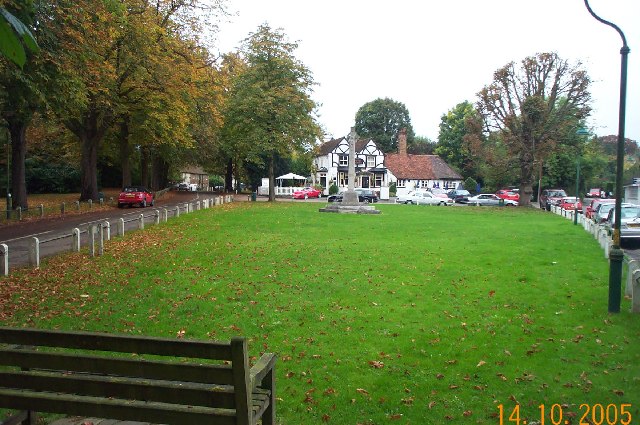
The real-life version of Midwich is the village of Letchmore  Heath near Watford, named after the original Old Saxon “leche mere” meaning muddy pond.  The present-day pond is just to the south of the fetching village green, and adjacent to the green is the Three Horseshoes pub, which was used in the filming.  Another building seen in the film was the Post Office and General Stores, occupying a charming village house also facing the green.  The building has hardly changed in appearance, although it no longer serves its original purpose.  Letchmore Heath is no stranger to filming, being close to both the MGM British Studios, which produced this horror masterpiece, and also the Elstree Studios.  In fact, so many TV series from the 60s and 70s were filmed around here that the area has been dubbed Avengerland, after the famous Avengers TV series.

File:Letchmore Heath - geograph.org.uk - 65207.jpg
Letchmore Heath - geograph.org.uk - 65207. Photo by Nigel Cox, via Wikimedia Commons.

Sadly, George Sanders, who played Professor Gordon Zellaby in the film, is no longer with us, having died in 1972.  However, his screen wife Anthea Zellaby (Barbara Shelley) and their son David (Martin Stephens) are still alive, and in 2013 they were reunited with other cast members, along with fans of the film, for a visit to the former film set and a lunch at the Three Horseshoes.