Showing posts with label Cheshire. Show all posts

Monday, 30 October 2023

HALLOWEEN SPECIAL: THE HOUND OF THE BASKERVILLES

 A story about a curse on a family involving a giant man-killing hound seems a perfect subject for a Halloween special.  The story is by Arthur Conan Doyle featuring the detective Sherlock Holmes.  The family in question are the Baskervilles, and the curse dates from the days of the English Civil War, when Sir Hugo Baskerville kidnapped a farmer’s daughter.  Sir Hugo is killed by a spectral hound, a fate which befalls a number of subsequent Baskervilles. 

The story has been turned into film a number of times over the years, firstly in 1939, which was mostly studio-based, then in 1959, in a film starring horror stalwarts Christopher Lee and Peter Cushing, with filming taking place in Surrey, at Frensham Ponds and Chobham Common.  More recently, a TV movie in 1988 starring Jeremy Brett as Holmes, was filmed in a number of locations in the Midlands and North (although the original story was based in Dartmoor).

In the 1988 film, The Heath House in Tean, Staffordshire doubled as Baskerville Hall, while Mobberley Old Hall near Knutsford, Cheshire, provided some of the interior shots.  Croxteth Hall on Merseyside leant one of its rooms to be used as a hotel room.  The hotel in the film was called The Northumberland Hotel.  The railway scenes were filmed at Pickering railway station, one of the terminii of the North Yorkshire Moors Railway.  Just outside Harrogate lie Brimham Rocks.  This is the area used as the moors around Baskerville Hall, where Watson shoots the hound. 

The Heath House-geograph-4049368. Photo by Dennis Thorley, via Wikimedia Commons.


The Heath House is a Gothic Revival building, which in 2021 was featured in Country Life magazine, being up for sale for 6 and a quarter million pounds.  The estate was described as a ‘farm’, but the magazine commented that it was more Downton Abbey than dirty wellies.  Tean lies just off the A50, to the south-east of Cheadle.  Mobberley Old Hall dates from the 17th century, and lies in the village of Mobberley in Cheshire, a short distance from Knutsford.  Croxteth Hall is just outside Liverpool and offers a function room and parkland open to visitors.  It was formerly the ancestral home of the Molyneux family, the Earls of Sefton.  Pickering railway station is the terminus of the North Yorkshire Moors Railway, a magnificent line which wends its way down to the coast at Whitby.  Brimham Rocks, run by the National Trust, is a beauty spot to the north-west of Harrogate and south-west of Ripon featuring dramatic rock formations.

Brimham Rocks turtle and eagle. Photo by Geertivp, via Wikimedia Commons.

The Hound of the Baskervilles is currently available to view on ITVX.


Tuesday, 30 September 2014

THE REAL CRANFORD: KNUTSFORD, CHESHIRE


There are reminders of the Victorian writer known as Mrs Gaskell (first name Elizabeth) all over Knutsford, a small town in Cheshire - not only of Mrs Gaskell's own life, but also of several works by the author set in the fictional town of Cranford, which was inspired by Knutsford.  Mrs Gaskell knew the town well, having spent much of her childhood living with her aunt in the town following the death of her mother.  In Cranford, Mrs Gaskell portrays a curious society dominated by women, in which men are considered at best superfluous.  In the first chapter Mrs Gaskell sings the praises of Cranford's women, "for keeping the trim gardens full of flowers without a weed to speck them".  It is also a society in which the characters are desperately trying to 'keep up appearances'.  Mrs Gaskell is known to have been very sympathetic to the poorer echelons of society.  She was also attuned to how people reacted to change, for example the momentous changes brought about by the coming of the railway.  

File:Elizabeth Gaskells House - geograph.org.uk - 80814.jpg
Elizabeth Gaskells house - geograph.org.uk - 80814. Photo by Ian Warburton, via Wikimedia Commons

The ever-growing encroachment of the railway was one of the most salient features of Victorian society.  Looked on from this day and age, the railway's arrival can only seem like a good thing, however the ordinary Victorians were deeply suspicious of the railway, partly because it brought with it a large number of immigrant workers, and partly because it was considered dangerous.  This fear is realised in chapter 2 of Cranford when one Captain Brown, who has been brought to the town courtesy of the railway, is killed by a train while rescuing a little girl who has strayed onto the line.  Captain Brown's house was inspired by a building at No. 15 King Street occupied by a real-life captain called Captain Hill.  The house now houses a chocolate shop. 

The Angel Inn in King Street features in Cranford as the place where Lord Maulever stays while visiting Captain Brown.  Another former hostelry called The Royal George Hotel features in the chapter called 'Signor Brunoni' in which Brunoni, a magician, performs at the hotel watched by the Cranford ladies.  The Royal George also housed the Assembly Rooms where the great and the good of the town gathered for their balls and card games. Meanwhile, a half-timbered building in the same street is the setting for Cranford's Johnson's store, where Miss Matty discovers that she has fallen victim to a bank failure.  The building is now a furniture store and Chinese restaurant.  

File:King Street, Knutsford (5).JPG
King Street, Knutsford (5). Photo by ReptOn1x, via Wikimedia Commons

As for Mrs Gaskell herself, the house where she lived with her aunt Hannah Lumb was called Heathwaite, and was on Heathside (now Gaskell Avenue).  Elizabeth's bedroom looked out over the local grandstand where the horse races were held.  Hollingford House in Toft Road, now a furniture shop, was the home of Mrs Gaskell's uncle and cousins - the latter are thought to be the inspiration for the Misses Jenkyns in Cranford.  Mrs Gaskell died in Hampshire in 1865, but she was buried at Brook Street Chapel along with her ancestors and immediate family.  The chapel, built in 1690, has been designated by English Heritage as a Grade I listed building.  Another ecclesiastical reminder of the writer is St John's Parish Church, where Elizabeth married Rev William Gaskell on 30th August 1832.  There is a striking Mediterranean style tower in King Street known as the Gaskell Memorial Tower, complete with a stone bust and a bronze relief depicting Mrs Gaskell.  The tower was built in 1907 by Richard Harding Watt.

File:Gaskell Memorial Tower, Knutsford, Cheshire - geograph.org.uk - 43169.jpg
Gaskell Memorial Tower, Knutsford, Cheshire - geograph.org.uk - 43169. Photo by Marion Dutcher, via Wikimedia Commons

In 2007 a TV adaptation of Cranford was shown on the BBC, with a large cast including Judi Dench, Francesca Annis, Barbara Flynn and Michael Gambon.  However, because Knutsford had changed so much since the time of Mrs Gaskell, a large part of the filming took place in Lacock, Wiltshire, a well-preserved National Trust village.

Knutsford is just to the east of the M6, about 14 miles southwest of Manchester (the inspiration for Dumble in Gaskell's novels).  The town's Heritage Centre runs walking tours including tours devoted to Cranford.  To the north of the town is the famous historic estate Tatton Park, known for its Tudor Old Hall,  Neo-Classical Mansion and 50 acres of landscaped gardens.  The Royal Horticultural Society holds its annual Flower Show at Tatton Park.  Tatton Park's great house featured in Gaskell's novel Wives and Daughters as Cumnor Towers.

Map of the area.


Monday, 26 August 2013

OH MR DARCY! LYME PARK, CHESHIRE


I have always found Sunday evening to be one of the most depressing parts of the week, what with the start of the new working week being just around the corner.  TV therefore has an important role to play by providing viewers with something to cheer themselves up.  Many women like nothing more than to settle down to a good costume drama, and on the evening of Sunday 24 September 1995 female viewers were in for a treat when the BBC's adaptation of Jane Austen's Pride And Prejudice burst onto our screens.  As well as being a jolly enjoyable drama, there was the added bonus of the dashing Colin Firth as Mr Darcy, his brooding good looks providing a much-needed Sunday evening tonic for the nation's women.  However, nothing could prepare them for the delights in store in episode four and the famous "lake scene".

Let us just relive the scene for a moment.  It is a swelteringly hot summer's day.  Mr Darcy strides towards the lakeside, removing his jacket, and sits down, contemplating a lovely cooling swim.  Off comes the scarf and off comes the waistcoat.  All over the country, female hands are fumbling distractedly in chocolate boxes, knocking over cups of tea, their owners unable to take their eyes off the screen.  However, that is all the stripping they are going to get.  Mr Darcy dives in, and we catch a glimpse of him moving through the murky water.  After his swim he is seen in his wet shirt, made slightly see-through by the sun.  Mr Darcy, still in a state of semi-undress and dripping wet, runs into Miss Bennett, who is not expecting him to be there, and a toe-curlingly awkward conversation ensues.

Earlier this year, this scene was voted the most memorable moment in TV drama, beating some of the most dramatic scenes from our beloved soap operas, such as the scene where Dirty Den hands the divorce papers to Angie in EastEnders, the tram crash in Coronation Street and the lesbian kiss in Brookside, among others.  The scene also made it into popular fiction when Bridget Jones and her friends settled down to watch the DVD with the obligatory bottle of wine (in fact the whole premise of the Bridget Jones story is as a modern-day equivalent of Austen's tale).  Apparently, Firth nearly turned the part of Mr Darcy down when originally offered it, believing himself to be a bit old for a romantic lead.  As for the actual dive, a body double was used due to concerns over the risks of Weil's disease from the lake waters.  However, Firth was used for the underwater part, which was filmed in a tank at Ealing Studios.

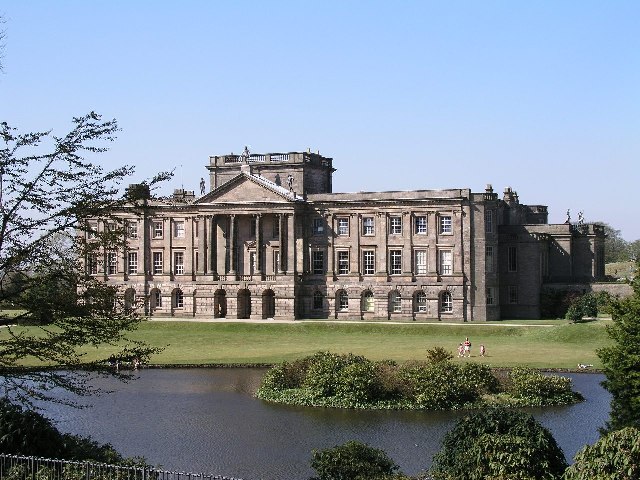
Apart from the undoubted charms of Colin Firth as Mr Darcy and Jennifer Ehle as Miss Bennett, the other star of the scene in question is Lyme Park where it was filmed and which doubled as Darcy's estate Pemberley in the series.  This estate near Disley in Cheshire, on the north-west edge of the Peak District, dates from the 14th century when it was granted to Sir Thomas Danyers.  It then passed to the Legh family, and remained with them until it was transferred to the National Trust in 1946.  The centrepiece of the estate is a large stately pile, the largest house in Cheshire, with a mixture of architectural styles from Elizabethan to Italianate.  Highlights include the Wardrobe Department where visitors can dress up in period costume, a cinefilm made by the last generation of the Legh family to occupy the house, a 15th century prayer book and numerous glimpses into the life of a well-to-do Edwardian household.  As well as the famous lake, the grounds include a deer park, an Edwardian rose garden, Cage Hill with its eponymous tower, a former hunting lodge, and walking trails that take in scenes from Pride and Prejudice.  Visitors to the property will have the chance to relive the lake scene when a statue of the semi-clad, sodden Mr Darcy is installed at Lyme Park following a tour around the country.  The statue, which was created to celebrate the launch of the new Drama TV channel, will remain at the estate until February 2014.

File:Lyme Hall 01.jpg
Lyme Hall 01. Photo by Alan Fleming, via Wikimedia Commons

Map of the area.