Showing posts with label Wiltshire. Show all posts

Wednesday, 8 April 2026

LONG LIVE THE PUB: MOTHER'S PRIDE/SOMERSET, WILTSHIRE AND BRISTOL

In this day and age, with pubs going under at an alarming rate due to the vicious economic policies of the Labour Party, the release of the film Mother’s Pride is very timely.  The film features a struggling West Country pub (with Martin Clunes playing the landlord) which manages to turn its fortunes around by brewing its own real ale, which is entered into the Great British Beer Awards, pitting itself against a rival pub.

The village of Norton St Philip in Somerset provided the location for the main pub in the film, the George Inn, and the rival pub, the Drovers Arms.  The real life George Inn plays its namesake, while the Fleur de Lys plays the part of the Drovers Arms.  The streets of this charming village are also seen in the film, including the scene depicting the village fete, which is set up between the George and the church of St Philip and St James.


NortonStPhilipTheGeorge. Photo by Rodhullandemu, via Wikimedia Commons.

Westbury and environs are also seen in the film.  The station scene was filmed at Westbury station, while the famous white horse etched into an escarpment to the east of the town is also featured.  The local press reported that a couple visiting the site ran into Martin Clunes while he was filming there, and described him as very nice.


Paragliding above Westbury White Horse - geograph.org.uk - 539764. Photo by Chris Downer, via Wikimedia Commons.

Back in the 80s, there was a large venue at Bristol Harbourside where beer and wine festivals were held, which always made for a fun day out.  In Mother’s Pride there is a nod to those times, as the Great British Beer Festival is filmed in the same area, specifically at the Aquarium.  


Bristol Harbourside.


Norton St Philip lies midway between Bath and Frome.  It was an important centre for the wool trade during the Middle Ages, and its church dates from the 14th century.  The Westbury White Horse, clearly visible from the trains moving through the area, is the oldest of eight white horses in Wiltshire, dating from around the late 17th or early 18th century. The Bristol Harbourside venue that used to host beer and wine fairs is no longer there, but it has been replaced by a large array of bars and restaurants, while the aquarium that featured in the film lies just behind the waterfront in another space given over to eating, drinking and entertainment. 


Wednesday, 17 January 2024

THE EXQUISITE WORLD OF ELIZABETH BENNET: PRIDE AND PREJUDICE 2005

Back in 2013, I did a piece about Lyme Park in Cheshire, which was where the famous ‘lake scene’ was filmed for the 1995 TV production of Pride and Prejudice, with Colin Firth as Mr Darcy emerging from the lake with diaphanous wet-through clothing.  This Christmas TV viewers have had the opportunity to see the 2005 film of this classic tale by Jane Austen, starring Keira Knightley as Elizabeth Bennet and Matthew Macfadyen as Mr Darcy.

The action kicks off with Elizabeth strolling towards the Bennet family home, Longbourn.  This scene was filmed at Groombridge Place, a moated manor house near Tunbridge Wells, Kent.  Inside the home, the family are discussing the new occupant of nearby Netherfield Park, Mr Bingley.  Later on the Bennets pay a visit to Netherfield, and as they depart we catch sight of its imposing exterior.  The real-life property standing in for Netherfield is Basildon Park, Berkshire. 

Basildon Park (4739480359). Photo by Jim Bowen, via Wikimedia Commons.

There are a number of scenes involving the local village of Meryton, including the one in which soldiers arriving in the area go marching down the street, to the delight of the  young women of the village.  These scenes were filmed in the picturesque market town of Stamford, Lincolnshire.  During the filming horses used as part of the marching scene were seen outside the Arts Centre, while the churchyard in the square was filled with sheep. .Near Stamford is another imposing property, Burghley House, which is used in the film for Rosings Park, home of the de Bourgh family.  Anne de Bourgh is expected to marry Darcy.

The clergyman Mr. Collins, a distant cousin of Mr. Bennett who has designs on Elizabeth, lives in a vicarage which in real life is in the village of Weekley in Northamptonshire.  Haddon Hall near Bakewell in Derbyshire also puts in an appearance, with the banqueting hall acting as the interior of the Inn at Lambton. 

Naturally, the most imposing property of all in the story is Pemberley, the home of Mr Darcy.  The Chatsworth estate in Derbyshire is used for Pemberley in the 2005 film.  This is not the first time Chatsworth has played the role of Pemberley.  The TV drama Death Comes To Pemberley  also made use of Chatsworth.  Meanwhile, Pemberley’s drawing room was filmed at Wilton House near Salisbury.

Chatsworth House, Derbyshire - geograph.org.uk - 2481560. Photo by Christine Matthews, via Wikimedia Commons.

Finally, there are a couple of outside scenes of note.  The scene which has Elizabeth standing on a precipice was filmed at Stanage Edge in Derbyshire.  Meanwhile, way down to the south, the stunning gardens of Stourhead in Wiltshire feature in the scene in which, in pouring rain, Mr Darcy first proposes to Elizabeth and is sharply rebuffed.  This scene takes place at a folly in the grounds known as the Temple of Apollo.

Stourhead Gardens - geograph.org.uk - 32663. Photo by Nigel Freeman, via Wikimedia Commons.

Groombridge Place is currently closed for renovation so cannot be visited by the public.  Basildon Park, an 18th century estate near the River Thames between Reading and Goring, is run by the National Trust and is open to visitors year round.  Burghley House is currently closed for the winter, but is due to reopen in March 2024.  Haddon Hall is open daily during the main season, and on selected dates in November and December.  Chatsworth House and its park are open year round, and is especially appealilng in the run up to Christmas.  

Stanage Edge lies in the Peak District, a couple of miles north of Hathersage, and is a gritstone escarpment popular with climbers.  The Temple of Apollo in Stourhead Gardens is a fine example of classical buildings known as 'follies' which were erected in the estates of the landed gentry of times gone by.  The gardens are run by the National Trust and are open year round.


Saturday, 2 April 2022

A FICTIONAL TOUR OF SOUTHERN ENGLAND: JUDE THE OBSCURE, THOMAS HARDY

 One notable feature of the novels of Thomas Hardy is his use of real locations masked by fictional names.  Probably the most famous of these is Casterbridge, aka Dorchester in real life.  In Jude The Obscure, the action takes place in a number of different locations, each with its real-life equivalent.


The story kicks off in the village of Marygreen, where Jude Fawley, who has been sent to live with his great-aunt Drusilla following the death of his father, is upset that the local schoolmaster, Phillotson, is taking off for pastures new, namely the university city of Christminster (see below).  As it happens, the real-life version of Marygreen is also called Fawley, a village in Berkshire.  The church of St Mary the Virgin, completed in 1866, is the real-life version of Marygreen Church in the novel.


Jude Fawley’s dearest wish is to go and study at Christminster, which becomes something of an obsession to the point where he considers it the “New Jerusalem”.  However, it is not to be, and he ends up as a stonemason instead.  It is not at all hard to guess which is the real-life equivalent of Christminster, especially when we discover that it is to the north-east of Marygreen.  A glance at the map reveals that this venerable seat of learning has to be Oxford, one of the most famous university cities in the world along with its cousin to the east, Cambridge.


Oxford from Westgate Mall. Photo by Dicklyon, via Wikimedia Commons.

In another chapter of Jude’s life he finds himself in Melchester, where his on-off love affair with his cousin Sue develops.  He goes there to study for the clergy, having been lured by Sue, who is at a Training College in the city.  Jude finds work in the cathedral there while reading theological works in preparation for his career.  The real-life cathedral city of Salisbury in Wiltshire was the inspiration for Hardy’s Melchester.  Salisbury lies to the north of the New Forest and south of Salisbury Plain, with its elegant cathedral spire visible from miles around.  The city made the news in 2018 for the worst of reasons, being the location where the poison novichok was used to target former Russian military intelligence officer Sergei Skripal, with an unfortunate local woman ending up dead as a result.


Salisbury, Salisbury Cathedral ^ Scenery - geograph.org.uk - 3106160. Photo by Lewis Clarke, via Wikimedia Commons.
 

By the time the action has moved to Shaston, Sue is married to Phillotson, who has moved there to run a school.  Jude catches up with Sue there and they flee together.  In real life, Shaston is the town of Shaftesbury, Dorset, famous for its picturesque cobbled street, Gold Hill, which featured in a 1970s TV advert for Hovis bread. 


Gold Hill Shaftesbury - geograph.org.uk - 2206454. Photo by peter robinson, via Wikimedia Commons.

Jude and Sue go to live together at Aldbrickham, which is where Jude’s flighty ex-wife Arabella used to work as a barmaid before she met him.  Arabella makes a reappearance in Jude’s life during this time at Aldbrickham, resulting in an unexpected addition to Jude’s family.  Aldbrickham’s real-life equivalent is the large Berkshire market town of Reading on the River Thames.  The town has long been an important commercial centre, above all most recently for the IT industry.

Sunday, 7 March 2021

A POOR MAN'S JANE AUSTEN RICH IN LOCATIONS: BRIDGERTON


When fans of the Regency period in general, and Jane Austen in particular, got wind of the imminent arrival of the Netflix series Bridgerton they were no doubt salivating at the anticipation of the prospect of flirtations between cleavage-bursting young women and dashing young men sporting sideburns and knee-high boots.  However, as the series got underway opinions were deeply divided between those who found the series embarrassingly lightweight (with plenty of dark mutterings about ‘wokeness’) and those who thought it was a wonderfully entertaining tonic for these dark covid times.  One thing that cannot be denied, though, is the splendour of the locations used in the series.

I have previously blogged about Bath and its Jane Austen connections, and this handsome, honey-coloured city in the west of England plays a large part in Bridgerton.  The Royal Crescent puts in an appearance with number 1 serving as the Baron Featherington household, with digital enhancements on the facade.  Filming also took place at the Assembly Rooms and Trim Street is where we see the exterior of Gunter’s Tea Shop.

Royal Crescent, Bath. Photo by MontanNito, via Wikimedia Commons.

The stately piles occupied by the various families involved in the story are played by photogenic properties scattered around the country.  An art museum in Greenwich called Ranger’s House was used for the Bridgerton family home, with the addition of wisteria and ivy to the facade to make it look more homely.  The property belonging to the dashing Duke of Hastings was represented by three different properties: Wilton House near Salisbury for interior and exterior shots, with further interior work done at Syon House in Middlesex and Badminton House, Gloucestershire, which we last encountered as Darlington Hall in The Remains Of The Day.  Badminton House and Wilton House were also used for some of the interior scenes depicting the home of Lady Danbury, who acts as a kind of mother figure to the Duke.  The exterior of Lady Danbury’s house, meanwhile, was shot at the Holburne Museum of Art, taking us back to Bath.

Wilton-House-02-2004-gje. Photo by Gerd Eichmann, via Wikimedia  Commons.


Soaring up to the heights of Regency society, we encounter Queen Charlotte, whose residence in the series is an actual palace in real life, namely Hampton Court Palace.  Wilton House pops up again here, with some of its interiors used in the filming, along with those of Lancaster House in London. 

For the marital home of a certain pair of newly-weds we are whisked to the north of England, to Castle Howard, 15 miles north of York, where the exterior scenes were filmed, while Wilton House and Badminton House are once again used for interiors, along with North Mymms Park, a wedding venue south of Hatfield, Hertfordshire.  Staying in Hatfield, Hatfield House, a property which has been used in numerous previous productions, provided some of the interior shots of the Featherington residence.

Castle Howard and garden. Photo by Pwojdacz (talk), via Wikimedia Commons.


The city of Bath nestles in a dip in the Somerset countryside with the River Avon running through it.  Jane Austen once lived there, and as a reminder of this time there is an annual Jane Austen Festival.  Visitors who are feeling a bit flush and who want to immerse themselves in the Bridgerton experience can stay at the Royal Crescent Hotel, the city’s finest, although the less moneyed can make do with a visit to No. 1, which is a heritage museum.  The Holburne Museum of Art is next to Sydney Gardens on the east side of the city.  The Assembly Rooms are run by the National Trust and are a short distance to the east of the Royal Crescent.  For visitors coming from outside the UK the nearest international airport is Bristol Airport. 

For Bridgerton fans visiting the London area, Ranger’s House, which lies on the boundary between Greenwich Park and Blackheath, is run by English Heritage and is home to the Wernher Collection.   Syon House to the west of London is across the Thames from Kew Gardens and is the London home of the Duke of Northumberland.  The house forms part of the wider Syon Park, which is open to visitors.  Hampton Court Palace is further upstream and is famous for having been the seat of Henry VIII.  Lancaster House is near St James’s Palace and is managed by the Foreign and Commonwealth Office. 

Further afield, North Mymms Park is just off the A1 (M) south of Hatfield and offers wedding and events services, while Hatfield House forms part of Hatfield Park, both of which are open to visitors, and is a short distance to the east of Hatfield.  Heading further west, Wilton House, just outside Salisbury, is home to the Earl and Countess of Pembroke, but is open to visitors.  Badminton House is part of Badminton Estate and has been the main seat of the Dukes of Beaufort since the 17th century.  The Estate is open to visitors for house tours and garden visits.  Finally, to Yorkshire and Castle Howard, 15 miles north-east of York just off the A64 Scarborough road, which belongs to the Howard family, going back several generations.  The house and gardens are open to visitors. 

Wednesday, 22 July 2020

UNPRECEDENTED EVENTS IN A CATHEDRAL CITY: THE SALISBURY POISONINGS


'Unprecented' is a word we have been hearing a lot recently, with the unwelcome arrival of Covid-19 in all of our lives.  For the inhabitants of the charming Wiltshire cathedral town of Salisbury it must have come all too soon after a previous unprecedented event: the targeting of a Russian national living in the city with the nerve agent novichok, a news story which broke in March 2018 and was watched with horror by people all over the country and the wider world.  I remember feeling outraged at this unwarranted attack on not just one individual (and his daughter who happened to be visiting), but an entire English city, particularly when a perfectly innocent member of the public died after unwittingly coming into contact with the deadly substance, and a policeman ended up in intensive care. 

That sense of outrage was reignited recently with the showing of a 3-part drama reliving the events of 2018 called The Salisbury Poisonings, starring Rafe Spall as the policeman.  There were eerie parallels with the Covid-19 crisis, with talk of tracing individuals who may have come into contact with the nerve agent and shutting down businesses while a massive cleanup took place, so that what at the time seemed unreal and inconceivable now seems a fact of life.

Much of the filming of the drama took place in Salisbury itself, with some of the key locations of the real-life event making a prominent appearance.  The shopping area just off the city’s main square known as The Maltings was where the Russian victims Sergei Skripal and his daughter Yulia were found on that fateful Sunday.  Adjacent to the shops are a pub called Bishops Mill, and a branch of the Zizzi pizza restaurant chain.  These were visited by the Skripals before they were discovered incapacitated on a bench.  I have visited both of these establishments several times, and could hardly believe that they played a part in such a sinister episode.

File:The Maltings, Salisbury - geograph.org.uk - 1052564.jpg
The Maltings, Salisbury - geograph.org.uk - 1052564. Photo by Jonathan Billinger, via Wikimedia Commons.

One of Salisbury’s most attractive features, apart from its magnificent cathedral, is the expanse of open green spaces with the River Avon flowing through them, with an often astonishing number of swans in attendance.  This was where a dead swan was found near the Five Rivers Leisure Centre and was investigated in case it was yet another victim of the nerve agent.  The unfortunate swan, though dead, was given the all clear as far as novichok was concerned.

File:Salisbury Cathedral exterior 2.jpg
Salisbury Cathedral exterior 2. Photo by WASD, via Wikimedia Commons.

The decontamination effort, which caused untold disruption to the city’s businesses, and which saw the centre of this genteel cathedral city colonised by men in special hazmat suits looking like something out of a sci-fi movie, was finally completed nearly a year after the original discovery of the stricken Russians.  The bench at the centre of it all was removed, and there was talk of putting an art installation in its place.  One cannot help but feel for the city’s inhabitants, who came out of the novichok scare only to be confronted with covid-19 a year later.  Let’s hope the city can bounce back again this time.


Tuesday, 9 June 2020

A SLICE OF HEAVEN IN DEVON: SENSE AND SENSIBILITY


Whenever there is an adaptation of a Jane Austen novel on the big or small screen, one thing can be certain: the locations will inevitably feature some of Britain’s finest stately properties. 

The property which kicks off the story in the 1995 film adaptation of Sense and Sensibility, directed by Ang Lee, is the fictional Norland Park in Sussex, which is left by a dying father to his son, but due to the rules of inheritance the three daughters Elinor, Marianne and Margaret and their mother (Emma Thompson, Kate Winslet, Emilie Francois and Gemma Jones) are left with next to nothing.  Worse still, they are forced to move out of their lovely family home, while the son and his wife John and Fanny (James Fleet and Harriet Walter) move in.  The mother and daughters are offered accommodation by a cousin, but it is a bit of a come-down, being just a ‘cottage’ in the depths of Devon, albeit in a heavenly rural setting near the coast.

The real-life version of Norland Park is Saltram House near Plymouth, a Grade I listed George II era mansion, while the cottage, Barton Cottage in the story, is Efford House on the Flete Estate, which actually is in Devon in real life, again near Plymouth.  The waterside scenes set near the cottage were also filmed in Devon, at the mouth of the River Erme.  However, the exterior of Barton Park, the wider estate where the cottage is located, is actually further east in Wiltshire, where the scenes were shot at Trafalgar Park, between the city of Salisbury and the northern edge of the New Forest.


File:Efford House - geograph.org.uk - 292694.jpg
Efford House - geograph.org.uk - 292694. Photo by Derek Harper, via Wikimedia Commons.


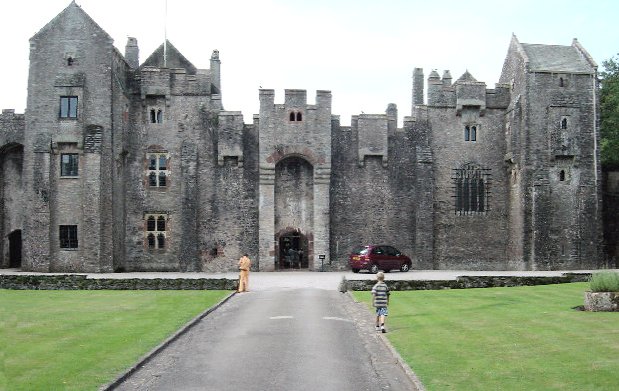
Another striking property in Devon, which is seen at a distance as a large grey mass of architectural splendour surrounded by sloping green fields, is the Combe Magna estate, owned by love interest John Willoughby (Greg Wise).  In real life this is a fortified manor house called Compton Castle near the resorts of Torbay.  The manor house dates from the 1400s and was connected to Sir Walter Raleigh.  Still in Devon, the wedding scene at the end was filmed at St Mary’s Church in the village of Berry Pomeroy near Totnes.

File:Compton Castle in Devon enh.jpg
Compton Castle in Devon enh. Photo by Smalljim, via Wikimedia Commons.

One of the most dramatic scenes in the film comes towards the end, when Marianne suffers a life-threatening illness, to the distress of Captain Colonel Brandon (Alan Rickman), who has developed a soft spot for her.  She falls ill while visiting the estate owned by a couple in the Dashwoods’ social circle called the Palmers (Imelda Staunton and Hugh Laurie).  This magnificent property is the real-life Montacute House near Yeovil in Somerset, a late Elizabethan mansion with manicured lawns and gardens.


                                                                      Montacute House. 

Mid-way through the film we are transported to London, where many well-to-do people in Jane Austen’s time had their “London base” in addition to their country properties.  The London abode of the dreadful Fanny Dashwood and her husband John is represented by a house in Adam Street, WC2, while Chandos House in Queen Anne Street is the home of the Palmers.  However, the Chelsea home of the ebullient Mrs Jennings (Elizabeth Spriggs) is not in London, but in Salisbury, in reality the 18th century Mompesson House in the Cathedral Close.

Most of the properties featured in the film are open to visitors.  Saltram, Compton Castle, Montacute House and Mompesson House are run by the National Trust.  Trafalgar Park is privately owned, but can be used for events and weddings.  Meanwhile, for anyone wanting to immerse themselves fully in the Dashwoods’ idyllic life in Devon, Efford House is available as a holiday let.


Wednesday, 9 October 2019

WHAT THE BUTLER SAW: THE REMAINS OF THE DAY, DARLINGTON HALL


It is a long time since I read The Remains of the Day by Kazuo Ishiguro, but I still remember how impressed I was by the authenticity of the dialogue of the period in which it was set, all the more so given the Japanese origins of the writer.  The focus of the story is Darlington Hall, where the butler James Stevens (Anthony Hopkins) and housekeeper Miss Kenton (Emma Thompson) develop a slow-burning relationship against the backdrop of the pre-war years (Lord Darlington is a Nazi sympathiser, a fact which Stevens turns a blind eye to).


As is so often the case in films, the scenes involving Darlington Hall were shot in a number of different properties, scattered between Gloucestershire, Devon and Wiltshire.  The scenes showing the driveway and exterior of the mansion were shot at the National Trust property Dyrham Park in Gloucestershire.  Also in Gloucestershire, nearby Badminton House was used for the scenes involving the servants’ quarters.  Some of the outside scenes were also filmed here, such as the scene where Stevens’ father (Peter Vaughan) suffers a fall and where Reginald Cardinal (Hugh Grant) is found having a sneaky cigarette.
File:At Dyrham Park 2018 020.jpg
At Dyrham Park 2018 020.  Photo by Mike Peel, via Wikimedia Commons

The county of Devon plays its part in the form of Powderham Castle on the estuary of the River Exe, which was used for the Blue Staircase, hall, master bedroom and music room.  The scene at the end featuring the trapped pigeon was also filmed there under the domed ceiling.  Corsham Court in Wiltshire, meanwhile, provided the library and dining room scenes, including the scene of the conference in the ‘Cabinet Room’.


File:Powderham Castle, east side-geograph-4066229-by-Stephen-Craven.jpg
Powderham Castle, east side-geograph-4066229-by-Stephen-Craven, via Wikimedia Commons


Dyrham Park is just off the A46 and to the south of the M4, handy for anyone staying in Bath.  The house, with treasures including a collection of Dutch Masters, dates from the 17th century and the grounds include a deer park.  The Badminton Estate is to the east of the A46 a little further north, and is famous for its annual Horse Trials.  Visits to the house and gardens are available by special arrangement for group tours.  The estate has a history stretching back centuries: it was mentioned in the Domesday Book as ‘Madmintune’, and the grounds incorporate the remains of several Roman Villas.


Powderham Castle, just off the west bank of the mouth of the River Exe, is open from March to the beginning of November.  There are a number of special events held during the year, such as a Food Festival and the Two Moors Festival of classical music.  The original structure was built in the late 14th century by the 2nd Earl of Devon, but much of the present-day building dates from the 18th century.  Corsham Court is open daily during summer but at weekends only in winter, closing in December.  It is a handsome country house built in the typical honey-coloured stone of the area, and the parkland surrounding it was designed by the prolific landscape designer Capability Brown.  The history of the estate dates back to Saxon times, when it was reputedly the seat of Ethelred the Unready.

File:Corsham Court.jpg
Corsham Court. Photo by Hugh McKechnie, via Wikimedia Commons

Map of Dyrham Park

Map of Badminton Estate

Map of Powderham Castle

Map of Corsham Court

Saturday, 21 July 2018

POLDARK REVISITED: THE GRAND HOUSES


The latest Poldark series is now upon us, and for this second piece on the locations used in the filming, rather than the gorgeous Cornish coastline, which I have already extensively covered in a previous piece, I thought I would focus on the grand houses occupied by the more well-to-do characters.  There are principally three of these, none of which are in Cornwall.

One house which has been seen since the start of the first series is the home occupied by Elizabeth and her family, Trenwith.  The property which was used for filming the interior and exterior scenes of Trenwith is Chavenage House, an Elizabethan house located near Prince Charles’ Highgrove in Tetbury, Gloucestershire.  The interior of the chapel at Chavenage was used to represent Sawle Church.  The house has a fascinating history; one of its former guests was Oliver Cromwell and his general Ireton, who stayed there in 1648.  Visitors to the house will get a guided tour included in the ticket price, during which, as well as the history of the property, they will hear about the various ghosts lurking in its darkest recesses.

File:Chavenage House 3-geograph-3507432.jpg
Chavenage House 3 - geograph - 3507432. Photo by Philip Halling, via Wikimedia Commons.


Another imposing property inhabited by members of the Poldark upper crust is the house known as Killewarren, home to the Penvenen family, formerly the now deceased uncle of Caroline, Ray Penvenen, and more recently by Caroline and her husband Dr Dwight Enys.  The house portraying Killewarren is Great Chalfield Manor, a short distance west of Melksham in Wiltshire, owned by the National Trust.  The 15th century moated manor house was built for a clothier who was a member of the local landed gentry.  Visitors to the property must join a guided tour in order to explore the manor house.  The garden, in the Arts and Crafts style, includes features such as topiary and a rose garden.  The southern aspect, with its grassy expanse leading down to the tranquil pond, will be familiar to Poldark fans.  This is where Caroline and Dwight were seen enjoying a moment together in a recent episode.

File:Great Chalfield Manor 11.jpg
Great Chalfield Manor - 11. Photo by Stuart Buchan, via Wikimedia Commons.

In the more recent series of Poldark we have unfortunately been increasingly exposed to the odious George Warleggan, whose Georgian town house is filmed at Dyrham Park, a National Trust property in South Gloucestershire, just to the south of the M4 motorway.  Convenient for Bath, this 17th century mansion with its garden and deer park will take up the best part of a day out.  The house itself is full of artistic treasures, while the grounds offer extensive walking and the Orangery offers an insight into an 18th century greenhouse.  The deer park is home to some 200 fallow deer.   The estate has been used before for filming, including for the film version of Kazuo Ishiguro’s The Remains Of The Day.

File:Dyrham Park lower park.jpg
Dyrham Park lower park. Photo by Rwendland, via Wikimedia Commons.

Friday, 22 December 2017

FOOLS' GOLD: THE ONLY FOOLS AND HORSES CHRISTMAS SPECIALS


During the ten years (1981 to 1991) that the popular comedy series Only Fools and Horses dominated our TV screens, the show’s Christmas specials were invariably a highlight of the festive period.  For this Christmas special I have picked out three of them, for which a variety of locations around the country were used in the filming.


Our first Christmas special, ‘To Hull and Back’, was first shown in 1985, and quite a few scenes were actually filmed in Hull.  In the story, Del, who is supposed to be acting as courier for a consignment of diamonds from Amsterdam, unwittingly ends up in Hull after hiding in Denzel’s van in order to evade Chief Inspector Slater.  From there, he and Rodney hire a boat and put their trust in Uncle Albert’s naval background to guide them to Amsterdam.  Two of Hull’s docks feature in the episode: St Andrew’s Dock, where Del crosses the road in front of Denzil, and Albert Dock, where the motley crew set off for Holland.  Denzil is seen catching some fresh air on the Spurn Nature Reserve, on the end of Spurn Head at the mouth of the River Humber.  The Humber Bridge also puts in an appearance, with Rodney attempting to use the toll without the correct change.  Two of the city’s streets are seen: Charles Street where the market scene was filmed, and John Street, where Del and Rodney park outside a cafe.


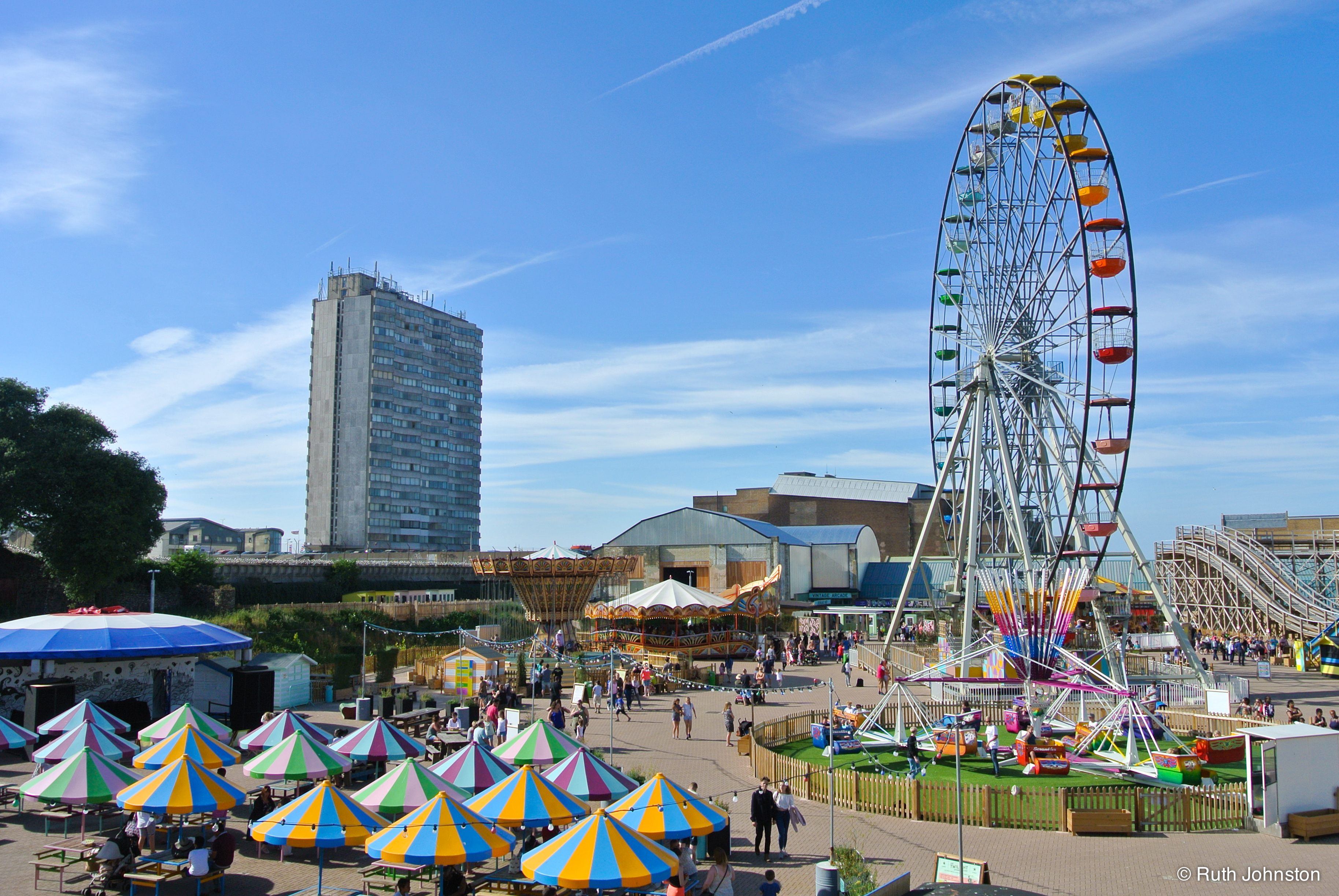
In 1989 the Christmas special saw Del, Rod and their friends from the Nag’s Head travelling down to Margate in The Jolly Boys’ Outing, not for Christmas but on an August Bank Holiday weekend.  Margate has long been a favourite with daytrippers from London, the most notorious visitors being the Mods and Rockers who used to gather there in the early 1960s, causing mayhem wherever they went.  One of the main attractions, especially with families, is the Dreamland amusement park, which was closed for a while but has since been redeveloped.  The park, which featured in the Christmas special, held an “Only Fools and Horses” exhibition last year, which was well received by the folks on Tripadvisor. 

The Harbour Arm in Margate is where Del and Rodney are seen discussing an “Eels on Wheels” business.  Cliftonville, to the east of Margate, was used for a couple of the scenes, with the hotel the lads were staying in being filmed at Dalby Square.  The Coachway at Prince’s Walk was the scene of high drama when the coach exploded.  The exterior of Cassandra’s flat was shot in Richard Court, Lower Northdown Avenue.  Further afield, on the way to Margate the daytrippers make a pitstop at a pub.  The pub in question is the Roman Galley, at the turnoff to Reculver on the A299, sadly, like so many other pubs, now closed and turned into ‘luxury apartments’.  The Wyevale Garden Centre at Ramsgate, formerly a greyhound stadium, was used for the market scene, and the police station which featured in the episode was at Broadstairs, but has since closed.

File:Midweek Birthday Margate Mini-Break-3220160816 (29052138755).jpg
Midweek Birthday Margate Mini-Break-3220160816 (29052138755). Photo by Ruth Johnston, via Wikimedia Commons

Finally, my personal favourite Christmas special was ‘A Royal Flush’, which had Rodney hooking up with a member of the aristocracy and Del muscling in on the act, with predictably embarrassing results.  The Theatre Royal in Drury Lane, London, is where Del brings his tarty girlfriend along to a performance of Carmen, where she proceeds to show everyone up by throwing up over the person in front after overindulging in sweets, and where Del announces “I know this one!” and sings along loudly to one of the production’s best known songs.  Later in the episode, the action moves to the stately home where Rodney’s new girlfriend lives, and where Del joins them for a spot of clay pigeon shooting and pretty much destroys Rodney’s chances with her father by getting obnoxiously drunk.  The scene of all this mayhem was Clarendon Park near Salisbury, Wiltshire, a grade I listed building and estate.  The house was completed in 1737 and is privately owned.  In the episode, Del visits a gentlemen’s outfitters to get kitted up for the occasion, and this was filmed in Salisbury at a premises in New Canal.

File:Theatre Royal Drury Lane 2007.jpg
Theatre Royal Drury Lane 2007. Photo by Andy Roberts, via Wikimedia Commons


Tuesday, 21 February 2017

WOEFUL IN WILTSHIRE: JOHN BETJEMAN AT MARLBOROUGH


The late John Betjeman, who was appointed Poet Laureate in 1972, and remained in the role until his death in 1984, leaves behind a wealth of evocative verse and prose, describing the places he knew and visited around Britain so vividly that he transports the reader back to an earlier time redolent with nostalgia.  One of his best known works is the autobiographical 'Summoned by Bells', which recalls his childhood, his school days and his time at University.  Chapter VII of the collection covers his time at Marlborough College, a boarding and day school in the attractive small Wiltshire town of the same name which he attended in the early 1920s.

File:Entrance to Marlborough College on the Bath Road. - geograph.org.uk - 1509846.jpg
Entrance to Marlborough College on the Bath Road - geograph.org.uk - 1509846. Photo by Steph, via Wikimedia Commons.

Betjeman was allegedly quite miserable at Marlborough College, where he spent five years (“Thank God I’ll never have to go through them again”) and he does not miss an opportunity to have a dig at it in his poetry, referring to it as “my prison house”.  Winters were a particular endurance test, described as “Black as our college suits, as cold and thin”.  Mealtimes did not bring any solace, with cakes “harder than the rocks”, tea which is “made from stewed up socks”, and a Dining Hall smelling of Irish Stew.  The teas at the College were described as a joke – “you only ate them when quite stony broke”.    

Sports formed a large part of life in the College, and Betjeman bemoaned the fact that for five years he and his fellow pupils “shivered in exiguous shorts”.  While at the College he founded a satirical magazine called ‘The Heretick’, which made fun of this obsession with sport.  Other negative memories recalled in the poem include the “casual beatings”, the stone flag passages and the iron bars.  In the early 1960s Betjeman made a documentary film about Marlborough, part of a series which became lost, but subsequently rediscovered.  The director of the piece on Marlborough recalls that it took some persuading to get him to go through the gates of the school for the filming on his first visit there for 40 years, such were his feelings about it.

It wasn’t all bad though, because he liked the town and adored the surrounding countryside.  He used to walk along the River Kennet, which he recalls in the poem with the line “The smell of trodden leaves beside the Kennet, On Sunday walks with Swinburne in my brain” (a reference to a fellow English poet).  He also cycled to Silbury, “by burnt-up hawthorn edged again with white from chalk dust whirled by Fords and Lancias” (Marlborough is in the middle of a predominantly chalk terrain) and to “sepulchral Avebury “.

File:Avebury Ring - geograph.org.uk - 443147.jpg
Avebury Ring - geograph.org.uk - 443147. Photo by Simon Barnes, via Wikimedia Commons.

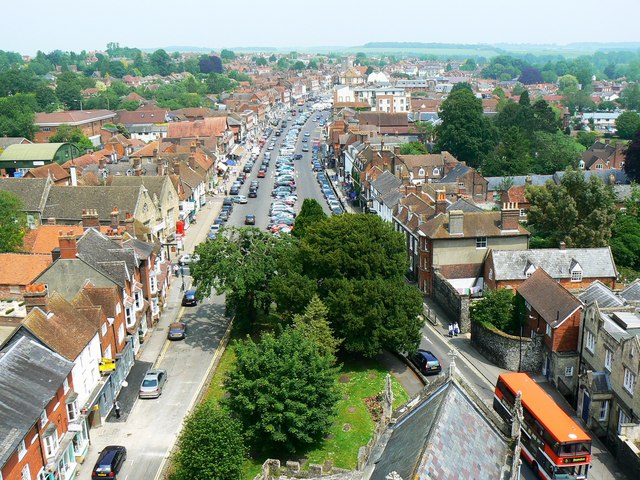
Marlborough used to be an important pit-stop on the old road from London to Bath, and the quaint old inns lining its main street are a reminder of that time.  Its most notable feature is its generous High Street, the second widest in the country, with a pleasant mix of pubs, cafes, restaurants and shops.  In fact, for a town of its size it has a surprisingly decent selection of shops, probably because the continued presence of Betjeman’s hated College lends the town an upmarket air.  The chalklands around Marlborough are full of fascinating ancient sites.  Silbury, mentioned above, is home to Silbury Hill, an artificial prehistoric chalk mound, and Avebury is famous for its Avebury Ring, a henge monument containing three stone circles.  These two Neolithic monuments, along with the West Kennet Long Barrow, are part of the Stonehenge, Avebury and Associated Sites UNESCO World Heritage Site.

File:High Street, Marlborough from St Peter's church roof - geograph.org.uk - 460662.jpg
High Street, Marlborough, from St Peter's Church roof - geograph.org.uk - 460662. Photo by Brian Robert Marshall, via Wikimedia Commons.