Showing posts with label Derbyshire. Show all posts

Sunday, 13 October 2024

THREE LOCATIONS USED IN THE 2018 FILM MARY QUEEN OF SCOTS

 There have been a number of films made over the years about the relationship between Queen Elizabeth I and her first cousin once removed Mary Stuart, better known as Mary Queen of Scots.  One of the more recent films stars Saoirse Ronan as Mary and Margot Robbie as Elizabeth.  Here are three of the locations used in the film.

The film opens with Mary’s return to Scotland from France, where she had briefly been Queen, but her reign ended with the death of her husband Francis.  The ship carrying Mary landed at Leith on the outskirts of Edinburgh in 1561.  The beach used in this scene in the film is Seacliff Beach, North Berwick, a pleasant seaside town in East Lothian, a bit further south.

After landing at Leith Mary makes her way to Holyrood House in Edinburgh.  The exterior of Holyrood in the film was shot at Blackness Castle near Linlithgow.  Situated on a promontory on the south bank of the River Forth, just upstream from the Forth Road Bridge, Blackness Castle is a 15th century castle owned by Historic Environment Scotland and is open to visitors year round.  The castle was originally built as a residence for the Crichtons, one of Scotland’s most powerful families at the time. 

Blackness Castle - geograph.org.uk - 1238628. Photo by Mike Pennington, via Wikimedia Commons.


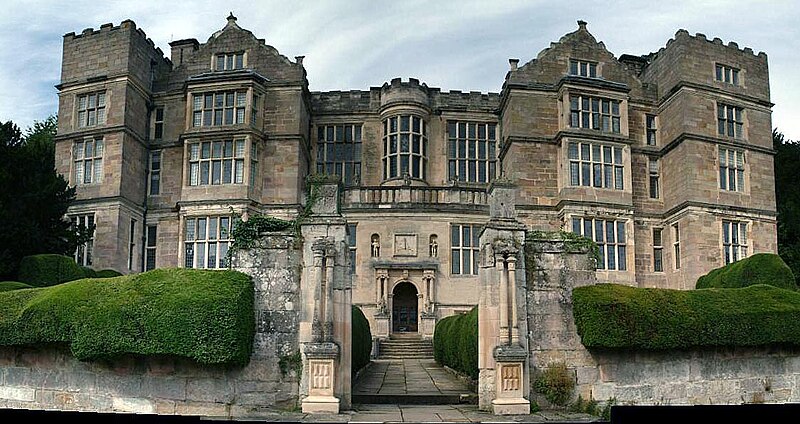
Meanwhile, Elizabeth is based at Hampton Court Palace on the outskirts of London.  The exterior of the palace in the film was represented by the magnificent Hardwick Hall near Chesterfield in Derbyshire.  We see the tall facade of the building and the formal garden fronting it.  Hardwick Hall is owned by the National Trust, and among its treasures are some fine tapestries.  The cafe downstairs offers a range of tasty meals, coffees, teas and cakes. The property is fully open until the end of October, and partially open thereafter.

Hardwick Hall - geograph.org.uk - 3339472. Photo by Chris Heaton, via Wikimedia Commons.


Wednesday, 17 January 2024

THE EXQUISITE WORLD OF ELIZABETH BENNET: PRIDE AND PREJUDICE 2005

Back in 2013, I did a piece about Lyme Park in Cheshire, which was where the famous ‘lake scene’ was filmed for the 1995 TV production of Pride and Prejudice, with Colin Firth as Mr Darcy emerging from the lake with diaphanous wet-through clothing.  This Christmas TV viewers have had the opportunity to see the 2005 film of this classic tale by Jane Austen, starring Keira Knightley as Elizabeth Bennet and Matthew Macfadyen as Mr Darcy.

The action kicks off with Elizabeth strolling towards the Bennet family home, Longbourn.  This scene was filmed at Groombridge Place, a moated manor house near Tunbridge Wells, Kent.  Inside the home, the family are discussing the new occupant of nearby Netherfield Park, Mr Bingley.  Later on the Bennets pay a visit to Netherfield, and as they depart we catch sight of its imposing exterior.  The real-life property standing in for Netherfield is Basildon Park, Berkshire. 

Basildon Park (4739480359). Photo by Jim Bowen, via Wikimedia Commons.

There are a number of scenes involving the local village of Meryton, including the one in which soldiers arriving in the area go marching down the street, to the delight of the  young women of the village.  These scenes were filmed in the picturesque market town of Stamford, Lincolnshire.  During the filming horses used as part of the marching scene were seen outside the Arts Centre, while the churchyard in the square was filled with sheep. .Near Stamford is another imposing property, Burghley House, which is used in the film for Rosings Park, home of the de Bourgh family.  Anne de Bourgh is expected to marry Darcy.

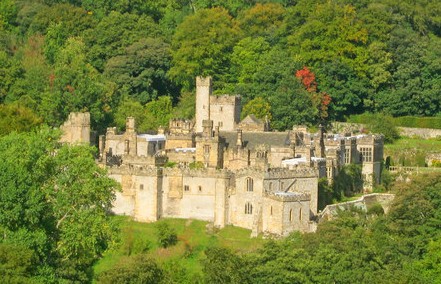
The clergyman Mr. Collins, a distant cousin of Mr. Bennett who has designs on Elizabeth, lives in a vicarage which in real life is in the village of Weekley in Northamptonshire.  Haddon Hall near Bakewell in Derbyshire also puts in an appearance, with the banqueting hall acting as the interior of the Inn at Lambton. 

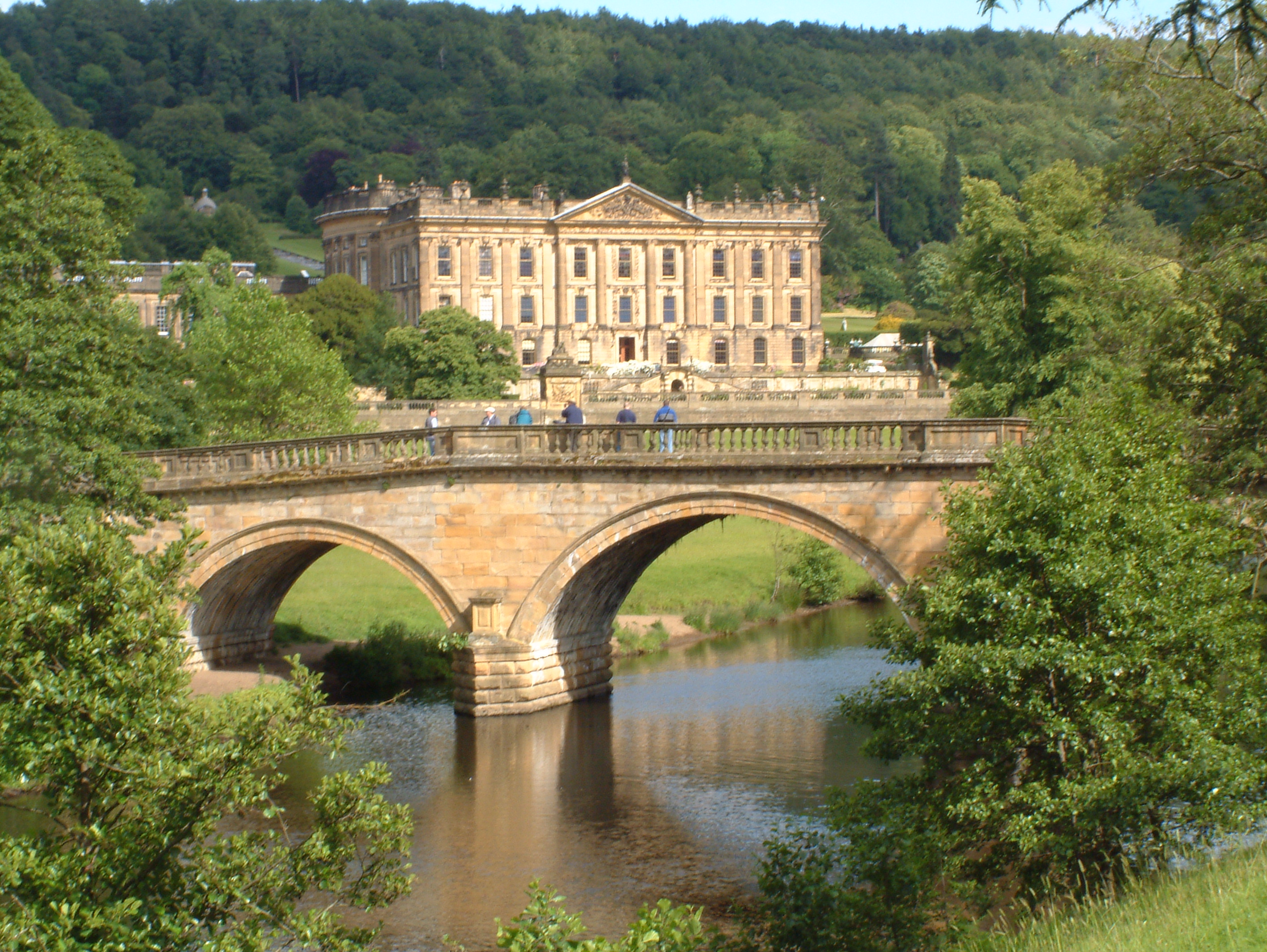
Naturally, the most imposing property of all in the story is Pemberley, the home of Mr Darcy.  The Chatsworth estate in Derbyshire is used for Pemberley in the 2005 film.  This is not the first time Chatsworth has played the role of Pemberley.  The TV drama Death Comes To Pemberley  also made use of Chatsworth.  Meanwhile, Pemberley’s drawing room was filmed at Wilton House near Salisbury.

Chatsworth House, Derbyshire - geograph.org.uk - 2481560. Photo by Christine Matthews, via Wikimedia Commons.

Finally, there are a couple of outside scenes of note.  The scene which has Elizabeth standing on a precipice was filmed at Stanage Edge in Derbyshire.  Meanwhile, way down to the south, the stunning gardens of Stourhead in Wiltshire feature in the scene in which, in pouring rain, Mr Darcy first proposes to Elizabeth and is sharply rebuffed.  This scene takes place at a folly in the grounds known as the Temple of Apollo.

Stourhead Gardens - geograph.org.uk - 32663. Photo by Nigel Freeman, via Wikimedia Commons.

Groombridge Place is currently closed for renovation so cannot be visited by the public.  Basildon Park, an 18th century estate near the River Thames between Reading and Goring, is run by the National Trust and is open to visitors year round.  Burghley House is currently closed for the winter, but is due to reopen in March 2024.  Haddon Hall is open daily during the main season, and on selected dates in November and December.  Chatsworth House and its park are open year round, and is especially appealilng in the run up to Christmas.  

Stanage Edge lies in the Peak District, a couple of miles north of Hathersage, and is a gritstone escarpment popular with climbers.  The Temple of Apollo in Stourhead Gardens is a fine example of classical buildings known as 'follies' which were erected in the estates of the landed gentry of times gone by.  The gardens are run by the National Trust and are open year round.


Friday, 1 May 2020

LOVELY SETTINGS FOR A LOVELESS MARRIAGE: THE DUCHESS


Lady Georgiana Spencer, an ancestor of Princess Diana, was born in Althorp, where the Princess is buried.  At the age of 17 she was married off to William Cavendish, 5th Duke of Devonshire, whereupon she became the Duchess of Devonshire.  On paper it sounds like a fairy tale for the young Georgiana, but unfortunately the Duke turned out to be a philanderer who was only interested in gaining a male heir.  Georgiana’s first two children, as sod’s law would have it, were female, but she finally managed a son the third time round.  Meanwhile, Georgiana became friendly with Lady Elizabeth Foster from Suffolk while on a visit to Bath.  Predictably, Elizabeth caught the roving eye of the Duke and she ended up in a ‘menage a trois’ with the pair of them, bearing two illegitimate children by him and finally becoming his wife three years after Georgiana’s death in 1806, only for the Duke to die two years later.  This saga is the subject of the 2008 film The Duchess, starring Keira Knightley as Georgiana and Ralph Fiennes as William. 

The scenes depicting Georgiana’s time at Althorp did not make use of the real-life Spencer family seat, but were filmed at Kedleston Hall in Derbyshire.   One twist to this whole sorry tale is that Georgiana fell madly in love with Charles Grey (played by Dominic Cooper), a Whig Party member who would later become Prime Minister, but in spite of William’s own infidelities he would not allow her to continue the liaison (which resulted in an illegitimate daughter).  In the film she is seen flirting with Charles, a scene filmed at the South Front of Kedleston Hall.  The scene in which her mother (Charlotte Rampling) is filmed meeting with William to persuade him of her daughter’s charms was filmed in the Library.  Another scene in which Georgiana’s hair catches fire was also filmed here, this time in the Marble Hall. 

File:Kedleston Hall 04.jpg
Kedleston Hall 04. Photo by Glen Bowman, via Wikimedia Commons.


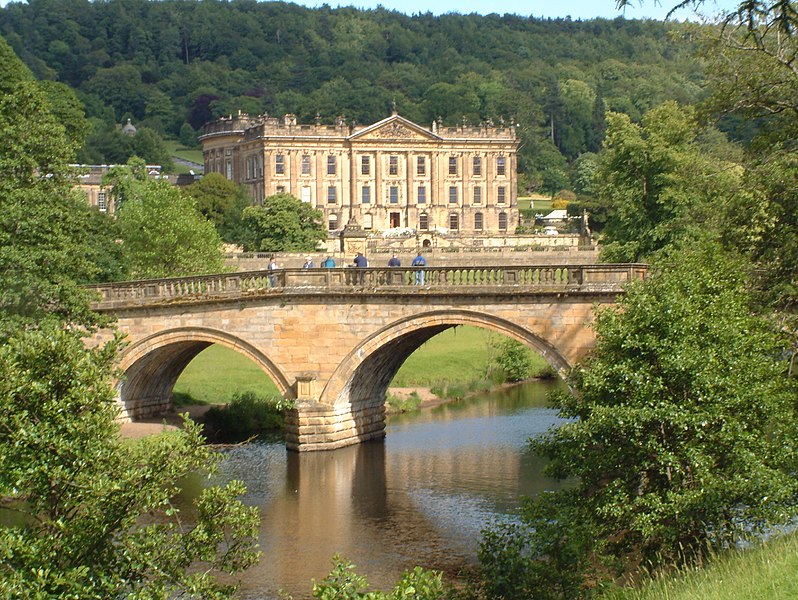
The country estate of the Dukes of Devonshire is Chatsworth House, one of Britain’s best-known stately homes.  Chatsworth played itself in the film when the wedding scenes were filmed there.  However, the Dukes had another base in London called Devonshire House in London’s Piccadilly.  The scenes depicting Devonshire House made use of a number of locations for the interior and exterior shots.  The original building was demolished in 1924, so the film-makers had to find an alternative for the exterior, and Somerset House in The Strand proved the perfect choice.  The interior scenes were all over the place, making further use of Kedleston for some scenes, plus Clandon Hall, Guildford, with Holkham Hall in Norfolk used to depict the dining room. The streets of London, in which the newly-weds are filmed trundling along in their carriage being cheered by crowds of people, are actually the grounds of the Old Royal Naval College in Greenwich.

File:Chatsworth Bridge.jpg
Chatsworth Bridge. Photo by Rob Bendall, via Wikimedia Commons.

In the scenes in which Georgiana goes to Bath to take the waters, this beautiful city gets to play itself, as the graceful Royal Crescent comes into view.  Another famous Bath landmark is the Assembly Rooms in Bennett Street.  The tea room forms the backdrop to the scene where Georgiana is presented to the throng and where she first meets Elizabeth.  However, the river scenes seen in this part of the film were not filmed in Bath, but back at Kedleston.

File:Royal Crescent, Bath 2014 04.jpg
Royal Crescent, Bath 2014 04. Photo by Mike Peel, via Wikimedia Commons.


Kedleston Hall, to the north-west of Derby, is an 18th century neo-classical house designed by Robert Adam and surrounded by sumptuous parkland.  The property is owned by the National Trust.  Chatsworth House, on the banks of the River Derwent near Bakewell, Derbyshire, is privately owned but open to visitors complete with retail and refreshment points.  The house was initially completed in 1708, with later additions the following century.  The extensive grounds include many interesting features, including fountains, a temple and a rectangular lake known as the Canal Pond.

Somerset House is a neo-classical building on the south side of The Strand in London.  It is been used for many purposes over the years, but its current role is principally as an arts centre.  The Old Royal Naval College dominates the banks of the River Thames in Greenwich.  A naval college since 1873, it forms part of the Maritime Greenwich UNESCO World Heritage Site.  The College has been used extensively in filming, proving useful to film-makers as a quieter alternative to Central London for street scenes, Clandon Park, to the north-east of Guildford, Surrey,  is owned by the National Trust, but unfortunately Clandon Hall itself was destroyed by a catastrophic fire in 2015 and still stands as a ruin today.  Holkham Hall is in Holkham in North Norfolk, famous for its vast sandy beach.  An 18th century house in the Palladian style surrounded by extensive parkland, it is privately owned but open to visitors.

The Royal Crescent in Bath was started in 1767 and consists of 30 Grade I listed terrace  houses.  For those wanting to immerse themselves in the Georgian spa town experience, part of the crescent has been given over to Bath’s poshest hotel, the Royal Crescent Hotel and Spa.  The Assembly Rooms, another National Trust property and designed in 1769, were the focal point of Georgian Bath’s social scene.  The building is used for functions and conferences, and can be visited when not in use.  There is also a Fashion Museum on the premises.  Both the Royal Crescent and The Assembly Rooms were designed by the architect John Wood, the Younger.

Thursday, 8 March 2018

LOSING THE PLOT IN YORKSHIRE: GUNPOWDER


The central theme of the TV series Gunpowder is the activities of the group of English Catholics who planned the failed Gunpowder Plot of 1605, and their subsequent gruesome punishments.  The plot was an attempt to assassinate King James I of England and VI  of Scotland during the State Opening of Parliament at the House of Lords, and the most famous of the plotters was Guy Fawkes, who was the inspiration for the enduring custom of "bonfire night" and "penny for the Guy".  Most of the filming of the series took place in a variety of stunning Yorkshire locations.  


One of the most atmospheric locations used was the Cellarium in Fountains Abbey, owned by the National Trust, which plays a key role as the vaults under the Houses of Parliament, where the plotters hoard their gunpowder and plan their dastardly deeds.  The abbey, founded in 1132, is a well-preserved but ruined Cistercian monastery located about 3 miles south-west of Ripon.  In the first episode a Catholic mass is celebrated at Fountains House.  Another National Trust property, East Riddlesden Hall between Riddlesden and Keighley, was used in the scene in which a Member of  Parliament receives a letter warning him of the plot.  The Dining Room and Great Chamber were stripped of their contents and redone specially for the filming.  The property overlooks the River Aire and was built in 1642.

File:Fountains Abbey, UK, Ripon.jpg
Fountains Abbey, UK, Ripon. Photo by Kisha Tracy, via Wikimedia Commons.

Students at Bradford College managed to get some hands-on experience when some of the scenes were filmed there, some of them working as make-up artists.  The college itself is ultra-modern, but its Garden Studio was chosen as the site for the construction of a 17th century manor house.  Across at Dalton Mills, a former Victorian textile mill in Keighley, there was another large set depicting a building from the period.  Meanwhile, out and about, two iconic Yorkshire bridges were used in the filming: Lendal Bridge in the centre of York and the turreted aqueduct bridge over the River Wharfe at the Bolton Abbey estate.  The abbey itself also featured.  The rough moorland seen in some of the scenes is the secton of moor between Ilkley and Keighley. 


Oakwell Hall is a magnificent Elizabethan manor house set in a country park in Birstall, West Yorkshire.  The hall was built in 1583 by John Batt, and as such provided a perfect backdrop for scenes from Gunpowder.  The hall is several miles south-west of Leeds.  A bit closer to the centre of Leeds, to the north-west of the city, is Kirkstall Abbey, dating from the 12th century and, like Fountains Abbey, one of the casualties of Henry VIII’s Dissolution of the Monasteries in 1539.  That the abbey was chosen as one of Gunpowder’s locations is rather appropriate, given that the abbey buildings were bought by a gunpowder dealer from Leeds in the late 1800s.   Another Yorkshire landmark, is Beverley Minster, an impressive church known for its Gothic architecture.  The Minster was begun in the 12th century on the site of a former monastery and updated further in the 15th and 19th centuries.  The Minster was used for scenes depicting the Palace of Westminster.

File:Beverley IMG 8292 - panoramio.jpg
Beverley IMG 8292 - panoramio. Photo by Paul Lakin, via Wikimedia Commons.

One location used in the series which is not in Yorkshire is Haddon Hall near Bakewell in Derbyshire.  The hall is used to depict Ashby St. Legers in Northamptonshire, which through marriage came into the hands of the Catesby family from Warwickshire, one of whom was Robert Catesby (played by Kit Harington), the leading figure in the Gunpowder Plot.

File:Haddon Hall (geograph 2270973) cropped.jpg
Haddon Hall (geograph 2270973) cropped. Photo by Trevor Rickard, via Wikimedia Commons.


Saturday, 11 January 2014

JANE AUSTEN'S DARK SIDE: DEATH COMES TO PEMBERLEY


Christmas is always something of a desert for viewers searching for a touch of class on TV.  However, Christmas 2013 provided a treat for Jane Austen fans in the form of Death Comes To Pemberley.  The 3-parter, based on a script by P D James, ventures into a world beyond Pride and Prejudice in which Mr Darcy and Elizabeth Bennett are blissfully married with children and living in a sumptuous house and estate.  However, their gilded existence is shattered by a tragedy involving the death of one of their circle.  Trevor Eve plays the sinister magistrate Sir Selwyn Hardcastle, who is called in to investigate the death.    

The undisputed star of the show is the magnificent Chatsworth House and Estate in Derbyshire, dating back to the 16th century and Bess of Hardwick, one of the most powerful women in Elizabethan England.  Nestling in the heart of the beautiful Peak District, the house is currently home to the Duke and Duchess of Devonshire and is open to visitors, with 30 rooms on display.  As well as the rooms there are a significant number of works of art available to view including Old Masters, artefacts from Ancient Egypt and modern sculptures.  Outside the house, visitors can explore 105 acres of garden with highlights including a number of water features, most notably the 300 year old Cascade and the gravity fed Emperor fountain.  There are five miles of walks available for visitors wanting to stretch their legs.

File:Chatsworth Bridge.jpg
Chatsworth Bridge. Photo by Rob Bendall, via Wikimedia Commons.

The opening scene of Death Comes To Pemberley has two maids from the House venturing into the woods above the estate.  One of them takes fright, having witnessed something spooky, and the pair run back to the House.  The Pemberley Woods scenes used in this opening sequence were filmed at Hardcastle Crags, a beauty spot in the South Pennines run by the National Trust.  There are footpaths galore available to visitors wanting to explore the waterfalls, streams and stacks of millstone grit.  The centrepiece of the site is Gibson Mill, which is used as a Visitor Centre.  Entomologists may be interested to know that the area is home to the scary-sounding northern hairy wood ant.    

Sir Selwyn Hardcastle occupies a property not quite in the league of Pemberley/Chatsworth, but quite impressive nonetheless.  The role of his house is played by Fountains Hall near Ripon in North Yorkshire, another National Trust property.  This elegant mansion was built by Sir Stephen Proctor in the late 16th/early 17th century and it lies within the Studley Royal Park World Heritage Site, which includes the ruins of Fountains Abbey.  The hall was commandeered during World War II to house evacuees.  It is also a hotspot for ghost sightings, with phenomena including the sound of rehearsing musicians and a "shining golden lady".  There are holiday flats available on site to those wanting to immerse themselves in these inspiring surroundings.

File:Fountains hall 2.jpg
Fountains hall. Photo by Adamjennison111, via Wikimediacommons.

Monday, 6 May 2013

VILLAGE LIFE: THE PEAK DISTRICT


Approaching Derbyshire from the south, skirting around the massive urban sprawl that is Birmingham, the beer-soaked town of Burton Upon Trent, and the cathedral city of Derby itself, it comes as something of a surprise to suddenly find oneself in the Derbyshire Peak District National Park, which in the south is characterised by rolling hills and dales, while the High Peak in the north is all dramatic, windswept uplands.  Nestled among all this scenic splendour are a range of villages and small towns, several of which were used in the filming of the BBC drama The Village starring Maxine Peake and John Simm, which chronicles the life of a fictional village amid the changing social and political landscape of the early 20th century.  The first series covered the period up to 1920, but there are plans for subsequent series taking the viewer further into the century.

The main village used in the series is Hayfield in the north-west of the national park, which lies at the foot of Kinder Scout, a moorland plateau which includes, at 636 metres above sea level, the highest point in the Peak District.  The village was on the old packhorse route from Cheshire to Yorkshire.  With the arrival of cotton in the 19th century the village spread down the Sett Valley and into Birch Vale.  The village has a range of specialist shops, seven pubs and good walking routes.  Once an important industrial centre, the village is now considered a desirable place to live, with property prices reflecting its popularity.  Each year in May there is a May Queen procession, while nearby Little Hayfield hosts sheepdog trials.  Locations in Hayfield which feature in the series include The Old Vicarage, The Royal Hotel, the cricket club and the Library.  Hayfield's other TV connection is that it was the birthplace of Arthur Lowe, who played Captain Mainwaring in Dad's Army, while at Little Hayfield the Lantern Pike pub was a favourite of Tony Warren, creator of Coronation Street, who used to work on writing the episodes while enjoying a pint or two at the pub.

Hayfield, Derbyshire from the northwest. Photo by Dave Dunford, via Wikimedia Commons.


Edale is another attractive Derbyshire village, and its main claim to fame is that it is at the southern end of the Pennine Way.  The village is on a railway line, and its station was used in The Village.  Edale is also where some of the farm scenes were filmed.   There is a Peak District NationalPark Visitor Centre in Edale.  Another location used in the series is Chapel-en-le-Frith, whose French-sounding name derives from the fact that the original settlement was founded by Normans in the 12th century for the purpose of hunting.  The Normans also built the town's first chapel, now the Church of St Thomas Becket.  The town's Playhouse Theatre was used as the village theatre in the series.  The church in the fictional TV village was actually a church in Glossop.  The Middleton Farm which formed the centrepiece of the drama was represented by Far Coombes Farm in Charlesworth.  Further afield in Cheshire, Tatton Park Farm, which forms part of Tatton Park Estate in Knutsford, was also used in the series.  

File:Edale - geograph.org.uk - 250254.jpg
Edale - geograph.org.uk - 250254. Photo by Stephen Burton, via Wikimedia Commons.

Further information about the Peak District National Park can be found here.