Showing posts with label Dorset. Show all posts

Tuesday, 1 August 2023

LITERARY PUBS: THE ACORN INN, EVERSHOT, DORSET

Thomas Hardy’s novels featured many fictional towns, villages and cities which often had clearly identifiable real-life equivalents.  One such example was Evershead, which in real life is Evershot.  The Sow and Acorn inn in Evershead, which featured in a number of Hardy's stories, was inspired by the Acorn Inn, a 16th century Grade II-listed pub in the village which was frequented by Hardy himself.

In Tess Of The D’Urbervilles, there is a scene in which Tess stops for breakfast in the village at a cottage near the Sow and Acorn inn; she avoids the inn itself, not being the pub-going type.  The inn is also mentioned in Interlopers at the Knap, in which Philip Hall collects Sally’s dress from the Sow and Acorn, and in The First Countess of Wessex, with Tupcombe indulging in a spot of eavesdropping from the inglenook.

Evershot, The Acorn Inn - geograph.org.uk - 3107193. Photo by Mr Eugene Birchall, via  Wikimedia Commons.

The present-day inn offers accommodation in rooms named after places and characters from Hardy’s novels.  The interior has changed somewhat since his time, being more open-plan now.  The village of Evershot is located just off the A37 midway between Yeovil and Dorchester, and around 30 minutes’ drive from the Jurassic Coast.  It is the second highest village in the county of Dorset. 

Map of the village.


Sunday, 19 March 2023

DALLIANCES IN DORSET: EMMA (1996)


One thing is guaranteed when it comes to film adaptations of Jane Austen novels: that they will be a feast for the eyes.  Not only for the dashing young men with their flowing locks and sexy boots, and the English roses with heaving bosoms vying for their attention, but also for the idyllic English town and country scenes, which invariably include a range of stately homes.  The 1996 film Emma, starring Gwyneth Paltrow as compulsive matchmaker Emma and Toni Collette as friend Harriet Smith, is no exception, with a variety of charming locations mainly in Dorset.

The first big property to feature in the film is Hartfield, home of Emma Woodhouse and her family, where Emma is seen discussing a wedding with her father.  The location used as the exterior of Hartfield is mostly Came House in the village of Winterbourne Came, Dorset.  However, some of the interior scenes were filmed entirely elsewhere.  The dinner party scene in which Emma introduces Mr Elton (Alan Cumming) to Harriet was filmed at Stratfield Saye House in Hampshire, while Hartfield’s book-lined gallery was filmed in the Long Gallery of Syon House, west London.

Came House (2) - geograph.org.uk - 855736. Photo by Mike Searle, via Wikimedia Commons.


Another imposing property in Dorset used in the filming of Emma is Crichel House near the village of Moor Crichel, to the north of Wimborne.  In the film the property plays the part of Donwell Abbey, home of a local landowner called George Knightley.  A lake on the estate features in a lakeside archery scene.  Meanwhile, another property, Claydon House in Middle Claydon near Aylesbury, Buckinghamshire, lends its elaborate North Hall for the filming of the grand dance, in which Harriet is snubbed but subsequently rescued by Knightley.  Another local man made good, Mr Weston, who married Emma’s former governess (played by Greta Scacchi) occupies a grand property called Randalls.  This honey-coloured property in real life is Mapperton, home of the Earl and Duchess of Sandwich, which is located a short distance to the east of Beaminster, Dorset.

Mapperton House - geograph.org.uk - 517671. Photo by Chris Downer, via Wikimedia Commons.


Aside from the sumptuous residences seen in the film, there are picturesque street scenes depicting the local village Highbury (Surrey), where Mr Elton is the vicar.  The street scenes used in the film were filmed in the Dorset village of Evershot, about 7 miles south of Yeovil.  The Old Manor House in the village is used as the schoolhouse, while the post office building is used for the haberdashery store.  In order to make the street scenes more authentic for the period, the main street, Fore Street,  was festooned with sheep pens and straw for the filming.  The filming is transferred to the neighbouring county of Somerset for the scene in which Emma visits a sick lady, Mrs Clark.  The venue for this scene is the Helyar Almshouses in the village of East Coker about 3 miles south of Yeovil.

Evershot, Tess Cottage and the church - geograph.org.uk - 447131. Photo by Chris Downer, via Wikimedia Commons.


Came House was built for John Damer in 1754 from a handsome light-coloured stone.  Lying about a mile south-east of Dorchester, nowadays the house is, appropriately enough, used as a wedding venue.  Stratfield Saye House in Hampshire, about 5 miles south of Reading, has been home to the Dukes of Wellington since 1817 and is open for pre-booked tours only.  Syon House, across the River Thames from Kew Gardens, has been used extensively in filming.  Forming part of Syon Park, the house has been the home of the Dukes of Northumberland for over 400 years.  The house and gardens are open to the public, with a mix of guided and self-guided tours of the house.

Crichel House is a Classical Revival country house built for the Napier family.  The property and grounds are not open to the public apart from specific events.  Claydon House is a National Trust property and is open to the public from April.  The North Hall is a riot of rococo in yellow and white.  Mapperton House originates from the 11th century, but a Tudor manor house was built on the site by Robert Morgan in the 1540s, and rebuilt the following century by Richard Brodrepp.  The property is now the  home of the Earl and Duchess of Sandwich. The Gardens and cafe are open from March, and the house from April.

Evershot is the second highest village in Dorset and the source of the River Frome.  The village featured heavily in Thomas Hardy’s works, most notably Tess of the D’Urbervilles.  East Coker lies over the county border in Somerset, and has a history stretching back to Roman times: a Roman villa was discovered there in the 18th century.  The Helyar Almshouses were built in the mid-17th century by the Archdeacon of Barnstaple.  The construction took twenty years due to an enforced interruption brought about by the Great Plague.


Wednesday, 9 November 2022

CRACKING THE CODES: THE IMITATION GAME/BUCKINGHAMSHIRE/SHERBORNE/LONDON


Bletchley Park in Buckinghamshire started out as a mansion in 1711, later to be pulled down.  The house which was subsequently built on the site was bought by MI6 in 1938 for use by intelligence personnel in the event of war, which turned out to be a wise investment as the centre proved to be a key factor in the country’s victory over Germany in World War Two.  During the War a young Cambridge graduate, Alan Turing, arrived at Bletchley Park and was put in charge of Hut 8, which dealt with German naval cryptanalysis.  While there, he became engaged to Joan Clarke, a fellow cryptanalyst, but they never married as Turing later came out as a homosexual. 

Bletchley Park Mansion. Photo by DeFacto, via Wikimedia Commons.

This story is played out in the film The Imitation Game, starring Benedict Cumberbatch as Turing and Keira Knightley as Joan, and Bletchley Park appears as itself in the interior shots.  For the exteriors Joyce Grove in Nettlebed, Oxfordshire, was used in the filming.   For the town of Bletchley itself, scenes were shot in Chesham, Buckinghamshire, where one of the buildings stood in as Joan’s lodgings.  The town was also used as the scene of a meeting with a possible Soviet spy, and a pillar box was erected opposite 68 Church Street for the scene. 

Church Street, Chesham - geograph.org.uk - 111011. Photo by Cathy Cox, via Wikimedia Commons.


During the film there are flashbacks to Turing’s schooldays, much of which were spent at Sherborne School.  The real-life school in this attractive small Dorset town was used for the school scenes in the film, with its lovely honey-hued stone buildings and arched cloisters much in evidence.

Naturally, any film about the intelligence services will have scenes shot in London.  The evacuation scenes were filmed at King’s Cross Station, while the interior of the MI6 Headquarters was filmed in the Lethaby Building on Southampton Row, seen in the scene where Joan turns up as the only female answering an advertisement for crossword solvers.  In one scene, Turing is seen cycling through a bombed out part of the city; heaps of rubble were dumped in Carey Street, Chancery Lane, for the filming of the scene.  In another throwback to the Blitz, the disused Aldwych Tube Station serves as an underground refuge for the populace. 

Bletchley Park, near Milton Keynes, has been turned into a museum commemorating its time as a code-breaking centre.  Guided tours are available, and the museum is open 6 days a week.  Joyce Grove, a country house built in the Jacobean style, is owned by the Sue Ryder charity.  Sherborne is a pleasant small town in north west Dorset, with its Abbey, founded in 705, as the focal point of the town.  Chesham is a market town 11 miles south east from Aylesbury in Buckinghamshire.

Sherborn Abbey.

Map of Bletchley Park and surrounding area.

Map of Sherborne

Saturday, 2 April 2022

A FICTIONAL TOUR OF SOUTHERN ENGLAND: JUDE THE OBSCURE, THOMAS HARDY

 One notable feature of the novels of Thomas Hardy is his use of real locations masked by fictional names.  Probably the most famous of these is Casterbridge, aka Dorchester in real life.  In Jude The Obscure, the action takes place in a number of different locations, each with its real-life equivalent.


The story kicks off in the village of Marygreen, where Jude Fawley, who has been sent to live with his great-aunt Drusilla following the death of his father, is upset that the local schoolmaster, Phillotson, is taking off for pastures new, namely the university city of Christminster (see below).  As it happens, the real-life version of Marygreen is also called Fawley, a village in Berkshire.  The church of St Mary the Virgin, completed in 1866, is the real-life version of Marygreen Church in the novel.


Jude Fawley’s dearest wish is to go and study at Christminster, which becomes something of an obsession to the point where he considers it the “New Jerusalem”.  However, it is not to be, and he ends up as a stonemason instead.  It is not at all hard to guess which is the real-life equivalent of Christminster, especially when we discover that it is to the north-east of Marygreen.  A glance at the map reveals that this venerable seat of learning has to be Oxford, one of the most famous university cities in the world along with its cousin to the east, Cambridge.


Oxford from Westgate Mall. Photo by Dicklyon, via Wikimedia Commons.

In another chapter of Jude’s life he finds himself in Melchester, where his on-off love affair with his cousin Sue develops.  He goes there to study for the clergy, having been lured by Sue, who is at a Training College in the city.  Jude finds work in the cathedral there while reading theological works in preparation for his career.  The real-life cathedral city of Salisbury in Wiltshire was the inspiration for Hardy’s Melchester.  Salisbury lies to the north of the New Forest and south of Salisbury Plain, with its elegant cathedral spire visible from miles around.  The city made the news in 2018 for the worst of reasons, being the location where the poison novichok was used to target former Russian military intelligence officer Sergei Skripal, with an unfortunate local woman ending up dead as a result.


Salisbury, Salisbury Cathedral ^ Scenery - geograph.org.uk - 3106160. Photo by Lewis Clarke, via Wikimedia Commons.
 

By the time the action has moved to Shaston, Sue is married to Phillotson, who has moved there to run a school.  Jude catches up with Sue there and they flee together.  In real life, Shaston is the town of Shaftesbury, Dorset, famous for its picturesque cobbled street, Gold Hill, which featured in a 1970s TV advert for Hovis bread. 


Gold Hill Shaftesbury - geograph.org.uk - 2206454. Photo by peter robinson, via Wikimedia Commons.

Jude and Sue go to live together at Aldbrickham, which is where Jude’s flighty ex-wife Arabella used to work as a barmaid before she met him.  Arabella makes a reappearance in Jude’s life during this time at Aldbrickham, resulting in an unexpected addition to Jude’s family.  Aldbrickham’s real-life equivalent is the large Berkshire market town of Reading on the River Thames.  The town has long been an important commercial centre, above all most recently for the IT industry.

Friday, 25 December 2020

WHEN IS CORNWALL NOT CORNWALL? REBECCA 2020


I read Daphne Du Maurier’s Rebecca for the first time this year during lockdown.  I wasn’t sure what to expect, but I found it to be one of the most amazing stories ever written.  Inevitably, such a famous novel found its way to the big and small screen, most famously in 1940 with Laurence Olivier playing the tragic Mr de Winter and Joan Fontaine playing his socially awkward second wife, struggling to step into the footsteps of the first Mrs de Winter, the Rebecca of the title. Shortly after I read the novel I learned that a new version was to be released, with Armie Hammer playing opposite Lily James, and with Kristin Scott Thomas as the forbidding head housekeeper Danvers.


I rushed to watch this new version, in anticipation of seeing some familiar scenes from my native Cornwall,  However, it turns out that just about anywhere other than Cornwall was used for the locations (at least the film used UK locations, unlike the 1940 version, which was largely filmed in California). 


As in the original, the film kicks off in the South of France, but the hotel suite occupied by the dreadful Mrs Van Hopper and the “new Mrs de Winter-to-be” is not in France at all, but was filmed at Waddesdon Manor in Buckinghamshire, which has a suitably chateau-like appearance.  The Manor was built by Baron Ferdinand de Rothschild in 1877 as a summer bolt-hole for entertaining.


                                  Waddesdonterrace. Photo by Giano, via Wikimedia Commons.

The first glimpse of Manderley as the newly weds drive up to the property was filmed at Cranborne Manor, midway between Wimborne Minster and Salisbury.  The great entrance hall where the couple are greeted by the servants was filmed at Hatfield House, Hertfordshire, which was also used for a pivotal point in the story when Mrs de Winter mark 2 is tricked into choosing an ill-advised costume for the summer ball she and Max are hosting at Manderley.  The painting which provides the inspiration for the outfit is in real life a portrait of Mrs Hugh Hammersley, which is to be found in Hatfield House.  The Persian rugs and wood panelled walls seen in the interior scenes were also from Hatfield.    


Cranborne Manor - geograph.org.uk - 1223951.  Photo by Mike Searle, via Wikimedia Commons.

As Mrs de Winter is seen exploring Manderley, there are many works of art in view.  Some of these are from the interior of Petworth House, West Sussex, which was used for some of the scenes.  Meanwhile, for Rebecca’s wing of Manderley, which has been kept as a shrine to her by Danvers, we are transported to Dorset, to Mapperton House, which is also where the accident with the precious porcelain was filmed.  The East Wing bedrooms, however, are from Loseley House near Guildford.

In the ‘downstairs’ part of Manderley, where the servants hang out, we see the basement kitchen and the corridors leading to and from it.  The kitchen area of Osterley House in the London Borough of Hounslow was used for these scenes, with some crockery and food items added in to complete the scene.  Osterley House also provided the stables for the scene in which Mrs de Winter was persuaded to try her hand at horse riding by Rebecca’s cousin, Jack Favell (Sam Riley). 


                                 Osterley Park 800. Photo by Sannse, via Wikimedia Commons.

For me, the biggest disappointment of the filming locations, given the gorgeousness of the Cornish coast, is that the coastal scenes were filmed outside the county, specifically at Hartland Quay, North Devon, recognisable from its unusual rock formations.


                Hartland Quay - panoramio (3). Photo by Matt Prosser, via Wikimedia Commons.

Waddesdon Manor is about five miles north-west of Aylesbury and is open to visitors, with advance booking only during the coronavirus pandemic.  The beautiful grounds include an aviary housing a range of exotic birds.  The house is a repository for an extensive collection of art, in particular 18th century French pieces, this being a favourite period of the Rothschilds. 

Cranborne Manor, just outside the village of Cranborne, is notable for its gardens, originally from a design by John Tradescant in the 17th century and rediscovered in the 19th century, then replanted in the Arts and Crafts style a century later.  Visitors to the gardens also have access to a cafe and a shop.  Hatfield House, dating from 1611 and owned by the Cecil family for 400 years, has been used extensively in filming.  The house and gardens are open to visitors except for the winter season, when only the park and woodland walks, the cafe and shops are open. 

Petworth House is on the edge of the small town of Petworth, West Sussex.  This vast 17th century house and its grounds are run by the National Trust.  Works of art on display in the state rooms include paintings by Van Dyck, Turner, Reynolds and Gainsborough.  Mapperton House is near Beaminster in Dorset and is the home of the Earl and Countess of Sandwich.  Both the house and gardens are open to visitors.  Loseley Park lies just beyond the southern edge of Guildford, Surrey.  The gardens are open to visitors in the summer, and the property is also available for weddings.  In normal, non-covid, times the house can be visited on guided tours.

Osterley Park and House, run by the National Trust, lies between the M4 and the Great West Road just a few miles east of Heathrow Airport.  The house is in the neo-classical style, designed by Robert Adam and is surrounded by landscaped parklands and gardens.  Hartland Quay is at the western extreme of the North Devon coast, known for its rough seas during the winter months, which have been responsible for many shipwrecks over the years.  The distinctive layered rocks seen in the film are sedimentary rocks deposited during the Carboniferous period.

Monday, 9 April 2018

DOOMED IN DORSET: ON CHESIL BEACH


The star location in the film On Chesil Beach (as well as the novel by Ian McEwan on which it is based) is self-evident from the title.  One of Britain’s most famous and unusual coastal features, Chesil Beach stretches for 29 miles between the base of the Isle of  Portland and the eastern edge of West Bay, hemming in a lagoon known as The Fleet, home to the Abbotsbury Swannery.  Filming began at the beach in October 2016, with the two main characters played by Saoirse Ronan and Billy Howle.


In the story a newly-married couple are spending their honeymoon at a hotel on Chesil Beach, but their wedding night is marred by the bride Florence’s antipathy towards the sexual act.  She walks out on the groom, Edward, he follows and they have a row on the beach.  The rest of the novel consists of Edward’s life in the decades that follow and his deliberations on what might have been. 


The weather is overcast and moody for the beach scenes in the film, no doubt reflecting the mood of the couple.  The hotel featured in the film is a fictional one, but there are a number of places to stay near the beach for those wanting to experience the locations from the film.  As well as Chesil Beach, another famous Dorset landmark, Lulworth Cove, makes an appearance in the film’s trailer.  Visitors to Chesil Beach should be aware that it is illegal to remove pebbles from the beach, incurring a hefty fine.  When writing the novel, McEwan was allegedly unaware of this and took some pebbles to keep on his desk while writing, attracting the opprobrium of local conservationists.  However, he returned the stones as soon as he realised his transgression.

Map of the area.

File:Chesil beach - geograph.org.uk - 911979.jpg
Chesil Beach - geograph.org.uk - 911979. Photo by StanWray, via Wikimedia Commons


Wednesday, 14 February 2018

VALENTINE SPECIAL: LOVE ON PAGE AND SCREEN


With Valentine’s Day upon us, I have come over all soppy and decided to share some British locations associated with some of the many romantic moments featured in our nation’s works of film, TV and literature.  So get out the heart-shaped chocolates and enjoy.


Gunwalloe, Cornwall: Dwight marries Caroline in Poldark


I have already described some of the Poldark locations in an earlier post, including the location of Nampara, where Ross and Demelza build their life together.  I do not tear up easily, but one scene in series 3 even got me going, when Caroline Penvenen and Dr. Dwight Ennis, after a seemingly doomed relationship, finally tied the knot.  The church where the wedding was filmed was the charming and very Cornish Church of St Winwaloe, nestled among the dunes in Gunwalloe near the Lizard Peninsula.  Being of a ‘three hall’ design, the present day church is thought to date from the 15th century, although the original chancel and nave were probably 13th century, and there is a Norman font.  

St Winwaloe Church and Church Cove - geograph.org.uk - 981092. Photo by Rod Allday, via Wikimedia Commons.


Valency Valley, Cornwall: Thomas Hardy meets his first wife


Staying in Cornwall, but this time near the north coast, the Valency Valley is a lush hideaway just inland from the picturesque harbour village of Boscastle.  Set in an isolated position on the northern slopes of the valley is the Church of St Juliot.  In 1870 Thomas Hardy, who at the time was an aspiring architect, arrived at the church to perform work on its restoration following the death of the person originally hired to do the job.  While there he met and fell in love with his first wife Emma, the rector’s sister-in-law and their courtship inspired one of his works, the novel ‘A Pair of Blue Eyes’. 


Mapperton House, Dorset: Bathsheba and her triangle of suitors


Continuing the Hardy theme, Bathsheba Everdene in Hardy’s Far From The Madding Crowd must surely be one of English literature’s most fascinating and complex characters, a woman ahead of her time for her fierce independence.  When she inherits a farmhouse and takes up residence there she find herself pursued by a trio of suitors: Gabriel Oak, a shepherd from her past who asks her to marry him but is rejected – although he gets his girl in the end; Sergeant Francis Troy, who succeeds in wooing her but turns out to be really bad news; and the lonely farmer William Boldwood, who Bathsheba foolishly leads on with a Valentine saying “Marry me” but who eventually succeeds in gaining her hand in marriage only for it to end in tragedy through a fatal spat with Troy.  The 2015 film version of the story, starring Carey Mulligan as Bathsheba, captures all this wooing and wedding perfectly.  Bathsheba’s farmhouse in the film is portrayed by Mapperton House near Beaminster in the Hardy county of Dorset, a Jacobean manor house and home to the Earl and Countess of Sandwich.  The house is open to visitors on guided tours only.


Mapperton House - geograph.org.uk - 517671. Photo by Chris Downer, via Wikimedia Commons.

Apple Tree Yard, London


The scene of the al fresco knee trembler involving Yvonne Carmichael and her mysterious lover in the book and TV series of the same name actually exists as Apple Tree Yard in real life.  It is an insignificant alleyway behind Jermyn Street in Mayfair.  However, the makers of the TV production were unable to use the yard for the series because of building work going on there for a major redevelopment, so a similar alleyway in the City had to be used instead. 


Romantic locations galore in Four Weddings and a Funeral


The 1994 romantic comedy Four Weddings and a Funeral, starring Hugh Grant and Andi McDowell, takes us on a tour of romantic locations in south-east England for the wedding scenes.  Wedding No. 1 takes place in St Michael’s Church, Betchworth near Reigate, with the reception filmed at a property named Goldingtons in Sarratt, Hertfordshire, which went up for sale in 2015 for a cool £4.5m.  No. 2 is conducted at the Old Royal Naval College in Greenwich, with Luton Hoo Estate near Luton being used for the reception.  The third wedding service was supposed to take place in Perthshire in the film, but was actually filmed at Albury Park, Guildford, Surrey, with the reception at Rotherfield Park near Alton, Hampshire.  The final wedding is scheduled to take place at St Bartholomew-the-Great in Clerkenwell, but turns into a non-wedding when Charles has second thoughts.


A wealth of stately homes: Pride and Prejudice


The 1995 version of Pride and Prejudice has Mr Darcy sneering at everyone in a lavish ballroom, meant to be the Netherfield Ballroom.  His dance with Lizzie on this occasion  marks the beginning of their romance.  Netherfield Park, where the scene takes place, is the home of Mr Bingley, a wealthy gentleman from the city, and the exterior of the property is represented by Edgecote House in Northamptonshire, while the ballroom scene was shot in the ballroom of Brocket Hall in Hertfordshire.  Later on in the series Darcy has an awkward encounter with Lizzie dressed in wet underclothes following a swim in a lake on a hot day.  This scene, which was voted one of the best on British TV, was shot at Lyme Park in Cheshire.


Teversal Manor, Nottinghamshire: Lady Chatterley's Lover


The racy novel by D H Lawrence, Lady Chatterley’s Lover, is centred on the tragic couple Lady Constance Chatterley and her paralysed husband Clifford.  At night Constance creeps from their  home, Wragby Hall, to spend time with her lover Oliver Mellors the gamekeeper.  The house believed to have provided the inspiration for Wragby Hall was Teversal Manor, near Mansfield, Nottinghamshire, which was put up for sale in 2013 for £1m.


Stokesay Court, Shropshire: Atonement


The novel Atonement by Ian McEwen explores the ill-fated romance between Cecilia Tallis and Robbie Turner, the son of the family’s cleaning lady.  In 2007 the novel was made into a film, and the Tallis family home which was the scene of the beginning of the couple’s romance was represented by Stokesay Court in Onibury, Shropshire, built by Victorian merchant John Derby Allcroft.  Not to be confused with the much older Stokesay Castle, an English Heritage site to the north, just south of Craven Arms.


Blackpool: a very Coronation Street romance


The fictional Coronation Street couple Roy and Hayley Cropper were once described as the greatest soap couple of all time.  They were also possibly the most unusual, given that Hayley started out as a bloke and was the first transgender character in a British soap opera.  Unfortunately, the romance between the two comes to a sad end when Hayley is diagnosed with terminal cancer.  Following the diagnosis the couple head to Blackpool to try and grab some last happiness together, for example dancing in the Tower Ballroom. Following Hayley’s death, Roy scatters her ashes in the sea at Blackpool.


Carnforth Station: Brief Encounter.


One of the most memorable images from 1940s British cinema is that of Trevor Howard and Celia Johnson gazing meaningfully into each other's eyes in a station cafe in Brief Encounter.   Those who want to relive that romantic moment should head for Carnforth, because it was the cafe at Carnforth Station, now known as the Brief Encounter Refreshment Room, which was used in the film with the station acting as Milford Junction.  It is a fitting name, because at that time Carnforth was a major junction in the railway system of the north-west, and during the war thousands of servicemen passed through on the way to their overseas destinations.  However, Carnforth was a victim of the Beeching rail cuts in the 1960s, and the station was turned into a mere branch line station with a lot of the buildings from its heyday falling derelict.  Recent restoration work has resulted in the opening of the Carnforth Station Heritage Centre, incorporating that famous cafe.

File:Carnforth Station waiting room.jpg
Carnforth Station waiting room. Photo by Deben Dave, via Wikimedia Commons.


High Sunderland Hall, Yorkshire: Wuthering Heights


Wuthering Heights, the property at the heart of Emily Bronte’s novel of the same name, is the scene of a classic story of love and revenge, charting the doomed love affair between Catherine Earnshaw, the daughter of the property’s owner, and the dark and brooding Heathcliff, an orphan boy brought by Earnshaw to live with the family following a trip to Liverpool.  The inspiration for the exterior of Wuthering Heights is thought to be High Sunderland Hall near Halifax, while the location of the property is assumed to be Top Withens, the site of a ruined farmhouse near the Bronte family’s home village, Haworth.


Tretower Court, Powys: The Libertine


The Libertine, starring Johnny Depp, is a historical romp centred on a drunken, sex-mad poet called John Wilmot, or the Earl of Rochester, a friend of King Charles II.  Wilmot falls in love with an actress he has decided to make into a star.  Much of the film was made in the Isle of Man for tax purposes, but several key scenes were filmed at the 14th century Tretower Court, a medieval courtyard house and adjoining castle near Crickhowell, Powys.   Apparently Depp joined some of the locals for a drink at the Bear Hotel, where some of the crew members were staying.


Cumbernauld: Gregory's Girl.


Gregory’s Girl, released in 1981, is a romantic comedy with a Scottish accent which launched the film acting career of John Gordon Sinclair, who was just 19 at the time of filming.  Much of the action takes place in and around the New Town of Cumbernauld in North Lanarkshire.  The site was designated for a New Town in 1955, and the town has since grown to be the ninth most populated locality in Scotland.  Among the industries which have grown up around this population are the studios for the TV series Outlander, which makes much use of the surrounding area.

Monday, 24 July 2017

SUMMER SPECIAL: BEACHES ON THE BIG AND SMALL SCREEN


Summer’s here and it’s time to head for the beach, but in between leaping into the waves and sunning yourself, why not stop to consider all the wonderful film and TV scenes produced over the years featuring the nation’s stunning beaches.  Here is a baker’s dozen of British beaches which have featured on the big and small screen.

Holywell Beach, Cornwall

In the third series of Poldark Geoffrey Charles, stepson of George Warleggan, is seen visiting a beautiful beach and declaring it the best beach in Cornwall.  In another episode the same beach forms the backdrop for the romantic reunion of Geoffrey Charles’ governess Morwenna and Demelza’s brother Drake.  The beach in question is the one at Holywell Bay, easily recognisable from the two pointy islets just offshore known as Gull Rocks.  This is not the first time the beach has been seen on screen: it appears on the big screen in Summer In February, the 2013 film about an Edwardian artists’ colony in Cornwall, in which Gilbert Evans and Alfred Munnings are seen riding together on horseback and discussing the love interest, the fragrant Florence Carter-Wood.  The bay’s name derives from St Cubert’s Holy Well, which is to be found in Holywell Cave, accessible at low tide.  The cave features in one of the above-mentioned Poldark episodes, when Drake leads Geoffrey Charles and Morwenna to it.

On a much grimmer note, in 2002 the beach was transformed into a North Korean battlefield for the opening scenes of the  James Bond film Die Another Day, although apart from a brief glimpse of Gull Rocks you would never recognise it.  The lifeguard hut was turned into a pill box and barbed wire was arranged all over in order to achieve the desired effect.

File:Dunes at Holywell Bay (6124).jpg
Dunes at Holywell Bay (6124). Photo by Nilfanion, via Wikimedia Commons

West Bay, Dorset

The distinctive orange-hued cliffs backing the beach at West Bay will be forever remembered by Broadchurch fans as the place where the Latimers’ son Danny was found dead on the beach, a tragic event which formed the central focus of the first series and continued to weave its way through the two subsequent series.  The beach is repeatedly seen thereafter, often with dramatic waves crashing onto the shore.  The rocks forming the cliffs date from the Early Jurassic age and consist of Bridport Sand Formation and Inferior Oolite.  There are also frequent glimpses of the harbour adjacent to the beach in the series.

Brighton, East Sussex

Brighton Beach has featured in many productions over the years.  Among the most memorable scenes is the one in Quadrophenia in which the central character Jimmy is sitting on the shingle after an eventful night out gazing pensively out to sea, accompanied by the strains of  The Who’s ‘Love, Reign O’er Me’.  Then there is the scene from Mona Lisa, in which Bob Hoskins and Cathy Tyson are seen larking about in comedy sunglasses on the Palace Pier.  The beach and seafront also appeared in The Boat That Rocked about a 1960s pirate radio station, and of course both the 1947 and 2010 version of  Brighton Rock, based on the Graham Greene novel of the same name, featured the seafront, in particular the pier.  This is just a small selection of appearances by the film makers’ favourite resort.

File:20070813 brighton10.jpg
20070813 brighton10. Photo by Jean Housen, via Wikimedia Commons.

Camber  Sands, East Sussex

Camber Sands near Rye is a riot of dunes, a rarity in the south-east.  The makers of the Carry On film Follow That Camel evidently thought the beach resembled the Sahara Desert, only without the attendant heat and lack of infrastructure.  The sands were also seen in a beach scene in The Theory of Everything, about the life of Stephen Hawking.  But most of the appearances by the sands have been in war films.  The 1958 version of Dunkirk used the beach as the backdrop for a recreation of Operation Dynamo, and in the 1962 film The Longest Day it was used to depict the Normandy beaches, a role repeated in the more recent film The Monuments Men, starring George Clooney and Matt Damon, about an attempt to save art treasures from the Nazis. 

Holkham Beach, Norfolk

This sweeping mass of sand manages to upstage Gwyneth Paltrow in the final scene in Shakespeare in Love.  The actress is seen striding along the beach, meant to be Shakespeare’s Illyria, in a flowing gown while Joseph Fiennes as Shakespeare sings her praises in a voiceover.  More recently, the beach became “Area X” in a sci-fi film called Annihilation starring Natalie Portman.  Visitors to the beach will no doubt want to look in on the nearby Palladian masterpiece Holkham Hall, which has also been used a fair bit in filming.

Redcar, North Yorkshire

Like Camber Sands, Redcar’s beach has been used to depict the beach at Dunkirk, this time in the film version of Ian McEwan’s novel Atonement, starring Keira Knightley and James McAvoy.  The harrowing wartime scenes filmed at Redcar included local people who were brought in as extras to play the soldiers.  One of the excited inhabitants of the town commented that they wished they could put a price on what the film was worth to the town, quite justifiably, since visitor numbers jumped by some 70% during the filming.

Bamburgh, Northumberland

As well as being a stunning beach, Bamburgh has the added attraction of being overlooked by one of the country’s most impressive castles.  This has inevitably made it irresistible to film makers.  The castle and beach were used for the filming of the 1971 version of Macbeth, directed by Roman Polanski, and during the production of the 2015 version the cast and 200 extras were seen at the castle.  The castle also made an appearance in the 1998 film Elizabeth.  On the small screen, the castle served to depict Belleme Castle in Robin of Sherwood.  Another appearance on the small screen was in an episode of Most Haunted, a ghost hunting series best known for Yvette Fielding screaming her head off  and Derek Acorah speaking in tongues.  The ghosts in the castle reportedly include a stunningly beautiful “pink lady”.

File:Bamburgh MMB 39 Bamburgh Castle.jpg
Bamburgh MMB 39 Bamburgh Castle. Photo by mattbuck, via Wikimedia Commons.

St Andrews, Fife

The opening scene of the film Chariots of Fire, which tells the story of two athletes who, after years of training, are accepted to compete in the 1924 Paris Olympics, features a race along a beautiful sandy beach with the athletes dressed in their white period racing gear, their feet splashing in the shallows, with the stirring theme tune by Vangelis ringing out.   Towards the end of the scene the skyline of the university and cathedral city of St Andrews comes into the camera shot, revealing that the scene of the race is the city’s West Sands beach, backed by St Andrews Links, this being “the home of golf”.  The beach where the athletes trained was meant to be at Broadstairs, but the film makers chose St Andrews for the running scenes.

Camusdarach Beach, Arisaig, Highland

In the heartwarming film Local Hero, which tells the story of a rich American oil company’s efforts to buy a small Scottish coastal village for oil prospecting purposes, much of the action takes place on the east coast, in the village of Pennan.  However, one of the most beautiful locations used in the film was actually on the other side of Scotland at Camusdarach Beach, between Morar and Arisaig.  The beach is the setting of the amusing scene in which the local populace gather in the little church overlooking the beach to hold a meeting about the oil company's bid to exploit the area, while the oil men stand on the beach, oblivious to the line of people filing into the church.

File:Looking North up Camusdarach Beach - geograph.org.uk - 68305.jpg
Looking North up Camusdarach Beach - geograph.org.uk - 68305. Photo by David Crocker, via Wikimedia Commons.


Blackpool, Lancashire

Blackpool has made repeated appearances in the long-running soap opera Coronation Street.  From the early days in 1961, when Ena, Minnie and Martha took a trip up the Blackpool Tower, to 1985 when Bet Lynch declared that "Everybody's letting their hair down. You can cut smell of shrimps and best bitter with a knife."  Fast forward to 1989 when one of Coronation Street's worst villains, Alan Bradley, met his end at the hands of a Blackpool tram while stalking Rita Fairclough, who had moved to the town to escape from him.  Then there was the recent heart-rending scene involving Roy and Hayley Cropper who went to Blackpool to try to blot out Hayley's terminal cancer.  On the big screen, the resort is the focal point of the British comedy film Bhaji On The Beach about a group of women from the Indian subcontinent enjoying a day trip to see the famous Blackpool Illuminations. 

Freshwater West, Pembrokeshire

The year 2009 was a big one for filming on the spectacular beach at Freshwater West.  In May of that year the beach was taken over by the Harry Potter team, when filming took place for Harry Potter and the Deathly Hallows.  The most striking prop was Dobby's Shell Cottage, which is seen in the film with the dunes as a backdrop.  Then, the following month the production crew of Ridley Scott's Robin Hood arrived and put on a dazzling display for any casual onlookers as they filmed the scene depicting a battle against French invaders with Robin Hood (Russell Crowe) leading his men into the fray.  The scene was so massive that it involved 800 actors and 130 horses as well as dozens of the boats that were built for the filming.   
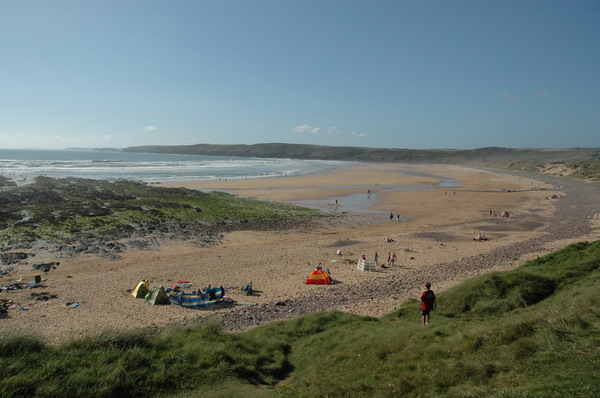
File:Freshwater West - geograph.org.uk - 239022.jpg
Freshwater West - geograph.org.uk - 239022. Photo by Jeremy Owen, via Wikimedia Commons.


Southerndown, Vale of Glamorgan

Many Doctor Who fans will have been touched by the relationship between the David Tennant version of the Doctor and his sidekick Rose Tyler (Billie Piper).  So the tearjerking scene in which the Doctor is about to declare his feelings for Rose when he suddenly dematerialises must have had them reaching for the tissues.  The scene of all this heartache was the beach at Southerndown in South Wales, meant to be Bad Wolf Bay in Norway in the series.  The production team evidently thought highly of the beach in question as a filming location: it was used in several other episodes including Journey's End, which saw Rose being joined by her successor Donna (Catherine Tate). 

Portstewart Strand, County Londonderry

One of the most magnificent beaches in Northern Ireland, and just one of a host of scenic coastal locations seen in Game of Thrones, which has just begun its seventh series, Portstewart Strand was where Jaime Lannister and Bronn were seen duelling with the Dornish guards in series 5.  The filming took place in August 2014, which was unfortunate, this being one of Northern Ireland’s most popular summer holiday spots, because the beach was completely closed for the filming.  The locals didn’t mind, though, considering the closure a small price to pay for the exposure given to Portstewart by its role in Game of Thrones.

File:A westerly view along The Strand, Portstewart - geograph.org.uk - 1312074.jpg
A westerly view along The Strand, Portstewart - geograph.org.uk - 1312074. Photo by Des Colhoun, via Wikimedia Commons.