Showing posts with label Scotland. Show all posts

Saturday, 15 March 2025

A BIRK OF A WORK: ROBERT BURNS/ABERFELDY

 I often feel the need for a special dictionary when reading the works of Scotland’s most celebrated poet, Robert Burns.  When I came across The Birks of Aberfeldy I had no idea what a birk was.  Turns out it is Gaelic for birch trees, and these are the trees overlooking the Falls of Moness on the outskirts of Aberfeldy, which provided the inspiration for this poem. There is a woodland walk taking in the scene, complete with a statue of Burns.

The Birks of Aberfeldy, Robert Burns statue - geograph.org.uk - 1195252. Photo by Bill Clark, via Wikimedia Commons.

The poem invites a “bony lassie” to go to the birks and enjoy the “flowery braes” (steep banks) and “chrystal streamlets”, “the hoary cliffs…crown’d wi’ flowers”, “fragrant spreading shaws” (hawthorn), and the “burnie” (stream) pouring “white o’er the linns (ravines).  


Aberfeldy is a small town on the banks of the River Tay in Perthshire.  As well as the Burns connection, the town’s main claim to fame is the beautiful old stone bridge dating from 1733 and built by British Army officer General Wade. Near the bridge is the Black Watch Monument consisting of a tall cairn topped by a statue of Private Farquhar Shaw dressed in the uniform of the Black Watch Regiment.


Map of the area.


Wade's Bridge


Thursday, 4 April 2024

OIL MAN VERSUS BEACH MAN: LOCAL HERO: PENNAN, ABERDEENSHIRE

If you are looking for a feel-good film in these depressing times, I can recommend Local Hero, made in 1983 and directed by Bill Forsyth.  In the film a rich American oil magnate (played by Burt Lancaster) has his eye on a beautiful stretch of Scottish coastline which has potential as the site for an oil refinery, so he sends a company rep over to check it out.  The locals are keen, seeing the opportunity to make a lot of money, but an eccentric old man living on the beach is refusing to budge.  As well as being a heart-warming story with plenty of gentle humour, the scenery is stunning, helped along by a score written by Mark Knopfler of Dire Straits.

The village targeted by the oil company in the film is called Ferness, but in real life it is the village of Pennan, Aberdeenshire.  Nestling at the foot of cliffs, and consisting of a row of squat whitewashed buildings, the village looks vulnerable to the often angry seas off this coast.  Much of the action centres around the local pub, where the oil company’s rep is staying.  Although Pennan has a pub, this was not used in the film; an ordinary house was used for the exterior scenes instead.

Pennan - geograph.org.uk - 684955. Photo by John Allan, via Wikimedia Commons.


The film was made in the days before mobile phones rendered the old red British telephone boxes obsolete, and there are some comical scenes in which the company rep frantically tries to gather together enough coins to go out to the telephone box to call his boss back home.  The production team used a mockup for the film instead of the existing village phone box, but the original one is still there, and over the years has had many fans of the film turning up to have their picture taken next to it.

Phone Booth Pennan. Photo by Blik, via Wikimedia Commons.

The most striking location used in the film is the beautiful beach with a church which featured in an amusing scene in which the locals gather in the church to hold a meeting, while the oil men stand on the beach oblivious to the line of people filing into the church.  Anyone visiting Pennan on a Local Hero pilgrimage will be disappointed if they are hoping to see the beach, as the real one, Camusdarach Beach, is on the other side of Scotland between Morar and Arisaig on the west coast of the Highland region. The exterior of the church was a mockup covering a house, but the church was based on Our Lady of the Braes near Lochailort a few miles east of Arisaig, which was used for the interior scenes.  A few years ago it was reported that the church was to be converted into a family home.

Camusdarach Beach - geograph.org.uk - 60994. Photo by Lynne Kirton, via Wikimedia Commons.

Pennan lies on the north-facing part of the Aberdeenshire coast, around 10 miles west of Fraserburgh.  Arisaig and Lochailort both lie very close to the route of the Jacobite, or “Harry Potter train”, so film buffs can kill two birds with one stone by visiting the area.  The famous beach is near the Mallaig end of the route, which runs between there and Fort William.

Map of Pennan. 

Map of  Camusdarach Beach.


Wednesday, 13 March 2024

A BONNIE BIRTHPLACE FOR A POET: ALLOWAY, SOUTH AYRSHIRE


One of the most famous poems by the Scottish poet Robert Burns is Tam O’ Shanter, written in 1791.  The poem was written by Burns while he was living in Dumfries and it features Ayr and the village of Alloway on the town’s southern outskirts, an area familiar to the poet since Alloway was where he was born.

Tam O’Shanter charts the progress of the Tam of the title as he makes his way home from a visit to the market which extends to a protracted stay in the pub.  The action takes place in Ayr and Alloway, Ayr being described as “Auld Ayr, wham ne’er a town surpasses//For honest men and bonie lasses”.  Incidentally, the nickname given to the Ayr United football team is “The Honest Men”. 

As for Alloway, it is the Auld Kirk (old church) that plays a central role in the poem, described as “Alloway’s ault haunted kirk...whare ghaists and houlets nightly cry”.  Riding past the church, Tam takes a look through the window and sees witches and warlocks dancing a ceilikh, with the Devil playing the bagpipes.

Auld Kirk Alloway - geograph.org.uk - 1213335. Photo by Mary and Angus Hogg, via Wikimedia Commons.


Alloway makes the most of its Burns connection, with Burns Cottage, a museum with self-guided tours, and with displays which include the bed in which Burns was born.  Admission also allows entrance to the Robert Burns Birthplace Museum, displaying original manuscripts and offering audio of songs and poems.  The Poet’s Path has a number of sculptures, and there is a Burns Monument and Gardens.

Burns Cottage - Alloway. Photo by DeFacto, via Wikimedia Commons.


The remains of the Alloway Auld Kirk lie near the River Doon at the south-western end of the village.  Burns’ father and sister are buried in the graveyard.  The church was already a ruin by the time Burns was born, which must have given it a spooky appearance.  Small wonder, then, that Burns made it the scene of supernatural shenanigans.

Map of the area.


Thursday, 12 October 2023

LITERARY PUBS: THE OXFORD BAR, EDINBURGH

The Scottish writer Ian Rankin is best known for his detective novels featuring Inspector John Rebus.  The series of novels, numbering 22 in all and which spawned a television series starring Ken Stott as Rebus, is set in Edinburgh.  The favourite watering hole of Rebus is the Oxford Bar, apparently chosen by Rankin because a lot of police drink there.  The bar is also a favourite of Rankin himself, who can often be found there enjoying a pint of Deuchars IPA.  Sean Connery has also visited, as has another detective novel supremo Colin Dexter, author of the Inspector Morse books.

The Oxford Bar can be found in Young Street, which is in the part of the city known as the New Town, something of a misnomer since the architecture is largely Georgian, and construction started in 1767.  The bar, which is a short walk north from Princes Street, has received many favourable reviews from visiting fans, being described as no frills, with prices to match.  The many pictures on the wall include photographs of Rankin and of Stott.

The Oxford Bar, Young Street - geograph.org.uk - 3150895. Photo by kim traynor, via Wikimedia Commons.

Map of Edinburgh New Town.


Thursday, 25 August 2022

THE GREAT DIVIDE: ESPRESSO TALES/EDINBURGH AND GLASGOW

 In his 44 Scotland Street series, Alexander McCall Smith introduces us to some of the more elegant parts of Edinburgh along with its residents with their varying degrees of eccentricity.  In one of the books, Espresso Tales, we are briefly transported to Glasgow, where the youngest and most engaging character in the series, the mother-smothered Bertie, travels by train with his father in search of a mislaid car. 

There is often a bitter rivalry displayed between the first and second cities of any given country: Sydney and Melbourne in Australia, Madrid and Barcelona in Spain are two that spring to mind.  In Espresso Tales we are left in no doubt as to which of Scotland’s two largest cities looks down its nose at the other, not least courtesy of Bertie’s insufferable mother, Irene, whose withering remarks about Glasgow lead Bertie to believe that he is heading into the Wild West.  She mutters darkly about deep fried Mars Bars, and tells Bertie to wash his hands while there because “Glasgow is not a very salubrious place”.  She also cites the city’s mortality rates, from drinking, smoking and heart disease.  These foreboding comments are not helped by the fact that, on the approach to Glasgow, “the clear skies of the east of Scotland yielded place to a lowered ceiling of grey and purple rain clouds”.

In the event, Bertie has a splendid time in Glasgow, where on arrival he finds that the railway station is not that different from the one in Edinburgh, and neither are the people waiting at the barrier.  However, he finds the language spoken by the locals baffling, “quite like Italian in some respects”.  Bertie is introduced to this strange dialect in all its glory on meeting the local hard man Lard O’Connor, who lives in the street where the mislaid car is supposed to be, and who introduces Bertie to the Burrell Collection, a famous Glasgow art gallery. 

Main Concourse at Glasgow Central Station. Photo by DrHermannWaltz, via Wikimedia Commons.

Glasgow Central Station is a fittingly grand venue for arrivals at Scotland’s second city.  Originally opened in 1879, with the expansion of rail travel meaning the station was becoming too small, a rebuild took place from 1901 to 1905, with subsequent refurbishments leading to the light, airy concourse encountered today. 

The Burrell Collection, named after the late Sir William Burrell, is the result of Sir William’s love of collecting art and antiques, enabled by the fortune he made as a shipping merchant.  He gave his collection to the city in 1944, and the museum opened in 1983, greatly enhancing Glasgow’s image as a cultural city.  The collection contains around 9,000 items, including Chinese art, medieval treasures and works by famous French artists.  The museum resides in Pollok Country Park to the south of the city, accessible by bus or train.  Once at the park, there is a shuttle bus available for visitors to get around the park’s extensive grounds.

Burrell collection Glasgow. Photo by Helen Simonsson, via Wikimedia Commons.


Map of Glasgow

Saturday, 9 July 2022

ON THE TILES IN THE ISLES: WHISKY GALORE/BARRA AND PORTSOY

 On 5 February 1941 the cargo ship SS Politician left Liverpool bound for the New World with a precious cargo on board: over a quarter of a million bottles of Scotch whisky.  However, the good folk of Kingston Jamaica and New Orleans, the ship’s final destinations, never got to sample the delights of Scotland’s most celebrated export due to a storm which started brewing early on in the SS Politician’s journey, causing the ship to founder off Rosinish Point on the isle of Eriskay.  Word quickly got round that there was an alcoholic bounty for the taking, and the islanders flocked to the scene to ‘salvage’ the whisky, with some coming from as far away as Lewis.  There ensued a cat and mouse game between the ‘salvagers’ and the authorities, who were aggrieved at the loss of duty payable on the goods. The story was the inspiration for a novel by Compton Mackenzie.

There have been two films made which were based on the story of the Eriskay bounty.  The first, In 1949, was made entirely on the tiny island of Barra.  Barra is a fitting location, given it was the birthplace of Compton Mackenzie.  Apart from its undeniable beauty, Barra’s main claim to fame is the eccentric landing experience for those arriving by plane: the plane lands on the beach.  For those wishing to visit the real location of the Whisky Galore story, the ferry crossing from Barra to Eriskay takes 40 minutes.

BARRA AIRPORT ISLE OF BARRA WESTERN ISLES SCOTLAND (5040163112). Photo by calflier001, via Wikimedia Commons.

The producers of the more recent film from 2016 went much further afield for the harbour shots and the filming of the building exteriors.  These were filmed at Portsoy, Aberdeenshire, on the east coast of Scotland, which became the island of Todday for the purposes of the film.  This fishing village, which has the oldest harbour on the Moray Firth, is known for its Scottish Traditional Boat Festival, which takes place each year in late june.  Portsoy Ice Cream proudly proclaims on its website that the stars of the film, which included Gregor Fisher and Eddie Izzard, were regular visitors to its establishment, and that it created special Whisky Galore themed ice creams for the Visit Scotland screening of the film.

Portsoy Harbours - geograph.org.uk - 3534612. Photo by Leslie Barrie, via  Wikimedia Commons.

Map of Barra.

Map of Portsoy.


Thursday, 13 January 2022

INFAMY AT INVERARAY: A VERY BRITISH SCANDAL

 During the 1960s, the world of the British aristocracy was rocked by the very public breakdown of the marriage between the Duke and Duchess of Argyll.  The newspapers of the time were full of stories of drunkenness, drug-taking, violence, in fact the full range of horrors of a highly dysfunctional marriage.  The Duchess, Margaret Campbell, was dragged through the mud by the press, who labelled her the “Dirty Duchess”.  This was the subject of one of the most heralded series from this last Christmas, A Very British Scandal, starring Claire Foy as Margaret and Paul Bettany as the Duke, Ian Campbell.  The other star of the series was InverarayCastle, the real-life seat of the Dukes of Argyll since the 18th century.  By all accounts, the current occupants of the castle were extremely welcoming to the production team and stars.


Inverary Castle, Argyll and Bute, Scotland-31May2010. Photo by Son of Groucho, via Wikimedia Commons.

Inveraray Castle started out as the stronghold of the Campbell chiefs, who later became the Dukes of Argyll.  The original settlement of Inveraray consisted of a small group of cottages watched over by the original castle, but in the mid-18th century the third Duke had a new castle built, and also a new town further away from the castle than the original settlement, with the castle and town lying on the shore of Loch Fyne.  The new version of the castle is a Gothic-style turreted wonder with interiors including the Armoury Hall and the Tapestry Drawing Room.  Both the castle and the surrounding parkland and woodland are open to visitors.  In 1975 there was a bad fire at the castle, and there were reports of local people forming a human chain in order to save some of its treasures. 


Inveraray from Dun na Cuaiche - geograph.org.uk - 1883808. Photo by David Hawgood, via Wikimedia Commons.

Think you’ve seen Inveraray Castle before on the small screen?  If you’re a Downton Abbey fan that will be because the castle featured in the 2012 Christmas special in which the Grantham family head north to the home of their cousins, ‘Duneagle Castle’, with the latter filmed at Inveraray.

Map of the area.


Saturday, 15 August 2020

A GOODBYE TO GRANDAD IN GAIRLOCH: WHAT WE DID ON OUR HOLIDAY

 My husband and I did the North Coast 500 scenic road trip in Scotland for our holiday last year, and we were blown away by the scenery, especially on the west coast.  So when I recently saw that BBC4 were showing the film What We Did On Our Holiday, and that the filming locations included the coast around Gairloch I decided to watch it.  The film is about a warring couple (David Tennant and Rosamund Pike) travelling to Scotland with their children to visit Tennant’s dying father (Billy Connolly).  While there Connolly takes the kids to the beach, where the story takes an unexpected and shocking turn.

The magnificent coastline where the outdoor Scottish scenes were filmed is the area around Gairloch in Wester Ross, and the beach which is the scene of the film’s climax is Red Point Beach.  The beach, which lies a short distance round the coast to the south of Gairloch and just north of Loch Torridon, is a sandy beach backed by dunes with wonderful views across to the north of the Isle of Skye.

                               File:Red Point Beach - geograph.org.uk - 1220306.jpg

Red Point Beach - geograph.org.uk - 1220306. Photo by Stuart Wilding, via Wikimedia Commons.

The village of Gairloch is the main tourist centre in the area, with a number of hotels and other accommodation along with a range of food outlets.  I can personally vouch for the Beachcomber fish and chips shop, and The Millcroft, where we stayed on our visit.  Near the Tourist Centre is the Gairloch Museum, which includes an exhibition space and displays on the life and natural history of the local area.

Map of Gairloch.


Wednesday, 20 November 2019

A ROYAL RETREAT IN SCOTLAND: THE CROWN/ARDVERIKIE ESTATE


Not being the most ardent royalist, I resisted all the hype surrounding the Netflix series The Crown until recently.  But with the latest series now upon us I decided to have a look at the earlier episodes to see what all the fuss is about, and to my surprise I am finding it rather good. 

Inevitably, a show such as The Crown will be full of sumptuous locations.  The interior of Buckingham Palace, for example, was shot in Wilton House near Salisbury, while Winchester Cathedral was used for the Churchill funeral scenes, and the Windsor Castle interiors were filmed at Belvoir Castle in Leicestershire.  

One of the most scenic locations is that used to represent the Queen’s Scottish retreat Balmoral: Ardverikie Estate in Inverness-shire.  The estate, which in earlier times was the subject of a tug-of-war between the Macpherson and Mackintosh clans, forms the backdrop to the 19th century baronial mansion Ardverikie House, formerly a hunting lodge and set on the shore of Loch Laggan, about 10 miles as the crow flies to the south of the more famous Loch Ness.  The present-day building is of typical Scottish baronial-style architecture, a riot of turrets and other grandiose grey-stone features.

File:Ardverikie House (2477752137).jpg
Ardverikie House (2477752137). Photo by Bert Kaufmann, via Wikimedia Commons
Ardverikie Estate has form when it comes to featuring in royal scenes, as it was also used in the film Mrs Brown, starring Judi Dench as Queen Victoria.  It was during her reign that Balmoral was purchased by her husband Prince Albert.  As it happens, in real life the couple stayed at Ardverikie Estate in 1847 as the guests of James Hamilton, the Marquis of Abercorn and Groom of the Stole to Prince Albert.  The estate was also used for the fictional Glenbogle Estate in the BBC series Monarch of the Glen.

Fans of The Crown who want to immerse themselves in the Ardverikie/Balmoral experience can stay at Ardverikie Estate, which offers a range of self-catering accommodation. 
Map of the area.

Monday, 30 July 2018

EDINBURGH ECCENTRICS: ALEXANDER McCALL SMITH'S 44 SCOTLAND STREET SERIES


The series of novels by Alexander McCall Smith known as the ’44 Scotland Street Series’, which started out as a series in The Scotsman, presents us with an interesting collection of characters who inhabit the address of the title, among them the child prodigy Bertie and his insufferable mother, Angus Lordie and his beer-loving dog with a gold tooth Cyril, always with one eye on tempting ankles to bite, and the anthropologist Domenica MacDonald.  Although the stories are fictional, the street and the favourite hangouts of the characters  are real places in the elegant New Town district of Edinburgh.


New Town is something of a misnomer, since this part of Edinburgh, considered to be a masterpiece of city planning, was actually built in the mid-to-late 18th century.  The part of Edinburgh now known as Old Town had become intolerably overcrowded, necessitating an overspill of the population into another area.  Although the stone used in the construction of the buildings has a rather dour, dark appearance, the architectural styles make up for it, with the neo-classical style prevailing and the inclusion of Grecian pillars on the outsides as well as other embellishments in the interiors.  Moray Place, which features in the series, is a typical example.

File:Moray Place, Edinburgh New Town.JPG
Moray Place, Edinburgh New Town. Photo by Kim Traynor, via Wikimedia Commons

So where do the characters hang out?  The delicatessen Valvona and Crolla in Elm Row is a favourite source of upmarket edibles.  The deli has a cafe bar attached and is an institution in Edinburgh.  The goods on sale there include a variety of coffee called Scotland Street in homage to its role in the series.  Angus and Cyril like to visit The Cumberland Bar in Cumberland Street, which describes itself as a classic Victorian New Town bar.  It has been reported that the owner of the bar once ran up to McCall Smith in Waitrose to thank him for the extra business his bar’s new found fame had brought him.  The Cafe St Honore in Thistle Street was the scene of an intimate lunch in The World According to Bertie.  Another cafe called Glass & Thompson, in Dundas Street, which was visited by the Glasgow gangster Lard O’Connor, has sadly closed recently.


Cyril the dog gets about a bit, especially on the occasion when he is stolen and manages to escape from his captor.  The canal where he has his encounter with a group of eider ducks is presumably the Union Canal which links Glasgow and Edinburgh, while the river which reminds him of his early life in the Hebrides would be the nearby Water of Leith, which flows out into the sea at Leith.  Drummond Street Gardens is the scene of a brief canine love affair which results in six puppies, an event which elicited a huge response from readers worldwide.  

File:Water of Leith01.jpg
Water of Leith01. Photo by Christian Bickel, via Wikimedia Commons


Fans of the books who want to visit these and other places written about may be interested to know that in 2016 an app was launched by Global called the Alexander McCall Smith App, which features walking trails and quizzes.

Map of the city


Thursday, 5 July 2018

OTTER PARADISE: RING OF BRIGHT WATER/ISLAND OF SEIL


Ring of Bright Water, based on a true story which was the subject of a book by Gavin Maxwell, was made in 1969, but the story it is based on has a timeless appeal, as do the locations used in the film.  The story begins in London, where an office worker called Graham Merill is drawn to an otter in a pet shop (Did they really sell otters in pet shops?).  He takes it home and names it Mij, but quickly realises that a flat in London is no place for an otter, so he buys a ramshackle old house in the wilds of West Scotland and sets up home there with his new friend.


As Merill makes his way to his new home by train we get a glimpse of the Glenfinnan Viaduct, made famous in the Harry Potter films and one of the key points along the Jacobite Steam Train route.  On arrival, the village nearest to the house is a typical little Scottish fishing hamlet, with rows of simple one-storey houses.  In real life the village is Ellenabeich on the Island of Seil, not entirely an island, being connected to the ‘mainland’ by the Atlantic Bridge, or the “Bridge Over the Atlantic”.  One of the most prominent businesses in the village is The Oyster Bar; this was the M. A. Cameron General Stores in the film.  

File:The Oyster Brewery, Ellenabeich. - geograph.org.uk - 457322.jpg
The Oyster Brewery, Ellenabeich. - geograph.org.uk - 457322 Photo by Steve Partridge, via Wikimedia Commons

Oban, which lies 10 miles to the north, also plays a role in the film, when Mij’s owner goes to buy fish for the otter.  The Railway Pier in Oban is the location of the fishing port where the fish sale takes place.  Another location featured in the film is the Firth of Lorne, where the scene depicting the hunt for the Basking Shark was filmed.  The Firth occupies an area of sea off the south-east edge of the island of Mull.


And what of the real story of Gavin Maxwell and his otters?   The writer named the place where he brought them up Camusfearna in the book, in order to hide the true location, which was in fact Sandaig near Glenelg on the mainland opposite Skye.

File:Beach at Sandaig - geograph.org.uk - 916465.jpg
Beach at Sandaig - geograph.org.uk - 916465. Photo by Peter Jones, via Wikimedia Commons

The Island of Seil is the northernmost of the Slate Islands.  Finding your way here from the A816 from Oban can be confusing – you need to follow the sign pointing to Easdale.  Easdale is another island just offshore, but this whole area is often referred to as Easdale.  As well as sampling the delights of The Oyster Bar, visitors can take a boat trip with Seafari Adventures, who have a base in the village.  There is also a large gift shop called Highland Arts next to the car and coach park.


Thursday, 31 May 2018

SCOTLAND IN SUSPENSE: ARDGOWAN HOUSE/ORDEAL BY INNOCENCE


No public holiday period would be complete without an Agatha Christie adaptation on the telly, and this past Easter we were treated to an adaptation of Christie’s Ordeal By Innocence, a star-studded murder mystery based around the murder of the Argyll family’s matriarch Rachel, played by Anna Chancellor.  Rachel’s adopted son Jack is arrested for the murder, wrongly as it turns out, and as is usual in such murder mysteries, during the course of the 3-part series we discover that pretty much most of those close to Rachel had a reason to be tempted to do her in, and we do not finally find out who dunnit until the end of the final episode.


The main focus of the action is a grand Scottish family home belonging to the Shaw-Stewart family, which in real life is Ardgowan House near Inverkip in Inverclyde, in the historic county of Renfrewshire.  The house is part of the Ardgowan Castle, House and Gardens, forming the Ardgowan Estate, which styles itself on its website as Scotland’s leading film location.  The estate is also used for weddings and there is a distillery on site. 


From humble beginnings as a solitary watchtower, the estate has evolved over the years via the building of the house in 1797 to its present-day role as a ‘pleasure dome’ for its visitors.  However, things have not always been so calm.  The estate and surrounding area has had an eventful history, ranging from a siege of the castle by Robert the Bruce during the 2nd Battle of Inverkip in 1314 and the founding of the Stewart Dynasty the following year, to the Inverkip Witch Hunts in the 1630s, and the use of the house as a hospital during the two World Wars, making it a target for German bombs.  A more detailed history can be found on the estate’s website.


Ardgowan offers a range of tours and courses and there is accommodation on site.  In addition to which, since the showing of Ordeal by Innocence, the estate has begun hosting Murder Mystery evenings and weekends.


File:Ardgowan House-geograph-5672498.jpg
Ardgowan House - geograph - 5672498. Photo by Thomas Nugent, via Wikimedia Commons.


Wednesday, 13 September 2017

J. M. BARRIE'S NEVERLAND: KIRRIEMUIR AND DUMFRIES


J. M. Barrie’s creation Peter Pan is one of the most enduring fictional characters in British literature, best known for his eternal youth.  Neverland, the fictional land occupied by Peter and his pals, is the other creation of Barrie’s which has caught the public imagination, with its landmarks including Neverwood, Neverpeak Mountain, the Maze of Regrets and Pixie Hollow.

So what is the origin of this fabled land?  J. M. Barrie was born in 1860 in Kirriemuir, in Angus, just under 20 miles north of Dundee, and spent his early years sharing the family home, a typical weaver's house, with his large family.  The countryside around Kirriemuir is enhanced by views of the snow-capped Cairngorm Mountains, which may have contributed to Barrie’s imaginings of Neverland. However, it is a property on the other side of Scotland at Dumfries that is credited as being the birthplace of Peter Pan.

File:Barrie's Birthplace, Kirriemuir - geograph.org.uk - 105807.jpg
Barrie's birthplace, Kirriemuir - geograph.org.uk - 105807.  Photo by Richard Slessor, via Wikimedia Commons

In 1873 Barrie moved from Kirriemuir to Dumfries, where he stayed with his older brother and attended the Dumfries Academy.  While at the Academy he began to hone his writing skills, writing for the school magazine.  From the ages of 13 to 18 Barrie frequented the Georgian house known as Moat Brae, built in the 1820s, where he played pirate games with his friends in the grounds surrounding the property, described by him as the ‘enchanted land’.  It was these exploits that were to provide the inspiration for the Peter Pan story.

File:Moat Brae - geograph.org.uk - 498825.jpg
Moat Brae - geograph.org.uk - 498825. Photo by Darrin Antrobus, via Wikimedia Commons

Today, the Peter Pan Moat Brae Trust, with Joanna Lumley as its patron, is trying to raise money to create a National Centre for Children’s Literature and Storytelling, complete with an adventure garden to give the kids a chance to recreate Barrie’s childhood activities.   Meanwhile, back in Kirriemuir, the National Trust for Scotland has taken ownership of  Barrie’s birthplace, located at 4 Brechin Road.  The house is stuffed full of exhibits and memorabilia pertaining to the author.  Fans of Barrie who want to visit the grave where he was buried upon his death in 1937 will find it in Kirriemuir Cemetery.

File:J. M. Barrie's Grave - geograph.org.uk - 393060.jpg
J. M. Barrie's Grave - geograph.org.uk - 393060.  Photo by Darrin Antrobus, via Wikimedia Commons

Map of Kirriemuir

Map of Dumfries.


Monday, 24 July 2017

SUMMER SPECIAL: BEACHES ON THE BIG AND SMALL SCREEN


Summer’s here and it’s time to head for the beach, but in between leaping into the waves and sunning yourself, why not stop to consider all the wonderful film and TV scenes produced over the years featuring the nation’s stunning beaches.  Here is a baker’s dozen of British beaches which have featured on the big and small screen.

Holywell Beach, Cornwall

In the third series of Poldark Geoffrey Charles, stepson of George Warleggan, is seen visiting a beautiful beach and declaring it the best beach in Cornwall.  In another episode the same beach forms the backdrop for the romantic reunion of Geoffrey Charles’ governess Morwenna and Demelza’s brother Drake.  The beach in question is the one at Holywell Bay, easily recognisable from the two pointy islets just offshore known as Gull Rocks.  This is not the first time the beach has been seen on screen: it appears on the big screen in Summer In February, the 2013 film about an Edwardian artists’ colony in Cornwall, in which Gilbert Evans and Alfred Munnings are seen riding together on horseback and discussing the love interest, the fragrant Florence Carter-Wood.  The bay’s name derives from St Cubert’s Holy Well, which is to be found in Holywell Cave, accessible at low tide.  The cave features in one of the above-mentioned Poldark episodes, when Drake leads Geoffrey Charles and Morwenna to it.

On a much grimmer note, in 2002 the beach was transformed into a North Korean battlefield for the opening scenes of the  James Bond film Die Another Day, although apart from a brief glimpse of Gull Rocks you would never recognise it.  The lifeguard hut was turned into a pill box and barbed wire was arranged all over in order to achieve the desired effect.

File:Dunes at Holywell Bay (6124).jpg
Dunes at Holywell Bay (6124). Photo by Nilfanion, via Wikimedia Commons

West Bay, Dorset

The distinctive orange-hued cliffs backing the beach at West Bay will be forever remembered by Broadchurch fans as the place where the Latimers’ son Danny was found dead on the beach, a tragic event which formed the central focus of the first series and continued to weave its way through the two subsequent series.  The beach is repeatedly seen thereafter, often with dramatic waves crashing onto the shore.  The rocks forming the cliffs date from the Early Jurassic age and consist of Bridport Sand Formation and Inferior Oolite.  There are also frequent glimpses of the harbour adjacent to the beach in the series.

Brighton, East Sussex

Brighton Beach has featured in many productions over the years.  Among the most memorable scenes is the one in Quadrophenia in which the central character Jimmy is sitting on the shingle after an eventful night out gazing pensively out to sea, accompanied by the strains of  The Who’s ‘Love, Reign O’er Me’.  Then there is the scene from Mona Lisa, in which Bob Hoskins and Cathy Tyson are seen larking about in comedy sunglasses on the Palace Pier.  The beach and seafront also appeared in The Boat That Rocked about a 1960s pirate radio station, and of course both the 1947 and 2010 version of  Brighton Rock, based on the Graham Greene novel of the same name, featured the seafront, in particular the pier.  This is just a small selection of appearances by the film makers’ favourite resort.

File:20070813 brighton10.jpg
20070813 brighton10. Photo by Jean Housen, via Wikimedia Commons.

Camber  Sands, East Sussex

Camber Sands near Rye is a riot of dunes, a rarity in the south-east.  The makers of the Carry On film Follow That Camel evidently thought the beach resembled the Sahara Desert, only without the attendant heat and lack of infrastructure.  The sands were also seen in a beach scene in The Theory of Everything, about the life of Stephen Hawking.  But most of the appearances by the sands have been in war films.  The 1958 version of Dunkirk used the beach as the backdrop for a recreation of Operation Dynamo, and in the 1962 film The Longest Day it was used to depict the Normandy beaches, a role repeated in the more recent film The Monuments Men, starring George Clooney and Matt Damon, about an attempt to save art treasures from the Nazis. 

Holkham Beach, Norfolk

This sweeping mass of sand manages to upstage Gwyneth Paltrow in the final scene in Shakespeare in Love.  The actress is seen striding along the beach, meant to be Shakespeare’s Illyria, in a flowing gown while Joseph Fiennes as Shakespeare sings her praises in a voiceover.  More recently, the beach became “Area X” in a sci-fi film called Annihilation starring Natalie Portman.  Visitors to the beach will no doubt want to look in on the nearby Palladian masterpiece Holkham Hall, which has also been used a fair bit in filming.

Redcar, North Yorkshire

Like Camber Sands, Redcar’s beach has been used to depict the beach at Dunkirk, this time in the film version of Ian McEwan’s novel Atonement, starring Keira Knightley and James McAvoy.  The harrowing wartime scenes filmed at Redcar included local people who were brought in as extras to play the soldiers.  One of the excited inhabitants of the town commented that they wished they could put a price on what the film was worth to the town, quite justifiably, since visitor numbers jumped by some 70% during the filming.

Bamburgh, Northumberland

As well as being a stunning beach, Bamburgh has the added attraction of being overlooked by one of the country’s most impressive castles.  This has inevitably made it irresistible to film makers.  The castle and beach were used for the filming of the 1971 version of Macbeth, directed by Roman Polanski, and during the production of the 2015 version the cast and 200 extras were seen at the castle.  The castle also made an appearance in the 1998 film Elizabeth.  On the small screen, the castle served to depict Belleme Castle in Robin of Sherwood.  Another appearance on the small screen was in an episode of Most Haunted, a ghost hunting series best known for Yvette Fielding screaming her head off  and Derek Acorah speaking in tongues.  The ghosts in the castle reportedly include a stunningly beautiful “pink lady”.

File:Bamburgh MMB 39 Bamburgh Castle.jpg
Bamburgh MMB 39 Bamburgh Castle. Photo by mattbuck, via Wikimedia Commons.

St Andrews, Fife

The opening scene of the film Chariots of Fire, which tells the story of two athletes who, after years of training, are accepted to compete in the 1924 Paris Olympics, features a race along a beautiful sandy beach with the athletes dressed in their white period racing gear, their feet splashing in the shallows, with the stirring theme tune by Vangelis ringing out.   Towards the end of the scene the skyline of the university and cathedral city of St Andrews comes into the camera shot, revealing that the scene of the race is the city’s West Sands beach, backed by St Andrews Links, this being “the home of golf”.  The beach where the athletes trained was meant to be at Broadstairs, but the film makers chose St Andrews for the running scenes.

Camusdarach Beach, Arisaig, Highland

In the heartwarming film Local Hero, which tells the story of a rich American oil company’s efforts to buy a small Scottish coastal village for oil prospecting purposes, much of the action takes place on the east coast, in the village of Pennan.  However, one of the most beautiful locations used in the film was actually on the other side of Scotland at Camusdarach Beach, between Morar and Arisaig.  The beach is the setting of the amusing scene in which the local populace gather in the little church overlooking the beach to hold a meeting about the oil company's bid to exploit the area, while the oil men stand on the beach, oblivious to the line of people filing into the church.

File:Looking North up Camusdarach Beach - geograph.org.uk - 68305.jpg
Looking North up Camusdarach Beach - geograph.org.uk - 68305. Photo by David Crocker, via Wikimedia Commons.


Blackpool, Lancashire

Blackpool has made repeated appearances in the long-running soap opera Coronation Street.  From the early days in 1961, when Ena, Minnie and Martha took a trip up the Blackpool Tower, to 1985 when Bet Lynch declared that "Everybody's letting their hair down. You can cut smell of shrimps and best bitter with a knife."  Fast forward to 1989 when one of Coronation Street's worst villains, Alan Bradley, met his end at the hands of a Blackpool tram while stalking Rita Fairclough, who had moved to the town to escape from him.  Then there was the recent heart-rending scene involving Roy and Hayley Cropper who went to Blackpool to try to blot out Hayley's terminal cancer.  On the big screen, the resort is the focal point of the British comedy film Bhaji On The Beach about a group of women from the Indian subcontinent enjoying a day trip to see the famous Blackpool Illuminations. 

Freshwater West, Pembrokeshire

The year 2009 was a big one for filming on the spectacular beach at Freshwater West.  In May of that year the beach was taken over by the Harry Potter team, when filming took place for Harry Potter and the Deathly Hallows.  The most striking prop was Dobby's Shell Cottage, which is seen in the film with the dunes as a backdrop.  Then, the following month the production crew of Ridley Scott's Robin Hood arrived and put on a dazzling display for any casual onlookers as they filmed the scene depicting a battle against French invaders with Robin Hood (Russell Crowe) leading his men into the fray.  The scene was so massive that it involved 800 actors and 130 horses as well as dozens of the boats that were built for the filming.   
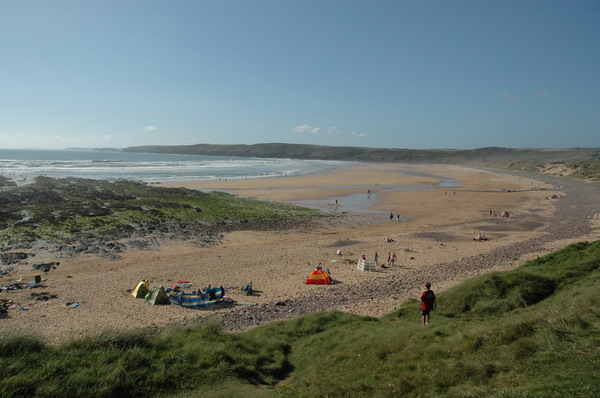
File:Freshwater West - geograph.org.uk - 239022.jpg
Freshwater West - geograph.org.uk - 239022. Photo by Jeremy Owen, via Wikimedia Commons.


Southerndown, Vale of Glamorgan

Many Doctor Who fans will have been touched by the relationship between the David Tennant version of the Doctor and his sidekick Rose Tyler (Billie Piper).  So the tearjerking scene in which the Doctor is about to declare his feelings for Rose when he suddenly dematerialises must have had them reaching for the tissues.  The scene of all this heartache was the beach at Southerndown in South Wales, meant to be Bad Wolf Bay in Norway in the series.  The production team evidently thought highly of the beach in question as a filming location: it was used in several other episodes including Journey's End, which saw Rose being joined by her successor Donna (Catherine Tate). 

Portstewart Strand, County Londonderry

One of the most magnificent beaches in Northern Ireland, and just one of a host of scenic coastal locations seen in Game of Thrones, which has just begun its seventh series, Portstewart Strand was where Jaime Lannister and Bronn were seen duelling with the Dornish guards in series 5.  The filming took place in August 2014, which was unfortunate, this being one of Northern Ireland’s most popular summer holiday spots, because the beach was completely closed for the filming.  The locals didn’t mind, though, considering the closure a small price to pay for the exposure given to Portstewart by its role in Game of Thrones.

File:A westerly view along The Strand, Portstewart - geograph.org.uk - 1312074.jpg
A westerly view along The Strand, Portstewart - geograph.org.uk - 1312074. Photo by Des Colhoun, via Wikimedia Commons.