Showing posts with label Somerset. Show all posts

Monday, 27 July 2026

THREE LOCATIONS USED IN THE ITV SERIES GONE: BRISTOL, FOREST OF DEAN, SOMERSET

 The ITV series Gone deals with the murder of the wife of Michael Polly (David Morrissey), headmaster of a prestigious school on the outskirts of Bristol. DS Annie Cassidy (Eve Myles) is the officer assigned as family liaison officer, then subsequently pulled from the role.  For much of the series Polly is a major suspect, but there is an unexpected twist at the end.

During the investigation, Cassidy has to make multiple visits to the Polly home, which entails crossing the Clifton Suspension Bridge, which is shown in all its glory from aerial views.  The bridge, the creation of the great Isambard Kingdom Brunel, opened in 1864, providing a link across the gorge between the Bristol neighbourhood of Clifton and Leigh Woods and the Ashton Court Estate in North Somerset.


Clifton Suspension Bridge - geograph.org.uk - 2085952. Photo by Steve Daniels, via Wikimedia Commons.

The school scenes which featured heavily in the series at the fictional St Bartholomew’s were filmed at Downside School an independent boarding and day school near Midsomer Norton in Somerset.  The school sits right alongside the A367, aka the Fosse Way, formerly a Roman road. 


Downside School and the abbey church - geograph.org.uk - 8257855. Photo by Neil Owen, via Wikimedia Commons.

For Mr Polly’s house, the action moves north to the Forest of Dean in Gloucestershire, namely Danby Lodge near Lydney. The property, which is listed on Booking.com, though not currently available, has a swimming pool in real life, but this was airbrushed out for the purposes of the series.


Wednesday, 8 April 2026

LONG LIVE THE PUB: MOTHER'S PRIDE/SOMERSET, WILTSHIRE AND BRISTOL

In this day and age, with pubs going under at an alarming rate due to the vicious economic policies of the Labour Party, the release of the film Mother’s Pride is very timely.  The film features a struggling West Country pub (with Martin Clunes playing the landlord) which manages to turn its fortunes around by brewing its own real ale, which is entered into the Great British Beer Awards, pitting itself against a rival pub.

The village of Norton St Philip in Somerset provided the location for the main pub in the film, the George Inn, and the rival pub, the Drovers Arms.  The real life George Inn plays its namesake, while the Fleur de Lys plays the part of the Drovers Arms.  The streets of this charming village are also seen in the film, including the scene depicting the village fete, which is set up between the George and the church of St Philip and St James.


NortonStPhilipTheGeorge. Photo by Rodhullandemu, via Wikimedia Commons.

Westbury and environs are also seen in the film.  The station scene was filmed at Westbury station, while the famous white horse etched into an escarpment to the east of the town is also featured.  The local press reported that a couple visiting the site ran into Martin Clunes while he was filming there, and described him as very nice.


Paragliding above Westbury White Horse - geograph.org.uk - 539764. Photo by Chris Downer, via Wikimedia Commons.

Back in the 80s, there was a large venue at Bristol Harbourside where beer and wine festivals were held, which always made for a fun day out.  In Mother’s Pride there is a nod to those times, as the Great British Beer Festival is filmed in the same area, specifically at the Aquarium.  


Bristol Harbourside.


Norton St Philip lies midway between Bath and Frome.  It was an important centre for the wool trade during the Middle Ages, and its church dates from the 14th century.  The Westbury White Horse, clearly visible from the trains moving through the area, is the oldest of eight white horses in Wiltshire, dating from around the late 17th or early 18th century. The Bristol Harbourside venue that used to host beer and wine fairs is no longer there, but it has been replaced by a large array of bars and restaurants, while the aquarium that featured in the film lies just behind the waterfront in another space given over to eating, drinking and entertainment. 


Monday, 3 November 2025

A REGENCY RESORT: THE SOMERSET COAST AND DYRHAM PARK/SANDITON

Sanditon is based on a novel by Jane Austen about a seaside town which is being developed into a resort by entrepreneur Tom Parker.  Unlike other dramatisations of Jane Austen novels, this one was never finished by Austen, giving the screenwriters free rein to develop the characters and storyline in the latter stages.

Episode four of the series had some of the characters going for a walk in the dunes of an extensive sandy beach, with one character collapsing from heatstroke in the dunes. We also see Sidney Parker surveying the beach from above in search of the errant Georgiana.  These scenes were filmed at Brean, one of the lesser known of the sweeping sandy beaches to grace the coast along the Bristol Channel, adjacent to the west Somerset resort of Burnham-On-Sea.  The better-known resort of Weston-Super-Mare was used for the bathing scenes, which were filmed in the Marine Lake.


Aside from Brean, other seafront scenes in the series were filmed at the small Somerset town of Clevedon.  Clevedon also has a marine lake but is best known for its graceful pier, which opened in 1869.  The pier can be glimpsed in Sanditon, which is a bit unfortunate because no such pier existed in Jane Austen’s day.


The seafront at Clevedon, Somerset - geograph.org.uk - 1867050. Photo by Anthony O'Neil, via Wikimedia Commons.

Moving away from the coast, another notable location seen in Sanditon is Dyrham Park, which we last encountered in this blog as Darlington Hall in The Remains of the Day.  In Sanditon the estate plays the role of Lady Denham’s home Sanditon House.  Managed by the National Trust, Dyrham Park is in South Gloucestershire, a few miles to the north of Bath.  We owe its existence to William Blathwayt and the fruits of the Empire, specifically the Colonies in North America, providing for its creation in the 17th century.  As well as the house there are extensive grounds, including a deer park.


Dyrham Park lower park. Photo by Rwendland, via Wikimedia Commons.


Sunday, 19 March 2023

DALLIANCES IN DORSET: EMMA (1996)


One thing is guaranteed when it comes to film adaptations of Jane Austen novels: that they will be a feast for the eyes.  Not only for the dashing young men with their flowing locks and sexy boots, and the English roses with heaving bosoms vying for their attention, but also for the idyllic English town and country scenes, which invariably include a range of stately homes.  The 1996 film Emma, starring Gwyneth Paltrow as compulsive matchmaker Emma and Toni Collette as friend Harriet Smith, is no exception, with a variety of charming locations mainly in Dorset.

The first big property to feature in the film is Hartfield, home of Emma Woodhouse and her family, where Emma is seen discussing a wedding with her father.  The location used as the exterior of Hartfield is mostly Came House in the village of Winterbourne Came, Dorset.  However, some of the interior scenes were filmed entirely elsewhere.  The dinner party scene in which Emma introduces Mr Elton (Alan Cumming) to Harriet was filmed at Stratfield Saye House in Hampshire, while Hartfield’s book-lined gallery was filmed in the Long Gallery of Syon House, west London.

Came House (2) - geograph.org.uk - 855736. Photo by Mike Searle, via Wikimedia Commons.


Another imposing property in Dorset used in the filming of Emma is Crichel House near the village of Moor Crichel, to the north of Wimborne.  In the film the property plays the part of Donwell Abbey, home of a local landowner called George Knightley.  A lake on the estate features in a lakeside archery scene.  Meanwhile, another property, Claydon House in Middle Claydon near Aylesbury, Buckinghamshire, lends its elaborate North Hall for the filming of the grand dance, in which Harriet is snubbed but subsequently rescued by Knightley.  Another local man made good, Mr Weston, who married Emma’s former governess (played by Greta Scacchi) occupies a grand property called Randalls.  This honey-coloured property in real life is Mapperton, home of the Earl and Duchess of Sandwich, which is located a short distance to the east of Beaminster, Dorset.

Mapperton House - geograph.org.uk - 517671. Photo by Chris Downer, via Wikimedia Commons.


Aside from the sumptuous residences seen in the film, there are picturesque street scenes depicting the local village Highbury (Surrey), where Mr Elton is the vicar.  The street scenes used in the film were filmed in the Dorset village of Evershot, about 7 miles south of Yeovil.  The Old Manor House in the village is used as the schoolhouse, while the post office building is used for the haberdashery store.  In order to make the street scenes more authentic for the period, the main street, Fore Street,  was festooned with sheep pens and straw for the filming.  The filming is transferred to the neighbouring county of Somerset for the scene in which Emma visits a sick lady, Mrs Clark.  The venue for this scene is the Helyar Almshouses in the village of East Coker about 3 miles south of Yeovil.

Evershot, Tess Cottage and the church - geograph.org.uk - 447131. Photo by Chris Downer, via Wikimedia Commons.


Came House was built for John Damer in 1754 from a handsome light-coloured stone.  Lying about a mile south-east of Dorchester, nowadays the house is, appropriately enough, used as a wedding venue.  Stratfield Saye House in Hampshire, about 5 miles south of Reading, has been home to the Dukes of Wellington since 1817 and is open for pre-booked tours only.  Syon House, across the River Thames from Kew Gardens, has been used extensively in filming.  Forming part of Syon Park, the house has been the home of the Dukes of Northumberland for over 400 years.  The house and gardens are open to the public, with a mix of guided and self-guided tours of the house.

Crichel House is a Classical Revival country house built for the Napier family.  The property and grounds are not open to the public apart from specific events.  Claydon House is a National Trust property and is open to the public from April.  The North Hall is a riot of rococo in yellow and white.  Mapperton House originates from the 11th century, but a Tudor manor house was built on the site by Robert Morgan in the 1540s, and rebuilt the following century by Richard Brodrepp.  The property is now the  home of the Earl and Duchess of Sandwich. The Gardens and cafe are open from March, and the house from April.

Evershot is the second highest village in Dorset and the source of the River Frome.  The village featured heavily in Thomas Hardy’s works, most notably Tess of the D’Urbervilles.  East Coker lies over the county border in Somerset, and has a history stretching back to Roman times: a Roman villa was discovered there in the 18th century.  The Helyar Almshouses were built in the mid-17th century by the Archdeacon of Barnstaple.  The construction took twenty years due to an enforced interruption brought about by the Great Plague.


Wednesday, 28 September 2022

REGENCY WRONGDOINGS: MCDONALD AND DODDS/BATH

Some of the best crime series on TV are those filmed in scenic parts of the country: Vera (ITV) showcases the windswept landscapes of Northumberland and the gritty streets of Newcastle; Inspector Morse and its spinoffs Endeavour and Lewis (ITV) take us on a tour of the venerable streets and colleges of Oxford; and Shetland (BBC) speaks for itself. These are just three examples among many.  In McDonald and Dodds, screened on ITV over three seasons, we are transported to the regency elegance of Bath and surrounding areas, as we follow the intricate caseloads of  “down from London” DCI Lauren McDonald (Tala Gouveia) and her new sidekick the drearily old-fashioned (but brilliant) DS Dodds (Jason Watkins).


We are shown some lovely aerial shots of the city, with two of the most famous landmarks standing out: the Royal Crescent and Pulteney Bridge.  Parade Gardens, near the weir below Pulteney Bridge, is where Dodds has a chat with Max Crockett (Robert Lindsay) in The Fall of the House of Crockett (season 1, episode 1), and also features in The War of Rose (season 2, episode 3), in which McDonald and Dodds are seen discussing the case of a murdered vlogger in the gardens, with Bath Abbey looming majestically in the background.   In A Wilderness of Mirrors (season 1, episode 2),  featuring an addiction treatment retreat, we are given a brief glimpse of the interior of a Bath institution, The Bell Inn on Walcote Street, a watering hole famous for its live music.  Queen Square makes several appearances in the series showing people playing boules. 

Pulteney Bridge


The countryside around Bath is studded with stunning properties, and some of these were used as locations in the series.  The Crockett household in The Fall of the House of Crockett is Crowe Hall in real life, a grade II listed Georgian mansion in Widcombe, to the east of the city centre heading out towards the University.  Eastwood Park  near Wotton-under-Edge in nearby Gloucestershire was used as the Mara Retreat in The Wilderness of Mirrors.  Other landmarks near the city used in the series include the Box Tunnel, where a murder takes place in We Need To Talk About Doreen (season 2, episode 2), and Dundas Aqueduct where the dramatic final scene of Clouds Across the Moon (last episode of series 3) was filmed.  In some scenes from Clouds Across the Moon we are taken further afield to the mystical town of Glastonbury and its famous Tor. 

Eastwood Park, Falfield - geograph.org.uk - 379225. Photo by Peter Wasp, via Wikimedia Commons.


The Royal Crescent in Bath was started in 1767 and consists of 30 Grade I listed terrace  houses, including the city’s most luxurious hotel.  The construction of Pulteney Bridge, designed by Robert Adam in the Palladian style, began in 1769, intended as a link between the city and land owned by the Pulteney family.  There is a small charge to enter Parade Gardens, which provide a pleasant riverside oasis within the city.  There is no charge to enter Bath Abbey, but donations are encouraged.  Queen Square, surrounded by elegant Georgian houses, was opened in 1728.  As in the series, in real life the square is used for playing boules, and is the venue for the annual Bath Boules tournament held in July. 


The gardens of Crowe Hall are open to the public several times a year for a small entrance charge.  Eastwood Park, near the M5 to the north of Bristol, is a conference and wedding venue.  The Park consists of a large Victorian house surrounded by 200 acres of countryside.  The Box Tunnel, opened in 1841, cuts through Box Hill on the railway line between Bath and Chippenham.  At the time of building the tunnel was claimed to be the longest railway tunnel ever built.  The Dundas Aqueduct, which opened in 1805, carries the Kennet and Avon Canal over the River Avon and the railway line between Bath and Westbury.  The town of Glastonbury has a unique atmosphere due to the many “new age” style shops and attendant eccentrics such as self-styled wizards and other spiritual types.  It is reputed to be the burial place of King Arthur, and to have been a site of Pre-Christian worship.  The tor, topped by St Michaels Tower, commands splendid views over the surrounding Somerset Levels.  The tor can often be glimpsed in shots of the Glastonbury Festival, which takes place near the village of Pilton, some distance away.

Glastonbury Tor from north east showing terraces 2. Photo by Rodw, via Wikimedia Commons.

Map of Bath.


Sunday, 7 March 2021

A POOR MAN'S JANE AUSTEN RICH IN LOCATIONS: BRIDGERTON


When fans of the Regency period in general, and Jane Austen in particular, got wind of the imminent arrival of the Netflix series Bridgerton they were no doubt salivating at the anticipation of the prospect of flirtations between cleavage-bursting young women and dashing young men sporting sideburns and knee-high boots.  However, as the series got underway opinions were deeply divided between those who found the series embarrassingly lightweight (with plenty of dark mutterings about ‘wokeness’) and those who thought it was a wonderfully entertaining tonic for these dark covid times.  One thing that cannot be denied, though, is the splendour of the locations used in the series.

I have previously blogged about Bath and its Jane Austen connections, and this handsome, honey-coloured city in the west of England plays a large part in Bridgerton.  The Royal Crescent puts in an appearance with number 1 serving as the Baron Featherington household, with digital enhancements on the facade.  Filming also took place at the Assembly Rooms and Trim Street is where we see the exterior of Gunter’s Tea Shop.

Royal Crescent, Bath. Photo by MontanNito, via Wikimedia Commons.

The stately piles occupied by the various families involved in the story are played by photogenic properties scattered around the country.  An art museum in Greenwich called Ranger’s House was used for the Bridgerton family home, with the addition of wisteria and ivy to the facade to make it look more homely.  The property belonging to the dashing Duke of Hastings was represented by three different properties: Wilton House near Salisbury for interior and exterior shots, with further interior work done at Syon House in Middlesex and Badminton House, Gloucestershire, which we last encountered as Darlington Hall in The Remains Of The Day.  Badminton House and Wilton House were also used for some of the interior scenes depicting the home of Lady Danbury, who acts as a kind of mother figure to the Duke.  The exterior of Lady Danbury’s house, meanwhile, was shot at the Holburne Museum of Art, taking us back to Bath.

Wilton-House-02-2004-gje. Photo by Gerd Eichmann, via Wikimedia  Commons.


Soaring up to the heights of Regency society, we encounter Queen Charlotte, whose residence in the series is an actual palace in real life, namely Hampton Court Palace.  Wilton House pops up again here, with some of its interiors used in the filming, along with those of Lancaster House in London. 

For the marital home of a certain pair of newly-weds we are whisked to the north of England, to Castle Howard, 15 miles north of York, where the exterior scenes were filmed, while Wilton House and Badminton House are once again used for interiors, along with North Mymms Park, a wedding venue south of Hatfield, Hertfordshire.  Staying in Hatfield, Hatfield House, a property which has been used in numerous previous productions, provided some of the interior shots of the Featherington residence.

Castle Howard and garden. Photo by Pwojdacz (talk), via Wikimedia Commons.


The city of Bath nestles in a dip in the Somerset countryside with the River Avon running through it.  Jane Austen once lived there, and as a reminder of this time there is an annual Jane Austen Festival.  Visitors who are feeling a bit flush and who want to immerse themselves in the Bridgerton experience can stay at the Royal Crescent Hotel, the city’s finest, although the less moneyed can make do with a visit to No. 1, which is a heritage museum.  The Holburne Museum of Art is next to Sydney Gardens on the east side of the city.  The Assembly Rooms are run by the National Trust and are a short distance to the east of the Royal Crescent.  For visitors coming from outside the UK the nearest international airport is Bristol Airport. 

For Bridgerton fans visiting the London area, Ranger’s House, which lies on the boundary between Greenwich Park and Blackheath, is run by English Heritage and is home to the Wernher Collection.   Syon House to the west of London is across the Thames from Kew Gardens and is the London home of the Duke of Northumberland.  The house forms part of the wider Syon Park, which is open to visitors.  Hampton Court Palace is further upstream and is famous for having been the seat of Henry VIII.  Lancaster House is near St James’s Palace and is managed by the Foreign and Commonwealth Office. 

Further afield, North Mymms Park is just off the A1 (M) south of Hatfield and offers wedding and events services, while Hatfield House forms part of Hatfield Park, both of which are open to visitors, and is a short distance to the east of Hatfield.  Heading further west, Wilton House, just outside Salisbury, is home to the Earl and Countess of Pembroke, but is open to visitors.  Badminton House is part of Badminton Estate and has been the main seat of the Dukes of Beaufort since the 17th century.  The Estate is open to visitors for house tours and garden visits.  Finally, to Yorkshire and Castle Howard, 15 miles north-east of York just off the A64 Scarborough road, which belongs to the Howard family, going back several generations.  The house and gardens are open to visitors. 

Monday, 13 July 2020

A TOUR OF ENGLAND'S FINEST CATHEDRALS: ELIZABETH AND ELIZABETH:THE GOLDEN AGE


Any film about events in English history will inevitably be chock-full of some of the finest examples of English heritage.  In the films Elizabeth (1998) and its sequel Elizabeth: The Golden Age (2007), both starring Cate Blanchett as Queen Elizabeth I, it is some of the country’s finest cathedrals that come to the fore among the locations used.

In Elizabeth, the coronation scene was filmed at York Minster, which proved a splendid substitute for Westminster Abbey, where the actual coronation took place on 15 January 1559.  The Minster lies in the centre of this historic city, and due to the flat terrain in the area surrounding it can be seen from miles around.  There has been a place of worship at this spot since the 7th century, but it was not until 732 that the first Archbishop of York was recognised by the Pope.  The present building took a massive 250 years to complete, starting in 1220 and ending in 1472.  The Minster brought shocking images to our TV screens in 1984 when a fire which started in the south transept raged out of control, and firefighters were forced to deliberately collapse the roof to save the rest of the building.

File:York Minster from M&S.JPG
York Minster from M&S. Photo by Matze Trier, via Wikimedia Commons.

The other cathedral which  makes an appearance in Elizabeth is Durham Cathedral.  The cathedral plays the part of the royal palace, and its distinctive pillars are seen in the scene where Elizabeth searches for Lord Robert after receiving a message.  Like York Minster, Durham Cathedral was preceded by a humbler place of worship known as the Saxon ‘White Church’.  The present-day building, which makes for a picturesque sight overlooking the River Wear, was built between 1093 and 1133, with further additions thereafter.

File:Durham Cathedral Nave.jpg
Durham Cathedral Nave. Photo by Michael D Beckwith, via Wikimedia  Commons.

In Elizabeth: The Golden Age we are taken further south, with Ely Cathedral in Cambridgeshire playing an important role as the Palace of Whitehall, which in those days was the main residence of the monarchs of the day.  It is seen in a number of scenes, such as the one where Elizabeth confronts the Spanish Ambassador, and when Sir Walter Raleigh arrives bearing gifts from the New World.  Ely Cathedral is unusual in that, unlike most cathedral cities, Ely is the size of a small town.  In fact, the cathedral came before the town, which grew up around it.  There is a slate in the cathedral marking the location of a former shrine to Ethelreda, daughter of the King of East Anglia, who founded an abbey at the location of what is now the cathedral.  The building dates from 1083, and was granted cathedral status in 1109.

File:Ely Cathedral Choir East View.jpg
Ely Cathedral Choir East View. Photo by Michael D Beckwith, via Wikimedia Commons.

The sequel covers the period leading up to, and including the country’s spat with Spain, and Westminster Cathedral transports us over the water to the court of King Philip II, as it was where the scenes were filmed featuring the ranting king, plotting his invasion of England following the execution of Mary, Queen of Scots.  As a Roman Catholic cathedral, Westminster Cathedral was a good choice.  The cathedral is much younger than the others used in the two films, with construction completed in 1903.  Its main distinguishing feature is the striped appearance of its exterior, fashioned from layers of brick and stone.

File:Westminster.cathedral.frontview.london.arp.jpg
Westminster.cathedral.frontview.london.arp. Photo by Arpingstone, via Wikimedia Commons.

One of the most dramatic scenes in the sequel is the attempt on Queen Elizabeth’s life by Thomas Babington (Eddie Redmayne), an event which is pure fiction, since in reality this particular individual did not get anywhere near the Queen, although it is true that there was a plot to assassinate her.  The scene in question was filmed in Winchester Cathedral.  Originally founded in 642 and known as Old Minster, the present-day cathedral was started in 1079 at a site nearby, and the Old Minster was demolished in 1093.  The cathedral has the distinction of being one of the largest in Europe, and includes many notable features, such as the 17th century choir screen designed by Inigo Jones.

File:Winchester Cathedral Nave 1, Hampshire, UK - Diliff.jpg
Winchester Cathedral Nave 1, Hampshire, UK - Diliff. Photo by DAVID ILIFF, via  Wikimedia Commons.

Finally, for the main entrance to Whitehall Palace as seen in the sequel, the producers made use of Wells Cathedral, specifically the staircase linking the North Transept to Chapter House.  Like Ely, Wells is another unusually small cathedral city, nestling among the green fields of the Somerset countryside.  The cathedral was built to replace an earlier church which had occupied the site since 705, and construction spanned the period from 1176 to 1450.  One of the cathedral’s best known features is its astronomical clock dating from around 1325.

File:Wells cathedral chapter house brighter.JPG
Wells cathedral chapter house brighter. Photo by Lamiai, via Wikimedia Commons.


Tuesday, 9 June 2020

A SLICE OF HEAVEN IN DEVON: SENSE AND SENSIBILITY


Whenever there is an adaptation of a Jane Austen novel on the big or small screen, one thing can be certain: the locations will inevitably feature some of Britain’s finest stately properties. 

The property which kicks off the story in the 1995 film adaptation of Sense and Sensibility, directed by Ang Lee, is the fictional Norland Park in Sussex, which is left by a dying father to his son, but due to the rules of inheritance the three daughters Elinor, Marianne and Margaret and their mother (Emma Thompson, Kate Winslet, Emilie Francois and Gemma Jones) are left with next to nothing.  Worse still, they are forced to move out of their lovely family home, while the son and his wife John and Fanny (James Fleet and Harriet Walter) move in.  The mother and daughters are offered accommodation by a cousin, but it is a bit of a come-down, being just a ‘cottage’ in the depths of Devon, albeit in a heavenly rural setting near the coast.

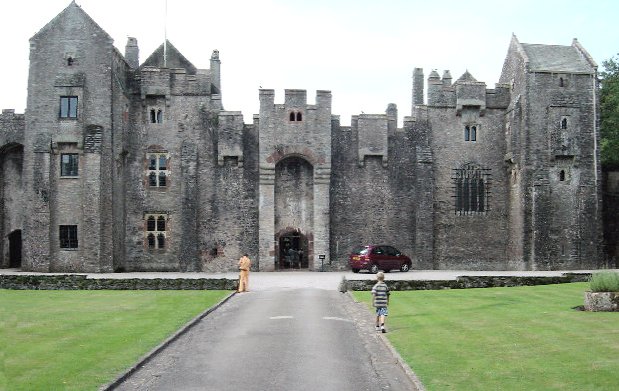
The real-life version of Norland Park is Saltram House near Plymouth, a Grade I listed George II era mansion, while the cottage, Barton Cottage in the story, is Efford House on the Flete Estate, which actually is in Devon in real life, again near Plymouth.  The waterside scenes set near the cottage were also filmed in Devon, at the mouth of the River Erme.  However, the exterior of Barton Park, the wider estate where the cottage is located, is actually further east in Wiltshire, where the scenes were shot at Trafalgar Park, between the city of Salisbury and the northern edge of the New Forest.


File:Efford House - geograph.org.uk - 292694.jpg
Efford House - geograph.org.uk - 292694. Photo by Derek Harper, via Wikimedia Commons.


Another striking property in Devon, which is seen at a distance as a large grey mass of architectural splendour surrounded by sloping green fields, is the Combe Magna estate, owned by love interest John Willoughby (Greg Wise).  In real life this is a fortified manor house called Compton Castle near the resorts of Torbay.  The manor house dates from the 1400s and was connected to Sir Walter Raleigh.  Still in Devon, the wedding scene at the end was filmed at St Mary’s Church in the village of Berry Pomeroy near Totnes.

File:Compton Castle in Devon enh.jpg
Compton Castle in Devon enh. Photo by Smalljim, via Wikimedia Commons.

One of the most dramatic scenes in the film comes towards the end, when Marianne suffers a life-threatening illness, to the distress of Captain Colonel Brandon (Alan Rickman), who has developed a soft spot for her.  She falls ill while visiting the estate owned by a couple in the Dashwoods’ social circle called the Palmers (Imelda Staunton and Hugh Laurie).  This magnificent property is the real-life Montacute House near Yeovil in Somerset, a late Elizabethan mansion with manicured lawns and gardens.


                                                                      Montacute House. 

Mid-way through the film we are transported to London, where many well-to-do people in Jane Austen’s time had their “London base” in addition to their country properties.  The London abode of the dreadful Fanny Dashwood and her husband John is represented by a house in Adam Street, WC2, while Chandos House in Queen Anne Street is the home of the Palmers.  However, the Chelsea home of the ebullient Mrs Jennings (Elizabeth Spriggs) is not in London, but in Salisbury, in reality the 18th century Mompesson House in the Cathedral Close.

Most of the properties featured in the film are open to visitors.  Saltram, Compton Castle, Montacute House and Mompesson House are run by the National Trust.  Trafalgar Park is privately owned, but can be used for events and weddings.  Meanwhile, for anyone wanting to immerse themselves fully in the Dashwoods’ idyllic life in Devon, Efford House is available as a holiday let.


Friday, 1 May 2020

LOVELY SETTINGS FOR A LOVELESS MARRIAGE: THE DUCHESS


Lady Georgiana Spencer, an ancestor of Princess Diana, was born in Althorp, where the Princess is buried.  At the age of 17 she was married off to William Cavendish, 5th Duke of Devonshire, whereupon she became the Duchess of Devonshire.  On paper it sounds like a fairy tale for the young Georgiana, but unfortunately the Duke turned out to be a philanderer who was only interested in gaining a male heir.  Georgiana’s first two children, as sod’s law would have it, were female, but she finally managed a son the third time round.  Meanwhile, Georgiana became friendly with Lady Elizabeth Foster from Suffolk while on a visit to Bath.  Predictably, Elizabeth caught the roving eye of the Duke and she ended up in a ‘menage a trois’ with the pair of them, bearing two illegitimate children by him and finally becoming his wife three years after Georgiana’s death in 1806, only for the Duke to die two years later.  This saga is the subject of the 2008 film The Duchess, starring Keira Knightley as Georgiana and Ralph Fiennes as William. 

The scenes depicting Georgiana’s time at Althorp did not make use of the real-life Spencer family seat, but were filmed at Kedleston Hall in Derbyshire.   One twist to this whole sorry tale is that Georgiana fell madly in love with Charles Grey (played by Dominic Cooper), a Whig Party member who would later become Prime Minister, but in spite of William’s own infidelities he would not allow her to continue the liaison (which resulted in an illegitimate daughter).  In the film she is seen flirting with Charles, a scene filmed at the South Front of Kedleston Hall.  The scene in which her mother (Charlotte Rampling) is filmed meeting with William to persuade him of her daughter’s charms was filmed in the Library.  Another scene in which Georgiana’s hair catches fire was also filmed here, this time in the Marble Hall. 

File:Kedleston Hall 04.jpg
Kedleston Hall 04. Photo by Glen Bowman, via Wikimedia Commons.


The country estate of the Dukes of Devonshire is Chatsworth House, one of Britain’s best-known stately homes.  Chatsworth played itself in the film when the wedding scenes were filmed there.  However, the Dukes had another base in London called Devonshire House in London’s Piccadilly.  The scenes depicting Devonshire House made use of a number of locations for the interior and exterior shots.  The original building was demolished in 1924, so the film-makers had to find an alternative for the exterior, and Somerset House in The Strand proved the perfect choice.  The interior scenes were all over the place, making further use of Kedleston for some scenes, plus Clandon Hall, Guildford, with Holkham Hall in Norfolk used to depict the dining room. The streets of London, in which the newly-weds are filmed trundling along in their carriage being cheered by crowds of people, are actually the grounds of the Old Royal Naval College in Greenwich.

File:Chatsworth Bridge.jpg
Chatsworth Bridge. Photo by Rob Bendall, via Wikimedia Commons.

In the scenes in which Georgiana goes to Bath to take the waters, this beautiful city gets to play itself, as the graceful Royal Crescent comes into view.  Another famous Bath landmark is the Assembly Rooms in Bennett Street.  The tea room forms the backdrop to the scene where Georgiana is presented to the throng and where she first meets Elizabeth.  However, the river scenes seen in this part of the film were not filmed in Bath, but back at Kedleston.

File:Royal Crescent, Bath 2014 04.jpg
Royal Crescent, Bath 2014 04. Photo by Mike Peel, via Wikimedia Commons.


Kedleston Hall, to the north-west of Derby, is an 18th century neo-classical house designed by Robert Adam and surrounded by sumptuous parkland.  The property is owned by the National Trust.  Chatsworth House, on the banks of the River Derwent near Bakewell, Derbyshire, is privately owned but open to visitors complete with retail and refreshment points.  The house was initially completed in 1708, with later additions the following century.  The extensive grounds include many interesting features, including fountains, a temple and a rectangular lake known as the Canal Pond.

Somerset House is a neo-classical building on the south side of The Strand in London.  It is been used for many purposes over the years, but its current role is principally as an arts centre.  The Old Royal Naval College dominates the banks of the River Thames in Greenwich.  A naval college since 1873, it forms part of the Maritime Greenwich UNESCO World Heritage Site.  The College has been used extensively in filming, proving useful to film-makers as a quieter alternative to Central London for street scenes, Clandon Park, to the north-east of Guildford, Surrey,  is owned by the National Trust, but unfortunately Clandon Hall itself was destroyed by a catastrophic fire in 2015 and still stands as a ruin today.  Holkham Hall is in Holkham in North Norfolk, famous for its vast sandy beach.  An 18th century house in the Palladian style surrounded by extensive parkland, it is privately owned but open to visitors.

The Royal Crescent in Bath was started in 1767 and consists of 30 Grade I listed terrace  houses.  For those wanting to immerse themselves in the Georgian spa town experience, part of the crescent has been given over to Bath’s poshest hotel, the Royal Crescent Hotel and Spa.  The Assembly Rooms, another National Trust property and designed in 1769, were the focal point of Georgian Bath’s social scene.  The building is used for functions and conferences, and can be visited when not in use.  There is also a Fashion Museum on the premises.  Both the Royal Crescent and The Assembly Rooms were designed by the architect John Wood, the Younger.

Tuesday, 26 June 2018

SAMUEL TAYLOR COLERIDGE: THE SOMERSET YEARS


The poet Samuel Taylor Coleridge was born in 1772 in Ottery St Mary in Devon, and he died in Highgate, Middlesex.  However, it was during the short time he spent in Somerset, in 1797-1798, when he lived at what is now known as Coleridge Cottage in Nether Stowey, that he produced some of his most famous work.  


File:Coleridge Cottage - Nether Stowey - Somerset, England - DSC01217.jpg
Coleridge Cottage - Nether Stowey - Somerset, England - DSC01217. Photo by Daderot, via Wikimedia Commons

Probably the most well known of his works is The Rime Of The Ancient Mariner.  The story goes that Coleridge was walking in the Quantock Hills with William Wordsworth and his sister Dorothy, who were staying at nearby Alfoxton Park, when the conversation turned to a book Wordsworth was reading about a round-the-world sea voyage, and that this provided the inspiration for The Rime Of The Ancient Mariner, which features an albatross which helps the ship and its crew out of an Antarctic ice jam.  There is a statue in nearby Watchet commemorating the poem, depicting the mariner with the albatross looped around his neck as described in one of the verses.

File:The Ancient Mariner, Watchet - geograph.org.uk - 1707049.jpg
The Ancient Mariner, Watchet - geograph.org.uk - 1707049. Photo by Nigel Chadwick, via Wikimedia Commons

Another work conceived during this time was the poem Kubla Khan.  Coleridge started the poem in 1797 following a vision in a dream – possibly opium-induced, as Coleridge was in the habit of using opium to ease his health issues.  However, the poem was never completed because while he was composing it he had an unwelcome visitor from Porlock who interrupted his train of thought.  Since then the phrase “person from Porlock”, or just Porlock, has been used as a reference to an unwanted visitor who interrupts the writer’s creative flow. 


It was also during his time in Somerset that Coleridge composed a trio of poems known as the “conversation poems”: This Lime-Tree Bower My Prison, Frost at Midnight and The Nightingale.  In 1798 he teamed up with his new chum Wordsworth to produce a joint volume of poetry called Lyrical Ballads.  This is widely recognised as marking the birth of the English ‘romantic age’.  The Lime-Tree Bower My Prison includes an entrancing description of the charms of the Quantocks, referring to: “the many steepled tract magnificent”; the view towards the Bristol channel with “the slip of smooth clear blue betwixt two isles”; the elms whose “branches gleam a darker hue through the late twilight”; and the birds – “the bat wheels silent by, and not a swallow twitters”.  In fact, Coleridge wrote this passage from the point of view of one of his friends, who had gone off to enjoy the hills while Coleridge was forced to stay behind at Nether Stowey after an accident involving boiling milk.

File:Newton, Bicknoller, and Quantock hills - geograph.org.uk - 93580.jpg
Newton, Bicknoller, and Quantock Hills - geograph.org.uk - 93580. Photo by Martin Southwood, via Wikimedia Commons

The village of Nether Stowey lies midway between Watchet and Bridgwater, just below the eastern flank of the Quantocks.  Coleridge Cottage, in Lime St, is now run by the National Trust and open to visitors.  There is a pub opposite called The Ancient Mariner in a nod to the famous poem.  Another point of interest in the village is the ancient Nether Stowey Castle, of which only the foundations of the keep remain.  It is believed that the castle was destroyed during the 12th Century Civil War.


Tuesday, 21 November 2017

HELL'S WELLS: HOT FUZZ


The cathedral city of Wells in Somerset has more of the feel of a market town than a city, but a city it is due to the presence of the aforementioned cathedral.  Its size has led to it being commonly described as England’s smallest city.  Traditionally, visitors have flocked to the city to admire the cathedral and the adjacent Bishop’s Palace with its famous swan-filled moat.  However, in more recent years film and TV buffs have started coming here, what with Wells’ starring role in a number of film and TV productions.  One film in particular is linked to the city, and that is Hot Fuzz, an action comedy about a police officer who is moved from the crime-ridden streets of London to the sleepy village of  Sandford (aka Wells) expecting to be bored stiff, only to find that the village is a hotbed of violent crime.

When filming took place in 2006, much was made of the city’s picturesque centre, in particular the main street and the Market Place, with its Bishops Eye Gate and the Penniless Porch, two arched entrances leading to the walled precinct known as the Liberty of St Andrew, within which are the Cathedral, the Bishop’s Palace and the Vicars’ Close.  The Penniless Porch, built around 1450, was named after the beggars who used to hang around there in those days.  The moat surrounding the Bishop’s Palace is where PC Angel is seen jogging in an early scene.  The Palace is also where Angel is seen meeting with the Neighbourhood Watch, and a night-time meeting described as taking place at the "castle" was also filmed outside the Palace (Wells does not have a castle).

File:Wells, Somerset, 24 June 2013.jpg
Wells, Somerset, 24 June 2013. Photo by Barry Lewis, via Wikimedia Commons
File:Wall and moat surrounding Bishop's Palace, Wells - geograph.org.uk - 1752894.jpg
Wall and moat surrounding Bishop's Palace, Wells - geograph.org.uk - 1752894.  Photo by Derek Harper, via Wikimedia Commons

Two of the city’s pubs feature heavily in the film.  When PC Angel first arrives from London he is put up in the Swan Hotel.  The local watering hotel where the cops meet up for a drink is the Crown, whose exterior features in many shots, although the interior scenes were filmed in The Royal Standard of England in Forty Green, Beaconsfield.  The city’s pint-sized entertainment venue, appropriately named The Little Theatre, also makes an appearance.  

File:The Swan hotel - geograph.org.uk - 188448.jpg
The Swan hotel - geograph.org.uk - 188448. Photo by Sharon Loxton, via Wikimedia Commons

Perhaps the most unlikely star location of the film is the Somerfield supermarket (no longer a supermarket since the demise of the Somerfield chain).  The supermarket’s charming but sinister manager, played by Timothy Dalton, is at the centre of the series of grisly murders taking place in the village, and the supermarket is one of the scenes of a prolonged gunfight towards the end of the film.  Apparently, the director of the film used to work at the store.  Another scene featured in the violent climax is a model village, but visitors in search of Hot Fuzz locations need not bother looking for it as Wells does not actually have a model village in real life.

Other film and TV productions which have featured Wells include Wolf Hall, Elizabeth: The Golden Age, The Libertine, The Hollow Crown and Poldark in which the Town Hall doubled as the Warleggan Bank.

Wells is to the south of Bristol, just under an hour by car from there, or reachable from junction 23 of the M5 motorway.  There is also a regular bus service from Bristol, but no rail service.