Tuesday, 31 March 2020

THE LADY OF LINDISFARNE: VERA


ITV seems to have become the go-to channel for crime and drama series set or filmed in picturesque parts of the British Isles.  We have had Broadchurch set on the Dorset coast, The Bay set in Morecambe Bay, Deep Water set in The Lake District, Midsomer Murders filmed around the Thames and Chilterns area, and of course Morse and its spin-offs Endeavour and Lewis set and filmed in Oxford and surrounding areas.  These are just the ones that immediately spring to mind.


With the Vera crime series, starring Brenda Blethyn as the motherly but stern lady detective, we are transported to the north-east, with its beautiful coastal and inland scenery and its wonderful local accents.  Of the many locations used in the 9 series so far televised, the most frequently seen is Lindisfarne, otherwise known as Holy Island, which is where Vera’s house is (Snook Cottage in real life).  Getting to and from  Holy Island involves a drive along a causeway which is engulfed by the sea at high tide closing it to traffic for several hours twice a day, begging the question how is Vera able to rush to the latest crime scene if the tide is up?  Something which is never really explained in the series.

File:Causeway and refuge Holy Island - geograph.org.uk - 971516.jpg
Causeway and refuge Holy Island - geograph.org.uk - 971516. Photo by Chris Gunns, via Wikimedia Commons.


Holy Island is a feature of the Northumberland coast which is unmistakeable to anyone heading north from Bamburgh, largely thanks to the castle perched at one end of it, looking like something out of a fairy tale.  A fort dating from the Tudor period, the castle sits so naturally on its cone of rock that it almost seems an extension of the rock itself.  The castle was built in 1550 and by the end of the 19th century it was a ruin, then in 1902 Edwin Lutyens restored it, converting it into a private house.  The property is now run by the National Trust, while the other prominent historical landmark on the island, Lindisfarne Priory, dating from 1093, is run by English Heritage.  There is a little village on the island with a cluster of cottages, a  handful of shops and a couple of pubs.  For nature lovers, the mudflats, salt marshes and dunes around the island form part of a National Nature Reserve.

Lindisfarne Castle in summer. Photo by Robert Eyers, via Wikimedia Commons.


Map of the area.

Tuesday, 17 March 2020

FACING THE MUSIC IN BUCKINGHAMSHIRE: QUARTET


Quartet, released in 2012 and directed by Dustin Hoffman, is based around Beecham House, a home for retired musicians, where the residents celebrate the birthday of Giuseppe Verdi every year with a concert in his honour.  This year’s concert is disrupted by the arrival of the ex-wife of one of the residents, Jean, a diva in the true sense of the word.


Jean is played by national treasure Dame Maggie Smith (alongside such luminaries as Michael Gambon, Tom Courtenay, Billy Connolly and Pauline Collins).  Another national treasure plays the role of the residence in question: Hedsor House, Taplow, between Slough and Maidenhead, which was used for almost the entirety of the filming, along with Taplow’s St Nicholas’ Church.


Hedsor House, which stands in 85 acres of parkland overlooking the River Thames, forms part of an estate dating from 1166, when it was owned by the de Hedsor family.  During the 18th century it was home to Princess Augusta, Dowager Princess of Wales and mother of King George III.  The following century it was regularly visited by Queen Victoria.  Latterly, the house became the property of the Shephard family, being gifted to one of its number, Alexander Shephard, by his great grandparents as a wedding present.  The house was requisitioned during World War 2 for military use, then in 1952 the Americans moved in, using it as a secret communications base before it was returned to the Shephards in 2003.  The house has 100 rooms and features include a ballroom, a grand hall with a gallery and a sunken garden.


Alexander and his wife now live in a farmhouse on the estate.  The main house has become popular as a wedding venue, and for filming.  One of Alexander’s sons recalls walking into the kitchen in the farmhouse during the filming of Quartet to find Dustin Hoffman sitting there, having decamped to the farmhouse while a wedding was going on in the main house.  Hoffman apparently made the bride and groom’s day by posing for photos with them.  During the filming Hoffman had a summer-house built in the grounds, and he left this for the family as a gift.


Other films featuring Hedsor House include Legend (2015) about the Kray brothers, and The Golden Compass(2007), a fantasy adventure film starring Nicole Kidman.

Map of Hedsor House and environs.

Hedsor House, Hedsor Park, Taplow, Buckinghamshire. Photo by Ami and Debo Mukherjee, via Wikimedia Commons.


Friday, 14 February 2020

A BEGINNING AND AN END TO A LIFE WELL LIVED: JANE AUSTEN/HAMPSHIRE


There are many places around the country with Jane Austen associations, whether from mentions in her books (for example Lyme Regis in Persuasion) or places she has visited and which have formed inspiration for her work (such as Netley Abbey, believed to be the inspiration for Northanger Abbey).  However, her life began and ended in two tranquil locations in Hampshire less than 20 miles apart.


Jane’s life began in 1775 in the Rectory in Steventon, a tiny village to the north of the A303 near Basingstoke, where she grew up with her siblings until the family moved to Bath.  It was here that she drafted two of her most famous stories: Pride and Prejudice and Sense and Sensibility.  Unfortunately, there is not much for Austen fans to see in the village now, the Rectory having been demolished soon after the move to Bath.  The site was excavated by volunteers in 2011, and the fragments of objects found during the dig provided an insight into the family’s day-to-day life.  All that remains now is an old lime tree planted by Jane’s eldest brother James.


Towards the end of her life, four years after her father’s death in 1805, Jane’s brother Edward moved her, her sisters and mother to a red brick cottage in Chawton, near the A31 and to the south-west of Alton, Hampshire.   Her life there was very quiet and family-oriented, certainly by comparison to the time she spent in Bath.  Her quiet existence there enabled her to concentrate on her writing, and it was from here that her novels became published works, including the earlier drafted Pride and Prejudice.  It is this property which is the one most visited by Austen fans, having been turned into the Jane Austen’s House Museum.


File:Chawton-Austen-House.jpg
Chawton-Austen-House. Photo by Jahs, via Wikimedia Commons.


Although Jane’s last permanent address was the cottage in Chawton, strictly speaking she ended her life in Winchester.  While in Chawton her health began to decline, with her deterioration becoming inescapable during 1816.  In January 1817 she began writing a novel initially titled ‘Two Brothers’, but later retitled ‘Sanditon’.  She only managed to complete eleven chapters before putting her pen down for the last time.  In May of that year her sister Cassandra and brother Henry brought her to Winchester for treatment, but sadly this was to no avail, and she died in July at the age of 41.  Jane died in a mustard-coloured house at 8 College Street, and she was buried at Winchester Cathedral.  The house bears a plaque recording her time there.  Her cause of death has widely been reported as Addison’s disease, although some versions cite Hodgkin’s lymphoma as the condition which finished her off.

File:Jane Austen's House, Winchester - geograph.org.uk - 1322610.jpg
Jane Austen's House, Winchester - geograph.org.uk - 1322610. Photo by Stephen McKay, via Wikimedia Commons.

Thursday, 16 January 2020

THE SHOW THAT PUT BARRY ON THE MAP: GAVIN AND STACEY


Until the mid-noughties, the Welsh town of Barry, including the resort area of Barry Island, was one of the more obscure coastal towns on the British coast, with a reputation for being a bit down-at-heel, a reputation confirmed by my husband’s accounts of childhood trips to the area.  However, all this has changed since 2007, when the engaging sitcom Gavin and Stacey hit our screens.  Barry has been used as the main backdrop of this story of a long-distance romance between Gavin from Essex (Matthew Horne) and Stacey from South Wales (Joanna Page), drawing in their friends Smithy (James Corden), Nessa (Ruth Jones) and assorted family members.

Barry Island (19246735281). Photo by Jeremy Segrott, via Wikimedia Commons.


Undoubtedly the main draw of Barry Island is its golden beaches, fringing the attractively curved Whitmore Bay, and this is where the beach scenes of the series were filmed.  In series 3, Stacey is seen working in a beachside cafe: this is Marco’s Cafe towards the western end of the beach.  A few steps from the cafe is the Island Leisure Amusement Centre, which is Nessa’s place of work.  The beach wall by Boofy’s Fish and Chips Cafe, was used for a classic shot of the four friends together.  

Barry Island promenade (4674). Photo by Nilfanion, via Wikimedia Commons.


In one episode, Nessa has a change of career when she tries her hand at being a human statue.  The scene was shot outside Barry’s Library and Town Hall in King’s Square.  Staying in Barry, a couple of local hotels feature in the filming: the Tadcross Hotel at 271 Holton Road is the scene of a christening party and the Colcot Arms in Colcot Road is where Smithy’s quiz night is held.  However, the hotel where Nessa reveals she is pregnant is not in Barry, but is the Glendale Hotel in Penarth, just outside Cardiff.  Penarth is also the location of Gwen’s birthday barn dance, which takes place in All Saints Church Hall, Victoria Road.  

File:All Saints Church, Penarth - geograph.org.uk - 5053179.jpg
All Saints Church, Penarth geograph.org.uk - 5053179. Photo by Jaggery, via Wikimedia  Commons
As for the houses occupied by the merry band of friends and relatives, several of the characters live in Trinity Street in Barry.  The real-life residents have had to put up with droves of fans turning up, even coach parties in some cases.  Another house in Dinas Powys near Penarth doubles as Gavin’s house in Billericay and has also been a magnet for fans, apparently to the dismay of the owner.  

Map of Barry  

Monday, 23 December 2019

SHERE CHRISTMAS ROMANCE: THE HOLIDAY


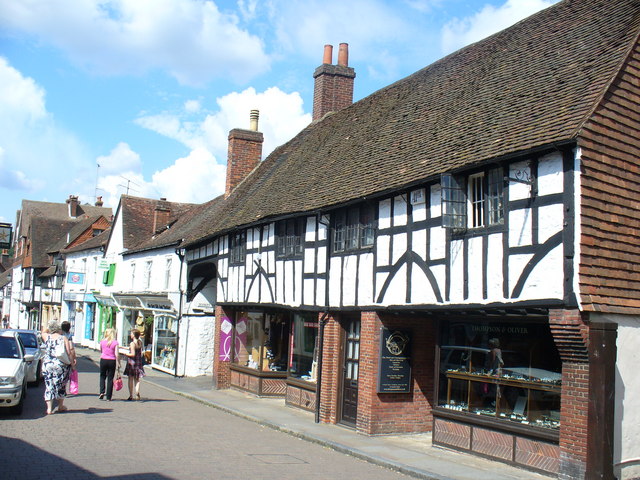
Shere is the sort of village that automatically comes to mind when people think of rural England.  So it is no surprise that it has been used in films on several occasions.  As well as Bridget Jones, The Edge of Reason and Four Weddings and a Funeral, Shere was one of several picturesque locations featured in the Christmas romantic comedy The Holiday, in which two women, one American (Cameron Diaz  as Amanda) and one British (Kate Winslet as Iris) swap houses for the Christmas period to get over their respective broken hearts and find new love.


Shere lies in the Vale of Holmesdale between Guildford and Dorking in Surrey at the foot of the North Downs, and consists of an assortment of pretty cottages, two pubs, a church, a tearoom and a small museum.  A stream running through it with ducks completes the idyllic picture.  The cottage Iris lives in was built specially for the film on a hillside overlooking Shere, but it was inspired by a real one much further away.  Of course, no Christmas romantic comedy would be complete without a covering of snow, so the village is seen in the film with its white winter coat on (disregarding the fact that southern England very rarely gets snow over Christmas).

Church Hill, Shere - geograph.org.uk - 535227. Photo by Colin Smith, via Wikimedia Commons.


As well as Shere, the nearby town of Godalming is seen in some of the village scenes plus the railway station scene.  Church Street is seen adorned with Christmas decorations and snow as Amanda heads into town to do some shopping.  Bigger than Shere, but almost as picturesque, Godalming lies to the south of the River Wey, four miles from Guildford.  

File:Church Street, Godalming - geograph.org.uk - 1380443.jpg
Church Street, Godalming - geograph.org.uk - 1380443. Photo by Colin Smith, via Wikimedia Commons
Map of the area

Wednesday, 11 December 2019

MADNESS AT THE MANOR: JANE EYRE/NORTON CONYERS, NORTH YORKSHIRE


There are certain novels which captured my imagination as a child, and Jane Eyre by Charlotte Bronte was one of them.  I remember being horrified at the idea of a madwoman holed up in an attic, in this case Mrs Rochester, first wife of Edward Rochester, the male romantic lead of the story who enters into a liaison with the governess he has hired, the Jane Eyre of the title.  Rochester is the master of Thornfield Hall, where he has shoved his unfortunate wife out of sight on the third floor.

So where did Charlotte get the idea for this grim tale?  Well, in 1839 she paid a visit to a medieval manor house called Norton Conyers near the village of Wath near Ripon North Yorkshire, and while she was there she learned of a mad woman who had allegedly been locked up in the attics the century before Charlotte’s visit.  That the property was the inspiration for Thornfield Hall is borne out by the fact that a blocked staircase connecting the first floor to the attics was discovered in 2004.  Such a staircase was mentioned in Jane Eyre, which seems pretty conclusive proof that Norton Conyers is the real-life Thornfield.

File:Norton Conyers - geograph.org.uk - 881476.jpg
Norton Conyers - geograph.org.uk - 881476. Photo by David Rogers, via Wikimedia Commons
The house and gardens at Norton Conyers are open to visitors, but only on certain days of the year due to ongoing renovation work on the house – the dates can be found on the website.  There is a charge for the house but the gardens are free to visit.  The gardens were laid out in the 18th century and their features include an orangery, herbaceous borders and an ornamental pond. 

For more information on the Bronte family, follow this link.


Wednesday, 20 November 2019

A ROYAL RETREAT IN SCOTLAND: THE CROWN/ARDVERIKIE ESTATE


Not being the most ardent royalist, I resisted all the hype surrounding the Netflix series The Crown until recently.  But with the latest series now upon us I decided to have a look at the earlier episodes to see what all the fuss is about, and to my surprise I am finding it rather good. 

Inevitably, a show such as The Crown will be full of sumptuous locations.  The interior of Buckingham Palace, for example, was shot in Wilton House near Salisbury, while Winchester Cathedral was used for the Churchill funeral scenes, and the Windsor Castle interiors were filmed at Belvoir Castle in Leicestershire.  

One of the most scenic locations is that used to represent the Queen’s Scottish retreat Balmoral: Ardverikie Estate in Inverness-shire.  The estate, which in earlier times was the subject of a tug-of-war between the Macpherson and Mackintosh clans, forms the backdrop to the 19th century baronial mansion Ardverikie House, formerly a hunting lodge and set on the shore of Loch Laggan, about 10 miles as the crow flies to the south of the more famous Loch Ness.  The present-day building is of typical Scottish baronial-style architecture, a riot of turrets and other grandiose grey-stone features.

Ardverikie House (2477752137). Photo by Bert Kaufmann, via Wikimedia Commons.


Ardverikie Estate has form when it comes to featuring in royal scenes, as it was also used in the film Mrs Brown, starring Judi Dench as Queen Victoria.  It was during her reign that Balmoral was purchased by her husband Prince Albert.  As it happens, in real life the couple stayed at Ardverikie Estate in 1847 as the guests of James Hamilton, the Marquis of Abercorn and Groom of the Stole to Prince Albert.  The estate was also used for the fictional Glenbogle Estate in the BBC series Monarch of the Glen.

Fans of The Crown who want to immerse themselves in the Ardverikie/Balmoral experience can stay at Ardverikie Estate, which offers a range of self-catering accommodation. 
Map of the area.