Tuesday, 21 February 2017

WOEFUL IN WILTSHIRE: JOHN BETJEMAN AT MARLBOROUGH


The late John Betjeman, who was appointed Poet Laureate in 1972, and remained in the role until his death in 1984, leaves behind a wealth of evocative verse and prose, describing the places he knew and visited around Britain so vividly that he transports the reader back to an earlier time redolent with nostalgia.  One of his best known works is the autobiographical 'Summoned by Bells', which recalls his childhood, his school days and his time at University.  Chapter VII of the collection covers his time at Marlborough College, a boarding and day school in the attractive small Wiltshire town of the same name which he attended in the early 1920s.

File:Entrance to Marlborough College on the Bath Road. - geograph.org.uk - 1509846.jpg
Entrance to Marlborough College on the Bath Road - geograph.org.uk - 1509846. Photo by Steph, via Wikimedia Commons.

Betjeman was allegedly quite miserable at Marlborough College, where he spent five years (“Thank God I’ll never have to go through them again”) and he does not miss an opportunity to have a dig at it in his poetry, referring to it as “my prison house”.  Winters were a particular endurance test, described as “Black as our college suits, as cold and thin”.  Mealtimes did not bring any solace, with cakes “harder than the rocks”, tea which is “made from stewed up socks”, and a Dining Hall smelling of Irish Stew.  The teas at the College were described as a joke – “you only ate them when quite stony broke”.    

Sports formed a large part of life in the College, and Betjeman bemoaned the fact that for five years he and his fellow pupils “shivered in exiguous shorts”.  While at the College he founded a satirical magazine called ‘The Heretick’, which made fun of this obsession with sport.  Other negative memories recalled in the poem include the “casual beatings”, the stone flag passages and the iron bars.  In the early 1960s Betjeman made a documentary film about Marlborough, part of a series which became lost, but subsequently rediscovered.  The director of the piece on Marlborough recalls that it took some persuading to get him to go through the gates of the school for the filming on his first visit there for 40 years, such were his feelings about it.

It wasn’t all bad though, because he liked the town and adored the surrounding countryside.  He used to walk along the River Kennet, which he recalls in the poem with the line “The smell of trodden leaves beside the Kennet, On Sunday walks with Swinburne in my brain” (a reference to a fellow English poet).  He also cycled to Silbury, “by burnt-up hawthorn edged again with white from chalk dust whirled by Fords and Lancias” (Marlborough is in the middle of a predominantly chalk terrain) and to “sepulchral Avebury “.

File:Avebury Ring - geograph.org.uk - 443147.jpg
Avebury Ring - geograph.org.uk - 443147. Photo by Simon Barnes, via Wikimedia Commons.

Marlborough used to be an important pit-stop on the old road from London to Bath, and the quaint old inns lining its main street are a reminder of that time.  Its most notable feature is its generous High Street, the second widest in the country, with a pleasant mix of pubs, cafes, restaurants and shops.  In fact, for a town of its size it has a surprisingly decent selection of shops, probably because the continued presence of Betjeman’s hated College lends the town an upmarket air.  The chalklands around Marlborough are full of fascinating ancient sites.  Silbury, mentioned above, is home to Silbury Hill, an artificial prehistoric chalk mound, and Avebury is famous for its Avebury Ring, a henge monument containing three stone circles.  These two Neolithic monuments, along with the West Kennet Long Barrow, are part of the Stonehenge, Avebury and Associated Sites UNESCO World Heritage Site.
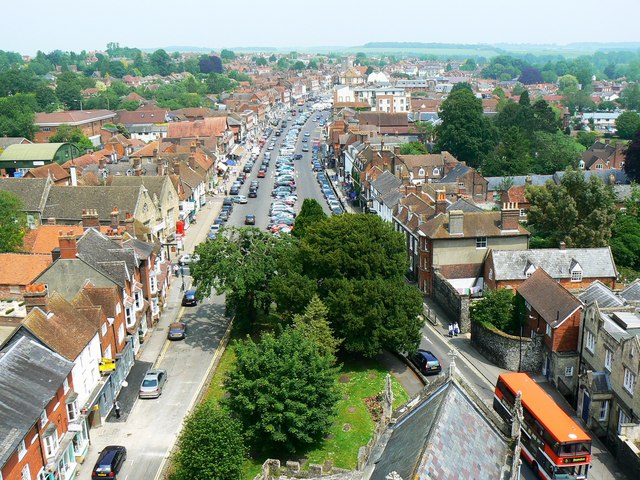
File:High Street, Marlborough from St Peter's church roof - geograph.org.uk - 460662.jpg
High Street, Marlborough, from St Peter's Church roof - geograph.org.uk - 460662. Photo by Brian Robert Marshall, via Wikimedia Commons.


Tuesday, 10 January 2017

ENEMY TERRITORY: WITLEY COURT, WORCESTERSHIRE


Love them or hate them, there is one thing about Stephen Poliakoff’s productions that cannot be denied: the filming is always exquisite.  The recent BBC series Close To The Enemy proved to be no exception for its beautifully shot images of a war-torn Britain.  The story is centred around Captain Callum Ferguson (Jim Sturgess) who is tasked with getting a captured German scientist to work for the RAF on developing the jet engine.  Much of the action takes place around a bombed-out London hotel just after World War II, although some critics have commented on the improbably pristine appearance of the rather glamorous cast. 

Many of the street scenes, while meant to be London, were filmed in Liverpool.  However, some of the most arresting scenes involved the ruined but magnificent Witley Court in Worcestershire, where in late April/early May 2015 the film crew turned up with actors dressed in World War II era uniforms and military vehicles, and where Alfred Molina as Harold Lindsay-Jones was filmed driving up to the property and wandering among the ruins.  On a recent visit to the property, run by English Heritage, we met the lady who got one of the property’s fountains going for the filming and who described to us how interminable the filming was, with take after take after take.  

This magnificent property was built in 1655 by Thomas Foley and during the 18th century the park was landscaped.  Around 1805 the property underwent a major reconstruction by John Nash on the orders of a second Thomas Foley (there were a number of Thomas Foleys associated with the property, which causes confusion for those studying its history).  The grounds feature two magnificent fountains, Neptune Fountain and the Perseus and Andromeda Fountain, currently undergoing restoration.  Later in its life the property became the scene of lavish house parties, with the then Prince of Wales (the future Edward VII)  a regular visitor.  Sadly, all this came to a tragic end in 1937 when a fire started in the bakery and ripped through a wing of the house.  When the property was sold soon after, what was left of it was stripped by scrap dealers, leaving the present-day shell, a haunting reminder of past glories.  One part of the estate which remains intact, however, is the amazing Parish Church of Great Witley, the neighbouring village.  The church is not in the village but next to the mansion, and boasts a magnificent Baroque interior which is completely disproportionate to its size.  No visit to the estate would be complete without looking in on it.

Witley Courth with Perseus Fountain. Photo by Tony Grist, via Wikimedia Commons.


As an aside, in 1967 Witley Court was chosen as the backdrop for a promotional film for Procol Harum’s song A Whiter Shade of Pale.  The band members are seen wandering around the grounds looking artistically moody in their trendy Sixties gear at a time when the property was even more derelict than now.   

Witley Court is  next to the village of Great Witley, a few miles north-west of Worcester.


Tuesday, 20 December 2016

A COTSWOLDS CHRISTMAS FOR BRIDGET: SNOWSHILL, GLOUCESTERSHIRE


The nation’s favourite singleton, Bridget Jones, first transferred from page to screen in 2001 with the release of Bridget Jones’s Diary, the film version of the first of a trilogy of books by Helen Fielding charting the ill-fated love life of the heroine, played by Renee Zellweger, in a modern day take on Jane Austen's Pride and Prejudice.  Much of the action centres around London, but when Bridget heads home for Christmas it is the charming North Cotswolds village of Snowshill which takes centre stage, improbably covered in snow in these days of climate change.

File:Stone Cottages facing the Village Church - geograph.org.uk - 1632420.jpg
Stone Cottages facing the Village Church - geograph.org.uk - 1632420. Photo by Cameraman, via Wikimedia Commons.


Of course, the snow was artificial, in fact the film makers covered the entire village in snow for the scenes, which must have been a strange experience for the locals and visitors, this being the month of July.  Christmas lights were put up in some of the village houses as well in order to complete the festive atmosphere.  They even put a Christmas tree up in the village and the house that featured as Bridget’s parents’ home had a Santa on the roof.  Sadly, the tourism boom that the village might have enjoyed as a result of playing a role in the film was curtailed due to the foot and mouth crisis of the time, which led to the closure of the main attraction in the village, the National Trust owned Snowshill Manor.


                                                                     Snowshill Manor

Snowshill occupies a location near the northern edge of the Cotswolds, a few miles from the more famous Broadway.  Snowshill Manor is good enough reason in itself to pay a visit, with  its fascinating collection of artefacts collected by its eccentric former owner Charles Paget Wade.  The collection includes a whole room devoted to Japanese samurai armour, and there are also musical instruments, clocks and a host of other interesting objects.  The gardens are lovely to wander round, and there is a tea room with lovely views over the surrounding countryside.  The Manor did not itself feature in the film, but the staff car park was used for shots of Bridget in the car with her parents.

Map of the area.


Saturday, 26 November 2016

OF MORSE AND MURDERS: OXFORD

 
Inspector Morse was a highly successful TV series based on the Chief Inspector Morse novels of Colin Dexter and set in and around Oxford.  The series, which ran from 1987 to 2000, gained international acclaim for its convoluted story lines and attractive locations, and international broacasting rights for the series were sold to 200 countries, making it the most exported TV series in the history of British television.  Viewers worldwide despaired at the behaviour of the irascible Inspector Morse, played by the late actor John Thaw, with his habit of taking every opportunity for a drink during the course of his investigations, his series of thwarted love affairs and his dismissive treatment of those around him, not least his sidekick the long-suffering Lewis, played by Kevin Whately.  
Inspector Morse was a real ale fanatic, so many scenes in the series were filmed in Oxford's historic pubs.  The Bear Inn featured in the "Death Is Now My Neighbour" episode in which Morse visits the pub for a beer during the course of a murder enquiry.  In "The Dead of Jericho", Morse has a drink with a fellow choir member - one of his many doomed romances - in the White Horse, Broad Street, after choir practice.  The Turf Tavern, an ancient inn nestled among a labyrinth of narrow lanes, was used in a number of Morse episodes, for example "The Daughters of Cain".   The Eagle And Child (currently closed) – a favourite haunt of J. R. Tolkien - was visited regularly by Colin Dexter and also featured in the series.
File:The Eagle and Child (Oxford).jpg
The Eagle and Child (Oxford). Photo by manray3, via Wikimedia Commons.
Apart from beer, another of Morse's passions is classical music, particularly opera, and as with the ale, this was an enthusiasm well catered for in Oxford.  He is often to be found attending concerts in the city.  In "Twilight Of The Gods", one of Morse's opera idols, the mezzo-soprano Gwladys Probert, is shot by a sniper.  Earlier in the episode she is seen giving a master-class at the Holywell Music Room.  The shooting takes place as a procession is making its way to the Sheldonian TheatreThis handsome building, started in 1664, is renowned both for its distinctive rounded exterior, topped by an eight-sided cupola, and for its beautiful galleried interior.
File:Sheldonian Theatre (5649724219).jpg
Sheldonian Theatre (5649724219). Photo by Tony Hisgett, via Wikimedia Commons.
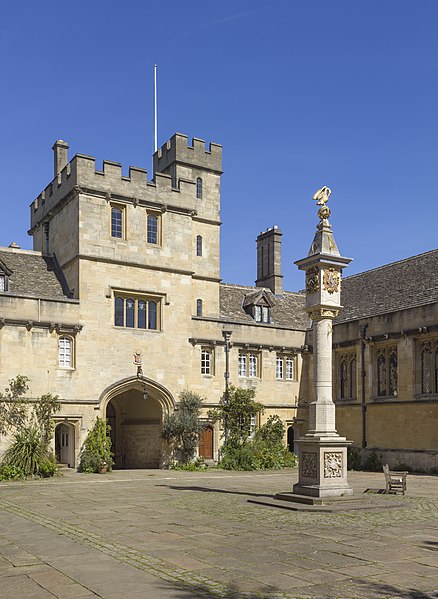
Naturally for a city such as Oxford, many of the Morse episodes had an academic flavour to them, with the colleges of the University playing a pivotal role.  In "The Last Enemy", the real identity of the fictional college called Beaumont College was Corpus Christi College.  Morse visits his old friend Sir Alexander Reece at the college, and Reece asks him to investigate the disappearance of the Deputy Master.   In "The Infernal Serpent" senior fellow of Beaufort College Dr Julian Dear is attacked and dies of a heart attack.  His funeral, which supposedly takes place at Beaufort College, was actually filmed in the chapel of University College and in Oriel College.  Oriel College was used in several other episodes, including "Deadly Slumber", "Twilight Of The Gods" and "Death Is Now My Neighbour".  Lonsdale College is another fictional college which features in a number of Morse episodes.  Brasenose College is the real-life college which was used to depict Lonsdale, while New College was used for the fictional St Saviour's.
File:UK-2014-Oxford-Corpus Christi College 02.jpg
UK-2014-Oxford-Corpus Christi College 02. Photo by Godot13, via Wikimedia Commons.

Continuing the learned theme, several of Oxford's museums and gardens have featured in the Morse series.  The title of "The Wolvercote Tongue" refers to a priceless piece of medieval jewellery belonging to a visiting tourist which vanishes.  An expert on the piece from the Ashmolean Museum, to which the tourist was going to donate the item, is found dead.  In "The Daughters Of Cain" a knife-wielding murderer steals his weapon from Pitt Rivers Museum.  The marksman who shoots Gwladys Probert in "Twilight Of The Gods" does the evil deed from a vantage point in the Bodleian Library, the main research library of the University of Oxford, and one of the oldest libraries in Europe.  The adjoining Radcliffe Camera, a beautiful circular building started in 1737, often appears in the background during Morse's strolls through the city, for example in "The Last Enemy" when he is seen walking past it with Lewis.  The Botanic Gardens, founded in 1621 under the auspices of the University, features in "The Settling Of The Sun".

File:Oxford - Bodleian Library - Radcliffe Camera - tree.JPG
Oxford - Bodleian Library - Radcliffe Camera - tree. Photo by Remi Mathis, via Wikimedia Commons.

The beauty of the architecture in central Oxford as well as the bucolic countryside surrounding the city has made it one of south-east England's most used locations in film and TV productions.  Films made in the city include Shadowlands, a film about C. S. Lewis, played by Anthony Hopkins, Harry Potter and the Philosopher’s Stone, featuring the Bodleian Library, X-Men: First Class, which includes scenes shot around the University buildings, and the 2006 film The History Boys.  On the small screen, the series Lewis, a spin-off from the Inspector Morse series, as well as another about the young Morse called Endeavour, were filmed in and around the city.

Oxford is a highly cosmopolitan city, where the mix of academic types and the more working class element has led to the use of the phrase “town and gown”.  This mixed population had led to a highly diverse range of attractions and entertainment, with something for everyone.  The city centre is a jumble of venerable old colleges, chapels, churches and museums, many open to visitors, plus a wide variety of restaurants and pubs.  Not surprisingly, the city offers Morse-themed tours of the city.  Or you could just go it alone and go on a Morse-themed pub crawl!

Map of the city.


Thursday, 27 October 2016

HALLOWEEN SPECIAL: THE VILLAGE OF THE DAMNED/LETCHMORE HEATH


There are few things creepier than a bunch of children with luminous staring eyes and impassive faces roaming around the place, especially when the place in question is an idyllic English village surrounded by a pastoral landscape with flocks of sheep.  The village which witnessed these disturbing scenes was Midwich, the focal point of the classic British horror movie The Village of the Damned. 

But how did Midwich reach this point?  The opening scenes of the film depict a man falling asleep mid-phone conversation, accompanied by his snoozing dog.  All over the village people are being plunged into a mysterious slumber, and when they wake up the women face a double whammy: all women of child-bearing age have become pregnant, and they all give birth at the same time to the aforementioned spooky children.  The children grow up very fast and to add to their unnatural demeanour they all have platinum blonde hair, and they are capable of communicating with each other telepathically.  The ensuing mayhem includes a plane crash caused by the pilot of a military reconnaissance plane sent to investigate the events falling asleep at the controls as he enters the sphere of influence of the village.

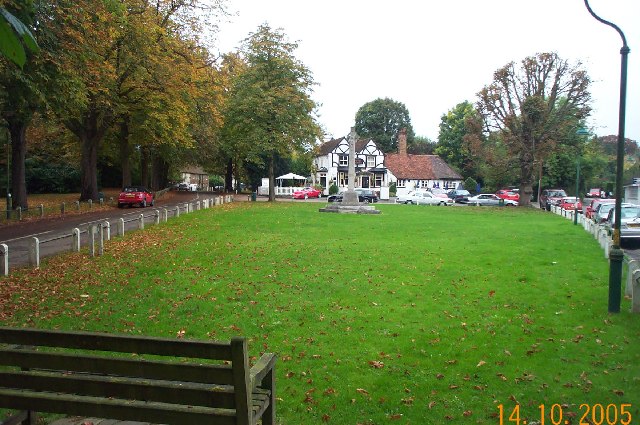
The real-life version of Midwich is the village of Letchmore  Heath near Watford, named after the original Old Saxon “leche mere” meaning muddy pond.  The present-day pond is just to the south of the fetching village green, and adjacent to the green is the Three Horseshoes pub, which was used in the filming.  Another building seen in the film was the Post Office and General Stores, occupying a charming village house also facing the green.  The building has hardly changed in appearance, although it no longer serves its original purpose.  Letchmore Heath is no stranger to filming, being close to both the MGM British Studios, which produced this horror masterpiece, and also the Elstree Studios.  In fact, so many TV series from the 60s and 70s were filmed around here that the area has been dubbed Avengerland, after the famous Avengers TV series.

File:Letchmore Heath - geograph.org.uk - 65207.jpg
Letchmore Heath - geograph.org.uk - 65207. Photo by Nigel Cox, via Wikimedia Commons.

Sadly, George Sanders, who played Professor Gordon Zellaby in the film, is no longer with us, having died in 1972.  However, his screen wife Anthea Zellaby (Barbara Shelley) and their son David (Martin Stephens) are still alive, and in 2013 they were reunited with other cast members, along with fans of the film, for a visit to the former film set and a lunch at the Three Horseshoes.