Tuesday, 24 May 2016

SHIPS AHOY! THE ONEDIN LINE: DARTMOUTH AND GLOUCESTER


One of the best drama series to hit our TV screens in the 1970s was The Onedin Line, which charted the fortunes of a 19th century shipping line.  The stirring theme music set the scene for this maritime epic, starring the late Peter Gilmore as James Onedin and Anne Stallybrass as his wife Anne, which gave a fascinating insight into seafaring life at the time, both at sea and on shore.  The shore base of the shipping line was meant to be Liverpool, but much of the filming took place in Dartmouth, while many of the dock scenes were filmed in Gloucester Docks (moving to Pembroke Dock for the last series).  Dartmouth’s historic riverfront, with its reminders of the town’s seafaring past, made a convincing backdrop for the filming of a story set during this period, while the massive 19th century waterside warehouses of Gloucester Docks, overlooked by the majestic tower of Gloucester Cathedral, served equally well for the shore-based scenes.

The action filmed in Dartmouth centred around Bayards Cove and the surrounding picturesque streets.  The 16th century fort at Bayards Cove was used as a gun emplacement intended as an additional line of defence to the Dartmouth and Kingswear castles, which face each other at the mouth of the Dart.  The fort was deliberately sited at the narrowest point of the channel forming the entrance to the harbour.  In the period leading up to the construction of the fort, Dartmouth had developed into an important trading port, serving the wine trade with France, and later on the cloth trade.  The town went into a decline in the 18th century, and with it the fort, but its fortunes were revived with the opening of the Naval College and the town’s popularity as a tourist destination.  The fort is now owned by English Heritage, who also own the castle.  

Dartmouth's waterfront

As well as the town’s historic sights, Dartmouth’s main appeal is its beautiful river.  Boat trips are available, some of them linking Dartmouth with Totnes, an attractive market town further upstream.  There is a steam railway on the Kingswear side of the estuary offering trips to Paignton, and tickets combining this with the boat trips are available.  The town itself is an appealing mix of pubs, restaurants, cafes and shops.  Dartmouth Museum is housed in the row of houses known as The Butterwalk, built in the 1630s as merchants’ trading houses.  

Dartmouth Castle

It was the 1827 opening of the Gloucester and Sharpness Canal, linking the city to the mouth of the River Severn and the Bristol Channel beyond, which led to Gloucester taking off as a trading port in the 19th century.  The docks’ facilities steadily grew during the course of the century, with the arrival of the railway in the 1840s providing a further fillip.  By the second half of the century goods were being imported from Northern Europe and the Black Sea ports, and even as far afield as North America and the Russian Arctic.  The produce reaching our shores via Gloucester ranged from timber to wines and spirits and even guano for fertiliser.  In the early 20th century steamers began running services from Gloucester to ports on the Continent.  It was the increasing size of many of the vessels which eventually contributed to the decline of the docks.  

File:Docks in Gloucester.JPG
Gloucester Docks

Nowadays, it is largely pleasure craft that make use of the facilities, with traditional canal barges rubbing shoulders with river cruisers in the 50-berth marina.  Anyone wanting to relive the glory days and immerse themselves in the Onedin Line experience should visit during the Tall Ships Festival, when visitors get the chance to view these evocative vessels at close quarters.  In the last few years, particularly since last year when the city hosted some of the Rugby World Cup matches, Gloucester Docks has really taken off as a tourist attraction, with Gloucester Quays Outlet shopping centre, a host of bars and restaurants, and a Waterways Museum from where tickets can be purchased for a boat trip along the canal.  There are also a number of other events each year besides the Tall Ships Festival, including a Food Festival, a Sea Shanty Festival and a Victorian Christmas Market.

Map of Dartmouth.

Map of Gloucester.


Friday, 22 April 2016

CASTLES FIT FOR THE BARD: ZEFFIRELLI'S HAMLET


April 23rd this year marks the 400th anniversary of the death of Shakespeare, Britain’s most famous playwright.  To mark the occasion, I thought we’d take a little tour of the castles used in the 1990 production of Hamlet starring Mel Gibson and directed by Franco Zeffirelli, one of many films based on the stories by the man affectionately known as “The Bard of Avon”. 

The story of Hamlet is set in the 14th and 15th centuries, and the main focus is on the fictional town of Elsinore, Denmark, although Shakespeare himself never actually went to Denmark as far as we know.  The castle of Elsinore referred to in the play, which is the home of Hamlet and his family, is probably Kronborg Castle in what is today known as Helsingør, a port on the east coast of Denmark facing Sweden.  For the purposes of the 1990 film, Elsinore Castle was represented by Dover Castle.  According to an article which came out around the time of filming, Mel Gibson said he had never been colder than when filming at Dover Castle. 

The castle has had a long, eventful history.  The site started off as an Iron Age hill fort, and one of the oldest elements still on display is the remarkably well-preserved Roman lighthouse.  When William the Conqueror burst onto the scene after his victory at Hastings, he turned the site into a Norman earthwork and timber-stockaded castle.  The castle we see today was started off as a medieval fortress by Henry II, and comprises a keep 83 feet high with walls of a thickness befitting the castle designed to defend the gateway to the realm.  Royal visitors to the castle have included Henry VIII and Elizabeth I.  Of course, the other feature for which Dover is famous is the towering White Cliffs surrounding the town.  One of these is called Shakespeare Cliff, so named because it was mentioned in King Lear, which was partly set around Dover.  Another castle in Kent which made an appearance in the film is Rochester Castle.  

File:Dover Castle 05.jpg
Dover Castle 05. Photo by Jake Keup, via Wikimedia Commons.

Zooming northwards to Scotland, there were two Scottish castles used in the film.  Both internal and external scenes of Elsinore Castle in the film were shot at Blackness Castle, set on the shores of the Firth of Forth between Falkirk and Edinburgh.  The scene featuring Ophelia's first appearance in the film was shot in the large hall in the Stern tower. The entrance to the tower, the courtyard next to it and the battlements also feature.  The castle was built in the 1440s by the Earl of Caithness, and in 1453 it was seized by King James II and it acted as a state prison for over 250 years.  Further fortifications were added in the 16th century.

File:Blackness Castle - geograph.org.uk - 1185379.jpg
Blackness Castle - geograph.org.uk - 1185379. Photo by James Denham, via Wikimedia Commons.

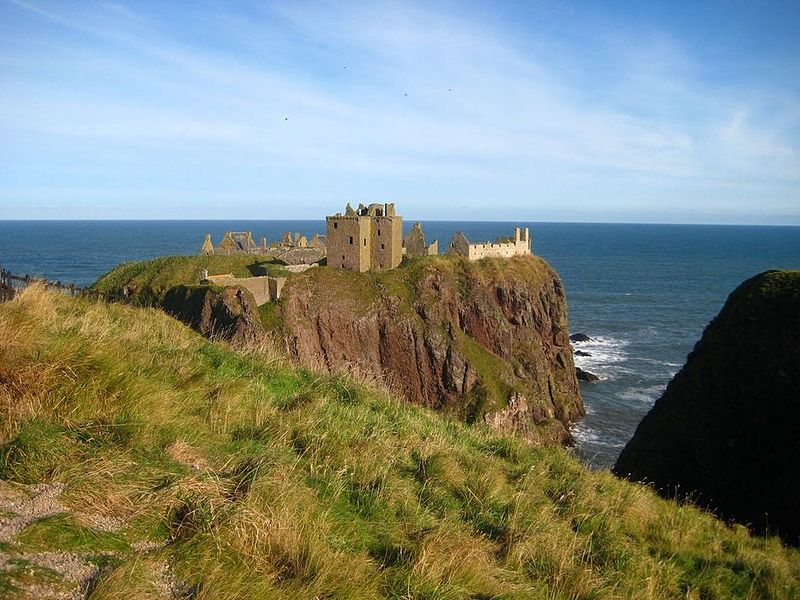
Set on top of an impregnable rock separated from the mainland by a ravine, Dunnottar Castle near Stonehaven is one of the most impressive sights on Scotland’s east coast.  The makers of Hamlet evidently agreed, as there are many shots of the castle from a distance – once again standing in as Elsinore Castle.  Towards the end of the film the base of the cliffs on which the castle stands were used for the cemetery scenes.  The present day ruins date from the 14th century, though it is thought that the castle’s origins lie in the arrival of St Ninian in the 5th century, when he chose the site for one of a chain of churches.  In spite of its seemingly inaccessible position, the castle can still be visited today via a path leading up to a tunnel entrance, but the access path is steep, so not suitable for everyone.  
File:CMSJ IMG 0217 (640x480) (3869554185).jpg
CMSJ IMG 0217 (640x480) (3869554185) (Dunnottar Castle). Photo by Carlos Menendez San Juan, via Wikimedia Commons.


Sunday, 13 March 2016

PUBS ON PAGE AND SCREEN


In a country where the pub forms such an important part of everyday life, it is no surprise to learn that there are a host of such establishments with film, TV and literary associations.  With Spring around the corner, why not get out and discover some of them.  The following is just a selection; if you know of any others, why not share them via the comments. 

Askrigg, North Yorkshire: The Kings Arms

In 1978 the popular drama All Creatures Great and Small arrived on our TV screens, set in 1940s Yorkshire, based on the books by real-life vet James Herriot, and featuring a trio of vets sharing a practice in a picturesque Yorkshire Dales village.  A number of different Dales locations were used for the filming, but the pub frequented by the vets, The Drovers Arms in Darrowby in the series, was actually the Kings Arms in the lovely village of Askrigg.  There are photographs inside the pub taken during the filming of the series.  For those who want to immerse themselves overnight in the Herriot experience, the pub does not offer accommodation, however Skeldale House just down the road, which acted as the frontage of the vets practice in the series, is a bed and breakfast.


Banff, Aberdeenshire: The Ship Inn

The heartwarming 1983 film Local Hero, about a small Scottish community called Ferness which was tempted by oil riches, was largely filmed in the village of Pennan in Aberdeenshire.  However, the interior of the local pub frequented by villagers and American visitors alike, called the Macaskill Arms in the film, was filmed in The Ship Inn in Banff, also in Aberdeenshire.  The exterior shots were filmed in Pennan itself, with ordinary buildings providing the basis for the facade.  Another pub, the Lochailort Hotel far away in Morar (currently closed), was also used for some of the interior scenes.  All this has not prevented Pennan’s real-life local, the Pennan Inn, from cashing in on the film’s fame.  The inn, which is located opposite the red phone box which played a pivotal role in the story, has a plaque on the wall commemorating the film.    

Bolventor, Cornwall: Jamaica Inn

Jamaica Inn is Daphne du Maurier’s story of a young woman who, following her mother’s death, is forced to go and live with her aunt and drunken uncle in the creepy Jamaica Inn, perched on the wild, windswept moorlands of Cornwall’s interior.  The story was recently serialised for television, attracting widespread derision for the mumbling Cornish accents issuing forth from the actors’ mouths.  The inn of the title actually exists in real life; it used to stand right next to the A30, but improvements to the main artery whisking tourists into Cornwall left it slightly adrift, necessitating a turnoff from the road – just follow the brown tourist sign.  Overnight accommodation is available at the inn – not for the fainthearted, since it has been the scene of many paranormal activities over the years, not surprisingly given the inn’s past as a smugglers’ haunt, which no doubt led to a number of murders.  The main resident ghost is said to be that of a traveller who stepped outside in the middle of his pint and was found dead on the moor the next day.  Footsteps heard along the passage leading to the bar are believed to be that of the ill-fated visitor returning to finish his ale.

File:Jamaica Inn - geograph.org.uk - 462626.jpg
Jamaica Inn - geograph.org.uk - 462626.  Photo by Kenneth Allen, via Wikimedia Commons.

Bristol: The Hole In The Wall

Long John Silver in Robert Louis Stephenson’s Treasure Island, surely the ultimate stereotype of the pirate-with-a-West-Country-accent, was the landlord of The Spyglass Inn in the novel.  The story’s narrator, Jim Hawkins, had orders to meet him there and when he arrived he realised with horror that the pub landlord had only one leg.  There are many pubs claiming to be the inspiration for The Spyglass Inn, but the one most closely matching the description is The Hole In The Wall in Bristol, not least because it has a spy-hole feature which was used to keep a look-out for the press gang, and it occupies a quayside position in line with the fictional pub.  Centrally located near Queen Square and the Arnolfini Gallery, the real-life pub continues to serve up food and drink to hungry and thirsty Bristolians and visitors.

Denton, Kent: The Jackdaw Inn

The wartime classic The Battle of Britain, released in 1969, is full of wonderful vintage scenes depicting the lifestyles of wartime Britain.  One of them features a pub where Squadron Leader Colin Harvey (Christopher Plummer) meets his screen wife (Susannah York).  The scene was filmed in Kent in The Jackdaw Inn , Denton.  Wartime memories live on in the pub with lots of wartime RAF memorabilia and vintage posters such as the one declaring “Don’t Help the Enemy! Careless Talk May Give Away Vital Secrets”, a poster which can be seen in the background in the film.   The pub used to be called The Red Lion, but it was renamed in 1962 because the Whitbread brewery felt there were too many pubs in the area with the same name.

Goathland: The Goathland Hotel

Heartbeat is a British TV series set in the 1960s in North Yorkshire, starring Nick Berry as PC Nick Rowan, which was shown between 1991 and 2009.  The filming of the series was centred around the village of Goathland,which lies on the Whitby to Pickering North Yorkshire Moors Railway line.  The local pub which featured in the story was the Aidensfield Arms, which was depicted by the Goathland Hotel.  The filming entailed the rebuilding of the interior of the bar as well as using the exterior for outside shots.

File:The Goathland Hotel (Aidensfield Arms) - geograph.org.uk - 685503.jpg
The Goathland Hotel (Aidensfield Arms) - geograph.org.uk - 685503.  Photo by Nicholas Mutton, via Wikimedia Commons.


London: The Grapes

Located at 76 Narrow Street, Limehouse, this inn was originally The Bunch of Grapes, built in 1583.  Its main literary claim to fame is that it was frequented by Charles Dickens.  In fact the opening sentences of Our Mutual Friend are believed to refer to it, describing it as “a tavern of dropsical appearance” in a “state of hale infirmity”.  Dickens went on to describe the inn’s waterside location as akin to “a faint-hearted diver, who has paused so long on the brink that he will never go in at all”.  The pub has a venerable history, particularly from the Elizabethan era, when Sir Walter Raleigh set sail on his third voyage to the New World from the river just below.  The present-day pub, now owned by the actor Sir Ian McKellen, has a small balcony overlooking the river, and Dickens fans will find a complete set of his works in the back parlour.

Newcastle Upon Tyne: The Victoria Comet

The premises now occupied by the Victoria Comet in Newcastle played a starring role in the 1972 Geordie gangster classic Get Carter starring Michael Caine, so much so that it is commonly referred to as the ‘Get Carter pub’.  When the venue started out as a pub in the 1800s, it was actually two pubs, The Victoria and The Comet, which later became a hotel known as The Victoria and Comet.  After a spell as a branch of O’Neills, it was revamped and renamed The Victoria Comet in a nod to its past, with posters depicting scenes from the film on the walls.  In the film the Caine character Jack Carter, following his arrival by train at the city’s main station, fetches up at the pub, where a young Alun Armstrong is serving behind the bar.  Allegedly some of the pub regulars were given roles as extras in the film and they took to their parts a bit too enthusiastically, including the imbibing of real beer, bringing them to various states of inebriation.  

New Quay: The Black Lion

High up above the harbour of this charming small resort on the coast of Ceredigion, The Black Lion boasts lovely views from its large garden.  In the mid-1940s the Welsh poet Dylan Thomas moved into Majoda, a house in an idyllic setting on the clifftop just outside the town.  It is a well-known fact that drinking was one of Thomas’ favourite pursuits, and The Black Lion was his favourite pub in New Quay.  The Dylan Restaurant in the basement has a large amount of Dylan Thomas memorabilia displayed on the walls.  Across the road from the pub is Gomer House, the former home of Captain Tom Polly, who was the inspiration for Captain Cat, the blind sea captain in Under Milk Wood.

Oxford: The Eagle and Child

Set among the venerable college buildings of Oxford University, the Eagle and Child was once a favourite haunt of J. R. R. Tolkien of The Hobbit fame.  He used to visit the pub as part of a group of writers called the Inklings, which also included C. S. Lewis.   Tolkien and Lewis were both at the English Faculty at the University.  Built in the mid-1600s, the pub’s name is said to have come from the crest of the Earl of Derby, which has an image of a baby in an eagle’s nest.  The pub recalls its literary past with photos on the wall and a plaque commemorating the Inklings.  (Postscript: The Eagle and Child is currently closed, but is expected to reopen in a new guise at some point.)

Slad, Gloucestershire: The Woolpack

With a beer terrace overlooking a beautiful valley in the southern Cotswolds, the interior of the Woolpack Inn in Slad looks as though it has never changed over the years, and certainly not since the times when local literary celebrity the late Laurie Lee used to prop up the bar here.  Slad was Lee’s home village, and his most famous work Cider With Rosie delightfully conjures up what comes across as an idyllic childhood.  After he married his wife Kathy, the couple made their home in a house just across the road.  The pub, which gets a mention in Cider With Rosie, has pictures of Laurie Lee on the walls, and there is a beer produced by the local Uley brewery named after him.  Fans of the writer who visit the pub for a pint can raise a glass to him while glancing up the road to the Church of Holy Trinity, where he is buried in the graveyard.

The Woolpack, Slad.

Whitstable: The Old Neptune

Perched precariously on Whitstable’s shingle beach, the Old Neptune – or Neppy as it is affectionately called by the locals – is in prime position for admiring the town’s legendary sunsets.  In 2006 Peter O’Toole, in a rather frail state from a broken hip, starred in the film Venus as a veteran actor, and some of the filming took place in the Neppy.  O’Toole was  nominated for an Oscar for the role, but he was beaten to it by Forest Whitaker as Idi Amin.  The pub was taken over for the whole day for filming, but the crew finished early and O’Toole bought the entire pub a round of drinks before leaving. 


The Old Neptune, Whitstable.
                                

Saturday, 30 January 2016

CHRISTIE COMES TO CORNWALL: AND THEN THERE WERE NONE


Aidan Turner fans living in Cornwall must think they have died and gone to heaven.  Not only has the Irish heartthrob made repeated visits to the county for the filming of Poldark – one series in the bag and another to come – but in summer 2015 he turned up on the county’s south coast for the filming of And Then There Were None, a TV adaptation of the Agatha Christie novel of the same name – originally given the rather less PC name Ten Little Niggers - which was aired over Christmas.  Female fans were no doubt particularly thrilled by a scene featuring Turner clad in nothing but a towel. 

The stylish and suspenseful mini-series also included luminaries such as Charles Dance, Miranda Richardson and Sam Neill whose characters form part of a group of people who are lured to an island called Soldier Island under various pretexts.  All of the ‘guests’ have been involved in the deaths of other people during their pasts and escaped justice.  A spooky gramophone recording informs them that they are going to get their comeuppance, and a series of murders ensues until the final scene when only two of the group remain: ex-mercenary Philip Lombard (Aidan Turner) and Vera (Maeve Dermody).  The series was critically acclaimed as a highly atmospheric drama with wonderfully tense scenes, particularly over dinner as the guests all start to suspect each other.

File:Mullion Island - geograph.org.uk - 371703.jpg
Mullion Island - geograph.org.uk - 371703. Photo by John Garfoot, via Wikimedia Commons.

The island which forms the main focus of the story was inspired by Burgh Island in Devon, but the island used in the TV series was Mullion Island.  In real life the island is a small uninhabited island offshore from Mullion Cove, which is where the scene was filmed in which the ill-fated group of guests are rowed out to the island.  In real life, Mullion Island does not have a mansion such as that depicted in the series: the building used for this was Harefield House in Hillingdon.  In one of the most striking scenes, there is an aerial view of a clifftop with a gaping hole and seagulls circling over it.  This was filmed at the Round Hole at Trevose Head near Constantine Bay on the North Cornwall coast. However, the most dramatic scene of all is the final showdown between Vera and Philip on one of the island’s beaches, with Philip ending up lying in a pool of blood in the shallows having been shot by Vera.  In real life this beach is Kynance Cove, one of the most beautiful spots on the Cornish coast.

Kynance Cove

Mullion Cove and Kynance Cove are very close together, both of them just to the west of Lizard Point, the most southerly place in mainland Britain.  Mullion’s tiny harbour has seen plenty of pirate and smuggling activity in the past.  The harbour was completed in 1895 with its two sturdy walls protecting the harbour from fierce winter gales.  The island is a nesting site for guillemots and kittiwakes, but is not open to the public.  Kynance Cove is a riot of interesting rock formations and golden sand lapped by turquoise sea.  There is a car park above the cove from where a path leads down to the beach, taking in a cafe on the way.  Just offshore is Asparagus Island, so called because wild asparagus used to grow there.  Trevose Head is a short distance from Padstow, and its Round Hole is a natural blowhole, formed from centuries of erosion upwards from caves below.  

File:Mullion Cove Harbour - geograph.org.uk - 266470.jpg
Mullion Cove Harbour - geograph.org.uk - 266470. Photo by Tony Atkin, via Wikimedia Commons.