Monday, 14 September 2015

CRADLE OF A LITERARY PHENOMENON: HAWORTH


The village of Haworth in West Yorkshire owes its place on the literary map to Patrick Brontë (originally Brunty, from County Down in Northern Ireland).  In 1820 Patrick moved his family to the village from their birthplace in Thornton near Bradford to take up the role of Church of England perpetual curate of the parish of Haworth.  Patrick himself was an author as well as a priest, but it was his three daughters, Charlotte, Emily and Anne who really sealed Haworth's fate as a literary mecca.  The sisters wrote a number of novels based around locations in the area including Jane Eyre (Charlotte), Wuthering Heights (Emily) and The Tenant of Wildfell Hall (Anne).  Patrick also had a son, Branwell, a painter, writer and poet, but tragically also an alcoholic, a condition made worse by a failed relationship, which led to his early death.  Incredibly, Patrick outlived all of his offspring as well as his wife Maria.

The main focal point for visitors to Haworth is the Brontë Parsonage Museum in Church Street.  The Parsonage, dating from 1778, was home to the Brontë family and it became a museum in 1928.  Visitors can view the rooms where the family lived their lives, and the museum hosts a range of events relating to the family.  Among the many visitors to Haworth, there is a particularly large Japanese contingent due to the country's love affair with the Brontës.  A few years ago some local teenagers studying AS level Japanese were invited to contribute to a website describing the area's attractions in Japanese. 

File:HaworthMainStreet.jpg
HaworthMainStreet. Photo by Jon Farman, via Wikimedia Commons
However, Brontë fans should not just limit themselves to Haworth itself, as there are a number of locations in the surrounding area of interest to readers of the Brontës' works.  There is a ruined farmhouse near Haworth called Top Withens which is believed to have been the inspiration for Wuthering Heights, the home of the Earnshaw family featured in the novel of the same name.  Walking enthusiasts might be interested to know that the farmhouse can be reached via the Pennine Way, being located east of Withins Height, below Delf Hill.  Some of the footpath signs are in Japanese for the benefit of the many Japanese tourists who visit the site.

File:Top Withens 2.jpg
Top Withens 2. Photo by Tim Green, via Wikimedia Commons

Ponden Hall near Stanbury to the west of Haworth is reputedly the inspiration for Thrushcross Grange, the home of the Linton family in Wuthering Heights (although it should be noted that the property does not actually match the description of Thrushcross Grange in the book).  Oakwell Hall is an Elizabethan manor house in the village of Birstall to the south-west of Leeds which was visited by Charlotte Brontë.  Charlotte was moved by her visits to make the house the inspiration for Fieldhead in her novel Shirley.  Nearby Gomersal is another location which provided inspiration for Charlotte, with Red House, a former cloth merchant's home in Gomersal, as inspiration for Briarmains in Shirley.  

File:Oakwell Hall.jpg
Oakwell Hall. Photo by Nigel Homer, via Wikimedia Commons
There are guided walks available for those who want to make the most of their visit to Haworth.  

Map of Haworth.


Tuesday, 18 August 2015

WHAT'S UP DOC: PORT ISAAC


The ITV series Doc Martin began airing in 2004 and several subsequent seasons followed, its popularity no doubt due in part to the stunning locations on the north Cornish coast used in the filming.  The series was inspired by the comedy film 'Saving Grace' which was also filmed in the area, and followed the trials and tribulations of a London doctor, Martin Ellingham (Martin Clunes), who returns to his native Cornwall to take up a position as the GP of a picturesque fishing village.  So far, so charming - however, Ellingham's irascible bedside manner quickly makes for a host of awkward encounters with the locals, although he manages to develop a relationship with the headmistress of the local school, Louisa Glasson.

The community where all this takes place is called Portwenn, but in real life it is Port Isaac on the north coast of Cornwall.  The green slopes surrounding the village are dotted with large cottages, one of which is Fern Cottage on Roscarrock Hill, used as Doc Martin's surgery in the series.  Fans wanting the full Doc Martin experience, not to mention wonderful views over the village and harbour, can rent the cottage as a holiday let.  Meanwhile, the former Bay Hotel on The Terrace was used in series 4 to depict Wenn House, home of the Wenn family, the most prominent family in the village.  Port Isaac is a typical and still working Cornish fishing village where the twisting lanes and alleys include one which is delightfully named Squeeze-ee-belly Alley.  As well as Doc Martin, the village's other claim to fame is that it spawned a male singing group called The Fisherman's Friends, who signed a recording contract in 2010.

File:Port Isaac - geograph.org.uk - 105004.jpg
Port Isaac - geograph.org.uk - 105004. Photo by Tony Atkin, via Wikimedia Commons.

As well as Port Isaac a number of other locations in the area have been used in the series.  Port Gaverne, next to Port Isaac, has been used for a number of exterior shots, and the Headlands Hotel, a Victorian hotel high above Port Gaverne, was used in series 3 as Mrs Wilson's Hotel.  The real-life hotel has been closed for a number of years and has been at the centre of a row about the site's future, with the locals up in arms about plans to demolish the building and replace it with a modern development.  Another hotel in a dramatic location, the Camelot Castle Hotel in Tintagel, put in an appearance in Series 1 and again, as the Castle Hotel, in Series 5.  Tintagel is best known for its clifftop castle ruins, home to the Legend of King Arthur.  Doyden Castle in the tiny Port Quin near Port Isaac played the part of  Pentire Castle in the series.  The 'castle', in reality a 19th century castellated folly, is now available as a holiday home.  The foodie town of Padstow, a bit further west, appeared in Series 1 as the harbour where John Slater's boat was moored.  Padstow is commonly referred to as 'Padstein' for the various eating establishments opened up there by former TV chef Rick Stein. 

File:Doyden Castle close-up - geograph.org.uk - 1290764.jpg
Doyden Castle close-up - geograph.org.uk - 1290764.  Photo by Andy F., via Wikimedia Commons.
Away from the coast, a number of inland locations have featured in the show.  Pencarrow House and Gardens between Wadebridge and Bodmin was the scene of Doc Martin and Louisa's first date when they attended a classical music concert.  This estate, which is approached via a mile-long drive through an Iron Age hill fort, is open to visitors from late March to early October.  The parish church at Lanteglos-by-Camelford was where the couple's 'almost wedding' was filmed in Series 3.  The church, dedicated to St Julitta, stands in a small valley south west of Camelford on a site thought to have been occupied by an earlier monastery.  In the series Doc Martin's Aunty Joan lives on a farm called Dannabroad Farm; in real life the farm is called Dinnabroad Farm and is found in the village of St Teath, just inland from the coast near Port Isaac.

File:Pencarrow House, Bodmin, Cornwall PL30 - geograph.org.uk - 1108891.jpg
Pencarrow House, Bodmin, Cornwall, PL30 - geograph.org.uk - 1108891. Photo by Paul Leonard, via Wikimedia Commons.


Tuesday, 28 July 2015

SINISTER SCENES ON THE WEST COAST OF SCOTLAND: THE WICKER MAN


The Wicker Man is sometimes described as a horror movie, but in reality it is a weird and idiosyncratic tale of pagan rites and strange inbred folk covering up the disappearance of a girl. However, for all its oddball qualities it acquired something of a cult status.  The film tells the story of a police sergeant called Howie (Edward Woodward) who is sent to a Scottish island called Summerisle to investigate the case of a missing girl only to be confronted with strange, uncooperative islanders.  During his time on the island Howie witnesses the bizarre pagan rites practised by the locals, such as toads placed in the mouth to cure whooping cough.  Not to mention a considerable amount of open nudity.

Most of the locations used in the film are in Dumfries and Galloway, but the filming starts further north.  In the opening credits Skye puts in an appearance as Howie is seen flying in a boat plane over Summerisle, with the Old Man of Storr and the Quiraing visible from the plane.  Howie lands his plane offshore from the lovely village of Plockton in Ross and Cromarty, where he is greeted by a none too welcoming group of locals who try to make out that he can't come ashore because it is private property.


                                                                           Plockton.

During his stay, Howie stays at an inn called The Green Man, where the landlord's daughter (Britt Ekland) tries and fails to seduce him, Howie being a strict believer in no sex before marriage.  The exterior of the inn was shot in Gatehouse of Fleet using a building which was not a pub but a grade B listed building called the Cally Estate Office.  The interior shots, meanwhile, were done inside the Ellangowan Hotel in Creetown, sadly now closed.  The hotel was a magnet for fans of the film, with photographs of the 'Green Man' scenes on the walls.

Much of the film's action is set in the fictional Summerisle, a community led by Lord Summerisle (the recently departed Christopher Lee). The mansion he lives in is actually Culzean Castle near Maybole, South Ayrshire.  The castle, run by the National Trust for Scotland and former home of the Marquess of Ailsa, chief of the Kennedy Clan, was completed in the late 18th century with Robert Adam as its architect and occupies a dramatic clifftop setting.  

File:Culzean Castle house and gardens 01.JPG
Culzean Castle house and gardens 01. Photo by Jamesx12345, via Wikimedia Commons.
 
Various scenes were filmed around the Isle of Whithorn in the far south-west of Scotland, in reality a village rather than an island.  The ruined St Ninian's Chapel lies in the 'Isle', but it was St Ninian's Cave, a sea cave 4 miles from Whithorn Abbey, which featured in The Wicker Man.  The cave is where Howie discovers the disappeared girl, Rowan.  Summerisle School is represented by a cottage in Anwoth, about a mile west of Gatehouse of Fleet.  The cottage is available to rent as a holiday let.  Anwoth's Old Kirk and its graveyard also feature in the film, the latter being where Rowan's body is meant to be buried.  A few miles to the south-east is the county town of Kirkcudbright, where the picturesque streets and alleys form the backdrop for a number of scenes.  A shop near the police station is used as Rowan's mother's shop. 

But it is back in the Isle of Whithorn area that the film's dramatic finale was filmed, on a clifftop at Burrowhead near Cutcloy, a former hotbed of smuggling from and to the Isle of Man.  The islanders decide to make a sacrifice to the Sun God following a poor harvest the previous year, and the unfortunate Howie is the chosen victim, evidently due to his virgin status.  The scene shows Howie stripped naked and placed inside a giant wicker man statue, which is then set alight.  Animal lovers might be distressed at the sight of animals in the cage with Howie.  However, the production team insisted at the time that no animals were harmed in the making of the film, that they were repeatedly put inside the cage and then taken out again for different shots so that they did not succumb to the flames.

File:Burrowhead - Sea Cliffs - geograph.org.uk - 1315956.jpg
Burrowhead - Sea Cliffs - geograph.org.uk - 1315956. Photo by Gordon Elliott, via Wikimedia Commons.

Thursday, 25 June 2015

SHROPSHIRE IMAGINED: A E HOUSMAN


I have always assumed that the poet A. E. Housman was born in Shropshire, since his best known work is a collection of poems called A Shropshire Lad.  So, on researching him, I was surprised to discover that he was actally born in Bromsgrove, Worcestershire, the county to the east of Shropshire, and that he wrote the work while living in London.  Housman once explained that Shropshire was on his western horizon, which made him romantic about it, and that he did not know the county well, so that some of the details about the county were wrong or imaginary.  However, this did not stop him from describing what he saw in the distance in famously poetic terms: "What are those blue remembered hills//What spires, what farms are those?"

One feature of the horizon that Housman may have discerned in the distance is Wenlock Edge, a limestone escarpment covered in woodland looked after by the National Trust which, along with another geographical feature known as The Wrekin, featured in the poem On Wenlock Edge from A Shropshire Lad, in which Housman describes a storm: "On Wenlock Edge the wood's in trouble//His forest fleece the Wrekin heaves".  Wenlock Edge, over 19 miles long, is a Site of Special Scientific Interest due to its geology.  At its north-eastern end is the picturesque small town of Much Wenlock with its Priory and Guildhall.  The Wrekin rises 407 metres above the Shropshire Plain and is visible from as far away as Cleeve Hill near Cheltenham in Gloucestershire.  Another prominent elevation in the area is the Long Mynd a bit further to the west.  On several occasions I have passed these landmarks on my way to Wales, and they always strike me as a tantalising foretaste of the splendours of the Welsh mountains.

File:Towards The Wrekin - geograph.org.uk - 1086915.jpg
Towards The Wrekin - geograph.org.uk - 1086915. Photo by Paul Beaman, via Wikimedia Commons.

In his piece about the stormy weather on Wenlock Edge, Housman speculates that there would have been similar weather "when Uricon the city stood".  This is a reference to the Roman town of Uriconium, or Viroconium Cornoviorum, once the fourth largest Roman settlement in Britain.  The remains of the settlement lie near the present-day Wroxeter, a village near Shrewsbury, and include an archway which formed part of the baths' frigidarium.  The ruins are open to visitors and are run by English Heritage.

File:Viroconium Cornoviorum 08.jpg
Viroconium Cornoviorum 08. Photo by Alastair Rae, via Wikimedia Commons.

The River Clun, which wends its way through the Shropshire countryside, lends its name to a number of villages as well as the small town of Clun, with its ruined medieval castle (English Heritage), nestling in the Shropshire Hills Area of Outstanding Natural Beauty.  In A Shropshire Lad Housman describes the sleepy nature of these settlements in the following whimsical verse: "Clunton and Clunbury//Clungunford and Clun//Are the quietest places//Under the sun."  Another larger town which features in the work is Ludlow, nowadays known as much as a foodie mecca as for its impressive castle overlooking the River Teme.  Housman writes about the town's fair: "The lads in their hundreds to Ludlow come in for the fair//There's men from the barn and the forge and the mill and the fold."  There is a memorial to Housman outside St Laurence's church in Ludlow and the ashes of the poet, who died in 1936, are buried under the stump of a cherry tree in the church grounds. 

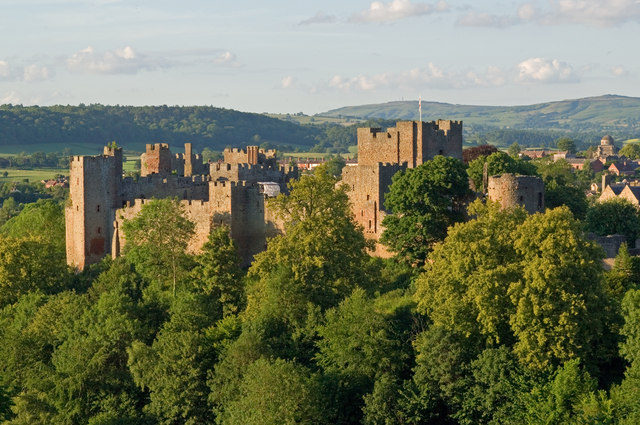
File:Ludlow Castle from Whitcliffe, 2011.jpg
Ludlow Castle from Whitcliffe, 2011. Photo by Ian Capper, via Wikimedia Commons.

Map of Shropshire.


Sunday, 24 May 2015

A MINE ROMANCE: POLDARK


In my blog piece about the 1995 TV production of Pride and Prejudice I wrote about Sunday evening costume dramas and their role in lifting the mood of the nation's women, particularly when there is a handsome male character for them to drool over.   Colin Firth as Mr Darcy was the male interest back then; this year, 20 years later, there has been another treat in store for the female populace in the form of Aidan Turner as Ross Poldark.   Poldark is arguably even more appealing, since unlike Mr Darcy, he has a benevolent personality to go with his dark good looks.  Added to which, while in 1995 Mr Darcy teased the nation's women in the famous 'lake scene' by stripping off to his undergarments but no further, Poldark is not afraid to display his hairy, tanned torso, no doubt setting female hearts throbbing in living rooms up and down the country. 

Anyway - ahem - that's enough of that.  Poldark, based on the works of Winston Graham and the successor to a series originally shown 40 years ago, is set in 18th century Cornwall, a time when the mining of tin and (in Poldark's case) copper was a mainstay of the local economy.  However, it was a fraught business with constant swings between boom and bust as local landowners sought to extract the ore from their estates, starting ventures which frequently failed and sent them into debt.  Then there was the difficulty of transporting the ore out of Cornwall which in those days was even more remote than it is now, making road transport almost impossible, so that desperate efforts were made to build harbours on an unforgiving rocky, windswept coast.  There were also many deaths, mining in those days being a dangerous affair, with many mineworks extending out under the sea.  During the bad times there was a mass exodus of miners to far-flung parts of the world, for example South Australia where to this day there are many people with Cornish surnames.  Eventually, competition from other countries such as Malaysia sent the Cornish mining industry into a decline.

File:View North from the Clifftop - geograph.org.uk - 187145.jpg
View North from the Clifftop - geograph.org.uk - 187145. Photo by Tony Atkin, via Wikimedia Commons.


The centre of Poldark's world is his estate in the fictional Nampara Valley, which in the series was filmed on St Agnes Head (pictured above) on the stretch of coast between St Ives and Newquay, where relics of mine workings and engine houses can still be seen.  However, Nampara cottage, where Poldark set up home with his sweetheart Demelza (Eleanor Tomlinson) has Bodmin Moor as its backdrop, which was where many of the horseback scenes were filmed.  Poldark's mine is represented by Saddle Rock mine, at Belowda Beacon on the edge of Goss Moor near St Austell.  Earlier this year there were news reports of the mine going up for sale for £375,000 - a snip for anyone wanting to own a piece of TV history.  This bleak piece of moorland is now a National Nature Reserve with a multi-use trail, and I well remember when I was a child growing up in Cornwall being terrified by tales of a headless horseman who was reputed to haunt the moor.  On the clifftop near Botallack in the far west of the county lie the remains of two engine houses, Wheal Owles and Crowns.  They play the part of Wheal Leisure, the family mine Poldark tries to resurrect.  The Levant Mine at Trewellard near Pendeen, now a National Trust property,  is used to depict Tresidders Rolling Mill.

File:Levant Steam Mine, Cornwall.jpg
Levant Steam Mine, Cornwall. Photo by Miles Wolstenholme, via Wikimedia Commons.

Several other beauty spots along the Cornish coast feature in the series.  Church Cove at Gunwalloe - named for the cute little church called St Wynwallow - is the scene of a ship wrecking episode filmed in the early hours of the morning.  The practice of wrecking - looting items of value from shipwrecks, often lured to their end by the wreckers themselves - was one of the more shameful facets of Cornwall's past.  Porthgwarra, a tiny cove in West Cornwall, was also used in the filming, while the sandy beach of Porthcothan between Padstow and Newquay was used in scenes featuring Nampara Cove.  

File:Church Cove from the south car park - geograph.org.uk - 926645.jpg
Church Cove from the south car park - geograph.org.uk - 926645. Photo by Row17, via Wikimedia Commons.

The main town in Poldark's neighbourhood was meant to be Truro, but the quayside scenes were filmed in Charlestown, a historic harbour just outside St Austell where the old ships and well-preserved historic buildings provide an authentic backdrop.  There is a fascinating Shipwreck and Heritage Centre by the harbourside in Charlestown, with exhibits on the Titanic as well as over 150 other shipwrecks.  The street scenes, meanwhile, were filmed several counties away in the picturesque Wiltshire town of Corsham.  Visitors to Cornwall expecting to find the mansion occupied by Poldark's uncle will be disappointed, since that also was filmed a long way away at Chavenage House near Tetbury, Gloucestershire.

File:Chavenage House 3-geograph-3507432.jpg
Chavenage House 3-geograph-3507432. Photo by Philip Halling, via Wikimedia Commons.


As an aside, there is an actual Poldark Mine which is open to visitors.  This 18th century tin mine, near Helston, has evidence of tin mining going back to prehistoric times and is located in the Cober River Valley, a UNESCO World Heritage Site.

Wednesday, 29 April 2015

REIGNING SUPREME: ARUNDEL CASTLE, THE YOUNG VICTORIA


Arundel Castle in West Sussex was one of a number of "wondrous places" (to quote Martin Scorsese's co-producer Graham King) chosen for The Young Victoria, a film based on a screenplay by Julian Fellowes, charting the formative years of this great British queen (played by Emily Blunt).  At the tender age of 20 Victoria displays remarkably strong will when faced with a domineering mother (Miranda Richardson) who, along with her aide (Mark Strong), attempts to force her daughter to sign papers declaring them as regents following the death of King William (Jim Broadbent).  Meanwhile, the German Prince Albert is being encouraged to court Victoria, and when he arrives in the country and meets her he finds himself becoming smitten, a feeling which appears to be mutual.  The film is beautifully shot and acted, and Arundel Castle looks good in its role as Windsor Castle (not for the first time, as it was also used in The Madness of King George).  In real life the castle was visited by Victoria and Albert, who spent a few days there in 1846.  The town made elaborate preparations for the visit, which caused much excitement among the local populace.  Victoria shared her impressions of the castle and its grounds in her diary, describing the garden as "very pretty and full of evergreens, which made Albert extremely jealous for Osborne House".

File:Arundel Castle - geograph.org.uk - 1765127.jpg
Arundel Castle - geograph.org.uk - 1765127. Photo by Brett Oliver, via Wikimedia Commons.
.

The Baron's Hall was used for the scene in the film depicting the grand banquet held for William IV's birthday, standing in for Windsor Castle's Great Hall.  Built on the site of the original Medieval Hall, the Baron's Hall, 130 feet in length, is a late Victorian structure which replaced the original octagonal great hall built by the Eleventh Duke.  The Fitzalan Chapel in the grounds of the castle was used to depict the Chapel Royal at St James's Palace where Victoria and Albert were married in 1840.  The chapel was founded in 1390 by the 4th Earl of Arundel and features gothic architecture with a carved timber roof and choir stalls.  Some of the external features of the castle can also be seen in the production, such as the Norman motte, which forms an impressive backdrop for the happy couple.

File:Arundel Castle - motte and quadrangle, England (18 April 2006).jpg
Arundel Castle - motte and quadrangle, England (18 April 2006). Photo by Luke van Grieken, via Wikimedia Commons.

As for the history of the castle, it was built high up on a hill overlooking the River Arun, which creates a gap in the surrounding dowland.  It was felt that this gap needed defending, which was how the castle came to be founded on Christmas Day 1067 by Roger de Montgomery, Earl of Arundel.  Many of the original features still survive, such as the crenellated Norman keep, the gatehouse and the barbican.  The living quarters, however, were almost completely rebuilt during the latter half of the 19th century, with Victorian architecture in the Gothic style.  There are a number of themed gardens in the grounds, and visitors can climb to the top of the Norman motte and keep from where there are magnificent views of the river and downlands.  The adjoining small town of Arundel is pleasant to wander around, with a range of enticing shops, restaurants and pubs.

Saturday, 11 April 2015

MYSTERIOUS NORFOLK: BLAKENEY


It has to be said that The Norfolk Mystery by Ian Sansom, a quirky and nostalgic novel set in the 1930s, has divided its readers right down the middle if online reviews of the book are anything to go by.  The story concerns a professor called Swanton Morley who engages a young assistant, Spanish Civil War veteran Stephen Sefton, to accompany him and his daughter on a tour of the country with the aim of producing a series of  'County Guides'.  Some people loved the novel, but others found it boring and pretentious.  For my own part, I started out eagerly anticipating a jolly jaunt around the delights of Britain, but was slightly disappointed when the journey failed to materialise, being prematurely aborted in Blakeney, where the local vicar has been found dead and Morley and Sefton find themselves drawn into a real-life whodunit. However, I still enjoyed the book, which paints an amusing picture of life in 1930s rural Norfolk with some wonderfully eccentric characters.

The scene of the tragedy is St Nicholas, the Anglican parish church of Blakeney, which is described by Morley as "a typical example of fifteenth-century Perpendicular architecture".  Morley also points out the fact that the church, unusually, has two towers, "like an aft mast and a main mast".  The tower at the east end was used as a beacon, and in fact churches with tall towers are a common feature of settlements along the coast of East Anglia.  It is believed that they were once used as 'lighthouses' to alert shipping to the proximity of the shore, no doubt helped by the flat landscape of the area.    

File:Church of St Nicholas, Blakeney - geograph.org.uk - 1062742.jpg
Church of St Nicholas, Blakeney - geograph.org.uk - 1062742. Photo by Ian Capper, via Wikimedia Commons

Going back to the novel, at one point in the story a cinema ticket is discovered in the dead vicar's pocket, arousing speculation on whether he indulged in unsavoury activities.  The detective Ridley, who has arrived at the scene, points out "he was a vicar", to which Morley retorts "so was the vicar of Stiffkey".  The author does not explain this remark, but it is a reference to a former vicar of nearby Stiffkey who was defrocked for his predilection for young girls.  You can find out more about this from my other blog Postcards From The Edge.

Blakeney is one of a number of charming villages along the North Norfolk coast.  It was a thriving port until the 17th century when the land was turned over to grazing and saltmarshes.  As well as the aforementioned church and the typical flint cottages, the village is famous for the grey seals who lounge around on Blakeney Point, a 4 mile long sand and shingle spit reached by boat from neighbouring Morston (or on foot for the more energetic).  The colony appears to be thriving, with numbers of pups reportedly at an all-time high - 2,425 at the last count.

File:Seals Blakeney Point.jpg
Seals Blakeney Point. Photo by Roy Turner, via Wikimedia Commons


Map of the area.