Thursday, 25 June 2015

SHROPSHIRE IMAGINED: A E HOUSMAN


I have always assumed that the poet A. E. Housman was born in Shropshire, since his best known work is a collection of poems called A Shropshire Lad.  So, on researching him, I was surprised to discover that he was actally born in Bromsgrove, Worcestershire, the county to the east of Shropshire, and that he wrote the work while living in London.  Housman once explained that Shropshire was on his western horizon, which made him romantic about it, and that he did not know the county well, so that some of the details about the county were wrong or imaginary.  However, this did not stop him from describing what he saw in the distance in famously poetic terms: "What are those blue remembered hills//What spires, what farms are those?"

One feature of the horizon that Housman may have discerned in the distance is Wenlock Edge, a limestone escarpment covered in woodland looked after by the National Trust which, along with another geographical feature known as The Wrekin, featured in the poem On Wenlock Edge from A Shropshire Lad, in which Housman describes a storm: "On Wenlock Edge the wood's in trouble//His forest fleece the Wrekin heaves".  Wenlock Edge, over 19 miles long, is a Site of Special Scientific Interest due to its geology.  At its north-eastern end is the picturesque small town of Much Wenlock with its Priory and Guildhall.  The Wrekin rises 407 metres above the Shropshire Plain and is visible from as far away as Cleeve Hill near Cheltenham in Gloucestershire.  Another prominent elevation in the area is the Long Mynd a bit further to the west.  On several occasions I have passed these landmarks on my way to Wales, and they always strike me as a tantalising foretaste of the splendours of the Welsh mountains.

File:Towards The Wrekin - geograph.org.uk - 1086915.jpg
Towards The Wrekin - geograph.org.uk - 1086915. Photo by Paul Beaman, via Wikimedia Commons.

In his piece about the stormy weather on Wenlock Edge, Housman speculates that there would have been similar weather "when Uricon the city stood".  This is a reference to the Roman town of Uriconium, or Viroconium Cornoviorum, once the fourth largest Roman settlement in Britain.  The remains of the settlement lie near the present-day Wroxeter, a village near Shrewsbury, and include an archway which formed part of the baths' frigidarium.  The ruins are open to visitors and are run by English Heritage.

File:Viroconium Cornoviorum 08.jpg
Viroconium Cornoviorum 08. Photo by Alastair Rae, via Wikimedia Commons.

The River Clun, which wends its way through the Shropshire countryside, lends its name to a number of villages as well as the small town of Clun, with its ruined medieval castle (English Heritage), nestling in the Shropshire Hills Area of Outstanding Natural Beauty.  In A Shropshire Lad Housman describes the sleepy nature of these settlements in the following whimsical verse: "Clunton and Clunbury//Clungunford and Clun//Are the quietest places//Under the sun."  Another larger town which features in the work is Ludlow, nowadays known as much as a foodie mecca as for its impressive castle overlooking the River Teme.  Housman writes about the town's fair: "The lads in their hundreds to Ludlow come in for the fair//There's men from the barn and the forge and the mill and the fold."  There is a memorial to Housman outside St Laurence's church in Ludlow and the ashes of the poet, who died in 1936, are buried under the stump of a cherry tree in the church grounds. 
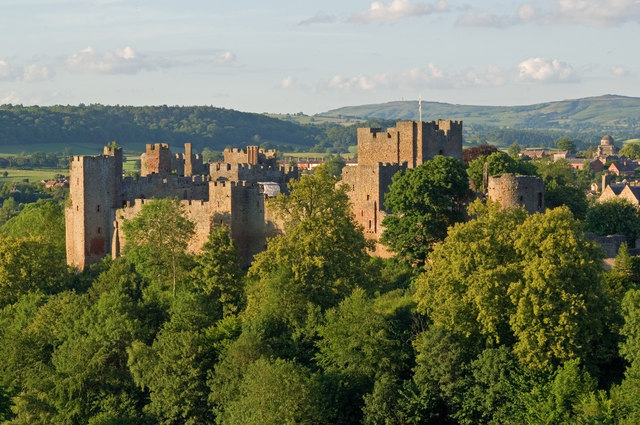
File:Ludlow Castle from Whitcliffe, 2011.jpg
Ludlow Castle from Whitcliffe, 2011. Photo by Ian Capper, via Wikimedia Commons.

Map of Shropshire.


Sunday, 24 May 2015

A MINE ROMANCE: POLDARK


In my blog piece about the 1995 TV production of Pride and Prejudice I wrote about Sunday evening costume dramas and their role in lifting the mood of the nation's women, particularly when there is a handsome male character for them to drool over.   Colin Firth as Mr Darcy was the male interest back then; this year, 20 years later, there has been another treat in store for the female populace in the form of Aidan Turner as Ross Poldark.   Poldark is arguably even more appealing, since unlike Mr Darcy, he has a benevolent personality to go with his dark good looks.  Added to which, while in 1995 Mr Darcy teased the nation's women in the famous 'lake scene' by stripping off to his undergarments but no further, Poldark is not afraid to display his hairy, tanned torso, no doubt setting female hearts throbbing in living rooms up and down the country. 

Anyway - ahem - that's enough of that.  Poldark, based on the works of Winston Graham and the successor to a series originally shown 40 years ago, is set in 18th century Cornwall, a time when the mining of tin and (in Poldark's case) copper was a mainstay of the local economy.  However, it was a fraught business with constant swings between boom and bust as local landowners sought to extract the ore from their estates, starting ventures which frequently failed and sent them into debt.  Then there was the difficulty of transporting the ore out of Cornwall which in those days was even more remote than it is now, making road transport almost impossible, so that desperate efforts were made to build harbours on an unforgiving rocky, windswept coast.  There were also many deaths, mining in those days being a dangerous affair, with many mineworks extending out under the sea.  During the bad times there was a mass exodus of miners to far-flung parts of the world, for example South Australia where to this day there are many people with Cornish surnames.  Eventually, competition from other countries such as Malaysia sent the Cornish mining industry into a decline.

File:View North from the Clifftop - geograph.org.uk - 187145.jpg
View North from the Clifftop - geograph.org.uk - 187145. Photo by Tony Atkin, via Wikimedia Commons.


The centre of Poldark's world is his estate in the fictional Nampara Valley, which in the series was filmed on St Agnes Head (pictured above) on the stretch of coast between St Ives and Newquay, where relics of mine workings and engine houses can still be seen.  However, Nampara cottage, where Poldark set up home with his sweetheart Demelza (Eleanor Tomlinson) has Bodmin Moor as its backdrop, which was where many of the horseback scenes were filmed.  Poldark's mine is represented by Saddle Rock mine, at Belowda Beacon on the edge of Goss Moor near St Austell.  Earlier this year there were news reports of the mine going up for sale for £375,000 - a snip for anyone wanting to own a piece of TV history.  This bleak piece of moorland is now a National Nature Reserve with a multi-use trail, and I well remember when I was a child growing up in Cornwall being terrified by tales of a headless horseman who was reputed to haunt the moor.  On the clifftop near Botallack in the far west of the county lie the remains of two engine houses, Wheal Owles and Crowns.  They play the part of Wheal Leisure, the family mine Poldark tries to resurrect.  The Levant Mine at Trewellard near Pendeen, now a National Trust property,  is used to depict Tresidders Rolling Mill.

File:Levant Steam Mine, Cornwall.jpg
Levant Steam Mine, Cornwall. Photo by Miles Wolstenholme, via Wikimedia Commons.

Several other beauty spots along the Cornish coast feature in the series.  Church Cove at Gunwalloe - named for the cute little church called St Wynwallow - is the scene of a ship wrecking episode filmed in the early hours of the morning.  The practice of wrecking - looting items of value from shipwrecks, often lured to their end by the wreckers themselves - was one of the more shameful facets of Cornwall's past.  Porthgwarra, a tiny cove in West Cornwall, was also used in the filming, while the sandy beach of Porthcothan between Padstow and Newquay was used in scenes featuring Nampara Cove.  

File:Church Cove from the south car park - geograph.org.uk - 926645.jpg
Church Cove from the south car park - geograph.org.uk - 926645. Photo by Row17, via Wikimedia Commons.

The main town in Poldark's neighbourhood was meant to be Truro, but the quayside scenes were filmed in Charlestown, a historic harbour just outside St Austell where the old ships and well-preserved historic buildings provide an authentic backdrop.  There is a fascinating Shipwreck and Heritage Centre by the harbourside in Charlestown, with exhibits on the Titanic as well as over 150 other shipwrecks.  The street scenes, meanwhile, were filmed several counties away in the picturesque Wiltshire town of Corsham.  Visitors to Cornwall expecting to find the mansion occupied by Poldark's uncle will be disappointed, since that also was filmed a long way away at Chavenage House near Tetbury, Gloucestershire.

File:Chavenage House 3-geograph-3507432.jpg
Chavenage House 3-geograph-3507432. Photo by Philip Halling, via Wikimedia Commons.


As an aside, there is an actual Poldark Mine which is open to visitors.  This 18th century tin mine, near Helston, has evidence of tin mining going back to prehistoric times and is located in the Cober River Valley, a UNESCO World Heritage Site.

Wednesday, 29 April 2015

REIGNING SUPREME: ARUNDEL CASTLE, THE YOUNG VICTORIA


Arundel Castle in West Sussex was one of a number of "wondrous places" (to quote Martin Scorsese's co-producer Graham King) chosen for The Young Victoria, a film based on a screenplay by Julian Fellowes, charting the formative years of this great British queen (played by Emily Blunt).  At the tender age of 20 Victoria displays remarkably strong will when faced with a domineering mother (Miranda Richardson) who, along with her aide (Mark Strong), attempts to force her daughter to sign papers declaring them as regents following the death of King William (Jim Broadbent).  Meanwhile, the German Prince Albert is being encouraged to court Victoria, and when he arrives in the country and meets her he finds himself becoming smitten, a feeling which appears to be mutual.  The film is beautifully shot and acted, and Arundel Castle looks good in its role as Windsor Castle (not for the first time, as it was also used in The Madness of King George).  In real life the castle was visited by Victoria and Albert, who spent a few days there in 1846.  The town made elaborate preparations for the visit, which caused much excitement among the local populace.  Victoria shared her impressions of the castle and its grounds in her diary, describing the garden as "very pretty and full of evergreens, which made Albert extremely jealous for Osborne House".

File:Arundel Castle - geograph.org.uk - 1765127.jpg
Arundel Castle - geograph.org.uk - 1765127. Photo by Brett Oliver, via Wikimedia Commons.
.

The Baron's Hall was used for the scene in the film depicting the grand banquet held for William IV's birthday, standing in for Windsor Castle's Great Hall.  Built on the site of the original Medieval Hall, the Baron's Hall, 130 feet in length, is a late Victorian structure which replaced the original octagonal great hall built by the Eleventh Duke.  The Fitzalan Chapel in the grounds of the castle was used to depict the Chapel Royal at St James's Palace where Victoria and Albert were married in 1840.  The chapel was founded in 1390 by the 4th Earl of Arundel and features gothic architecture with a carved timber roof and choir stalls.  Some of the external features of the castle can also be seen in the production, such as the Norman motte, which forms an impressive backdrop for the happy couple.

File:Arundel Castle - motte and quadrangle, England (18 April 2006).jpg
Arundel Castle - motte and quadrangle, England (18 April 2006). Photo by Luke van Grieken, via Wikimedia Commons.

As for the history of the castle, it was built high up on a hill overlooking the River Arun, which creates a gap in the surrounding dowland.  It was felt that this gap needed defending, which was how the castle came to be founded on Christmas Day 1067 by Roger de Montgomery, Earl of Arundel.  Many of the original features still survive, such as the crenellated Norman keep, the gatehouse and the barbican.  The living quarters, however, were almost completely rebuilt during the latter half of the 19th century, with Victorian architecture in the Gothic style.  There are a number of themed gardens in the grounds, and visitors can climb to the top of the Norman motte and keep from where there are magnificent views of the river and downlands.  The adjoining small town of Arundel is pleasant to wander around, with a range of enticing shops, restaurants and pubs.

Saturday, 11 April 2015

MYSTERIOUS NORFOLK: BLAKENEY


It has to be said that The Norfolk Mystery by Ian Sansom, a quirky and nostalgic novel set in the 1930s, has divided its readers right down the middle if online reviews of the book are anything to go by.  The story concerns a professor called Swanton Morley who engages a young assistant, Spanish Civil War veteran Stephen Sefton, to accompany him and his daughter on a tour of the country with the aim of producing a series of  'County Guides'.  Some people loved the novel, but others found it boring and pretentious.  For my own part, I started out eagerly anticipating a jolly jaunt around the delights of Britain, but was slightly disappointed when the journey failed to materialise, being prematurely aborted in Blakeney, where the local vicar has been found dead and Morley and Sefton find themselves drawn into a real-life whodunit. However, I still enjoyed the book, which paints an amusing picture of life in 1930s rural Norfolk with some wonderfully eccentric characters.

The scene of the tragedy is St Nicholas, the Anglican parish church of Blakeney, which is described by Morley as "a typical example of fifteenth-century Perpendicular architecture".  Morley also points out the fact that the church, unusually, has two towers, "like an aft mast and a main mast".  The tower at the east end was used as a beacon, and in fact churches with tall towers are a common feature of settlements along the coast of East Anglia.  It is believed that they were once used as 'lighthouses' to alert shipping to the proximity of the shore, no doubt helped by the flat landscape of the area.    

File:Church of St Nicholas, Blakeney - geograph.org.uk - 1062742.jpg
Church of St Nicholas, Blakeney - geograph.org.uk - 1062742. Photo by Ian Capper, via Wikimedia Commons

Going back to the novel, at one point in the story a cinema ticket is discovered in the dead vicar's pocket, arousing speculation on whether he indulged in unsavoury activities.  The detective Ridley, who has arrived at the scene, points out "he was a vicar", to which Morley retorts "so was the vicar of Stiffkey".  The author does not explain this remark, but it is a reference to a former vicar of nearby Stiffkey who was defrocked for his predilection for young girls.  You can find out more about this from my other blog Postcards From The Edge.

Blakeney is one of a number of charming villages along the North Norfolk coast.  It was a thriving port until the 17th century when the land was turned over to grazing and saltmarshes.  As well as the aforementioned church and the typical flint cottages, the village is famous for the grey seals who lounge around on Blakeney Point, a 4 mile long sand and shingle spit reached by boat from neighbouring Morston (or on foot for the more energetic).  The colony appears to be thriving, with numbers of pups reportedly at an all-time high - 2,425 at the last count.

File:Seals Blakeney Point.jpg
Seals Blakeney Point. Photo by Roy Turner, via Wikimedia Commons


Map of the area.


Saturday, 21 March 2015

TUDORMANIA ON THE TELLY: WOLF HALL


The television adaptation of Wolf Hall, based on Hilary Mantel's Wolf Hall and its sequel Bring Up The Bodies and starring Damien Lewis as Henry VIII and Claire Foy as Anne Boleyn, very nearly didn't get made in England.  The makers of the programme, which covers the Anne Boleyn phase of Henry's love life and the pivotal role of Thomas Cromwell (Mark Rylance) as Henry's fixer, originally wanted to film in Belgium where there were tax breaks available, but they changed their minds, deciding that Belgium somehow just didn't look right.  Britain's tourism officials must have been very glad of this change of heart, because the sumptuous historic houses and gardens used in the series, many of them owned by the National Trust, provide the best possible showcase for the country's history and heritage.  The locations are spread across a range of counties, mainly in Southern England.

First off Somerset, where the crew made use of Barrington Court (National Trust), a 16th century Tudor manor house near Ilminster.  The house was restored in the 1920s and was used for evacuees during World War II.  There are no collections or furniture in the interior, so it is up to the visitor to visualise how the rooms would have looked during Tudor times.  The gardens were designed by Gertrude Jekyll.  For Wolf Hall the house portrayed York Place, the home of Cardinal Wolsey (Jonathan Pryce), with scenes set in the inner and outer privy chambers, while the gardens doubled as Windsor Great Park.  On to Montacute House (National Trust) near Yeovil, an Elizabethan mansion completed in 1601 and built from local 'ham' stone.  A highlight is the Long Gallery (171 feet long) with over 60 Tudor and Elizabethan portraits.  The house was given a majestic air by the architects courtesy of the towering windows.  In Wolf Hall Montacute was used for Greenwich Palace, with the Long Gallery stripped bare for the filming.  The surrounding parkland was used for the jousting scenes.  Further west, near Wellington, is the 14th century Cothay Manor, which was used in the series as the home of Thomas More.

File:Barringtoncourt.jpg

Barringtoncourt. Photo by Andrew Longton, via Wikimedia Commons.


Heading northeast to Wiltshire we come to Great Chalfield Manor (National Trust) near Melksham.  This moated 15th century manor was built by Thomas Tropenell, who graced it with oriel windows and carvings of griffons and monkeys on the roof tops.  The property is surrounded by charming gardens.  For Wolf Hall the house served as Austin Friars, the London home of Thomas Cromwell.  For anyone wanting to relive the Wolf Hall experience there is bed and breakfast accommodation available at the property.  Also in Wiltshire is Lacock Abbey (National Trust), a former nunnery turned country house with various architectural styles.  As well as Lacock Abbey itself, visitors can stroll around the adjacent Lacock Village, with quaint streets, shops, cafes and pubs.  The pioneering photographer William Henry Fox Talbot once lived here, and there is a museum devoted to him.  In the series, Lacock Abbey was used to depict Wolf Hall itself, with outdoor scenes shot in the surrounding woodland.  Wolf Hall fans may have experienced a feeling of deja vu at the sight of this property, as it has been used for filming before, most notably in the Harry Potter films and the Cranford TV series.


File:Lacock Abbey cloister.jpg
Lacock Abbey cloister. Photo by John Chapman, via Wikimedia Commons.

To the north of Wiltshire is Gloucestershire with its county town of Gloucester, where the cathedral, built between 1089 and 1499, was used as the Court of Henry VIII.  During the filming the locals were treated to the sight of members of the cast in full Tudor regalia queuing up at a fish and chip van.  To the south west, near the mouth of the River Severn, is the small town of Berkeley and its castle, which has been the home of the Berkeley family for 850 years, making it the oldest building in the country still inhabited by the family who built it.  The castle, whose origins date back to the 11th century, is built from a warm-hued pink stone, with battlements towering 60 feet above the Great Lawn.  It was one of the so-called 'March Castles' built to keep out the Welsh.  The makers of the series made use of the Bailey Gates and Inner Bailey, The Great Hall, kitchens, buttery and The Long Drawing Room.  Further north in the county in the depths of the Cotswolds is Stanway House, a Jacobean manor house known for its single-jet fountain, the highest gravity fountain in the world.  As it happens Thomas Cromwell had close links to this part of the country, and witnessed the destruction of the nearby Hailes Abbey.

File:Berkeley Castle - geograph.org.uk - 1440400.jpg
Berkeley Castle - geograph.org.uk - 1440400. Photo by Philip Halling, via Wikimedia Commons.

Zooming across to the south-east corner of the country, there are two locations in Kent which featured in the series.  Penshurst Place is a 14th century hunting lodge near Tonbridge which once belonged to Henry VIII.  It was where Henry courted Anne Boleyn, so that the scenes shot in The Long Gallery were filmed in the very place that the action between the two lovers took place 500 years ago.  Candles were used for the filming, adding an extra air of authenticity, although some viewers complained about the darkness of the scenes on the telly.  Other parts of the property used for filming include the Queen Elizabeth Room, Baron's Hall, The Tapestry Room, The Solar and The Crypt, with scenes depicting York Place and Whitehall.  Two other historical films were made here: The Other Boleyn Girl and Anne of the Thousand Days.  Down on the coast, Dover Castle (English Heritage) with its 83-foot Great Tower played the Tower of London - not for the first time, as it has been used in a number of other productions for the same purpose. The grisly execution scene at the end of the series was shot here.  The castle occupies the site of an Iron Age hillfort which was used by William the Conqueror for the construction of an earthwork and timber-stockaded castle.  The stone castle was begun in the 1180s by Henry II.

These are the main locations used in the series, but there are a number of others: Bristol and Winchester Cathedrals, Broughton Castle and Chastleton House (National Trust) in Oxfordshire, the Tithe Barn (English Heritage) in Bradford on Avon, Raglan Castle (Cadw) in Monmouthshire and the beguiling fairytale Castell Coch (Cadw) to the north of Cardiff in Wales.


Wednesday, 25 February 2015

LOVE AMONG THE BOOKSHELVES: NOTTING HILL


Released in 1999 and one of a series of films by the writer Richard Curtis, the romantic comedy Notting Hill, starring Hugh Grant and Julia Roberts, was both set in and filmed around the London district of the same name.  The uber-cool shops, restaurants and cafes of this sought-after part of London provided the perfect backdrop for this tale of a romance between book shop owner Will Thacker (Grant) and a very famous American film actress called Anna Scott (Roberts).  The unlikely pair gradually fall for each other in spite of Will's modest way of life, which includes sharing a flat with the revolting Spike (hilariously portrayed by Rhys Ifans). 

One of the most famous attractions in Notting Hill is the Portobello Road Market.  Number 142 Portobello Road was used in the film to portray Will's shop, while in real life it was the site of an antiques arcade, although it has since changed hands.  Will gets off to a bad start with Anna when he upsets orange juice over her white t-shirt: the coffee shop where he buys the orange juice is at 303 Westbourne Park Road, which is now a barber's.  The entrance to Will's flat features in one of the film's funniest moments when the papparazzi  turn up in search of Anna Scott, only to be confronted with a half-naked Spike flexing his dubious muscles.  The actual location of the blue doorway as seen in the film is at 280 Westbourne Park Road, which was once the home of Richard Curtis.  The blue door used in the film was removed and auctioned off as people kept turning up and leaving graffiti on it.  The scenes showing Will relaxing on his roof terrace were filmed at 113 Portobello Road, which is currently an art shop which forms part of the the Antique Arcade.  

File:Portobello4.jpg

Portobello4. Photo by Albeins, via Wikimedia Commons.


Will has a restaurateur friend called Tony, whose establishment is represented by a location at 105 Golborne Road; this is now a card, poster and gift shop.  In one scene, Will is shown going to see one of Anna's films in a lovely old cinema, the cinema in question being the Coronet Cinema, a fabulous confection of neoclassical features and one of Notting Hill's most iconic buildings.  In another scene, after a dinner at the house of Will's friends Bella and Max, which was filmed on location at 91 Lansdowne Road, Will and Anna break into a private communal garden.  The gardens used for the scene were Rosemead Gardens, part of a residential area called the Ladbroke Estate right in the heart of Notting Hill.  Such expensive living spaces are typical of the area, and were hilariously sent up in Rachel Johnson's novel Notting Hell.    

File:Coronet Cinema, Notting Hill Gate 02.JPG

Coronet Cinema, Notting Hill Gate 02. Photo by Edwardx, via Wikimedia Commons.


For those unfamiliar with the area, Notting Hill lies to the north of Kensington and northwest of Hyde Park.  The big event of the year is the Notting Hill Carnival, the nearest thing Britain has to a real Latin-style carnival, which takes place at the end of August each year.  Notting Hill has not always been as universally upmarket as it is today.  The area around Pottery Lane was such a miserable slum in the 19th century that it was commonly known as the "Potteries and the Piggeries" - at one time there were thought to be roughly three pigs to every person.  But then there was the other side of the coin, with exclusive enclaves such as the aforementioned Ladbroke Estate, which belonged to the wealthy Ladbroke family in the 19th century and was developed according to a plan drawn up by the architect Thomas Allason, who envisaged a large central circus with streets radiating out from it and garden squares.  Today, the estate is a conservation area looked after by the Ladbroke Association.  

File:Stanley Crescent garden and houses - geograph.org.uk - 837128.jpg

Stanley Crescent garden and houses - geograph.org.uk - 837128. Photo by David Hawgood, via Wikimedia Commons.


Notting Hill is by no means the only film featuring this vibrant, cosmopolitan part of London.  A range of other films have made use of locations in the area, from Alfie and Blow-Up in the 1960s, the crime drama 10 Rillington Place and Antonioni's The Passenger in the 1970s, Withnail and I in the 1980s, right up to London Boulevard starring Keira Knightley in 2010, to name but a few.

The Visit London website is a good source of practical information for visitors to the area.

Map of the area.


Tuesday, 3 February 2015

PINING FOR THE CAM: RUPERT BROOKE AND GRANTCHESTER


When in the beautiful university city of Cambridge, if you want to escape the hubbub of the centre you should make your way along the banks of the Cam to the village of Grantchester, a riverside settlement with charming pubs and cottages.  Probably the best known building in the village is The Orchard Tea Garden, which is known in literary and academic circles as the place where a group of talented friends known as the Grantchester Group used to congregate.  The group included philosophers Bertrand Russell and Ludwig Wittgenstein, writers E. M. Forster and Viriginia Woolf, the economist Maynard Keynes, the artist Augustus John and the poet Rupert Brooke.

Brooke, who moved into Orchard House in 1909, was a central figure to the group.  His boyish good looks and floppy hair once moved the Irish poet W. B. Yeats to describe him as the "handsomest young man in England".  This was a peaceful period when hedonism was the order of the day, and the group led an idyllic existence, skinny dipping in the river and hanging out together in the orchard.  On one occasion Brooke and Virginia Woolf swam naked by moonlight in a weir pool known as Byron's Pool, a reminder of  an earlier poetic presence in the village.  However, as was the case for so many people, the fun ended abruptly in 1914 with the onset of World War I.  Brooke entered the war by joining the Navy, and he sailed with the British Mediterranean Expeditionary Force in 1915.  Tragically, he died of sepsis brought on by an infected mosquito bite while moored off the Greek island of Skyros.  He was buried there, and the grave remains on the island to this day.  

File:River Cam at Grantchester - geograph.org.uk - 808244.jpg
River Cam at Grantchester - geograph.org.uk - 808244. Photo by Trevor Peach, via Wikimedia Commons
 
In May 1912 Brooke found himself in Berlin, and was so overcome with nostalgia for Grantchester that he penned a poem called 'The Old Vicarage, Grantchester'.  In the poem he recalls wistfully the flowers in the garden: "And in my flower-beds I think//Smile the carnation and the pink".  Suffering from the Berlin heat, he longs for the cool river back home: "The stream mysterious glides beneath//Green as a dream and deep as death", and "And there the shadowed waters fresh//Lean up to embrace the naked flesh".  He then pokes fun at the Germans and their rules and regulations: "Meads towards Haslingfield and Coton//Where das Betreten's not verboten."  (an allusion to the German mania of the time for banning people from walking on grass).  He also has a go at the inhabitants of the other neighbourhoods in and around Cambridge, accusing them of being miserable, as in the lines "Strong men have run for miles and miles//When one from Cherry Hinton smiles", in contrast to Grantchester, where "They love the Good, they worship Truth//They laugh uproariously in youth".  

File:Grantchester Mill Pond - geograph.org.uk - 649084.jpg
Grantchester Mill Pond - geograph.org.uk - 649084. Photo by Sebastian Ballard, via Wikimedia Commons


The Orchard Tea Garden still serves tea to thirsty passers-by today, and the wooden tea pavilion still stands there.  For those who want something stronger, the pleasant selection of pubs in the village includes one named after Rupert Brooke.  The walk to Grantchester is an easy 2-mile hike along well-worn riverside paths taking in the verdant stretch known as Grantchester Meadows.       

File:The Red Lion - geograph.org.uk - 649097.jpg
The Red Lion - geograph.org.uk - 649097. Photo by Sebastian Ballard, via Wikimedia Commons
Map of the area.