Tuesday, 16 December 2014

GHOSTS OF CHRISTMAS PAST IN LONDON: A CHRISTMAS CAROL


During his long and prolific writing career, Charles Dickens wrote many Christmas stories, but the best known one must surely be A Christmas Carol, first published in 1843.  The main character of the story is Ebenezer Scrooge, a man whose penny-pinching and mean spiritedness was such that his surname  has become synonymous with mendacity in the English language.  You will often hear people say things like "Oh, he's a right old Scrooge".  During the course of a series of chapters, or staves, Scrooge is visited by a series of ghostly apparitions who take him to see a variety of Christmas scenes designed to make him change his ways, the most heartbreaking of which is when the Ghost of Christmas Yet to Come shows him a time in the future when Tiny Tim, the son of Scrooge's long-suffering and poorly paid clerk Bob Cratchit, has died because Cratchit's pay is insufficient to look after his sickly son properly.  By the end of all this, Scrooge undergoes a transformation, his new-found largesse leading him to donate a Christmas turkey to the Cratchit family.

The opening paragraph includes a reference to 'Change.  This was how the Victorians referred to the Royal Exchange, a London centre of commerce founded in the 16th century by the merchant Thomas Gresham.  The building was devastated by the Great Fire of London, and suffered another fire in 1838, but has been returned to its former glory.  Commerce is still alive and kicking today at the building, which is next to the Bank of England: it is now a luxury shopping centre with designer stores and smart restaurants.  The building's grand facade, with the appearance of an ancient Greek temple, is as pretty as a picture at this time of year, with its columns all lit up and a huge Christmas tree in front.

File:The Royal Exchange - geograph.org.uk - 863444.jpg
The Royal Exchange - geograph.org.uk - 863444. Photo by Peter McDermott, via Wikimedia Commons

As for Scrooge's hangouts, his counting house lay in an alley in the heart of the City, off Cornhill, which runs east from the Bank underground station.  Dickens describes the building as facing an ancient church tower, "whose gruffold bell was always peeping down at Scrooge out of a Gothic window in the wall".  His house was at 45 Lime Street, off Leadenhall Street, "a gloomy suite of rooms", where the yard was so dark that even Scrooge, who lived there, "was fain to grope with his hands".  The well-known Leadenhall Market (known as much as anything for its role in the Harry Potter films) lies nearby, and may well have been where Scrooge went to get the turkey for the Cratchits.  Today, Lime Street is home to the futuristic Lloyds Insurance building, on the site of the former East India House. 

The wretched Bob Cratchit and his family lived in Camden Town, which in those days was a filthy slum.  The area around Agar Grove in the east part of Camden is described by Dickens as "a complete bog of mud and filth".  Hard to believe today, since Camden Town is now an achingly hip and trendy part of London, most famous for its amazing market which is guaranteed to be heaving on weekends.  Another place referred to in the novel is Mansion House in Walbrook, the Lord Mayor's official residence.  This neoclassical house was built by George Dance in 1753 and it has its own court and prison cells.  Dickens recounts how the fifty cooks and butlers were ordered to "keep Christmas as a Lord Mayor's household should".  

File:Starbucks at Camden Market.jpg
Starbucks at Camden Market. Photo by CherryX, via Wikimedia Commons

Charles Dickens fans visiting London who want to explore the areas featured in the novel can join an A Christmas Carol walking tour.  The Charles Dickens Museum at 48 Doughty Street in Holborn occupies the house where Dickens lived from 1837 to 1839.

Map of the area around Lime Street.


Saturday, 22 November 2014

HERE BE DRAGONS: GAME OF THRONES PART 1, COUNTY DOWN


Game of Thrones, a kind of medieval fantasy adventure for adults (it has an 18 certificate), is based on the novel A Song of Ice and Fire by George R. R. Martin about the fight for control of the fictional land of Westeros involving several noble families.  The TV adaptation of Martin's work, made by HBO and launched in 2011, is being screened by Sky Atlantic in this country, and is currently on season 4, although at least two more are planned.  The show's visual impact owes much to the wild beauty of Northern Ireland, particularly County Down and the Antrim coast.  This piece will cover the main locations used for the series in County Down; the Antrim coast will have to wait for another time. Watch this space.   

Anyone visiting the low-lying areas of County Down cannot fail to notice the Mountains of Mourne, which dominate the horizon hereabouts.  The mountains form the backdrop to many of the scenes in Game of Thrones, often decked out in snow for added effect.  The bleak, windswept conditions on the mountains must have been an endurance test for the cast and crew, but as one of the team remarked in an interview, this adds to the authenticity of the proceedings.  This, after all, is the northern edge of civilization for the peoples of Game of Thrones.  The scenes depicting the Stark family seat, Winterfell, make use of the estate of Castle Ward on Strangford Loch (Doune Castle in Scotland was used in the pilot series for the external shots).  King Robert is seen arriving at Winterfell with his entourage in season one; this scene was shot at Old Castle Ward, a 16th century ruin in the lower part of the estate.  Near Castle Ward is Audley's Field and Castle, the scene of Robb's camp, where viewers witness the capture and release of the Kingslayer and Talisa tending to the wounded.    

File:A southerly view of Audley's castle, County Down - geograph.org.uk - 1659939.jpg
A southerly view of Audley's Castle, County Down - geograph.org.uk - 1659939. Photo by Des Colhoun, via Wikimedia Commons.

In the foothills of the Mourne Mountains lies Tollymore Forest Park, where Theon is stalked by Ramsay Snow.  This area is used to depict the snow-covered lands between Winterfell and the Wall.  Meanwhile, the monastic ruins of Inch Abbey on the River Quoile outside Downpatrick also feature heavily in the series.  The river itself is used as the Riverlands, home of the Tullys, and the area around the abbey features in Hoster Tully's funeral as well as the journey undertaken by The Hound and Arya towards the Red Fork.

File:Newcastle Co, Down - geograph.org.uk - 97011.jpg
Newcastle Co, Down - geograph.org.uk - 97011. Photo by Patrick Haughian, via Wikimedia Commons.

Tourism providers in Northern Ireland have been quick to cater for visiting Game of Thrones fans.  In particular the National Trust owned Castle Ward, where Clear Sky Adventure offers a range of activities including the chance to dress up in character costumes and indulge in a spot of archery.  There are also boat tours and self-guided cycle trails taking in some of the locations used in the filming of the show such as Winterfell, Robb's Camp and Dreadfort.  

File:Old Castle Ward.JPG
Old Castle Ward. Photo by Irishdeltaforce, via Wikimedia Commons.

The County Down locations are easily accessible from Belfast, which has an International Airport as well as ferry links to Liverpool, the Isle of Man and Cairnryan (Stranraer) in Scotland.

Map of County Down.


Wednesday, 29 October 2014

ZOMBIE APOCALYPSE IN GLASGOW: WORLD WAR Z

It is not unknown for mayhem to erupt on the streets of Glasgow, as anyone who has been there on a Saturday night will testify. But the chaotic scenes that were witnessed in the area around George Square in August 2011, rather than the product of a booze-sodden populace enjoying a night out, came about during the filming of the zombie horror epic World War Z, based on the book by Max Brooks and starring Brad Pitt. In the film the world succumbs to an outbreak of plague which turns people into zombies. Brad Pitt plays a former UN investigator, Gerry Lane, whose role is to save the world from this terrifying scourge. Some of the film's most dramatic scenes were filmed in Glasgow, which was transformed into Philadelphia with the help of American road signs and flags, yellow taxis and kerbside newspaper dispensers. One can't help wondering why the film-makers didn't just go ahead and film the scenes in Philadelphia in the first place. Still, the city makes a good stand-in with its solid big city architecture and its wide streets.

Early on in the film Lane finds himself stuck in traffic with his family in Cochrane Street as the zombie hordes approach (of course it goes without saying that the family manages to escape unscathed). As the people start to panic, setting off a stampede in front of the City Chambers in George Square, an errant rubbish truck ploughs into the traffic and overturns. Soldiers and policemen (in suitably American uniforms) flood into the scene in an attempt to head off the danger. George Square is the civic heart of Scotland's second city, laid out in 1781 and named after King George III. The headquarters of Glasgow City Council occupies the elaborate Glasgow City Chambers building on one side of the square, and there are a number of monuments, including one to Robbie Burns and the only known equestrian statue of Queen Victoria and Prince Albert. Probably the most dramatic episode in the square's real-life history came in 1919 with the Black Friday rally by campaigners for better working conditions, which ended in scenes of violence which were met with tanks and troops.

File:City Chambers, Glasgow, Scotland.jpg
City Chambers, Glasgow, Scotland. Photo by Andy Farrington, via Wikimedia Commons.

The makers of the film made the most of their time in Britain by including a number of other locations around the country. Still in Scotland, Lane is seen driving a camper van past a plastics factory on Wholeflats Road, Grangemouth, near Falkirk. Meanwhile, down south, the Heygate Estate in Southwark features in a scene in which the Lane family hide and await rescue by helicopter. The picture-perfect Lulworth Cove in Dorset puts in an appearance when Lane crosses the bay in a speedboat to meet his family - the cove plays the part of a 'safe zone' in Nova Scotia. A business park in Sandwich, Kent, called Discovery Park is the location of a WHO laboratory (and our brand new Doctor Who Peter Capaldi plays a WHO doctor in the film!). The Royal Fleet Auxiliary ship Argus, which was in the news recently for its role in the fight against ebola, was renamed the USS Madison and Brad Pitt turned up in its home port Falmouth for some of the filming. Some of the sets for the film were built on the disused Bovingdon Airfield in Hertfordshire.


File:Lulworth Cove - geograph.org.uk - 587780.jpg
Lulworth Cove - geograph.org.uk - 587780. Photo by Julian Dowse, via Wikimedia Commons.


The film attracted mixed reviews, some of them less than complementary. But hey, it's Halloween, and Halloween wouldn't be the same without settling down to some enjoyable tosh on the big screen would it?

Map of the George Square area.


Tuesday, 30 September 2014

THE REAL CRANFORD: KNUTSFORD, CHESHIRE


There are reminders of the Victorian writer known as Mrs Gaskell (first name Elizabeth) all over Knutsford, a small town in Cheshire - not only of Mrs Gaskell's own life, but also of several works by the author set in the fictional town of Cranford, which was inspired by Knutsford.  Mrs Gaskell knew the town well, having spent much of her childhood living with her aunt in the town following the death of her mother.  In Cranford, Mrs Gaskell portrays a curious society dominated by women, in which men are considered at best superfluous.  In the first chapter Mrs Gaskell sings the praises of Cranford's women, "for keeping the trim gardens full of flowers without a weed to speck them".  It is also a society in which the characters are desperately trying to 'keep up appearances'.  Mrs Gaskell is known to have been very sympathetic to the poorer echelons of society.  She was also attuned to how people reacted to change, for example the momentous changes brought about by the coming of the railway.  

File:Elizabeth Gaskells House - geograph.org.uk - 80814.jpg
Elizabeth Gaskells house - geograph.org.uk - 80814. Photo by Ian Warburton, via Wikimedia Commons

The ever-growing encroachment of the railway was one of the most salient features of Victorian society.  Looked on from this day and age, the railway's arrival can only seem like a good thing, however the ordinary Victorians were deeply suspicious of the railway, partly because it brought with it a large number of immigrant workers, and partly because it was considered dangerous.  This fear is realised in chapter 2 of Cranford when one Captain Brown, who has been brought to the town courtesy of the railway, is killed by a train while rescuing a little girl who has strayed onto the line.  Captain Brown's house was inspired by a building at No. 15 King Street occupied by a real-life captain called Captain Hill.  The house now houses a chocolate shop. 

The Angel Inn in King Street features in Cranford as the place where Lord Maulever stays while visiting Captain Brown.  Another former hostelry called The Royal George Hotel features in the chapter called 'Signor Brunoni' in which Brunoni, a magician, performs at the hotel watched by the Cranford ladies.  The Royal George also housed the Assembly Rooms where the great and the good of the town gathered for their balls and card games. Meanwhile, a half-timbered building in the same street is the setting for Cranford's Johnson's store, where Miss Matty discovers that she has fallen victim to a bank failure.  The building is now a furniture store and Chinese restaurant.  

File:King Street, Knutsford (5).JPG
King Street, Knutsford (5). Photo by ReptOn1x, via Wikimedia Commons

As for Mrs Gaskell herself, the house where she lived with her aunt Hannah Lumb was called Heathwaite, and was on Heathside (now Gaskell Avenue).  Elizabeth's bedroom looked out over the local grandstand where the horse races were held.  Hollingford House in Toft Road, now a furniture shop, was the home of Mrs Gaskell's uncle and cousins - the latter are thought to be the inspiration for the Misses Jenkyns in Cranford.  Mrs Gaskell died in Hampshire in 1865, but she was buried at Brook Street Chapel along with her ancestors and immediate family.  The chapel, built in 1690, has been designated by English Heritage as a Grade I listed building.  Another ecclesiastical reminder of the writer is St John's Parish Church, where Elizabeth married Rev William Gaskell on 30th August 1832.  There is a striking Mediterranean style tower in King Street known as the Gaskell Memorial Tower, complete with a stone bust and a bronze relief depicting Mrs Gaskell.  The tower was built in 1907 by Richard Harding Watt.

File:Gaskell Memorial Tower, Knutsford, Cheshire - geograph.org.uk - 43169.jpg
Gaskell Memorial Tower, Knutsford, Cheshire - geograph.org.uk - 43169. Photo by Marion Dutcher, via Wikimedia Commons

In 2007 a TV adaptation of Cranford was shown on the BBC, with a large cast including Judi Dench, Francesca Annis, Barbara Flynn and Michael Gambon.  However, because Knutsford had changed so much since the time of Mrs Gaskell, a large part of the filming took place in Lacock, Wiltshire, a well-preserved National Trust village.

Knutsford is just to the east of the M6, about 14 miles southwest of Manchester (the inspiration for Dumble in Gaskell's novels).  The town's Heritage Centre runs walking tours including tours devoted to Cranford.  To the north of the town is the famous historic estate Tatton Park, known for its Tudor Old Hall,  Neo-Classical Mansion and 50 acres of landscaped gardens.  The Royal Horticultural Society holds its annual Flower Show at Tatton Park.  Tatton Park's great house featured in Gaskell's novel Wives and Daughters as Cumnor Towers.

Map of the area.


Monday, 18 August 2014

TEARS FOR THE DOCTOR: SOUTHERNDOWN


You might want to get the tissues out for this one.  Imagine you are standing on a beautiful beach with the man you love.  You have just declared your feelings for him, and he in turn begins to reciprocate, but just as he is saying your name he disappears from view, being just a hologram.  This was the heartbreaking end to probably the best ever pairing of a Dr Who and assistant, played by David Tennant and Billie Piper respectively.  The production team evidently thought highly of the beach in question as a filming location: it was used in several other episodes including Journey's End, which saw Rose being joined by her successor Donna (Catherine Tate). 

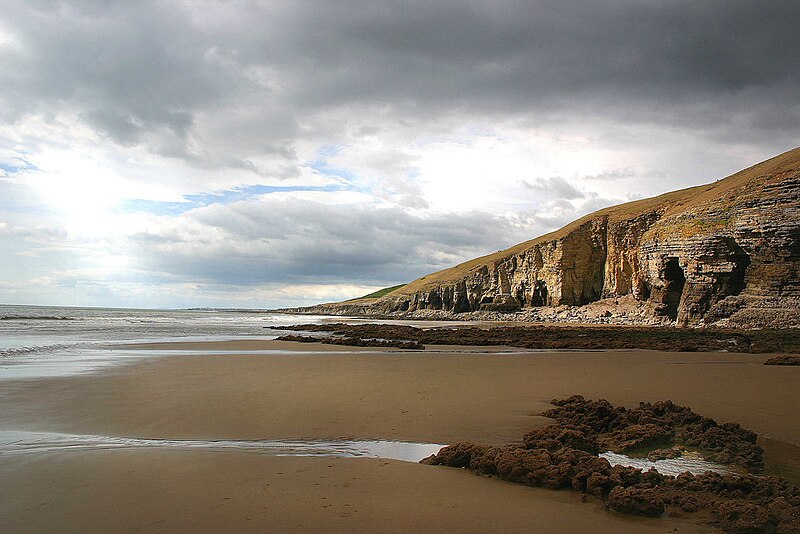
File:Southerndown beach.jpg
Southerndown beach. Photo by Chris Cardew, via Wikimedia Commons.

In the series, the beach was Bad Wolf Bay in Norway, but in real life it is Southerndown Beach in Ogmore Vale near Bridgend, Vale of Glamorgan in South Wales.  The beach forms part of Dunraven Bay, backed by cliffs formed from sedimentary rocks and popular with surfers.  The bay was designated a piece of Heritage Coast in 1972.  At low tide there is an extensive expanse of sand and pools.  The headland to the south of Southerndown Beach is the site of Dunraven Castle, built in 1803 on the site of earlier constructions, and demolished in 1963.  Nearby Ogmore-by-Sea is a seaside village at the estuary of the River Ogmore.  There are some large caves by the mouth of the river, which is probably where the village got its name, 'og' being the Welsh for 'cave'.  Just off this stretch of coast is the treacherous Tusker Rock, which has been responsible for a number of shipwrecks over the years, not helped by the fact that this reef is completely covered at high tide.   

Map of the area. 


Monday, 21 July 2014

HOLLYWOOD COMES TO DARTMOOR: WAR HORSE


This year marks the centenary of the start of the First World War, a conflict which resulted in the deaths of 9 million combatants.  Of course, warfare was very different in those days, with mounted forces playing an important role.  The early part of the War saw cavalry units being deployed in an offensive and logistical role, although they were soon phased out due to the vulnerability of the animals to heavy artillery and machine gun fire.  In the Steven Spielberg film War Horse, based on a children's novel by Michael Morpurgo, the main character Albert, the son of a couple living on a remote farm, has an exceptionally close relationship with his horse Joey, bought by his father for ploughing, and when the horse is sold to the cavalry he follows Joey into battle.  The early scenes in the film were mainly shot in a number of locations in Dartmoor and in the Wiltshire village Castle Combe. 


The scenes involving the farmhouse where Albert is shown training Joey were shot at a remote house in south-west Dartmoor called Ditsworthy Warren.  The house was built for the keeper of a nearby rabbit warren.   Further early scenes in the film were shot in the areas around the village of Meavy and the well-known beauty spot Sheepstor.  Another 'tor' called Bonehill Rocks, above Widecombe-in-the-Moor provided a further backdrop for filming.  The raw beauty of this windswept part of Devon evidently got to Spielberg, who spoke of the 'stunning scenery' and 'abundance of natural beauty' of the area.    

File:Sheeps Tor, Dartmoor - geograph.org.uk - 53861.jpg

Sheeps Tor, Dartmoor - geograph.org.uk - 53861. Photo by Gwyn Jones, via Wikimedia Commons.


Dartmoor is the upland area which separates the gentle rias and bays of South Devon from the dramatic, windswept cliffs of North Devon.  For those not constrained by time, one of the joys of travelling through the south-west corner of the country is to take a slow meander across Dartmoor, passing through the village of Two Bridges and Princetown (site of the notorious prison).  The 'tors' such as those used in the film are a recurring feature of the landscape here, and a clamber up these elevated rocky outcrops is rewarded with panoramic views, some stretching as far as the coast.  Another major draw for visitors to the area are the cute Dartmoor ponies who are prone to congregating around the car parks at the beauty spots, hoping for freebies from the tourists.  It is actually illegal to feed them, but it is not uncommon for visitors to cave in when confronted with their hopeful faces.  These free-roaming ponies are a particularly hardy breed well suited to this harsh environment, and were once used for mining and quarrying.

File:Dartmoor Ponies.jpg

Dartmoor Ponies. Photo by lostajy, via Wikimedia Commons.


The village scenes, such as that depicting the auction where Joey is bought, were filmed in Castle Combe, an impossibly picturesque village in Wiltshire.  Many of the villagers were used as extras, and the cast and crew took over all the accommodation within a 15-mile radius.  In a bid to give the village an authentic early 20th century look, the tarmac surface of the road running through it was changed to mud.  The filming allegedly caused tensions with the local populace, who were irritated by the tightened security which was in place.  However, it was not a new experience for them: Castle Combe's film star looks has led to it being used in a variety of film and TV productions, such as Lark Rise to Candleford.  

File:Castle Combe, Wiltshire-2817460377.jpg

Castle Combe, Wiltshire-2817460377. Photo by Kačka a Ondra, via Wikimedia Commons.

Castle Combe started life as a hill fort occupied by the Romans.  The castle implied by the name no longer exists, but it occupied a site half a mile north west of the Manor House.  The church of St Andrews dates from medieval times and comes complete with the Castle Combe Clock, a rare example of a still functioning medieval clock.  The market cross is from the 14th century.  The honey-coloured cottages, the small river running through it and its position nestling in the southern Cotswolds has earned the village the title of 'prettiest village in England'.  There is a disused RAF airfield which is now used as the Castle Combe Circuit motor racing venue.  

Map of Dartmoor 

Map of Castle Combe


Sunday, 29 June 2014

SNAPSHOTS OF 17TH CENTURY LONDON: SAMUEL PEPYS


Of all the many books I have read over the years, one of the most enjoyable consisted of the day-to-day ramblings of an ale-swilling, philandering but very capable civil servant.  The diary of Samuel Pepys, who rose through the ranks to occupy an important role in the Administration of the Navy, and later became an MP, although only covering a decade of his life, provides not only a fascinating insight into the life of 17th century London, but also a running commentary on some of the most significant events in the city's history, including the Black Death and the Great Fire of London.

Pepys was born on 23 February 1633 in Salisbury Court, a street leading from Fleet Street towards the River Thames.  The street was once the main carriage entrance to the medieval palace of the Bishops of Salisbury.  The area was destroyed during the Great Fire, but Salisbury Court still exists as a street, and there is a blue plaque declaring that "In a house on this site Samuel Pepys, diarist, was born".  Pepys' education included a stint at St Paul's School, still in existence and located in the riverside suburb of Barnes in south-west London.  He went on to study at Cambridge University.

Pepys started keeping his diary at the beginning of 1660, and during this first year he was appointed to the Navy Board.  During this time he lived and worked in Seething Lane, which is just to the west of Tower Hill Underground Station, where there is a bust commemorating him.  This location actually survived the Great Fire, only to succumb to a later fire in 1673.  Again, a blue plaque marks the spot.  His leisure time included visits to the 'coffee houses' which were gaining popularity at that time, and he was an avid theatre-goer.  An entry in his diary in September 1661 talks of a visit to his local theatre, Salisbury Court Theatre, to view a performance of 'Tis a Pity She's a Whore' during which, true to form, he was distracted from the proceedings on the stage by the attractive females in the audience.  

File:Bust of Samuel Pepys, Seething Lane, London EC3 - geograph.org.uk - 1077498.jpg
Bust of Samuel Pepys, Seething Lane, London EC3 - geograph.org.uk - 1077498. Photo by John Salmon, via Wikimedia Commons

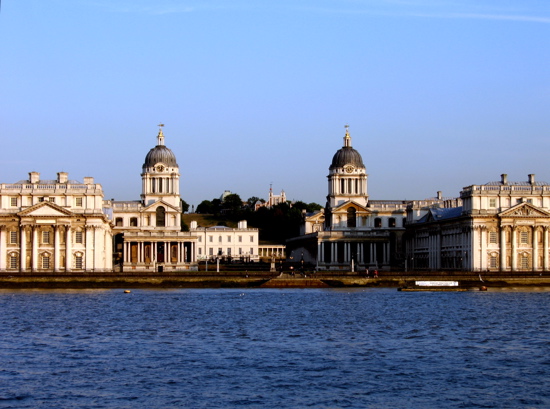
His job with the Navy took Pepys to a number of locations outside London, and even abroad in his early career, when he was sent to the Netherlands to bring Charles II back from exile.  His diary entry for 30 April 1660 describes a visit to Deal on the Kent coast, which he dismisses as 'a very pitiful town'.  His negative image seems to have derived mostly from the fact that the town came up short on the ale front: “We went to Fuller’s (the famous place for ale), but they have none but what was in the vat.”  Nevertheless, the day ended with much drinking and bonhomie aboard the ships in port.   However, Pepys was much more taken with 'Maydstone' (now Maidstone), a Kent town on the River Medway, which he found "very pretty as most towns I ever saw, though not very big, and people of good fashion in it". As the running of the naval dockyards fell within Pepys' remit, he spent a lot of time in the environs of Medway and the Thames, where most of the dockyard activity was centred.  At Upnor on the Medway Pepys describes the “great disorder by multitude of servants and old decrepid men, which must be remedied”.  Another regular haunt was Deptford on the Thames, where the first of the Royal Dockyards was built.  His visit to Deptford overnight from 11-12 January 1660 was enlivened by "a rising of Fanatiques" in response to which "seamen of all the ships present repair to us, and there we armed every one with a handspike, with which they were as fierce as could be".  Pepys made many visits to Greenwich, another Thames location with a strong naval pedigree.  The Navy Office was moved to Greenwich in August 1665, and Pepys stayed in lodgings nearby for a while.

File:2005-06-27 - United Kingdom - England - London - Greenwich.jpg
2005-06-27 - United Kingdom - England - London - Greenwich - CC-BY 4887324365. Photo by CGP Grey, via Wikimedia Commons

After the period covered by the diary, Pepys went on to have an eventful life, including being imprisoned for Jacobitism in 1690.  In 1701 he moved to a house in Clapham, and he died there two years later.  However, he was buried back in London, alongside his wife and one of his brothers, at St Olave's Church in Hart Street in the City of London, which he refers to in the diary as "our own church".  As for the diary itself, the original manuscript survives to this day, and is kept in the Pepys Library at his Cambridge college, Magdalene College.

File:PepysLibraryCambridge.jpg
PepysLibraryCambridge. Photo by Andrew Dunn, via Wikimedia Commons