Wednesday, 12 February 2014

LAMORNA, BUT NOT AS WE KNOW IT: SUMMER IN FEBRUARY


I was born in West Cornwall, just a few miles from the pretty little cove of Lamorna which forms the centrepiece of the story told in the film Summer In February, based on a true story about a colony of artists known as the Lamorna Group and the love triangle which develops between one of the artists, Sir Alfred Munnings (Dominic Cooper) and his friend Gilbert Evans (Dan Stevens, who met an untimely end in Downton Abbey) who both fall for the visiting beauty Florence Carter-Wood (Emily Browning).  I was therefore looking forward to settling down to watch the film, hoping to catch a glimpse of some of my favourite childhood haunts.  In fact, Lamorna itself features surprisingly little in the film, although there are a number of beautiful Cornish locations for location-spotters to feast their eyes on. 

The film's most gorgeous beach scenes were filmed at Holywell Bay, a short distance from Newquay on the north coast - perfect for horseriding as demonstrated by the film's characters - and at Porthcurno, famed for its unique Minack Theatre, which is actually quite close to Lamorna.   Prussia Cove, further round Mounts Bay beyond St Michael's Mount, was used for most of the Lamorna scenes in the film, as the crew deemed it more practical for filming purposes.  Prussia Cove, which actually includes four tiny coves set among an Area of Outstanding Natural Beauty, is a private estate which includes holiday and event accommodation.  The notorious smuggler John Carter operated out of this stretch of coast in the late 1700s, hence his nickname, the King of Prussia.  Trereife House in my home town, Penzance, was another filming location; this elegant country house used to offer holiday accommodation, but is no longer open to visitors.  The woods featured in the film looked suspiciously un-Cornish to me, and I was right: it turns out the woodland walk scene was filmed in Hertfordshire.

File:Holywell Bay.jpg
Holywell Bay. Photo by Nilfanion, via Wikimedia Commons.

As for Lamorna itself, the village and its cove lie at the end of a lush green valley.  There is a tiny harbour, which has sadly fallen victim to the violent storms which are still battering Britain as I type: the harbour wall was literally broken in two by the force of the waves.  Art fans who want to immerse themselves fully in the Cornish landscape so beloved of Munnings and his friends can rent holiday accommodation adjoining the converted barn used as a studio by the artist.  Alternatively, The Cove Hotel was once home to Gilbert, and later to Florence and Alfred after they were married.  While in Lamorna a drink in the village pub, The Lamorna Wink, is a must - one of the film's early scenes features a boozy evening in The Wink.  There are lovely cliff-top walks from Lamorna, towards Porthcurno in one direction and towards Mousehole in the other - one of the film's scenes features a short clip of the latter.  Near Lamorna is a stone circle called the Merry Maidens, where Florence and Gilbert used to meet.  Legend has it that a group of maidens were turned to stone for dancing on a Sunday; I vividly remember being told this as a small child, to my utter terror.  Finally, Lamorna is only a few miles away from some of Cornwall's most artistic towns and villages, including Newlyn, Mousehole and last, but by no means least, St Ives.  
File:Lamorna Cove - geograph.org.uk - 847500.jpg
Lamorna Cove - geograph.org.uk - 847500. Photo by Tony Atkin, via Wikimedia Commons.


Map of Lamorna.


Friday, 24 January 2014

THE GAFF ON THE TAF: DYLAN THOMAS AND HIS LAUGHARNE HIDEAWAY


I first visited the estuary town of Laugharne - pronounced Larne - a few years ago on the way home from a weekend in Tenby with my husband.  I must confess I had never heard of it before, but the landlady of our bed and breakfast recommended it, so we decided to look in on it.  After wandering around the town we decided to go for a walk along the path by the west bank of the estuary of the River Taf, on which the town is situated, and after a short distance we came across a sweet little building, barely more than a hut.  Peering through the window, it became apparent that what we were looking at was the 'Writing Shed' used by Dylan Thomas during his time living in Laugharne.  Thomas and his family spent the last four years of his tragically short life living in the Boat House on the shore of the estuary, and the shed was perched just above it.  It was a lovely Sunday morning when we visited, and as we gazed out at the stunning views of the estuary and of the majestic Gower Peninsula away in the distance, it was easy to imagine what a source of inspiration this spot must have been for the most famous Welsh poet.
The Boathouse

The first poem written by Dylan Thomas in his Writing Shed was 'Over St John's Hill', which describes the view - "Crystal harbour vale//Where the sea cobbles sail", "wharves of water where the walls dance and the white cranes stilt" - and the wildlife - "the hawk on fire hangs still" and "the elegiac fisherbird stabs and paddles".  Other works borne from Thomas' time in the shed include 'Do Not Go Gentle into that Good Night' about his dying father and 'Poem on his Birthday'.  The characters in 'Under Milkwood' are believed to have been inspired by the people of Laugharne, although the location is thought to be based on New Quay in Cardigan Bay.  


The Taf Estuary

For visitors who want to follow a 'Dylan trail' there are a number of sites around Laugharne with connections to the poet.  Brown's Hotel was where he would retreat to after a bout of poetry-writing in order to indulge his other great passion in life: drinking.  The sign outside the hotel shows an image of the poet.  There are two former homes which were occupied by the poet and his family before they settled in the Boat House: Eros, a fisherman's cottage on Gosport Street and Sea View behind the castle.  The castle, dating from Norman times and now a ruin, was a favourite haunt of Thomas when seeking peace and solitude.  The hillside cemetery of St Martin's Church harbours the graves of both Dylan and his beloved wife Caitlin.  Nature lovers will find plenty of birdlife down at the estuary, with egrets, lapwings, herons, oystercatchers, seals and even the occasional otter making an appearance.

File:Browns hotel.jpg
Browns Hotel. Photo by Tony in Devon, via Wikimedia Commons
The Boat House is open to visitors from May to October, and offers memorabilia devoted to Thomas as well as a tea room and art gallery.

This year marks the centenary of the birth of Dylan Thomas, who was born on 27 October 1914.  For the centenary a pop-up replica of the Writing Shed will be touring throughout Wales.

Map of the area.


Saturday, 11 January 2014

JANE AUSTEN'S DARK SIDE: DEATH COMES TO PEMBERLEY


Christmas is always something of a desert for viewers searching for a touch of class on TV.  However, Christmas 2013 provided a treat for Jane Austen fans in the form of Death Comes To Pemberley.  The 3-parter, based on a script by P D James, ventures into a world beyond Pride and Prejudice in which Mr Darcy and Elizabeth Bennett are blissfully married with children and living in a sumptuous house and estate.  However, their gilded existence is shattered by a tragedy involving the death of one of their circle.  Trevor Eve plays the sinister magistrate Sir Selwyn Hardcastle, who is called in to investigate the death.    

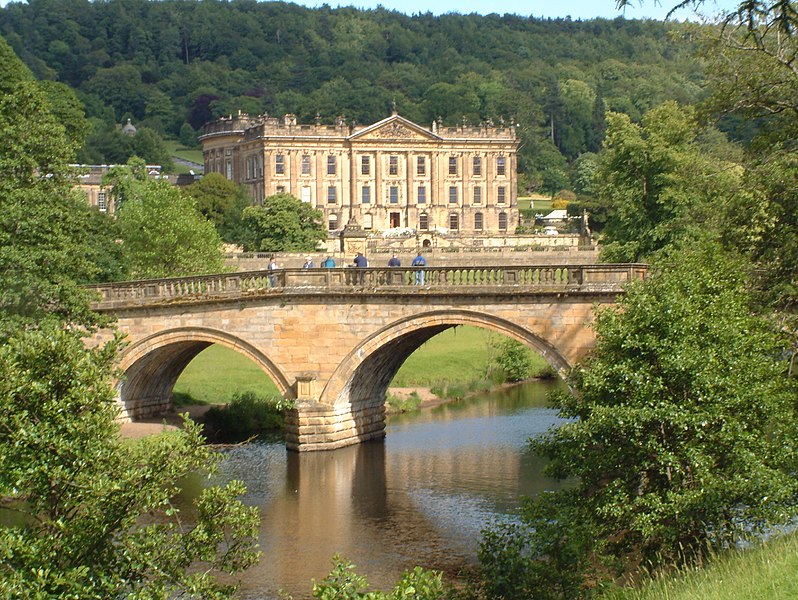
The undisputed star of the show is the magnificent Chatsworth House and Estate in Derbyshire, dating back to the 16th century and Bess of Hardwick, one of the most powerful women in Elizabethan England.  Nestling in the heart of the beautiful Peak District, the house is currently home to the Duke and Duchess of Devonshire and is open to visitors, with 30 rooms on display.  As well as the rooms there are a significant number of works of art available to view including Old Masters, artefacts from Ancient Egypt and modern sculptures.  Outside the house, visitors can explore 105 acres of garden with highlights including a number of water features, most notably the 300 year old Cascade and the gravity fed Emperor fountain.  There are five miles of walks available for visitors wanting to stretch their legs.

File:Chatsworth Bridge.jpg
Chatsworth Bridge. Photo by Rob Bendall, via Wikimedia Commons.

The opening scene of Death Comes To Pemberley has two maids from the House venturing into the woods above the estate.  One of them takes fright, having witnessed something spooky, and the pair run back to the House.  The Pemberley Woods scenes used in this opening sequence were filmed at Hardcastle Crags, a beauty spot in the South Pennines run by the National Trust.  There are footpaths galore available to visitors wanting to explore the waterfalls, streams and stacks of millstone grit.  The centrepiece of the site is Gibson Mill, which is used as a Visitor Centre.  Entomologists may be interested to know that the area is home to the scary-sounding northern hairy wood ant.    

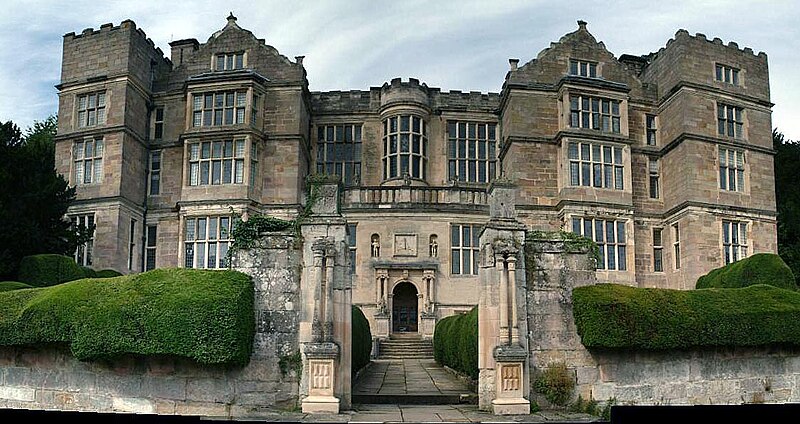
Sir Selwyn Hardcastle occupies a property not quite in the league of Pemberley/Chatsworth, but quite impressive nonetheless.  The role of his house is played by Fountains Hall near Ripon in North Yorkshire, another National Trust property.  This elegant mansion was built by Sir Stephen Proctor in the late 16th/early 17th century and it lies within the Studley Royal Park World Heritage Site, which includes the ruins of Fountains Abbey.  The hall was commandeered during World War II to house evacuees.  It is also a hotspot for ghost sightings, with phenomena including the sound of rehearsing musicians and a "shining golden lady".  There are holiday flats available on site to those wanting to immerse themselves in these inspiring surroundings.

File:Fountains hall 2.jpg
Fountains hall. Photo by Adamjennison111, via Wikimediacommons.

Monday, 23 December 2013

POTTERING AROUND ON THE JACOBITE STEAM TRAIN


At Christmas you just know that certain films are going to make an appearance on TV: It's A Wonderful Life for vintage film buffs, Love Actually for fans of modern romances, the obligatory sprinkling of James Bond films for the guys, while for the kids (and some of the adults!) it just has to be Harry Potter.  One of the most prominent features of the Harry Potter films is the Hogwarts Express, and probably the most memorable image from the journey taken by this vintage steam train is that of a magnificent viaduct set among classic Scottish mountain scenery.  In Harry Potter and the Chamber of Secrets a turquoise Ford Anglia is seen flying over it.  The viaduct which features in the films is the Glenfinnan Viaduct, and the train carriages used in the filming are those of the Jacobite steam train, a heritage railway open to visitors which follows a route generally considered to be one of the finest railway journeys in the world, an 84-mile round trip between Mallaig and Fort William on the west coast of Scotland, taking in both the deepest freshwater loch in Britain and the deepest seawater loch in Europe.  The steam train runs from May to October and makes a stop at Glenfinnan, where there is a railway museum, and also stops at Arisaig, from where there are boat trips to the Small Isles. 

File:Train across Glenfinnan Viaduct (239397344).jpg
Train across Glenfinnan Viaduct (239397344). Photo by Tony Hisgett, via Wikimedia Commons.
The Glenfinnan Viaduct has 21 arches and a maximum height of 30m and was built in the years 1897-1898 as part of the Mallaig extension of the West Highland Railway.  The viaduct overlooks Loch Shiel and the Glenfinnan Monument.  The monument marks the spot where Bonnie Prince Charlie raised his standard at the start of the Jacobite Rising in 1745.  However, the monument was not built until the following century, by which time the Jacobite cause was a spent force.  Standing at 18m high, the monument takes the form of a column with the figure of a kilted highlander on top.  Visitors can climb a spiral staircase to the top of the monument, where there is an observation platform with sensational views over the loch and mountains.  The National Trust for Scotland now looks after the monument, with the addition of a visitor centre with exhibitions, a shop and refreshment facilities.  An additional diversion available to visitors to Glenfinnan is a boattrip on Loch Shiel, with some trips offering a guided "Eagle-Watch".  

File:Loch Shiel and the Glenfinnan Monument - geograph.org.uk - 701693.jpg
Loch Shiel and the Glenfinnan Monument - geograph.org.uk - 701693. Photo by Peter Levy, via Wikimedia Commons.


Map of the area.


Tuesday, 26 November 2013

WHAT THE DICKENS! ROCHESTER AND CHATHAM


The celebrated British writer Charles Dickens was born in Portsmouth, but he spent part of his childhood at 2 Ordnance Terrace in Chatham, adjacent to Rochester.  He later bought a house at Gad's Hill Place, Higham, between Gravesend and Rochester.  It is evident from his writing that Rochester and the surrounding area made quite an impression on him, in fact it features in a number of his works.  For Dickens fans visiting Rochester, the city offers the Footsteps In Time guided walking tours conducted by costumed Dickens characters, while the best time of year for them to visit Rochester is just before Christmas, when the Dickensian Christmas Festival takes place, and there is also a Christmas market at the castle.  There is another Dickens festival in the town in June.

Rochester Castle

One of Dickens' best known works is The Pickwick Papers, originally written as a serial for a publication, 19 issues in all.  The story centres around Mr Pickwick, founder of the Pickwick Club based in London, and three of his fellow Pickwickians, as they set off on a journey full of amusing adventures - or more often misadventures - encountering a whole sub-cast of eccentric characters along the way.  The action kicks off with a stay in Rochester, where they put up at the Bull Inn on the High Street.  The castle makes an immediate impression on the friends: one of them, Mr Snodgrass, declares it a "Magnificent ruin!", while Pickwick himself adds "What a study for an antiquarian!" Pickwick makes some observations on the character of the town, describing its "principle productions" as "soldiers, sailors, Jews, chalk, shrimps, officers and dockyard men", while commercial activities include marine stores and the sale of "hard-bake, apples, flat-fish and oysters".  He also comments on the smell of tobacco in the streets: as a sign of how different attitudes to such things were in those days, he describes it as "exceedingly delicious to those who are extremely fond of smoking".  

View of the Medway from the castle

In one of the story's many comic episodes, one of Pickwick's friends, Mr Winkle, becomes the unwitting victim of a case of mistaken identity following an incident at a ball being held at The Bull, which very nearly results in him becoming involved in a duel.  Another hilarious episode takes place on a journey from the inn out to the country, in which the friends make a disastrous attempt at controlling a horse.  One of their outings from Rochester is a visit to Chatham to observe some military maneuvers put on for the public on The Lines, an open space neaer Chatham barracks.  The friends get into trouble again, this time finding themselves in the line of fire by standing in the wrong place.  Dickens' affection for Rochester shows through in a contemplative scene in which Pickwick is standing on Rochester Bridge admiring the river scene.  There is a vivid description of the castle on the left with "the ruined wall, broken in many places", while the banks of the Medway are "covered with corn-fields and pastures, with here and there a windmill". 

Rochester Castle still makes an impressive sight today, as does the Cathedral, which dates back to Norman times.  The inn featured in The Pickwick Papers (and also in Great Expectations, where it was named the Blue Boar Inn) still stands on the High Street at nos 16-18.  It is now called the Royal Victoria and Bull Hotel - the name acquired the Victoria part following a stay by Queen Victoria, who allegedly complained about the uncomfortable bed she slept in.  The High Street retains quite a lot of its old world charm, with a pleasant mix of pubs, restaurants and independent shops occupying the period buildings.  One of these, an Elizabethan mansion called Eastgate House, featured in Dickens' final, unfinished novel The Mystery of Edwin Drood.  As for neighbouring Chatham, the other big draw besides Dickens World is the Chatham Historic Dockyard, where the construction of ships dates back to Tudor times and has encompassed both surface ships and submarines.  The site is now a major tourist attraction for visitors to the area.  

Side entrance to Eastgate House


For more information about the area see the Visit Medway website. 


Tuesday, 5 November 2013

AGATHA CHRISTIE COMES HOME WITH POIROT: GREENWAY HOUSE


The edition of the Poirot series shown on ITV at the end of last month was a special one in that the location used for the filming was the real-life holiday home of Agatha Christie, whose work the series is based on.  Greenway House provided the inspiration for the original story Dead Man's Folly as well as a perfect setting for the filming.  The episode was also a sad one for David Suchet, the actor who has played Poirot for the last 24 years, as it involved him being filmed as Poirot for the last time, although two more episodes would be shown following this one.  The makers of the series decided that it would be appropriate for Suchet's final piece of filming as Poirot to take place in the Christie home, hence the timing.  In a recent interview, Suchet revealed that he was looking for a way to imitate the mincing gait of Poirot as described by Agatha Christie, and he ended up nicking a tried and tested technique of Laurence Olivier's: walking with a coin clenched between his buttocks.

In Dead Man's Folly, Greenway House plays the part of Nasse House, recently taken over by a wealthy couple.  A fete is being held at the house, and as part of the festivities a murder hunt is being organised by famous author Ariadne Oliver (Zoe Wannamaker).  However, Oliver has her suspicions about some of the people attending the event, and begins to fear that a real-life murder might take place, so she invites Poirot to the house just in case.  Needless to say a murder does take place...but I'll leave it there in case anyone reading this has not watched the episode yet. 

Greenway House, built on a site originally occupied by a Tudor mansion, lies in an elevated position in an idyllic spot overlooking the east bank of the River Dart in South Devon.  The house itself is ravishing, with its elegant, classic exteriors in a tasteful shade of cream, beautifully set off by the green of the equally exquisite grounds.  Agatha Christie and her husband Max Mallowan bought the house in 1938, and they used it as a holiday home until their respective deaths, which occurred within the space of two years in the 1970s.  During World War II the house was requisitioned by the US military for the D-Day preparations.  The house is filled with reminders of the couple's time there, including the Steinway piano Agatha used to play and artefacts brought back from the Middle East by her husband, who was into archaeology.  The gardens slope towards the banks of the river and are filled with plants such as camellias and rhododendrons.  The property is now owned and operated by the National Trust.  The nicest way to arrive at the house is by taking the Greenway Ferry from Dartmouth, Totnes, Brixham or Torquay.

Map of the area. 

Front of Greenway House