Monday, 26 August 2013

OH MR DARCY! LYME PARK, CHESHIRE


I have always found Sunday evening to be one of the most depressing parts of the week, what with the start of the new working week being just around the corner.  TV therefore has an important role to play by providing viewers with something to cheer themselves up.  Many women like nothing more than to settle down to a good costume drama, and on the evening of Sunday 24 September 1995 female viewers were in for a treat when the BBC's adaptation of Jane Austen's Pride And Prejudice burst onto our screens.  As well as being a jolly enjoyable drama, there was the added bonus of the dashing Colin Firth as Mr Darcy, his brooding good looks providing a much-needed Sunday evening tonic for the nation's women.  However, nothing could prepare them for the delights in store in episode four and the famous "lake scene".

Let us just relive the scene for a moment.  It is a swelteringly hot summer's day.  Mr Darcy strides towards the lakeside, removing his jacket, and sits down, contemplating a lovely cooling swim.  Off comes the scarf and off comes the waistcoat.  All over the country, female hands are fumbling distractedly in chocolate boxes, knocking over cups of tea, their owners unable to take their eyes off the screen.  However, that is all the stripping they are going to get.  Mr Darcy dives in, and we catch a glimpse of him moving through the murky water.  After his swim he is seen in his wet shirt, made slightly see-through by the sun.  Mr Darcy, still in a state of semi-undress and dripping wet, runs into Miss Bennett, who is not expecting him to be there, and a toe-curlingly awkward conversation ensues.

Earlier this year, this scene was voted the most memorable moment in TV drama, beating some of the most dramatic scenes from our beloved soap operas, such as the scene where Dirty Den hands the divorce papers to Angie in EastEnders, the tram crash in Coronation Street and the lesbian kiss in Brookside, among others.  The scene also made it into popular fiction when Bridget Jones and her friends settled down to watch the DVD with the obligatory bottle of wine (in fact the whole premise of the Bridget Jones story is as a modern-day equivalent of Austen's tale).  Apparently, Firth nearly turned the part of Mr Darcy down when originally offered it, believing himself to be a bit old for a romantic lead.  As for the actual dive, a body double was used due to concerns over the risks of Weil's disease from the lake waters.  However, Firth was used for the underwater part, which was filmed in a tank at Ealing Studios.

Apart from the undoubted charms of Colin Firth as Mr Darcy and Jennifer Ehle as Miss Bennett, the other star of the scene in question is Lyme Park where it was filmed and which doubled as Darcy's estate Pemberley in the series.  This estate near Disley in Cheshire, on the north-west edge of the Peak District, dates from the 14th century when it was granted to Sir Thomas Danyers.  It then passed to the Legh family, and remained with them until it was transferred to the National Trust in 1946.  The centrepiece of the estate is a large stately pile, the largest house in Cheshire, with a mixture of architectural styles from Elizabethan to Italianate.  Highlights include the Wardrobe Department where visitors can dress up in period costume, a cinefilm made by the last generation of the Legh family to occupy the house, a 15th century prayer book and numerous glimpses into the life of a well-to-do Edwardian household.  As well as the famous lake, the grounds include a deer park, an Edwardian rose garden, Cage Hill with its eponymous tower, a former hunting lodge, and walking trails that take in scenes from Pride and Prejudice.  Visitors to the property will have the chance to relive the lake scene when a statue of the semi-clad, sodden Mr Darcy is installed at Lyme Park following a tour around the country.  The statue, which was created to celebrate the launch of the new Drama TV channel, will remain at the estate until February 2014.
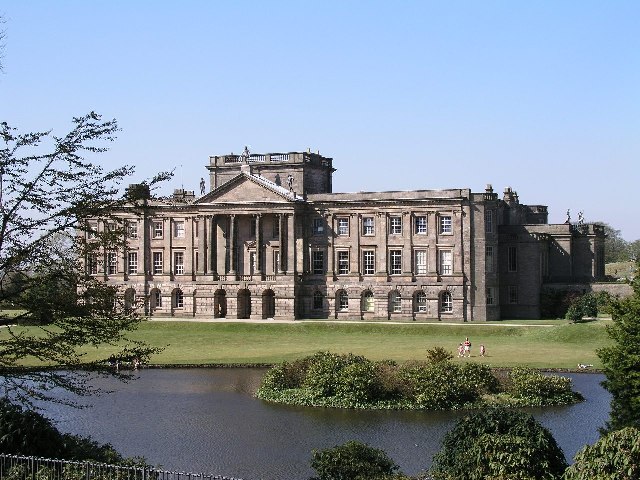
File:Lyme Hall 01.jpg
Lyme Hall 01. Photo by Alan Fleming, via Wikimedia Commons

Map of the area.

Thursday, 8 August 2013

UNMISTAKABLY DORCHESTER: THE MAYOR OF CASTERBRIDGE


There can be few towns in literature as readily identifiable with their real life counterparts as Casterbridge, Thomas Hardy's fictional version of Dorchester.  The town is the focal point of The Mayor Of Casterbridge, the story of a man, Michael Henchard, who drunkenly sells his wife in his youth.  This act comes back to haunt him later in life, by which time he has become the Mayor Of Casterbridge. The story makes numerous references to local landmarks and buildings which can be pinned down to their real-life equivalents.  One of Dorchester's best known features is The Walks, a series of pleasant, tree-lined avenues which follow the line of the original Roman walls.  In Hardy's time, these avenues more or less formed the boundary between the town and the countryside, and there are several references to the way in which the agricultural areas around the town almost encroached on its streets.  Hardy describes the town as "like a chessboard on a green table-cloth", and he talks of how, when an execution took place, the cows had to be moved out of the way from the meadow next to the "drop" to make way for the spectators.  And how the judge, when passing sentence, did so "to the tune of Baa", from the sheep nearby.  Meanwhile, the High Street was colonised by pig-dealers occupying the recesses outside people's houses, and by the sellers of horses who "occasionally nipped little boys by the shoulder who were passing to school".  Needless to say, the present-day Dorchester has spread far beyond the confines of The Walks.

Halfway up Dorchester's High Street is the Kings Arms Hotel (now closed), an inn built in 1720 which has played host to Queen Victoria and King George VI.  The hotel, with the same name, features prominently in The Mayor Of Casterbridge (and also appeared in Far From The Madding Crowd).  Many of the important events of the novel take place in the Kings Arms.  In chapter 5 the Mayor of the title presides over "a great public dinner of the gentlepeople and such like leading volk", with the town band playing outside and lesser townsfolk peering in through the windows at the proceedings therein.  This is the point at which the sold wife first sees her husband after a long separation.  Another prominent pub which features in the story is The Three Mariners - this was based on an inn called The King Of Prussia, which was pulled down at the end of the 19th century.  

The house reputed to have been lived in by Michael Henchard. Photo by Brian Turland

The Kings Arms. Photo by Brian Turland

As well as the town itself, several nearby landmarks play an important part in the story.  As its name suggests, Dorchester had Roman origins, and there are many relics of that time around the town.  Maumbury Rings was the site of a Roman amphitheatre in the 1st century AD.  The site, which is referred to as the Ring in the novel, is where Henchard has a rendezvous with his former wife, and later with the other woman in his life, Lucetta.  There is a road referred to in the story as the Via, so called because it was once a Roman road.  This Via is overlooked by Maiden Castle - or Mai Dun - the largest prehistoric earthwork in the country, which is used as a vantage point by Henchard to observe comings and goings along the Via.  Some of the more rural scenes in the novel are set in "an eastern purlieu" called Durnover.  This is a fictional village on the edge of town, of which the real-life equivalent is Fordington, a former village which now forms part of the built-up area of Dorchester.  Further afield, the seaside town named Budmouth in the novel is Hardy's version of Weymouth, which also appears elsewhere in his work.


Maumbury Ring. Photo by Brian Turland


Fordington, aka Durnover. Photo by Brian Turland


Hardy was well qualified to base a novel around Dorchester: he was born in Higher Bockhampton near the town in 1840, and in 1849 began attending a school in Dorchester.  At 16 he went to work for the architect John Hicks, at 39 South Street.  Later in life, after spending time in London and a variety of locations he returned to live in Dorchester, moving into Max Gate in 1885.  This Victorian house designed by Hardy himself is now run by the National Trust, who also run his Higher Bockhampton birthplace.  Near Dorchester, commanding an elevated position with views out to the coast and inland, is the Hardy Monument, also National Trust.

File:Thomas Hardy's Birthplace (8061936623).jpg
Thomas Hardy's Birthplace (8061936623). Photo by Peter Broster, via Wikimedia Commons

Thomas Hardy's statue. Photo by Brian Turland


For tourist information about Dorchester follow this link.

Map of the town.


Friday, 12 July 2013

YORKSHIRE IN THE BUFF: CALENDAR GIRLS


I have a confession to make.  For the first thirty years of my life I hardly ventured north of Birmingham.  I grew up in Cornwall, and as far as I was concerned "oop north" was a cold, dark place with sooty, industrial cities and little to tempt me there.  Then, two years into my marriage my husband and I decided to drive to Scotland.  On the way up we stopped in Wharfedale in the Yorkshire Dales, and as we wound our way up the dale with its vast, rolling green meadows with flocks of sheep being rounded up by spirited sheepdogs and its quaint little villages nestling in the folds of the countryside on the banks of the River Wharfe I started mentally kicking myself.  What had I been missing all these years?  This was wonderful.  And so the Yorkshire Dales came to be one of my favourite parts of Britain.  This stunning part of the country is the backdrop to the film Calendar Girls, based on a true story about a group of "women of a certain age" from a local Women's Institute who wanted to create a best-selling calendar to raise money for a hospital in memory of a friend's late husband and who decided to produce a series of tasteful images of themselves in the altogether.

The village where the W.I. held their meetings was called Knapely in the film, but in reality many of the scenes representing Knapely were filmed in Kettlewell in Upper Wharfedale.  For example, the hillside where the ladies did their tai chi was at Leyburn Road in Kettlewell, while John and Angela's house was at Cam Lodge.  Kettlewell lies on the banks of the River Wharfe and the mountains of Great Whernside and Buckden Pike tower over this idyllic scene.  The village was once a thriving market centre, and later grew rich on textiles and lead mining.  The remains of a smelting mill are still visible above the village.  Nowadays, agriculture is the economic mainstay, together with tourism of course, especially with the number of visitors coming to see where the film was made.  Once a year in August the village hosts a scarecrow festival, with scarecrows dotted around the place dressed in different costumes.

File:Town Head - geograph.org.uk - 1441734.jpg
Town Head - geograph.org.uk - 1441734. Photo by John Illingworth, via Wikimedia Commons.
Another location in Wharfedale which featured in the film is Burnsall, where the annual village show, referred to as the "Kilnsey Show" was filmed.  We made a lunch stop at a riverside pub in Burnsall on my "voyage of discovery" en route to Scotland, actually an alfresco lunch even though it was October - so much for the North being cold!  Burnsall is very popular for walking and fishing, and there is a path by the river between here and Hebden dating from Viking times.  There is a handsome five-arched bridge in the village which forms part of the Dales Way long-distance trail.  On our way through the dale, we made an overnight stop at the Tennants Arms Hotel in Kilnsey, not knowing at the time that it was to be used in a future film - the hotel featured in the press conference scenes.  Towering over this small village is a prominent local geographical feature called Kilnsey Crag, a large limestone cliff.  Another beautiful Wharfedale location used in the film is Buckden, towards the north end of the dale.

File:Burnsall Village from the Barden Road - geograph.org.uk - 946841.jpg
Burnsall Village from the Barden Road - geograph.org.uk - 946841. Photo by Doug Elliot, via Wikimedia Commons.

The film used a number of other Yorkshire locations besides Wharfedale:  Coniston, North Yorkshire (not to be confused with the Coniston in the Lake District); Cow and Calf rocks which overlook the town of Ilkley; Settle - southern terminus of the Settle-Carlisle Railway - where Chris (Helen Mirren) goes to the pharmacy to collect the photographs; Ingleton, famous for its WaterfallsTrail and for Ingleborough, the second highest mountain in the Yorkshire Dales; Malham with its spectacular "Cove"; Skipton, where the Calendar Girls try to get sponsorship; and White Abbey, Linton, where the photo shoot took place at Celia's house.  So anyone visiting the area who enjoyed the film can easily fill a week discovering the filming locations while making the most of all that this wonderful part of the country has to offer.

File:IlkleyCowandCalfRocks.jpg
IlkleyCowandCalfRocks. Photo by Jon Farman, via Wikimedia Commons.

For information about the Yorkshire Dales, visit the National Park website.

Map of the Kettlewell area.


Friday, 21 June 2013

UPSTAIRS DOWNSTAIRS IN DEEPEST HAMPSHIRE: DOWNTON ABBEY


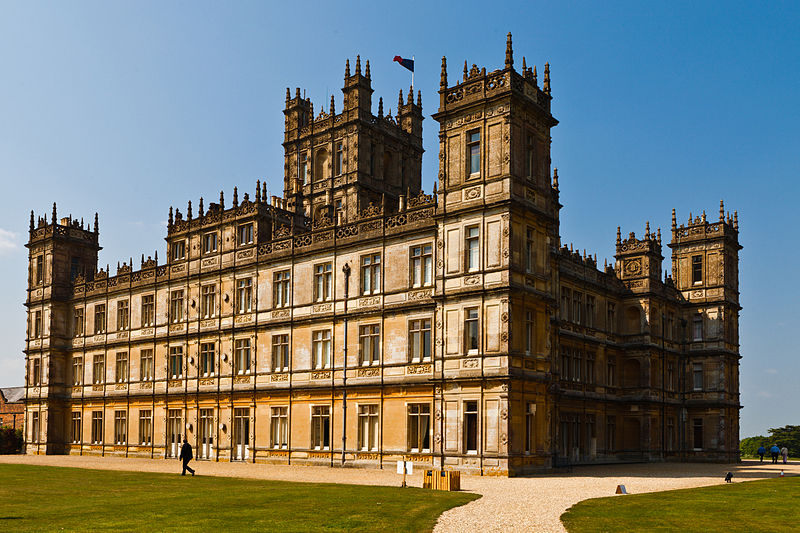
Highclere Castle has become so inextricably linked to the ITV period drama series Downton Abbey that the area surrounding it has been christened "Downtonia".  The hugely successful series, the brainchild of Julian Fellowes, takes us through the emotional rollercoaster that makes up the family life of the aristocratic Crawley family and their servants during the reign of King George V.  The latest series had a suitably dramatic ending as Dan Stevens (playing Matthew Crawley) ruined everyone's Christmas by fatally crashing his car in the show's Christmas special.  The setting of the drama is a fictional estate in Yorkshire which is the seat of the Earl and Countess of Grantham, but the exterior shots and most of the interior ones were filmed at Highclere Castle, apart from certain areas such as the servants' quarters, for which Ealing Studios was used.

The site occupied by Highclere Castle was in medieval times the location of the palace of the Bishops of Winchester.  A house was later built on its foundations, then later still Highclere Castle came into existence: it has been the seat of the Carnarvon family since 1679.  In 1692 Robert Sawyer, a former Speaker of the House of Commons and college friend of the 17th century diarist Samuel Pepys, bequeathed a mansion at Highclere to his daughter Margaret, wife of the 8th Earl of Pembroke.  It was their son, Robert Saywer Herbert who began its picture collection and created the garden temples.  In the mid-19th century, the architect responsible for the present incarnation of the Houses of Parliament, carried out extensive rebuilding work on the house in an "Anglo-Italian" style.  The park surrounding the castle was created according to a design by Capability Brown, and the local village was actually moved during the process: the remains of the original 17th century church are at the south-west corner of the castle.

Visitors to Highclere Castle can luxuriate in the sumptuously decorated rooms open to the public, which include the Saloon, the State Dining Room, the Library, the Music Room, the Drawing Room and the Smoking Room.  Some of the bedrooms can also be viewed, reachable via the suitably impressive oak staircase, as can the kitchens, cellars and so on in the "downstairs" part of the household.   The glorious grounds of the Castle feature the Monks' Garden, whose name is a nod to the Bishops of Winchester, and such delightfully named areas as the Secret Garden and the Wood of Goodwill.  The extensive parkland includes a number of classically inspired follies, as well as remains of ancient Iron Age and Bronze Age hill forts and tumuli.  

File:Highclere Castle (April 2011).jpg

Highclere Castle (April 2011). Photo by Richard Munckton, via Wikimedia Commons.

Probably the most notable episode in the history of the Carnarvon family occurred in 1922, when the 5th Earl of Carnarvon, along with the archaeologist Howard Carter, discovered the tomb of Tutankhamun.  The find was the pinnacle of 16 years spent excavating at several key archeological sites in Egypt.  Sadly, the Earl died the year after the incredible find, but his legacy was an extraordinary collection of antiquities, most of which were sold to the Metropolitan Museum of New York, although a few less significant items remained at Highclere.  Now these and some of the other items have been brought together for an exhibition at Highclere which, as well as displaying some of the fruits of Carnarvon's time in Egypt, tells the story of the quest by Lord Carnarvon and Howard Carter which led up to the discovery of the tomb.  The fascinating artefacts on display include a  noble woman's coffin from 3,500 years ago.

There is one note to add on Carnarvon's death.  One of the best known legends surrounding the antiquities unearthed in Egypt is that of Tutankhamun's curse.  As it happens, it was less than two weeks after the official opening of the burial chamber that Lord Carnarvon was bitten by a mosquito, and the bite became infected.  The Lord fell ill with pneumonia, from which he died, aged just 57.  But that's not all: allegedly, the lights went out in Cairo at the moment of his death, while back home his dog started howling and died at the same moment.  Meanwhile, back in the present, it has been reported that several of the cast members of Downton Abbey had accidents during the filming, resulting in two broken wrists and a foot impaled by a dropped knife.  Perhaps the Curse of Tutankhamun lives on...

The house and grounds are open to the public at peak times of the year and on certain other dates for special events.  Downton Abbey returns to our TV screens later this year.

Highclere Castle is in the far north of Hampshire, near Newbury.  See here for a map.


Monday, 27 May 2013

JANE AUSTEN'S LYME REGIS


Jane Austen's novel Persuasion, which tells the story of love lost and refound, is set largely in the leafy countryside of the West Country, and in the elegant town of Bath.  However, the most dramatic scene in the novel, and the most pivotal to the story, takes place in Lyme Regis, where one of the characters has a nasty accident on The Cobb, the sturdy stone quay which encloses one side of the town's harbour, and is forced to extend her stay there while recovering from the incident.  Even today it is easy to imagine such an accident; I had to exercise great caution walking up and down the Cobb's steps on a recent visit.  In fact there is one set of steps on the Cobb nicknamed "granny's teeth", presumably for their unevenness.  

The Cobb


Lyme Regis, one of the loveliest towns on the Jurassic Coast, so named for the rich fossil content in its cliffs, is an attractive small resort, with a harbour and beach area backed by restaurants and pubs. The town is very hilly, and every street seems to offer a view of the sea.  This was well illustrated by Jane Austen in Persuasion, when she described "the principal street almost hurrying into the water".  However, she was less charitable about the architecture, declaring that "there is nothing to admire in the buildings themselves", a fact I would personally dispute, especially in the case of the lovely little promenade lined with elegant Georgian buildings.

The seafront, with views towards Golden Cap

In Jane Austen's era Lyme Regis was a fashionable place to head for during the summer season (although the action in Persuasion takes place in November, "too late in the year for any amusement or variety").  Those who wanted to take to the water had bathing machines at their disposal.  The machines were hired by the hour and were wheeled out to sea by an attendant.  Sea bathing in those days was not just for fun: it was widely believed that a dip in the briny would cure a range of illnesses.  Dances were held in the Assembly Rooms, sadly now gone and occupied by a car park on the seafront at the bottom of the main street.  As for Jane herself, she is known to have enjoyed at least two summer breaks in the town, in 1803 and 1804, and she evidently became very fond of it, judging from her affectionate descriptions of Lyme and the surrounding area, talking of "high grounds and extensive sweeps of country" and "its sweet, retired bay".  She visited the Assembly Rooms on her second visit, and in a letter to a relative described how she was passed over for the first two dances, but danced with a Mr. Crawford for the second two.  There is an unassuming building in the main street called Pyne House which is believed to have been the one where Jane Austen stayed.

Pyne House
Jane Austen fans who want to follow in her footsteps can join a walking tour courtesy of Literary Lyme, who also do French Lieutenant's Woman tours for fans of John Fowles whose novel of the same name was largely set in the town.  

Lyme Regis is on a regular bus service between Weymouth and Exeter, but does not have a train station.  The nearest station is at Axminster, while Weymouth is reachable by a direct rail service from London.  

Official Tourist Information website.

Map of the town.


Friday, 17 May 2013

ABOUT A BOY: CLERKENWELL


In 1998 a book called 'About A Boy' by the popular British author Nick Hornby appeared on the shelves, and quickly turned into a bestseller.  The story was an unusual but heartwarming tale about an unlikely friendship which develops between a spoilt young man called Will (played by Hugh Grant), who lives a life of leisure courtesy of the royalties from a hit song by his father, and an awkward young boy called Marcus, whose mother, a suicidal hippy vegetarian, dresses him in strange clothes making him a magnet for the school bullies.  Will has a creative way of meeting women involving posing as the father of a fictitious two year old at a single parents' group, and it is this that leads to him meeting the boy of the title and his mother and reluctantly becoming  the lad's mentor in life. 

The film made use of a number of locations around London, but many of the crucial scenes were filmed in Clerkenwell in the London Borough of Islington.  The epicentre of Will's life - his hi-tech apartment - was located in St James Walk; for the purposes of the film a false entrance was specially added to the side entrance of numbers 16-18.  The meeting place for the single parents' group was filmed at Woodbridge Chapel.  Meanwhile, in one of the early scenes, Will briefly considers volunteering at a drop-in centre.  The building whose exterior was used to represent the centre in the film was St James's Church.  


Clerkenwell Green - geograph.org.uk - 650865. Photo by Colin Smith, via Wikimedia Commons.


The name Clerkenwell derives from Clerk's Well: the term "clerk" dates from the Middle Ages, and means a literate person or clergyman.  The well in question is still visible today, albeit as part of a modern building called Well Court on Farringdon Lane.  The district's former existence as a village is evident in the presence of an area known as Clerkenwell Green, which survives to this day, although it is some time since the "Green" actually had any grass.  Clerkenwell has a long and varied history.  During the Crusades, the Knights Hospitallers used Clerkenwell Priory as their Headquarters.  Later, in the 17th century when Clerkenwell became a fashionable place to live, the area's distinguished residents included Oliver Cromwell, who owned a house on Clerkenwell Close.  Around this time, several spas opened up, turning Clerkenwell into something of a resort for the well-to-do.  Tea gardens and theatres provided additional diversion, including Sadler's Wells Theatre, which survives to this day, albeit in a much more modern form.  During the Industrial Revolution a number of breweries, distilleries and printing works sprang up in the area, in fact the oldest printing company in the world, Witherby's, is based in Clerkenwell.  During the post-war period the district's industry went into a decline, and the 1980s saw a period of "gentrification", with affluent professionals moving in, along with a number of upmarket restaurants.

As for the buildings used in About A Boy, Woodbridge Chapel was built in the 1830s for Independent Calvinists, then later in that century it was bought by John Groom, who provided employment for disabled girls making artificial flowers, and the chapel became known as the Watercress and Flower Girls Christian Mission.  Later the chapel was transformed into the Clerkenwell and Islington Medical Mission.  Now it is the Clerkenwell Christian Centre.  The site occupied by St James's Church was the location of the springs which gave Clerkenwell its name.  In the 12th century a nunnery was founded there, which fell victim to the dissolution under the reign of Henry VIII.  In the 16th century the nunnery's church became the Old Church of St James, and its existence proved somewhat precarious, with the steeple falling down twice in 1623.  The New Church of St James dates from 1792.  The interior includes some impressive rococo work, particulary the carved drapery over the organ pipes.  There is a wooden figure of St James over the west door of the Nave. 

Clerkenwell has been used in a number of other well-known films, with one building in particular proving popular with film-makers: the George Farmiloe building at 34 St John Street, dating from 1868 and formerly used as a warehouse for the George Farmiloe and Sons lead and glass company.  Three of the Batman films featured the building as the Gotham City Police Department: Batman Begins (2005), The Dark Knight (2008) and The Dark Knight Rises (2012).  The building also played a pharmacy in the 2010 Leonardo di Caprio film Inception.  Meanwhile, over on TV, the Farmiloe building was used as a safe house in an episode of Spooks.


Clerkenwell, Former George Farmiloe Building, St John Street, EC1 - geograph.org.uk - 756323. Photo by Nigel Cox, via Wikimedia Commons.
 Map of the area.


Monday, 6 May 2013

VILLAGE LIFE: THE PEAK DISTRICT


Approaching Derbyshire from the south, skirting around the massive urban sprawl that is Birmingham, the beer-soaked town of Burton Upon Trent, and the cathedral city of Derby itself, it comes as something of a surprise to suddenly find oneself in the Derbyshire Peak District National Park, which in the south is characterised by rolling hills and dales, while the High Peak in the north is all dramatic, windswept uplands.  Nestled among all this scenic splendour are a range of villages and small towns, several of which were used in the filming of the BBC drama The Village starring Maxine Peake and John Simm, which chronicles the life of a fictional village amid the changing social and political landscape of the early 20th century.  The first series covered the period up to 1920, but there are plans for subsequent series taking the viewer further into the century.

The main village used in the series is Hayfield in the north-west of the national park, which lies at the foot of Kinder Scout, a moorland plateau which includes, at 636 metres above sea level, the highest point in the Peak District.  The village was on the old packhorse route from Cheshire to Yorkshire.  With the arrival of cotton in the 19th century the village spread down the Sett Valley and into Birch Vale.  The village has a range of specialist shops, seven pubs and good walking routes.  Once an important industrial centre, the village is now considered a desirable place to live, with property prices reflecting its popularity.  Each year in May there is a May Queen procession, while nearby Little Hayfield hosts sheepdog trials.  Locations in Hayfield which feature in the series include The Old Vicarage, The Royal Hotel, the cricket club and the Library.  Hayfield's other TV connection is that it was the birthplace of Arthur Lowe, who played Captain Mainwaring in Dad's Army, while at Little Hayfield the Lantern Pike pub was a favourite of Tony Warren, creator of Coronation Street, who used to work on writing the episodes while enjoying a pint or two at the pub.

Hayfield, Derbyshire from the northwest. Photo by Dave Dunford, via Wikimedia Commons.


Edale is another attractive Derbyshire village, and its main claim to fame is that it is at the southern end of the Pennine Way.  The village is on a railway line, and its station was used in The Village.  Edale is also where some of the farm scenes were filmed.   There is a Peak District NationalPark Visitor Centre in Edale.  Another location used in the series is Chapel-en-le-Frith, whose French-sounding name derives from the fact that the original settlement was founded by Normans in the 12th century for the purpose of hunting.  The Normans also built the town's first chapel, now the Church of St Thomas Becket.  The town's Playhouse Theatre was used as the village theatre in the series.  The church in the fictional TV village was actually a church in Glossop.  The Middleton Farm which formed the centrepiece of the drama was represented by Far Coombes Farm in Charlesworth.  Further afield in Cheshire, Tatton Park Farm, which forms part of Tatton Park Estate in Knutsford, was also used in the series.  

File:Edale - geograph.org.uk - 250254.jpg
Edale - geograph.org.uk - 250254. Photo by Stephen Burton, via Wikimedia Commons.

Further information about the Peak District National Park can be found here.