Tuesday, 27 October 2020

LADIES ON THE WARPATH IN LONDON: SUFFRAGETTE


In 1912 the women of Britain were in the throes of an awakening.  Thanks to the fearless and feisty efforts of Emmeline Pankhurst and her daughters, and of Millicent Fawcett, the ladies of London and beyond were starting to realise the extent of the discrimination against them, in particular with regard to the vote.

The 2015 film Suffragette tells the story of a young married woman, Maud Watts (Carey Mulligan) who finds herself drawn into the struggle, with Meryl Streep putting in an appearance as Emmeline Pankhurst.  Much of the action takes place in London, however, not all the scenes were filmed in London.

Maud works at a laundry in Bethnal Green, a grim working environment with a misogynistic boss who is not above seeking sexual favours from female employees, some of them very young.  The exterior of the laundry building was filmed at Chatham Historic Dockyard in Kent, while the interior scenes were built at an educational establishment called the Highfield Oval in Harpenden, Hertfordshire.  In those days it was common for factory workers to live in purpose-built housing, and the red-brick tenements where Maud’s family live are on the Boundary Estate, Shoreditch.

In one scene, Maud is seen venturing to London’s West End, where she witnesses an attack on the shop fronts.  The West End is generally regarded as the area in Central London where the main shopping and entertainment areas are, but in the film it is the area known as Cornhill, a few hundred metres to the east of St Paul’s Cathedral, which is used to represent the West End.  The district falls within the City of London, the oldest part of the city.  It developed into the city’s financial centre, and the Bank of England can still be found nearby, on Threadneedle Street, while the Royal Exchange, a trading centre first established in Elizabethan times, is now a shopping centre. The shop coming under attack in the West End scene is at Smythson, 7 Royal Exchange Buildings.


                            London Royal Exchange. Photo by ÁWá, via Wikimedia Commons.

The most recognisable part of London seen in the film is Westminster, with Big Ben appearing in the scene in which Maud heads to the Palace of Westminster to give testimony before a Parliamentary committee tasked with looking into the question of women’s suffrage.  The Central Lobby with its distinctive octagonal shape features in the interior scenes depicting the committee’s enquiries, with Committee Room 16 acting as the scene of the hearing. 


               London - The Parliament - 2773. Photo by Jorge Royan, via Wikimedia Commons.

As Maud finds herself being drawn into the world of the suffragettes, we see her arrest and imprisonment in Holloway Prison, and ultimately the break-up of her marriage and the loss of her son, who is placed with another more ‘suitable’ family.  The interior of the prison is filmed far away in Wales in Ruthin Gaol (now a museum), Denbighshire, while the cells are taken from the former Clerkenwell House of Detention back in London (now converted to apartments, though the cells remain in the basement, in a part of the building known as the Clerkenwell Catacombs).  The prison gates, seen in the scene where Maud gets a medal for her first arrest, were filmed at Lincoln’s Inn Gate, Newman’s Row, Lincoln’s Inn Fields.  Maud is arrested again after listening to Emmeline Pankhurst giving a speech to the suffragettes – this took place at 18 Myddelton Square in Islington.


                     Ruthin Gaol - courtyard. Photo by Arwel Parry, via Wikimedia Commons.

These are just some of the chapters of the story of Maud and her fellow suffragettes, but before we go there is one final location which was used in the explosive and tragic scene where Maud’s friend Emily Davison (Natalie Press) throws herself under a galloping racehorse, resulting in her death and martyrdom for the suffragette cause.  The real-life event took place at Epsom Racecourse, but  Royal Windsor Racecourse stood in for Epsom in the film.

Chatham Historic Dockyard is open to the public, and the attractions there include visits to historic ships and a Victorian Ropery.  The Boundary Estate is just to the east of the A10, adjacent to Hackney.  The Royal Exchange shopping centre has a range of upscale dining options as well as some big name high end boutiques.  The Palace of Westminster is open to visitors, who can take a tour or watch debates and committees. 

Ruthin Gaol is beside the River Clwyd in this historic Welsh town, and has received the Visit Wales Hidden Gem award three times.  Lincoln’s Inn Fields is in the Holborn area of Central London, near the Holborn Underground Station.  Myddelton Square lies just south of the A501, to the west of Sadler’s Wells Theatre.  Royal Windsor Racecourse lies by the side of the A308 at the western edge of Windsor, Berkshire.

Map of London.

Wednesday, 23 September 2020

A DAWDLE THROUGH THE DALES: WAINWRIGHT'S PENNINE JOURNEY


The late Alfred Wainwright is best known for his walks in the Lake District, and the wonderful series of guides that he wrote, complete with hand-drawn maps.  However, in 1938 he escaped the rising tensions in the country brought on by the threat of impending war by taking a holiday from work to go walking in the dales of Yorkshire, heading through into Teesdale and Weardale, reaching the climax of his walk on his arrival at Hadrian’s Wall before heading back down south, all on foot.  This was well before the days of the Internet and accommodation booking websites, so when he turned up at his chosen overnight destination, unless he was lucky enough to find a room at the inn, he would knock on a random door to enquire about rooms in the private homes of the area – unthinkable nowadays.  Wainwright documented his holiday in his book A Pennine Journey.

When we think of The Dales, it is the Yorkshire Dales which immediately spring to mind.  However, a bit further north is Teesdale in County Durham, which I visited for the first time a few years ago, and found quite charming.  Wainwright’s introduction to Teesdale is a descent “from heather to pastureland, and”...”further downhill amongst meadows and woodlands”.  He comes to Cotherstone with its village green and prosperous air, too posh to offer accommodation to the passing walker.  He therefore ends up spending the night in Romaldkirk, with two inns: the upmarket Rose and Crown and the much more modest and neglected Kirk Inn.  Wainwright opts for the latter, which he likens to a shy woman looking over her shoulder at a prospective lover (the Rose and Crown).  Wainwright is less taken with the larger Middleton with its “homes built in long, ugly rows”.  For present-day visitors, the Rose and Crown is still operating as a hotel and the Kirk Inn as a pub but with no accommodation. 


       Romaldkirk. - geograph.org.uk - 132432. Photo by Colin Smith, via Wikimedia Commons.

The highlight of Wainwright’s walk is Hadrian’s Wall, and he makes no bones about his excitement on approaching this great feature of the landscape of Northern England.  The first hint that he is approaching his much anticipated goal is when he comes to a village called Wall, around 5 miles north of Hexham.  His eagerness to reach the Wall is such that he breaks into a run on approaching it. 

When he joins the Wall he can’t see it as it is buried under tarmac at this point, but he presses on to Cilurnum – now known as Chesters Roman Fort and Museum, run by English Heritage.  In Wainwright’s day you just knocked up the caretaker and paid a fee. Now there is a proper visitor entrance, a shop, cafe and toilets.  He then heads west to Borcovicium, better known as Housesteads, where he encounters a single solitary car in the car park – a bit different to when we visited a few years ago.  Like Chesters Roman Fort, Housesteads has a cafe, shop and toilets for modern day visitors, and is also run by English Heritage.


               Chesters Roman fort gate. Photo by Steven Fruitsmaak, via Wikimedia Commons.

After exploring the Wall, Wainwright heads south again via Appleby-in-Westmorland, with the village of Dent in Dentdale as his last overnight stop.  He gives a vivid description of Dent, which is across the border in Cumbria, as being “like a fairy tale”, with narrow twisting streets paved with cobbles, “one block of jumbled masonry”.  Then homeward via Ingleton (famous for its waterfalls and dominated by the peak of Ingleborough) to Settle.  He arrives back home relieved that there is not going to be a war (for now – little does he know what is coming).  Anyone wanting to retrace this part of his journey but reluctant to do it on foot can take the Settle to Carlisle Railway, which has stops at Dent and Appleby. 


                          Main Street, Dent. Photo by Parrot of Doom, via Wikimedia Commons.

For A Pennine Journey Route Summary, follow this link.


Sunday, 30 August 2020

A TRAGEDY RECREATED FOR THE CROWN: CWMAMAN AS ABERFAN


When I began watching series 3 of The Crown on Netflix, it took a while to adjust to Olivia Colman as The Queen, much as I admire her as an actress, mainly because I thought Claire Foy was magnificent as the young Queen.  However, in episode 3, which covered the tragic events in October 1966 when a school in the Welsh mining village of Aberfan was buried in rubble from from a colliery spoil tip, resulting in the deaths of 116 children and 28 adults, she proved her worth as an actress.  It couldn’t have been an easy role to play, with the Queen coming across as aloof and uncaring, then later caving in to pressure to make a personal visit to the scene of the tragedy, and finally shedding a tear while listening to a recording of a hymn which was played at one of the funerals.  I vividly remember that awful event and the horror I felt, as I was a schoolgirl myself at the time, and it was hard to imagine something so terrible happening while attending class.

The horrifying scene of the tragedy was actually recreated in Elstree Studios.  However, the focus of the drama was filmed back in Wales, including the use of local people as extras.  The people concerned were offered counselling, as they were still traumatised by the event, and it became apparent that they had never before been offered such help.

The village chosen to play the role of Aberfan was the nearby village of Cwmaman, which is another typical Welsh mining village. The village includes several streets which are among the steepest in the United Kingdom.  However, the village’s main claim to fame is the fact that the Welsh supergroup Stereophonics hail from Cwmaman.  In spite of their fame, the band are not above putting in appearances in unexpected places, and in 2007 they appeared in the local Working Men’s Club, where they first performed.

Map of the area


                            File:Cwmaman.jpg    

                                  Cwmaman. Photo by Bev, via Wikimedia Commons.                                    

Saturday, 15 August 2020

A GOODBYE TO GRANDAD IN GAIRLOCH: WHAT WE DID ON OUR HOLIDAY

 My husband and I did the North Coast 500 scenic road trip in Scotland for our holiday last year, and we were blown away by the scenery, especially on the west coast.  So when I recently saw that BBC4 were showing the film What We Did On Our Holiday, and that the filming locations included the coast around Gairloch I decided to watch it.  The film is about a warring couple (David Tennant and Rosamund Pike) travelling to Scotland with their children to visit Tennant’s dying father (Billy Connolly).  While there Connolly takes the kids to the beach, where the story takes an unexpected and shocking turn.

The magnificent coastline where the outdoor Scottish scenes were filmed is the area around Gairloch in Wester Ross, and the beach which is the scene of the film’s climax is Red Point Beach.  The beach, which lies a short distance round the coast to the south of Gairloch and just north of Loch Torridon, is a sandy beach backed by dunes with wonderful views across to the north of the Isle of Skye.

                               File:Red Point Beach - geograph.org.uk - 1220306.jpg

Red Point Beach - geograph.org.uk - 1220306. Photo by Stuart Wilding, via Wikimedia Commons.

The village of Gairloch is the main tourist centre in the area, with a number of hotels and other accommodation along with a range of food outlets.  I can personally vouch for the Beachcomber fish and chips shop, and The Millcroft, where we stayed on our visit.  Near the Tourist Centre is the Gairloch Museum, which includes an exhibition space and displays on the life and natural history of the local area.

Map of Gairloch.


Monday, 3 August 2020

THE REAL MANDERLEY: MENABILLY, CORNWALL


I read Daphne du Maurier’s Rebecca for the first time recently during lockdown.  It made such an impression that I went searching for the film version starring Sir Laurence Olivier (as husband Maxim de Winter) and Joan Fontaine (as the narrator known only as the new Mrs de Winter – her first name is never revealed) and watched that for good measure.  I must say I have never come across a story quite like it.  A story of marrying into money, trying to live up to the late former lady of the house (the Rebecca of the title) in the face of a hostile army of servants, the sheer oppressiveness of living in a big house with said servants lurking on every corner, dark secrets from the past and a tragic, explosive ending. 

The bulk of the story is concentrated in the house and grounds known as Manderley in the story, on the Cornish coast.  The inspiration for Manderley was a property called Menabilly about 2 miles west of Fowey on Cornwall’s south coast.  Du Maurier was born in London, but she spent much of her life in Cornwall, and she became fascinated with the Menabilly estate, which had belonged to an influential local family called the Rashleighs since the 16th century. 

                                      File:MenabillyAntiquePrint.jpg 

                                                                         Menabilly, c. 1820

By the time Daphne discovered the house, it had fallen into disrepair, and Daphne used to sneak into the grounds, dreaming of being able to live there and restore the property.  In fact in 1943, following the success of Rebecca the book and the film, she managed to persuade the Rashleighs to let her and her family live there as tenants.  They stayed for 26 years until the tenancy ended in 1969, during which time she worked hard at the restoration work.  She then moved to nearby Kilmarth in Tywardreath near Par, but the memory of Menabilly no doubt lingered on, just as it did for the heroine of Rebecca, evident from the unforgettable opening line of the story: “Last night I dreamt I went to Manderley again”.

One place which features heavily in the story is a cove at the edge of the Manderley estate.  This is where Rebecca would retreat to a cottage on the beach, and where the new Mrs De Winter encounters a local simpleton called Ben.  It is also where a ship goes aground, leading to a grisly discovery revealing dark secrets from the past.  There is a cove on the coastline which forms part of the Menabilly estate called Polridmouth Cove, which was the inspiration for the cove in the story. 

                              File:Approaching Polridmouth - geograph.org.uk - 1239664.jpg

Approaching Polridmouth - geograph.org.uk - 1239664. Photo by Derek Harper, via Wikimedia Commons.

Fans of Rebecca who want to visit Menabilly will be disappointed, because the property is privately owned, still belonging to the Rashleigh family, and not open to visitors.  However, there are a couple of holiday lets on the wider estate.  Kilmarth is also privately owned.

Map of the area.


Wednesday, 22 July 2020

UNPRECEDENTED EVENTS IN A CATHEDRAL CITY: THE SALISBURY POISONINGS


'Unprecented' is a word we have been hearing a lot recently, with the unwelcome arrival of Covid-19 in all of our lives.  For the inhabitants of the charming Wiltshire cathedral town of Salisbury it must have come all too soon after a previous unprecedented event: the targeting of a Russian national living in the city with the nerve agent novichok, a news story which broke in March 2018 and was watched with horror by people all over the country and the wider world.  I remember feeling outraged at this unwarranted attack on not just one individual (and his daughter who happened to be visiting), but an entire English city, particularly when a perfectly innocent member of the public died after unwittingly coming into contact with the deadly substance, and a policeman ended up in intensive care. 

That sense of outrage was reignited recently with the showing of a 3-part drama reliving the events of 2018 called The Salisbury Poisonings, starring Rafe Spall as the policeman.  There were eerie parallels with the Covid-19 crisis, with talk of tracing individuals who may have come into contact with the nerve agent and shutting down businesses while a massive cleanup took place, so that what at the time seemed unreal and inconceivable now seems a fact of life.

Much of the filming of the drama took place in Salisbury itself, with some of the key locations of the real-life event making a prominent appearance.  The shopping area just off the city’s main square known as The Maltings was where the Russian victims Sergei Skripal and his daughter Yulia were found on that fateful Sunday.  Adjacent to the shops are a pub called Bishops Mill, and a branch of the Zizzi pizza restaurant chain.  These were visited by the Skripals before they were discovered incapacitated on a bench.  I have visited both of these establishments several times, and could hardly believe that they played a part in such a sinister episode.

File:The Maltings, Salisbury - geograph.org.uk - 1052564.jpg
The Maltings, Salisbury - geograph.org.uk - 1052564. Photo by Jonathan Billinger, via Wikimedia Commons.

One of Salisbury’s most attractive features, apart from its magnificent cathedral, is the expanse of open green spaces with the River Avon flowing through them, with an often astonishing number of swans in attendance.  This was where a dead swan was found near the Five Rivers Leisure Centre and was investigated in case it was yet another victim of the nerve agent.  The unfortunate swan, though dead, was given the all clear as far as novichok was concerned.

File:Salisbury Cathedral exterior 2.jpg
Salisbury Cathedral exterior 2. Photo by WASD, via Wikimedia Commons.

The decontamination effort, which caused untold disruption to the city’s businesses, and which saw the centre of this genteel cathedral city colonised by men in special hazmat suits looking like something out of a sci-fi movie, was finally completed nearly a year after the original discovery of the stricken Russians.  The bench at the centre of it all was removed, and there was talk of putting an art installation in its place.  One cannot help but feel for the city’s inhabitants, who came out of the novichok scare only to be confronted with covid-19 a year later.  Let’s hope the city can bounce back again this time.


Monday, 13 July 2020

A TOUR OF ENGLAND'S FINEST CATHEDRALS: ELIZABETH AND ELIZABETH:THE GOLDEN AGE


Any film about events in English history will inevitably be chock-full of some of the finest examples of English heritage.  In the films Elizabeth (1998) and its sequel Elizabeth: The Golden Age (2007), both starring Cate Blanchett as Queen Elizabeth I, it is some of the country’s finest cathedrals that come to the fore among the locations used.

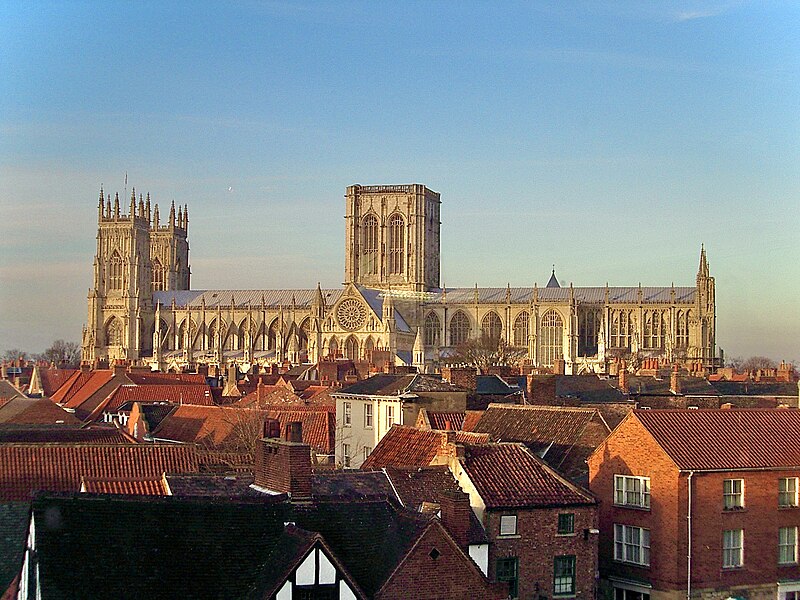
In Elizabeth, the coronation scene was filmed at York Minster, which proved a splendid substitute for Westminster Abbey, where the actual coronation took place on 15 January 1559.  The Minster lies in the centre of this historic city, and due to the flat terrain in the area surrounding it can be seen from miles around.  There has been a place of worship at this spot since the 7th century, but it was not until 732 that the first Archbishop of York was recognised by the Pope.  The present building took a massive 250 years to complete, starting in 1220 and ending in 1472.  The Minster brought shocking images to our TV screens in 1984 when a fire which started in the south transept raged out of control, and firefighters were forced to deliberately collapse the roof to save the rest of the building.

File:York Minster from M&S.JPG
York Minster from M&S. Photo by Matze Trier, via Wikimedia Commons.

The other cathedral which  makes an appearance in Elizabeth is Durham Cathedral.  The cathedral plays the part of the royal palace, and its distinctive pillars are seen in the scene where Elizabeth searches for Lord Robert after receiving a message.  Like York Minster, Durham Cathedral was preceded by a humbler place of worship known as the Saxon ‘White Church’.  The present-day building, which makes for a picturesque sight overlooking the River Wear, was built between 1093 and 1133, with further additions thereafter.

File:Durham Cathedral Nave.jpg
Durham Cathedral Nave. Photo by Michael D Beckwith, via Wikimedia  Commons.

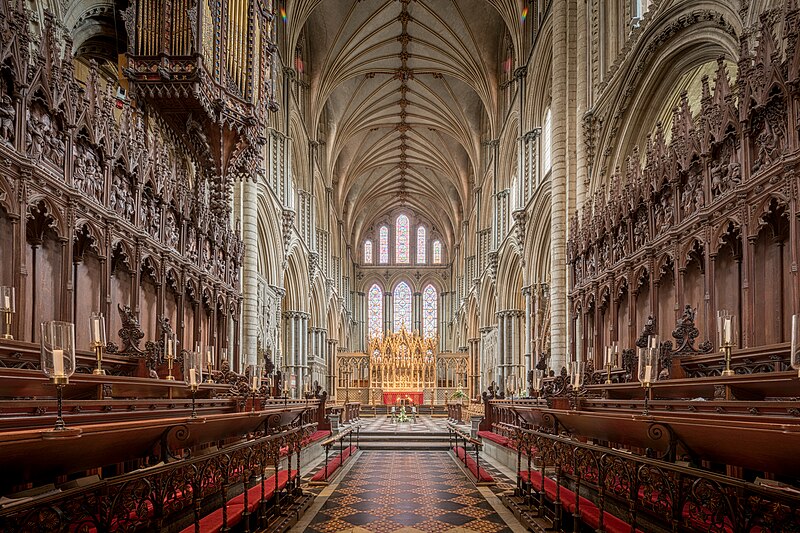
In Elizabeth: The Golden Age we are taken further south, with Ely Cathedral in Cambridgeshire playing an important role as the Palace of Whitehall, which in those days was the main residence of the monarchs of the day.  It is seen in a number of scenes, such as the one where Elizabeth confronts the Spanish Ambassador, and when Sir Walter Raleigh arrives bearing gifts from the New World.  Ely Cathedral is unusual in that, unlike most cathedral cities, Ely is the size of a small town.  In fact, the cathedral came before the town, which grew up around it.  There is a slate in the cathedral marking the location of a former shrine to Ethelreda, daughter of the King of East Anglia, who founded an abbey at the location of what is now the cathedral.  The building dates from 1083, and was granted cathedral status in 1109.

File:Ely Cathedral Choir East View.jpg
Ely Cathedral Choir East View. Photo by Michael D Beckwith, via Wikimedia Commons.

The sequel covers the period leading up to, and including the country’s spat with Spain, and Westminster Cathedral transports us over the water to the court of King Philip II, as it was where the scenes were filmed featuring the ranting king, plotting his invasion of England following the execution of Mary, Queen of Scots.  As a Roman Catholic cathedral, Westminster Cathedral was a good choice.  The cathedral is much younger than the others used in the two films, with construction completed in 1903.  Its main distinguishing feature is the striped appearance of its exterior, fashioned from layers of brick and stone.

File:Westminster.cathedral.frontview.london.arp.jpg
Westminster.cathedral.frontview.london.arp. Photo by Arpingstone, via Wikimedia Commons.

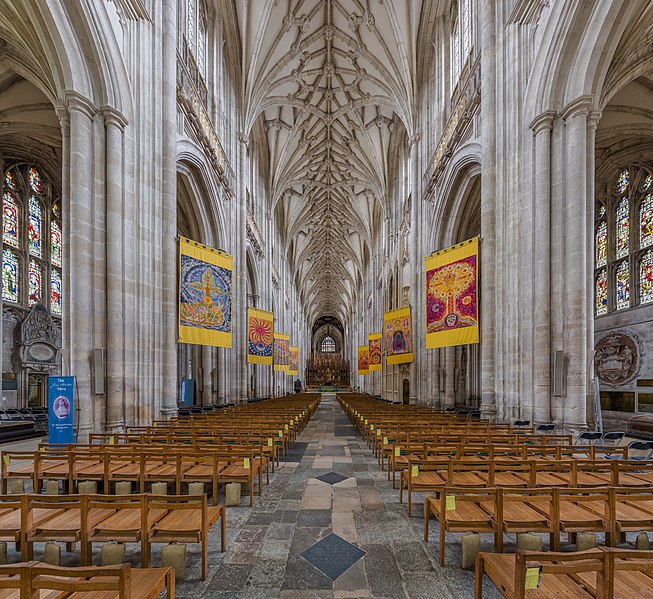
One of the most dramatic scenes in the sequel is the attempt on Queen Elizabeth’s life by Thomas Babington (Eddie Redmayne), an event which is pure fiction, since in reality this particular individual did not get anywhere near the Queen, although it is true that there was a plot to assassinate her.  The scene in question was filmed in Winchester Cathedral.  Originally founded in 642 and known as Old Minster, the present-day cathedral was started in 1079 at a site nearby, and the Old Minster was demolished in 1093.  The cathedral has the distinction of being one of the largest in Europe, and includes many notable features, such as the 17th century choir screen designed by Inigo Jones.

File:Winchester Cathedral Nave 1, Hampshire, UK - Diliff.jpg
Winchester Cathedral Nave 1, Hampshire, UK - Diliff. Photo by DAVID ILIFF, via  Wikimedia Commons.

Finally, for the main entrance to Whitehall Palace as seen in the sequel, the producers made use of Wells Cathedral, specifically the staircase linking the North Transept to Chapter House.  Like Ely, Wells is another unusually small cathedral city, nestling among the green fields of the Somerset countryside.  The cathedral was built to replace an earlier church which had occupied the site since 705, and construction spanned the period from 1176 to 1450.  One of the cathedral’s best known features is its astronomical clock dating from around 1325.

File:Wells cathedral chapter house brighter.JPG
Wells cathedral chapter house brighter. Photo by Lamiai, via Wikimedia Commons.