Tuesday, 21 May 2019

INSPIRATION FOR NORTHANGER? NETLEY ABBEY, HAMPSHIRE


I have written before about the fun of trying to guess the inspiration for the properties and estates which feature in the novels of Jane Austen.  Northanger Abbey is a tricky one, but given the novel of the same name is Gothic in style, and the fact that the Austen family made multiple visits to the spooky ruins of Netley Abbey near Southampton when Jane was a girl, it does not take too much of a leap of imagination to suppose that Netley Abbey, while far from a complete and occupied property unlike the fictional Northanger Abbey, may have contributed to Jane’s interest in the Gothic, and therefore may have influenced her creation of Northanger Abbey.


Jane Austen grew up in Hampshire, and she and her sister Cassandra went to school in Southampton in 1783.  It was probably during that time, and 10 years later when she stayed with her second cousin in Southampton, that she got to know the abbey.  On one particular visit in 1807, it was not Jane but her niece Fanny who waxed lyrical about the site, describing it as a “compound of everything that is striking, ancient and majestic”, and how it “stands on an eminence, in the most romantic situation you can imagine, overgrown with ivy and concealed from your view by a high wood, down to the water’s edge” – the water in question being Southampton Water.  Work on Jane’s novel Northanger Abbey began in 1798, and it is not known to what extent she had Netley Abbey in mind when inventing the Abbey of the novel, but given the above it seems highly likely that Netley was the inspiration for Northanger.

File:Eastrange.jpg
Eastrange. Photo by Coradia1000, via Wikimedia Commons

The abbey is now managed by English Heritage, who on their website inform us that it is the most complete surviving abbey built by the Cistercian monks in Southern England.  The abbey is open year round, with slightly reduced hours during the winter months.  There are many spooky stories surrounding the abbey, which would have circulated around the time of Jane’s visits, including the story of an apparition dressed as a monk who appeared before a local undertaker who wanted to dismantle the church ruins.  The monk warned him not to, but he disregarded the warning and was rewarded with a stone falling on his head and killing him.

Map of the area.

Sunday, 28 April 2019

MURDER IN MORECAMBE: THE BAY


Being set in a seaside location and starting with the disappearance of two teenagers, inevitably there will be comparisons between The Bay and Broadchurch.  Personally, I think The Bay is the better of the two.  It starts on a very interesting premise, every policewoman’s nightmare.  I won’t say any more in case anyone has not got around to viewing it yet. 


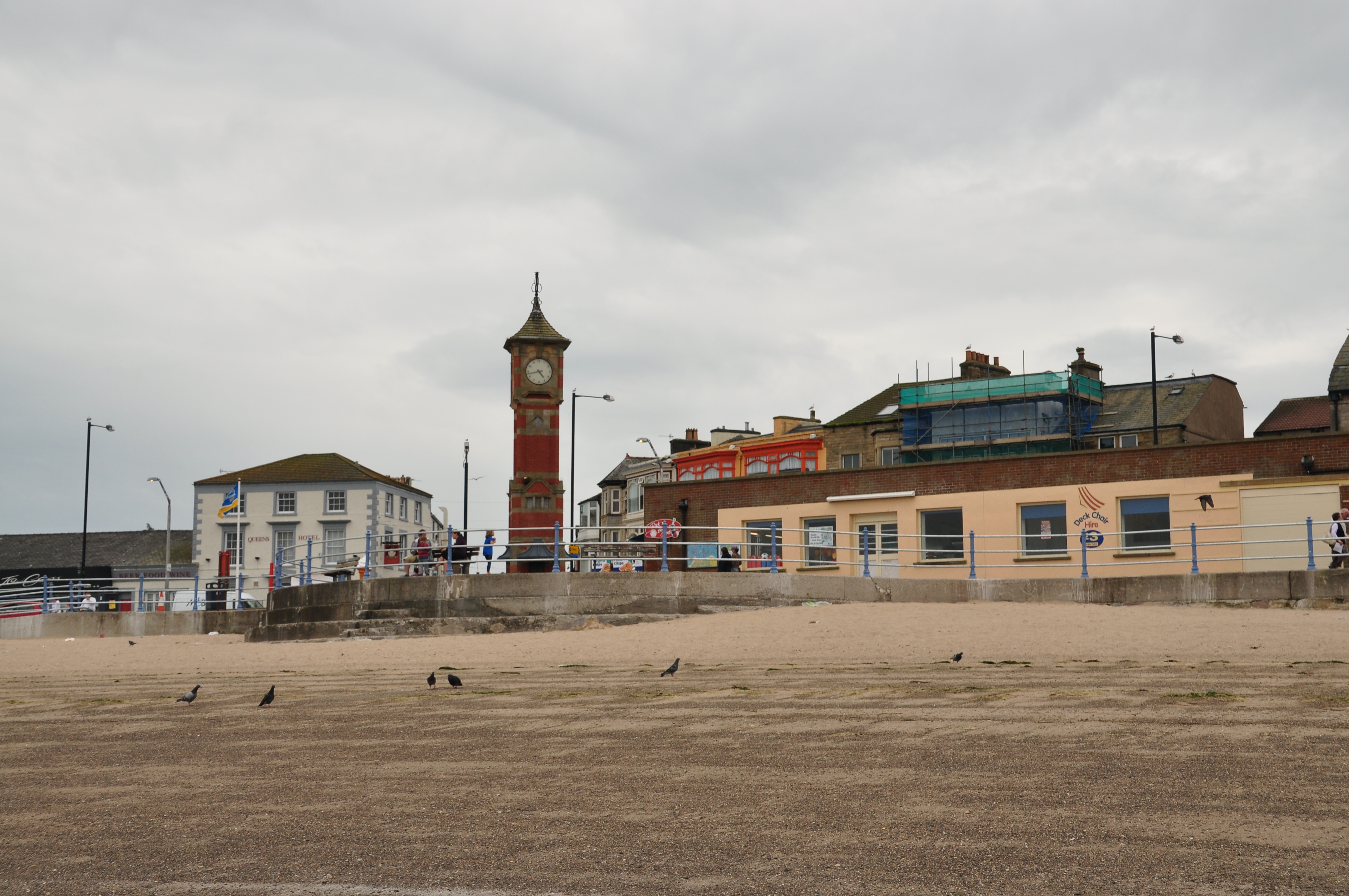
The seaside location in question is Morecambe of Morecambe Bay, with its famously treacherous sands, and there are plenty of shots of the beach.  Much of the filming took place around the Stone Jetty.  Apparently Morecambe was chosen because as well as being a beautiful part of the British coast, it is also a town with an edge to it.  At the beginning, there is an aerial shot of the town with the magnificent art-deco Midland Hotel taking centre stage. The hotel was renovated and reopened in 2008, but in its heyday was frequented by the likes of Coco Chanel and Noel Coward. 

File:Beach at Morecambe (7907).jpgp
Beach at Morecambe (7907). Photo by Nilfanion, via Wikimedia Commons.

Episode 1 has the lead policewoman in the drama heading to town on a night out, culminating in a karaoke session.  This takes place in the Royal Bar at the Royal Hotel, which was actually used in the scene.  Away from Morecambe, there is a scene involving an outdoor lido.  This was filmed at nearby Grange Lido at Grange-Over-Sands, on the north shore of Morecambe Bay.

Map of the area.


Monday, 15 April 2019

FAMILY STRIFE IN SHROPSHIRE: ATONEMENT/STOKESAY COURT


The film Atonement, based on the novel of the same name by Ian McEwan, begins in the stately abode of the Tallis family, whose daughter Cecilia is smitten by Robbie, the son of one of the servants whose university education the family has paid for.  Robbie is wrongly accused of rape by Cecilia’s younger sister Briony, who has already misinterpreted an encounter between the two by the fountain in the garden as malicious behaviour on Robbie’s part.  This combination of misunderstanding and malice has a lasting effect on the lives of Cecilia and Robbie.

During the summer of 2006 the film’s production team headed for Stokesay Court, a privately-owned country house and estate near Onibury in Shropshire.  The team had discovered the property in an issue of Country Life magazine and decided it was a perfect candidate for the role of the Tallis house.  The crucial fountain scene did not use the actual fountain to be found in the grounds; a sculptor produced a more elaborate one specially for the filming.  As well as the grounds of the estate, the film made use of the interiors of the house and a cottage, occupied by the Robbie character.  The library which featured in Atonement is actually a billiards room in real life.

File:Stokesay Court - panoramio (1).jpg
Stokesay Court - panoramio(1). Photo by PJMarriott, via Wikimedia Commons.


Stokesay Court was originally built for a wealthy Victorian businessman whose father went into partnership with a Worcester glove maker, with construction starting in 1889.  During World War I it was used as a convalescent home for soldiers, and during World War II the property was requisitioned by the Army for training purposes. The property remains in private hands with tours available for individuals or groups on certain set dates, to be booked in advance.  The estate acquired by the original owner included the nearby Stokesay Castle, run by English Heritage, which is a fine example of a fortified medieval manor house built in the 13th century by Laurence of Ludlow.  

Map of the area.

Tuesday, 9 April 2019

LEWIS CARROLL'S WELSH WONDERLAND: LLANDUDNO


In the latter part of the 19th century a little girl called Alice Liddell used to visit the Welsh resort of Llandudno, staying at the family holiday home Penmorfa on the town’s West Shore.  Like any young girl, Alice had her share of adventures while on holiday in the town.  The writer Lewis Carroll was a close friend of the Liddell family, and although he reputedly never met Alice there, he got wind of Alice’s holiday exploits and used them as the basis for a story which he recounted to Alice and her sisters on a rowing trip.  And so the famous children’s novel Alice’s Adventures in Wonderland came into being, followed by the sequel Through  The Looking Glass.


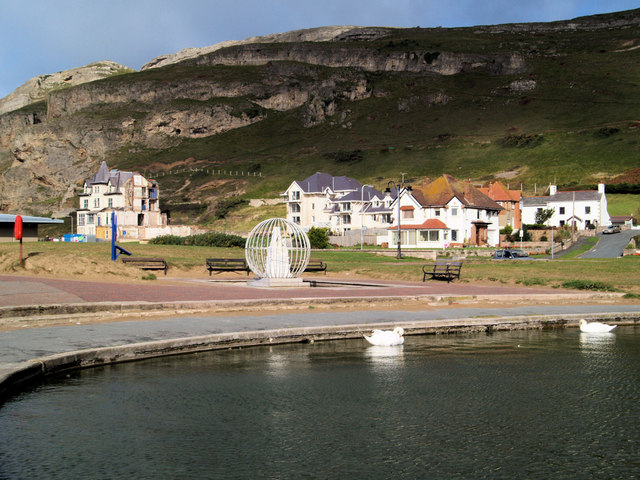
Llandudno has not forgotten its association with Lewis Carroll and Alice, and commemorates it in a number of ways, including a a town trail.  There is a statue of the White Rabbit character on the West Shore, and also just off the West Shore there are two big rocks which are said to represent the Walrus and the Carpenter from Through The Looking Glass.  Unfortunately, fans visiting the town will not be able to see Penmorfa.  After a few years as a hotel, in 2008 the building was demolished as it was deemed to be  unsafe.

File:Alice in Wonderland - geograph.org.uk - 580510.jpg
Alice in Wonderland - geograph.org.uk - 580510. Photo by Steve F, via Wikimedia Commons

Llandudno is a typical seaside resort, with its long promenade and pier and its array of restaurants and shops, but what makes it stand out from other similar resorts is its position at the foot of the mighty Great Orme, a mountain which can be reached by tramway or cable car or, for the energetic, on foot.  There is a bar and restaurant at the top and the views out to sea are stupendous, only marred by the ‘forest’ of wind turbines on the horizon.  The sheep to be found on the mountain have been joined by 122 wild Kashmiri goats, who made the news recently when they headed down to the town during bad weather, stopping the traffic, nibbling plants in people’s gardens and generally causing chaos.

The Great Orme, from the Promenade.
Map of the area.

Tuesday, 26 March 2019

AN OLDIES' PLAYGROUND IN YORKSHIRE: LAST OF THE SUMMER WINE/HOLMFIRTH


Running from 1973 to 2010, with 31 series and a whopping 295 episodes, Last of the Summer Wine is not only the longest-running comedy programme in Britain, but is the longest-running sitcom in the world.  Although all three of the original actors playing the oldies are now dead (one had to be replaced after two series due to ill health, and a completely new trio was introduced towards the end), their memory lives on with reruns of the show still gracing our screens today on the Gold, Yesterday and Drama channels.  The basic premise of the series is the childlike antics of three pensioners and their interactions with an eccentric cast of local characters, with most of the action filmed in and around the picturesque Yorkshire town of Holmfirth.

One focal point in the series is Sid’s Cafe, which is an actual cafe in Towngate, complete with the famous red and white cafe sign and gingham curtains.  The cottage occupied by Nora Batty, where she was frequently to be seen loitering on the outside steps donning her wrinkly stockings, pinny and curlers, is at 28 Huddersfield Road and is now available as a holiday let.  The town’s current landscape includes a tearoom dedicated to Nora’s memory called The Wrinkled Stocking.  Clegg’s home in the series is to be found in Hill Street at Jackson Bridge, to the west of Holmfirth, and the White Horse pub is nearby bearing the same name as the one in the series.

File:Holmfirth Sid's Cafe.jpg
Holmfirth Sid's Café. Photo by Nigel Homer, via Wikimedia Commons


Much of Holmfirth’s charm lies in its geographical position in the lovely Holme Valley, which is made much of in the series.  The valley lies in West Yorkshire, just to the north of the Peak District.  The town arose from the existence of a corn mill in the 13th century, and the economy developed around the cloth trade and nearby quarries.  Unfortunately, the town’s riverside location makes it vulnerable to flooding, and the worst flood in its history took place in February 1852, when the nearby Bilberry reservoir burst its banks and the resulting torrent of water took out mills, cottages, animals and people, including dead ones in the graveyard.  81 people died in this flooding event.

File:Holmfirth (3922393517).jpg
Holmfirth (3922393517). Photo by Tim Green, via Wikimedia Commons


For fans of the series who want to make sure they do not miss any of the key locations, there is a Summer Wine Tour Bus which covers a 10-mile route. 

Map of Holmfirth.

.

Friday, 15 March 2019

ARISTOCRATIC ASSIGNATIONS IN NORFOLK: THE GO-BETWEEN

 
Based on the novel by L. P. Hartley and with a screenplay by Harold Pinter, the 1971 film The Go-Between starring Julie Christie and Alan Bates, which triumphed at the Cannes Film Festival, tells the story of a doomed love affair between Marian (Christie), the daughter of a wealthy family, and a neighbour Ted Burgess (Bates), during Marian’s engagement to viscount Hugh Trimingham (Edward Fox).  Marian’s younger brother brings his friend Leo to stay at the family home, Brandham Hall, and Marian takes a shine to Leo, recruiting him as a go-between to pass messages to her secret lover.


The part of Brandham Hall is played by Melton Constable Hall in the Norfolk village of Melton Constable.  The property, built around 1670, was for seven centuries the home of the Astley family.  It is surrounded by extensive parkland, which also features heavily in the film.  More recently the Hall has been in private hands, and sadly has become somewhat dilapidated.  Last year a castellated former watch tower in the grounds of the Hall came up for sale in what was described as a “rare opportunity”.  The village of Melton Constable, which was once at the hub of a number of railway lines, lies around 7 miles south-west of Holt, just inland from the popular North Norfolk coast.

File:Melton Constable Morris edited.jpg
Melton Constable Hall.  Image taken from Morris's Country Seats, via Wikimedia Commons.

In a scene vaguely reminiscent of the famous “lake scene” in the 1995 TV production of Pride and Prejudice, the fragrant ladies and gentlemen of Brandham Hall arrive at a lake on a hot day to find an interloper cooling off in the water.  The bather turns out to be Ted Burgess, who is seen emerging from the water dripping wet and resplendent in his 19-century bathing costume.  This scene was filmed at Hickling Broad, the largest of the Norfolk Broads and protected by the Norfolk Wildlife Trust.  The Broad, which has moorings available, is located just inland roughly midway between Great Yarmouth and Cromer.

File:Hickling Broad.jpg
Hickling Broad. Photo by Andrew Lowe Watson, via Wikimedia Commons.


Norwich plays a starring role in a sequence in which Marian takes Leo to the city for the day to buy him something cool to wear in the hot weather.  During the visit, Leo is packed off to explore the cathedral, and we are treated to views of both the magnificent exterior and the impressive interior.  The city’s imposing railway station also puts in an appearance, with its elaborate red brick and stucco arched facade topped with a dome and clock. 


The cathedral was begun in 1096 and has the second largest cloisters in England, as well as the second tallest spire.  The architecture is a mix of Norman and English Gothic.  The station building was built in 1886 and designed by William Ashbee, to form part of the Yarmouth & Norwich Railway, the earliest railway in the county.

File:Norwich Cathedral, Gesamtansicht.jpg
Norwich Cathedral, Gesamtansicht. Photo by Rensi, via Wikimedia Commons.

As for the village scenes, these were principally filmed in the village of Heydon, to the north-west of Aylsham.  The Church of St Peter and St Paul, with its tall grey tower, is where the older Leo is seen walking in the graveyard.  Marian’s cottage, which is where Leo is asked to pass on one last message, is at the edge of the village green.  However, the cricket scene was filmed in the village of Thornage, in the Glaven Valley, a short distance to the south-west of Holt.  Heydon is a period film-maker’s dream, being a conservation area with no new buildings added since the 1887 Queen Victoria commemorative well. Thornage used to have a brass and iron foundry in the 19th century, and though now gone, its memory lives on in the village sign.

Map of Norfolk.

Tuesday, 5 March 2019

BIRTHPLACE OF AN EARLY TRAVEL WRITER: MANORBIER, PEMBROKESHIRE


The small Pembrokeshire village of Manorbier with its ruined castle was the birthplace of Gerald of Wales, a prolific writer and author of what must have been some of the earliest known travelogues.  Gerald, whose father was the Anglo-Norman knight William of Barri, was born in 1146 in Manorbier Castle.  He travelled extensively in Ireland and Britain and his first book, about his Irish travels, was written during an expedition accompanying Prince John in 1184, but it was a later tour during which he accompanied the Archbishop of Canterbury, Baldwin of Exeter, to gather recruits for the Third Crusade, which gave rise to his best known works, the Itinerarium Cambriae (1191) and Descriptio Cambriae (1194) – he always wrote in Latin. 


The Welsh expedition gave Gerald the chance to wax lyrical about his place of birth, in his day known as Maenor Pyrr (“the mansion of Pyrrus”).  He describes the castle as “excellently well defended by turrets and bulwarks”, and as having a fish-pond “as conspicuous for its grand appearance as for the depth of its waters”.  This was complemented by an orchard “inclosed on one part by a vineyard, and on the other by a wood”.  The adjacent valley had “a rivulet of never-failing water”.  The body of water offshore, which today is regarded as the mouth of the Bristol Channel, is referred to by Gerald as the Severn Sea, where the passing ships can be seen to “daringly brave the inconstant waves and raging sea” on their way towards Ireland.  The area in those days benefitted from supplies of corn, sea-fish and imported wines.  Gerald declares his home village “the pleasantest spot in Wales” and begs the reader’s pardon for “having thus extolled his native soil, his genial territory, with a profusion of praise and admiration”.  


File:Manorbier Castle.jpg
Manorbier Castle. Photo by Paul Allison, via Wikimedia Commons

Manorbier is just a few miles around the coast from the popular resort of Tenby, and there is a car park by the side of the stream for visitors arriving by car.  The village is also just off the Pembrokeshire Coast Path for those coming on foot.  The castle and its garden are open to visitors for a fee, and for anyone wanting the full Gerald experience it is possible to stay overnight in self-catering accommodation.  Another prominent building in the village is St James Church, dating from the 12th century.  There is a sandy beach backed by dunes at the foot of the valley.  

Map of the village.