Monday, 20 March 2017

BROADCHURCH REVISITED: LITTLEBREDY, DORSET


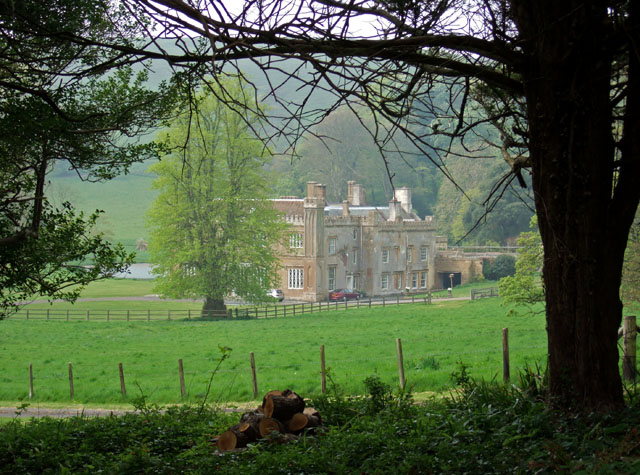
The latest (and last) series of Broadchurch is currently gracing our TV screens, and with it a new location – the scene of the rape which forms the core of the latest investigation.  The rape took place at a party in a manor house called Axehampton House in the series, but in real life the house is the privately owned Bridehead House.  Originally the Manor of Brydian, owned by Cerne Abbey from 987 until the Dissolution, a new manor house was built on the site around 1600 by Sir Robert Mellor.  In the 19th century the architect Benjamin Ferrey made substantial changes to the house on behalf of his client Robert Williams of the Williams Deacon & Co bank.

The house, situated between Bridport and Dorchester, is surrounded by the chalk hills of the Dorset Downs, at the head of the Bride Valley.  The lake seen in Broadchurch is fed by the waters of the River Bride which gushes from nearby springs and tumbles down a waterfall.  Although the house itself is private, there is a 5-acre site open to visitors, including the Victorian Walled Kitchen and Flower Gardens and a series of walks. 

Along with the revamped manor house, Ferrey built the estate village of Littlebredy (bredy pronounced ‘briddy’) and he added a spire to the 14th century tower of the church of St Michael and All Angels.  The church has a lovely carved font and in the churchyard is a memorial to the former Bishop of Wellington, New Zealand, Frederic Wallis, who returned to the UK to become Archdeacon of Sherborne.  The attractive thatched village hall used to be the village school.  The area around the village is dotted with signs of early occupation – stone circles, tumuli etc.  The National Nature Reserve known as the Valley of Stones in the south of the parish was the source of building material for many of these early constructions.

File:Bridehead House from the Littlebredy road - geograph.org.uk - 415796.jpg
Bridehead House from the Littlebredy road - geograph.org.uk - 415796. Photo by Mike Searle, via Wikimedia Commons.

Friday, 3 March 2017

NAKED AMBITION: HARDRAW FORCE


Stand by ladies.  Hot on the heels of Colin Firth diving into the lake at Lyme Park and Aidan Turner baring his torso in Poldark, here we have another male heartthrob stripping off, only this time we get the full frontal.  In 1991 the film Robin Hood: Prince of Thieves was released, starring Kevin Costner as Robin and Mary Elizabeth Mastrantonio as Maid Marian, just two of an illustrious cast.  In one of the film’s most memorable scenes, Maid Marian happens upon a naked Robin Hood bathing in a beautiful waterfall. 

The waterfall in question was Hardraw Force, just one of a number of spectacular waterfalls to be found in the north of England – Hardraw is old English for ‘shepherd’s dwelling’.  Another one, Aysgarth Falls, was used in the same film for the fight scene between Robin and Little John.  Located just under a mile from the town of Hawes in Wensleydale, Hardraw Force has its origin in Hardraw Beck, in Hardraw Scar, a wooded ravine.  With a drop of 100 feet, the waterfall claims the title of England’s highest unbroken waterfall, not including underground ones. 

Near the waterfall is a 13th century pub called The Green Dragon which, last year, went up for sale for 1.5 million pounds.  The price included not only the pub but 5.5 acres of parkland, a visitor centre, a campsite and Hardraw Force waterfall itself.  Apparently when the owner at the time of the sale originally bought the pub in 2001, the leaks in the roof were a rival for the waterfall itself.  (Postscript - 2020 - the Green Dragon is now open again as a pub and hotel.)

As an aside, the inn was visited by the painter JMW Turner in 1816, and Turner painted the gorge into which the waterfall plunges in the painting titled Hardraw Fall  


File:Hardraw Force (6250).jpg
Hardraw Force (6250). Photo by Nilfanion, via Wikimedia Commons.

Tuesday, 21 February 2017

WOEFUL IN WILTSHIRE: JOHN BETJEMAN AT MARLBOROUGH


The late John Betjeman, who was appointed Poet Laureate in 1972, and remained in the role until his death in 1984, leaves behind a wealth of evocative verse and prose, describing the places he knew and visited around Britain so vividly that he transports the reader back to an earlier time redolent with nostalgia.  One of his best known works is the autobiographical 'Summoned by Bells', which recalls his childhood, his school days and his time at University.  Chapter VII of the collection covers his time at Marlborough College, a boarding and day school in the attractive small Wiltshire town of the same name which he attended in the early 1920s.

File:Entrance to Marlborough College on the Bath Road. - geograph.org.uk - 1509846.jpg
Entrance to Marlborough College on the Bath Road - geograph.org.uk - 1509846. Photo by Steph, via Wikimedia Commons.

Betjeman was allegedly quite miserable at Marlborough College, where he spent five years (“Thank God I’ll never have to go through them again”) and he does not miss an opportunity to have a dig at it in his poetry, referring to it as “my prison house”.  Winters were a particular endurance test, described as “Black as our college suits, as cold and thin”.  Mealtimes did not bring any solace, with cakes “harder than the rocks”, tea which is “made from stewed up socks”, and a Dining Hall smelling of Irish Stew.  The teas at the College were described as a joke – “you only ate them when quite stony broke”.    

Sports formed a large part of life in the College, and Betjeman bemoaned the fact that for five years he and his fellow pupils “shivered in exiguous shorts”.  While at the College he founded a satirical magazine called ‘The Heretick’, which made fun of this obsession with sport.  Other negative memories recalled in the poem include the “casual beatings”, the stone flag passages and the iron bars.  In the early 1960s Betjeman made a documentary film about Marlborough, part of a series which became lost, but subsequently rediscovered.  The director of the piece on Marlborough recalls that it took some persuading to get him to go through the gates of the school for the filming on his first visit there for 40 years, such were his feelings about it.

It wasn’t all bad though, because he liked the town and adored the surrounding countryside.  He used to walk along the River Kennet, which he recalls in the poem with the line “The smell of trodden leaves beside the Kennet, On Sunday walks with Swinburne in my brain” (a reference to a fellow English poet).  He also cycled to Silbury, “by burnt-up hawthorn edged again with white from chalk dust whirled by Fords and Lancias” (Marlborough is in the middle of a predominantly chalk terrain) and to “sepulchral Avebury “.

File:Avebury Ring - geograph.org.uk - 443147.jpg
Avebury Ring - geograph.org.uk - 443147. Photo by Simon Barnes, via Wikimedia Commons.

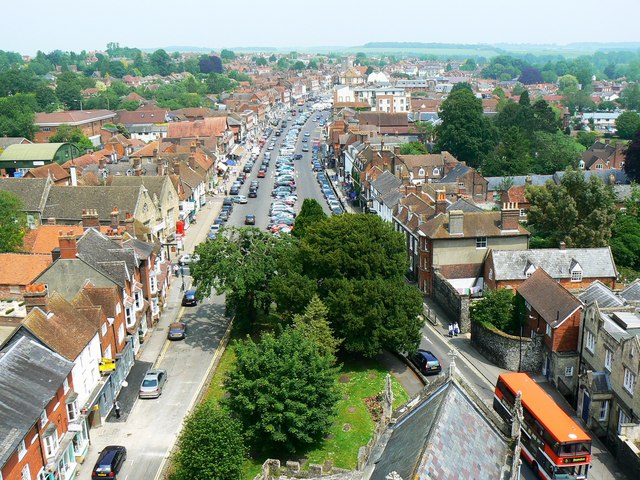
Marlborough used to be an important pit-stop on the old road from London to Bath, and the quaint old inns lining its main street are a reminder of that time.  Its most notable feature is its generous High Street, the second widest in the country, with a pleasant mix of pubs, cafes, restaurants and shops.  In fact, for a town of its size it has a surprisingly decent selection of shops, probably because the continued presence of Betjeman’s hated College lends the town an upmarket air.  The chalklands around Marlborough are full of fascinating ancient sites.  Silbury, mentioned above, is home to Silbury Hill, an artificial prehistoric chalk mound, and Avebury is famous for its Avebury Ring, a henge monument containing three stone circles.  These two Neolithic monuments, along with the West Kennet Long Barrow, are part of the Stonehenge, Avebury and Associated Sites UNESCO World Heritage Site.

File:High Street, Marlborough from St Peter's church roof - geograph.org.uk - 460662.jpg
High Street, Marlborough, from St Peter's Church roof - geograph.org.uk - 460662. Photo by Brian Robert Marshall, via Wikimedia Commons.


Tuesday, 10 January 2017

ENEMY TERRITORY: WITLEY COURT, WORCESTERSHIRE


Love them or hate them, there is one thing about Stephen Poliakoff’s productions that cannot be denied: the filming is always exquisite.  The recent BBC series Close To The Enemy proved to be no exception for its beautifully shot images of a war-torn Britain.  The story is centred around Captain Callum Ferguson (Jim Sturgess) who is tasked with getting a captured German scientist to work for the RAF on developing the jet engine.  Much of the action takes place around a bombed-out London hotel just after World War II, although some critics have commented on the improbably pristine appearance of the rather glamorous cast. 

Many of the street scenes, while meant to be London, were filmed in Liverpool.  However, some of the most arresting scenes involved the ruined but magnificent Witley Court in Worcestershire, where in late April/early May 2015 the film crew turned up with actors dressed in World War II era uniforms and military vehicles, and where Alfred Molina as Harold Lindsay-Jones was filmed driving up to the property and wandering among the ruins.  On a recent visit to the property, run by English Heritage, we met the lady who got one of the property’s fountains going for the filming and who described to us how interminable the filming was, with take after take after take.  

This magnificent property was built in 1655 by Thomas Foley and during the 18th century the park was landscaped.  Around 1805 the property underwent a major reconstruction by John Nash on the orders of a second Thomas Foley (there were a number of Thomas Foleys associated with the property, which causes confusion for those studying its history).  The grounds feature two magnificent fountains, Neptune Fountain and the Perseus and Andromeda Fountain, currently undergoing restoration.  Later in its life the property became the scene of lavish house parties, with the then Prince of Wales (the future Edward VII)  a regular visitor.  Sadly, all this came to a tragic end in 1937 when a fire started in the bakery and ripped through a wing of the house.  When the property was sold soon after, what was left of it was stripped by scrap dealers, leaving the present-day shell, a haunting reminder of past glories.  One part of the estate which remains intact, however, is the amazing Parish Church of Great Witley, the neighbouring village.  The church is not in the village but next to the mansion, and boasts a magnificent Baroque interior which is completely disproportionate to its size.  No visit to the estate would be complete without looking in on it.

Witley Courth with Perseus Fountain. Photo by Tony Grist, via Wikimedia Commons.


As an aside, in 1967 Witley Court was chosen as the backdrop for a promotional film for Procol Harum’s song A Whiter Shade of Pale.  The band members are seen wandering around the grounds looking artistically moody in their trendy Sixties gear at a time when the property was even more derelict than now.   

Witley Court is  next to the village of Great Witley, a few miles north-west of Worcester.


Tuesday, 20 December 2016

A COTSWOLDS CHRISTMAS FOR BRIDGET: SNOWSHILL, GLOUCESTERSHIRE


The nation’s favourite singleton, Bridget Jones, first transferred from page to screen in 2001 with the release of Bridget Jones’s Diary, the film version of the first of a trilogy of books by Helen Fielding charting the ill-fated love life of the heroine, played by Renee Zellweger, in a modern day take on Jane Austen's Pride and Prejudice.  Much of the action centres around London, but when Bridget heads home for Christmas it is the charming North Cotswolds village of Snowshill which takes centre stage, improbably covered in snow in these days of climate change.

File:Stone Cottages facing the Village Church - geograph.org.uk - 1632420.jpg
Stone Cottages facing the Village Church - geograph.org.uk - 1632420. Photo by Cameraman, via Wikimedia Commons.


Of course, the snow was artificial, in fact the film makers covered the entire village in snow for the scenes, which must have been a strange experience for the locals and visitors, this being the month of July.  Christmas lights were put up in some of the village houses as well in order to complete the festive atmosphere.  They even put a Christmas tree up in the village and the house that featured as Bridget’s parents’ home had a Santa on the roof.  Sadly, the tourism boom that the village might have enjoyed as a result of playing a role in the film was curtailed due to the foot and mouth crisis of the time, which led to the closure of the main attraction in the village, the National Trust owned Snowshill Manor.


                                                                     Snowshill Manor

Snowshill occupies a location near the northern edge of the Cotswolds, a few miles from the more famous Broadway.  Snowshill Manor is good enough reason in itself to pay a visit, with  its fascinating collection of artefacts collected by its eccentric former owner Charles Paget Wade.  The collection includes a whole room devoted to Japanese samurai armour, and there are also musical instruments, clocks and a host of other interesting objects.  The gardens are lovely to wander round, and there is a tea room with lovely views over the surrounding countryside.  The Manor did not itself feature in the film, but the staff car park was used for shots of Bridget in the car with her parents.

Map of the area.