Wednesday, 3 August 2016

GHOSTLY OCCURRENCES ON THE COTSWOLD WAY: THE LIVING AND THE DEAD


For walkers following the Cotswold Way on the approach to Bath, the ups and downs of the northern part of the Cotswolds give way to a rolling plateau just to the north of the M4 motorway.  One of the points of interest on this stretch of the trail is Horton Court, a National Trust property (now turned into a holiday cottage) which is a honey-coloured manor house built on the site of a Norman hall.  This property recently graced our TV screens in The Living And The Dead as Shepzoy House, the home of a young couple whose marriage is threatened by all manner of supernatural horrors going on around them, and by the husband’s descent into madness over the death of his son Gabriel, who died from drowning, a tragedy for which he blames himself.  The series is set in Somerset in the late 19th century, but Horton is in South Gloucestershire near Chipping Sodbury, between Stroud and Bath, a rural area where the brooding woodlands and swaying grasses of the fields create a suitably spooky atmosphere, prompting some to refer to the series as a kind of Gothic Thomas Hardy.  

File:Horton Court.jpg
Horton Court. Photo by Marion Dutcher, via Wikimedia Commons.

The main subject of the story, Nathan Appleby (‘Merlin’ with a beard aka Colin Morgan), is a psychologist who returns from London to the family home after the death of his mother and with his young wife Charlotte (Charlotte Spender) takes over the running of the farm there. The locals are like something from a bygone age with their ancient rituals and superstitions, something akin to the community encountered by Edward Woodward in The Wicker Man.  As for Nathan, he finds it hard to shake off his psychological calling, and starts investigating the case of a possessed local girl called Harriet, which unleashes a series of sinister phenomena and apparitions.  Harriet’s party piece is mimicking the voice of the late Gabriel, which tests Nathan’s sanity to the limit.  The sinister atmosphere and tension continue to build up in subsequent episodes, and the final episode is full of surprises, which I won’t go into in case anyone hasn’t seen it yet. 

File:West from Highfield Lane near Horton Court - geograph.org.uk - 1001174.jpg
West from Highfield Lane near Horton Court - geograph.org.uk - 1001174. Photo by Maurice Pullin, via Wikimedia Commons.
 
According to the Cotswold Way Trail Guide, Horton Court is probably the oldest property along the trail, being based on a single-storey hall house from the 12th century.  The adjoining church is the parish church of St James the Elder, built around 1300 on the site of the previous Norman church.  The manor itself, which lies alongside the hall, was built around 1521 by the Rev. William Knight, the future Bishop of Bath and Wells.  The most charming feature of the gardens is a 16th century Italianate loggia.  Although ramblers following the Cotswold Way are unable to enter the manor house at this time, the church is still up and running for those wanting to relive the atmosphere surrounding the drama series, and of course there is the bucolic countryside to wander through.

File:Horton church in South Gloucestershire England arp.jpg
Horton church in South Gloucestershire England arp. Photo by Adrian Pingstone, via Wikimedia Commons.


Map of the area.


Sunday, 10 July 2016

GOING FOR GOLD: CHARIOTS OF FIRE, ST ANDREWS


It seems hard to believe that four years have gone past since the nation and the world witnessed the stirring spectacle of the London 2012 opening ceremony.  The most memorable part of the ceremony was the spine-tingling sequence representing Britain’s Industrial Revolution, but prior to that there was a comedy sketch involving British comedian Rowan Atkinson playing a pianist with a repetitive role in a performance of the theme music to Chariots of Fire, a film made in 1981 but re-released in 2012 prior to the London Olympics, which tells the story of two athletes who, after years of training, are accepted to compete in the 1924 Paris Olympics.  The film triumphed at the 1982 Oscars, winning four awards including Best Picture.  The music also earned its Greek composer Vangelis an Oscar for Best Original Score. 

Anyone who has seen the film will remember the scene near the beginning where, with the theme music as a backdrop, the athletes raced along a glorious sandy beach in their white period racing gear, their feet splashing in the shallows.  In the 2012 opening ceremony Rowan Atkinson’s mind wanders off during his boring part of the musical performance and he starts fantasising about being a part of the beach scene.  Some clever camera trickery is used to superimpose him on the scene alongside the original actors.  Ben Cross, who played Jewish athlete Harold Abrahams in the film, described the act of running along the sand as ‘hell’.  Worth enduring though, for what has come to be one of the most iconic scenes in British film, so much so that people can often be spotted recreating the scene on the beach.  

So where was this beach?  Well in the film it was meant to be Broadstairs, but in fact, the scene was shot at West Sands in St Andrews, Scotland’s answer to Oxford, famous for its university and the fact that the Duke and Duchess of Cambridge met there.  Famous also for its fine golf courses, one of which was founded in 1754 and is regarded as the home of golf.  St Andrews was chosen as a cost-saving measure, due to the fact that other scenes were being filmed elsewhere in Scotland.  Filming on a beach is not without its problems: the story goes that the crew were forced to return to the location to film the sequence again because sand had got into the camera the first time round, damaging the negatives.

File:West Sands Beach, St Andrews - geograph.org.uk - 1803950.jpg
West Sands Beach, St Andrews - geograph.org.uk - 1803950. Photo by Stephen Sweeney, via Wikimedia Commons

The production crew had to change the outward appearance of some of the city’s newer buildings to make them look more in keeping with the period.  Towards the end of the beach sequence an imposing building can be seen near the golf course, with the name Carlton Hotel on it.  The building was used as a University residence at the time but was relabelled for the film.  Sean Connery reportedly joined the film’s producer David Puttnam at a screening of the film, and when the building came into view he tapped Puttnam on the shoulder and said “That’s not the Carlton Hotel, that’s St Andrews”.  Apparently a lot of the extras used in the filming were recruited the night before from the local bars.  

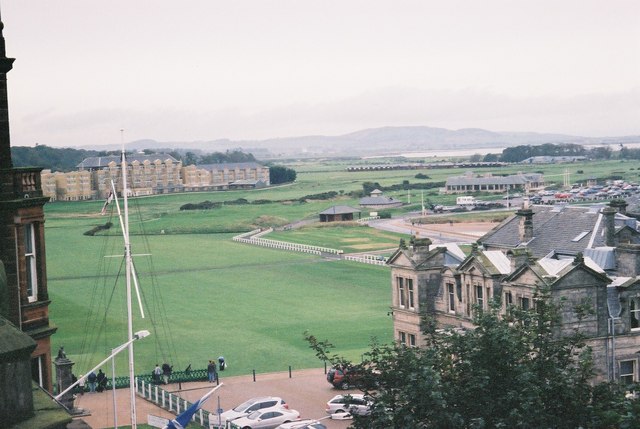
File:St Andrews Golf Links from The Scores - geograph.org.uk - 305228.jpg
St Andrews Golf Links from The Scores - geograph.org.uk - 305228. Photo by Rob Bishop, via Wikimedia Commons

Although the city did not form a part of the film’s story and, Connery aside, many people would not have recognised it in the beach scene, St Andrews is evidently determined not to forget its role in the film, with a plaque commemorating the filming and a hotel bar called Chariots.  There is also an annual Chariots of Fire fun run on the beach, giving fans of the film a chance to relive the scene.

Map of the area.


Sunday, 12 June 2016

POOH TERRITORY: ASHDOWN FOREST, EAST SUSSEX


I have been a prolific reader ever since I can remember, and one of my fondest literary memories from my childhood is the series of books featuring an overweight, honey-guzzling bear called Winnie-the-Pooh, or Pooh.  The stories, by A. A. Milne and written in the 1920s, followed the adventures of Pooh and a host of other lovable animal characters, including the diminutive Piglet, the morose donkey Eeyore and the excitable Tigger.  The token human, Christopher Robin, was based on the author’s son Christopher Robin Milne, who grew up on the family farm in the village of Hartfield, between Royal Tunbridge Wells and East Grinstead. 

The scene of the action is Ashdown Forest adjoining Hartfield .  Within the forest is the Five Hundred Acre Wood, which features in the Pooh stories as ‘Hundred Acre Wood’ or ’100 Aker Wood’.  The characters frequent a number of locations within the wood, for example ‘Owl’s House’.  There is a car park on Gill’s Lap (Galleon’s Lap in the stories) where there is a map of the surrounding area showing some of the key locations from the stories.  

File:Ashdown Forest, Milne memorial, Gill's Lap 02.JPG
Ashdown Forest, Milne memorial, Gill's Lap 02. Photo by Poliphilo, via Wikimedia Commons

Hartfield itself is home to Pooh Corner, which runs an online shop selling Pooh merchandise, and there is also a tearoom there.  Nearby is a stream which eventually runs into the River Medway, and crossing the stream is the famous Poohsticks Bridge, where the game Poohsticks was invented by A A Milne for his son Christopher Robin.  The game involves people lining up on the bridge and dropping sticks into the water.  They then rush to the other side of the bridge and the owner of the first stick to emerge is  the winner.  The game is still kept alive today, and world championships in the 'sport' have been held.  

File:Goodnight Pooh - geograph.org.uk - 1048150.jpg
Goodnight Pooh - geograph.org.uk - 1048150. Photo by Ian Paterson, via Wikimedia Commons

At the south-east corner of the Hundred Acre Wood is a spot described as “rather boggy and sad”.  This is Eeyore’s Gloomy Place, where the sad old donkey lived in a stick house prone to falling down.  The Milne family kept a donkey called Jessica in a pasture, and it is thought that this provided the inspiration for Eeyore’s Gloomy Place.  Meanwhile, at the entrance to the farm itself is a walnut tree where Christopher Robin built a trap which ensnared the foot of the gardener’s wife.  This was the inspiration for the story about the Heffalump trap built by Pooh and Piglet to ensnare the mythical elephant-like beast.

Ashdown Forest was once a medieval hunting forest which was created soon after the Norman Conquest.  Today it is the largest area of open access land in the south-east, running at 9.5 acres of beech woods and open heath with wonderful views of the High Weald Area of Outstanding Natural Beauty, making it a popular destination for walkers.  As well as the resident sheep and horses, there is a large deer population and there are also ground nesting birds, so walkers need to keep any dogs under control.  

Map of the area.


Tuesday, 24 May 2016

SHIPS AHOY! THE ONEDIN LINE: DARTMOUTH AND GLOUCESTER


One of the best drama series to hit our TV screens in the 1970s was The Onedin Line, which charted the fortunes of a 19th century shipping line.  The stirring theme music set the scene for this maritime epic, starring the late Peter Gilmore as James Onedin and Anne Stallybrass as his wife Anne, which gave a fascinating insight into seafaring life at the time, both at sea and on shore.  The shore base of the shipping line was meant to be Liverpool, but much of the filming took place in Dartmouth, while many of the dock scenes were filmed in Gloucester Docks (moving to Pembroke Dock for the last series).  Dartmouth’s historic riverfront, with its reminders of the town’s seafaring past, made a convincing backdrop for the filming of a story set during this period, while the massive 19th century waterside warehouses of Gloucester Docks, overlooked by the majestic tower of Gloucester Cathedral, served equally well for the shore-based scenes.

The action filmed in Dartmouth centred around Bayards Cove and the surrounding picturesque streets.  The 16th century fort at Bayards Cove was used as a gun emplacement intended as an additional line of defence to the Dartmouth and Kingswear castles, which face each other at the mouth of the Dart.  The fort was deliberately sited at the narrowest point of the channel forming the entrance to the harbour.  In the period leading up to the construction of the fort, Dartmouth had developed into an important trading port, serving the wine trade with France, and later on the cloth trade.  The town went into a decline in the 18th century, and with it the fort, but its fortunes were revived with the opening of the Naval College and the town’s popularity as a tourist destination.  The fort is now owned by English Heritage, who also own the castle.  

Dartmouth's waterfront

As well as the town’s historic sights, Dartmouth’s main appeal is its beautiful river.  Boat trips are available, some of them linking Dartmouth with Totnes, an attractive market town further upstream.  There is a steam railway on the Kingswear side of the estuary offering trips to Paignton, and tickets combining this with the boat trips are available.  The town itself is an appealing mix of pubs, restaurants, cafes and shops.  Dartmouth Museum is housed in the row of houses known as The Butterwalk, built in the 1630s as merchants’ trading houses.  

Dartmouth Castle

It was the 1827 opening of the Gloucester and Sharpness Canal, linking the city to the mouth of the River Severn and the Bristol Channel beyond, which led to Gloucester taking off as a trading port in the 19th century.  The docks’ facilities steadily grew during the course of the century, with the arrival of the railway in the 1840s providing a further fillip.  By the second half of the century goods were being imported from Northern Europe and the Black Sea ports, and even as far afield as North America and the Russian Arctic.  The produce reaching our shores via Gloucester ranged from timber to wines and spirits and even guano for fertiliser.  In the early 20th century steamers began running services from Gloucester to ports on the Continent.  It was the increasing size of many of the vessels which eventually contributed to the decline of the docks.  

File:Docks in Gloucester.JPG
Gloucester Docks

Nowadays, it is largely pleasure craft that make use of the facilities, with traditional canal barges rubbing shoulders with river cruisers in the 50-berth marina.  Anyone wanting to relive the glory days and immerse themselves in the Onedin Line experience should visit during the Tall Ships Festival, when visitors get the chance to view these evocative vessels at close quarters.  In the last few years, particularly since last year when the city hosted some of the Rugby World Cup matches, Gloucester Docks has really taken off as a tourist attraction, with Gloucester Quays Outlet shopping centre, a host of bars and restaurants, and a Waterways Museum from where tickets can be purchased for a boat trip along the canal.  There are also a number of other events each year besides the Tall Ships Festival, including a Food Festival, a Sea Shanty Festival and a Victorian Christmas Market.

Map of Dartmouth.

Map of Gloucester.