Tuesday, 8 December 2015

A MAGICAL REALM BY THE RIVER WYE: MERLIN


For four years from 2008 until 2012 Merlin, a fantasy drama series about the young wizard of the same name, was a popular show on the BBC.  Loosely based on the Arthurian legends, and portraying Merlin’s developing relationship with the Prince Arthur Pendragon, and a whole other cast of colourful characters, the series required a suitably fairytale backdrop, and the makers found some of the best locations for this in the Forest of Dean and adjacent Wye Valley.  The Forest of Dean in the westernmost reaches of Gloucestershire is an elevated expanse with lots of enchanting nooks and crannies, which in recent years has gained notoriety for the wild boar roaming and breeding in the area.  The Wye Valley is an Area of Outstanding Natural Beauty on the border between England and Wales.

The magical Puzzlewood, located within the Forest of Dean, featured in all five series, acting as the secret hideaway of the sinister Morgana, plus scenes featuring dragons and unicorns and druid camps.  Puzzlewood’s appeal lies in its lush, mossy rocks and gulleys, and its twisted tree roots and fantastical rock formations, which can all be explored via a maze of winding paths.  It is rumoured that JRR Tolkien took the inspiration for Middle Earth from Puzzlewood.  There are a number of attractions aimed at families, including mazes and picnic areas.  As well as Merlin, these woodlands have featured in a number of other productions, including Dr Who.

File:Puzzlewood.jpg
Puzzlewood. Photo by Reiner Tegtmeyer, via Wikimedia Commons

Also in the Forest of Dean, Clearwell Caves provided the backdrop for some of the most memorable scenes in the series.  The caves played the part of the caverns below Camelot’s Castle with tunnels leading to a sorcerer’s tomb in ‘The Curse of Cornelius Sigan’.  The caves also acted as the interior of the Tunnels of Andor in ‘Lancelot and Guinevere’, in which Arthur and Merlin rush to save Gwen, and they put in an appearance in ‘The Last Dragonlord’.   The caves in real life are naturally formed caves where iron ore has been mined for over 4,500 years, and continues to be mined to this day.   The caves are open to the public between February and October.  As was the case with Puzzlewood, Clearwell Caves has also featured in Dr Who.

File:Subterranean lake Clearwell Caves - geograph.org.uk - 1794.jpg
Subterranean lake Clearwell Caves geograph.org.uk - 1794. Photo by Penny Mayes, via Wikimedia Commons

Another landmark in the area which featured in Merlin is Goodrich Castle, located near Ross-On-Wye, to the west of the Wye Valley, overlooking the river. Merlin and Arthur are seen riding up to the castle for a visit to Morgause.  This part was filmed in the Solar Block, which was the castle’s main living quarters.  The castle was begun in the late 11th century and lasted until it fell during the Civil War.  The present-day castle, now run by English Heritage, is a romantic ruin surrounded by beautiful scenery and offering wonderful views of the surrounding area.  


                                                                      Goodrich Castle

 Map of the area.


Thursday, 19 November 2015

HOLLYWOOD MEETS THE HOME COUNTIES: MY WEEK WITH MARILYN


In 2014 Eddie Redmayne had his finest hour so far in The Theory of Everything, starring as Stephen Hawking.  However a few years before Redmayne appeared in another excellent film called My Week With Marilyn. The film centres around the visit to the UK in 1956 by Marilyn Monroe (Michelle Williams) and her new husband Arthur Miller for the making of The Prince And The Showgirl with Laurence Olivier (Kenneth Branagh), whose patronising attitude towards Marilyn leads to a prickly relationship. Redmayne plays the part of an aspiring film-maker called Colin Clark who is working on the film,  and who finds himself looking after Marilyn when Arthur departs for Paris.  The real-life Colin Clark chronicled his blissful week with the great star in his diaries ‘My Week With Marilyn’, which followed an earlier account of the wider visit by the star called ‘The Prince, the Showgirl and Me’ – the film is based on both of these accounts.  

Apart from the brilliant cast of the film, which also includes Judi Dench, the film features a wide variety of locations in south-east England, including several in the Home Counties. Marilyn and Arthur flew in to London Airport in 1956 (the precursor to Heathrow), which in the film is represented by White Waltham Airfield, one of the oldest airfields in the country, located 2 miles south-west of Maidenhead.  While in Britain, the couple stayed at Parkside House on the edge of the village of Englefield Green in Surrey, and the makers of My Week With Marilyn managed to do some of the filming there, including the shot of the newly-weds standing in the doorway of the house.  It was Clark who was dispatched to look for a suitable property within easy reach of Pinewood Studios, where The Prince and the Showgirl was being made, and what he found was a large Regency house set in a secluded location adjoining Windsor Great Park and set in 10 acres of grounds, including the rose garden where the newly-weds held a photo call.  Other famous people who have stayed at the house include Dame Margot Fonteyn and Rudolf Nureyev.

File:St Simon and St Jude, Englefield Green - geograph.org.uk - 1521391.jpg
St  Simon and St Jude, Englefield Green - geograph.org.uk - 1521391. Photo by Michael FORD, via Wikimedia Commons

During Marilyn’s week with Clark, he takes her to Windsor Castle.  Some of the interior shots of this episode plus the castle grounds were shot at Hatfield House in Hertfordshire.  This Jacobean property has been home to the Cecil family ever since it was built in 1611 by Robert Cecil, the 1st Earl of Salisbury and Chief Minister to King James I.  The present-day building is located at the site of an earlier building, the Royal Palace of Hatfield, which was the childhood  home of Queen Elizabeth I.  The building was given to Cecil by Elizabeth's successor James I because he did not like it much, and it was Cecil's fondness for instigating building work that led to its transformation into what is seen today.  The 42 acres of gardens were created in the 17th century by John Tradescant the elder, who introduced plants new to England and added a number of features including a maze, fountains, water parterres and terraces.  One feature of the grounds known as Broad Water is where the skinny dipping scene was filmed.  Fans of Johnny Depp should be familiar with Hatfield House, since several of his films were made there, including Charlie and the Chocolate Factory, Sleepy Hollow and Mortdecai.  Hatfield House is open to visitors, but is currently closed, although the shops and restaurant are still open along with Hatfield Park Farm and Bloody Hollow.  The house and estate reopen in March.

File:Hatfield House - geograph.org.uk - 760240.jpg
Hatfield House - geograph.org.uk - 760240. Photo by Pam Fray, via Wikimedia Commons

Clark also takes Marilyn to his old school, Eton College, which was also where one of the interior shots depicting Windsor Castle was filmed, in which Marilyn puts on a show for the Windsor staff.   Coincidentally Eddie Redmayne also attended Eton.   The college was founded by Henry VI as a place of free learning for poor boys who would then go on to King’s College, Cambridge.  Somewhat different to today, as Eton is now a preferred choice of schooling for the likes of royalty and future politicians.  Eton has been used for many films over the years, including Chariots of Fire, The Madness of King George and Shakespeare In Love, to name but a few.
File:Eton College quadrangle.jpg
Eton College quadrangle. Photo by jtriefen, via Wikimedia Commons


Friday, 30 October 2015

HALLOWEEN SPECIAL: WHITBY WOO!


This weekend Whitby is set to be invaded by hordes of ‘goths’ as it hosts one of its twice-yearly Goth Weekends (the other being in late April).  These interestingly attired folk, sometimes scary-looking but always genial, evidently regard Whitby as their spiritual home, and they lend a unique atmosphere to the streets and pubs of this picturesque Yorkshire harbour town. 

But why Whitby?  Well, a certain 19th-century author called Bram Stoker probably has a lot to do with it.  His classic horror novel Dracula, published in 1897, starts off in continental Europe, but in chapters 6-8 the action moves to Whitby. Stoker stayed in a house on the West Cliff in 1890, and it was during this stay that the inspiration for Count Dracula took hold.  Stoker visited Whitby Library during his stay, where he studied a history book containing a reference to the name Dracula. 

In the novel, Dracula is shipwrecked off the coast of North Yorkshire on the Russian schooner Demeter as he makes his way from Varna to England. The approach of the Demeter is witnessed by a multitude of people gathered on the pier.  Certain among them describe  how “lashed to the helm was a corpse, with drooping head, which swung horribly to and fro”.  When the ship ran aground, “an immense dog sprang up on deck from below” – the dog in question being a manifestation of Dracula. 

File:Replica Endeavour pleasure boat entering Whitby Harbour - geograph.org.uk - 787533.jpg
Replica Endeavour pleasure boat entering Whitby Harbour - geograph.org.uk - 787533. Photo by derek dye, via Wikimedia Commons.

Mina Harker, the fiancée of Jonathan Harker, who has the unenviable task of bringing Dracula to England, describes Whitby Abbey as “a most noble ruin, of immense size, and full of beautiful and romantic bits”.  She also tells of the legend of a ‘white lady’ who has been seen in one of the windows.  In the novel, Dracula is buried in St Mary’s Church graveyard.  Many visitors come looking for the grave, forgetting that it is a work of fiction.  However, visitors wanting to immerse themselves fully in the Whitby experience can always join one of the excellent ghost tours on offer.  They might also want to visit the Bram Stoker Memorial Seat, placed in an elevated position with a view which is allegedly identical to that which inspired the Whitby scenes in Dracula.  

File:Whitby - geograph.org.uk - 661437.jpg
Whitby - geograph.org.uk - 661437.  Photo by dennis smith, via Wikimedia Commons.

Apart from its spooky credentials, Whitby is famous for the quality of its fish and chips, and the most famous fish and chip restaurant in the town is The Magpie, although it has become something of a victim of its own success, with queues often stretching out into the street. Those who don’t like having to queue, however, have plenty of other alternatives to choose from, as there are several other exceptionally good fish and chip venues in the town. Best to ask a local for advice on where to go, although you’ll probably get as many different answers as people you ask. Apart from the aforementioned Abbey and the Captain Cook Memorial Museum, another activity not to be missed is to take one of boat trips which leave from the harbour, including sailings on a replica of Captain Cook’s HMS Endeavour. One of the commercial activities which used to take place out of Whitby was whaling, and there is a relic of that time in the form of the whale jaw bone arch on the West Cliff. Another product of the area is jet, a lustrous black mineral formed from the fossilized remains of trees from the Jurassic period, which can be found for sale in many of the shops mainly as jewellery.

Map of the area.


Monday, 14 September 2015

CRADLE OF A LITERARY PHENOMENON: HAWORTH


The village of Haworth in West Yorkshire owes its place on the literary map to Patrick Brontë (originally Brunty, from County Down in Northern Ireland).  In 1820 Patrick moved his family to the village from their birthplace in Thornton near Bradford to take up the role of Church of England perpetual curate of the parish of Haworth.  Patrick himself was an author as well as a priest, but it was his three daughters, Charlotte, Emily and Anne who really sealed Haworth's fate as a literary mecca.  The sisters wrote a number of novels based around locations in the area including Jane Eyre (Charlotte), Wuthering Heights (Emily) and The Tenant of Wildfell Hall (Anne).  Patrick also had a son, Branwell, a painter, writer and poet, but tragically also an alcoholic, a condition made worse by a failed relationship, which led to his early death.  Incredibly, Patrick outlived all of his offspring as well as his wife Maria.

The main focal point for visitors to Haworth is the Brontë Parsonage Museum in Church Street.  The Parsonage, dating from 1778, was home to the Brontë family and it became a museum in 1928.  Visitors can view the rooms where the family lived their lives, and the museum hosts a range of events relating to the family.  Among the many visitors to Haworth, there is a particularly large Japanese contingent due to the country's love affair with the Brontës.  A few years ago some local teenagers studying AS level Japanese were invited to contribute to a website describing the area's attractions in Japanese. 

File:HaworthMainStreet.jpg
HaworthMainStreet. Photo by Jon Farman, via Wikimedia Commons
However, Brontë fans should not just limit themselves to Haworth itself, as there are a number of locations in the surrounding area of interest to readers of the Brontës' works.  There is a ruined farmhouse near Haworth called Top Withens which is believed to have been the inspiration for Wuthering Heights, the home of the Earnshaw family featured in the novel of the same name.  Walking enthusiasts might be interested to know that the farmhouse can be reached via the Pennine Way, being located east of Withins Height, below Delf Hill.  Some of the footpath signs are in Japanese for the benefit of the many Japanese tourists who visit the site.

File:Top Withens 2.jpg
Top Withens 2. Photo by Tim Green, via Wikimedia Commons

Ponden Hall near Stanbury to the west of Haworth is reputedly the inspiration for Thrushcross Grange, the home of the Linton family in Wuthering Heights (although it should be noted that the property does not actually match the description of Thrushcross Grange in the book).  Oakwell Hall is an Elizabethan manor house in the village of Birstall to the south-west of Leeds which was visited by Charlotte Brontë.  Charlotte was moved by her visits to make the house the inspiration for Fieldhead in her novel Shirley.  Nearby Gomersal is another location which provided inspiration for Charlotte, with Red House, a former cloth merchant's home in Gomersal, as inspiration for Briarmains in Shirley.  

File:Oakwell Hall.jpg
Oakwell Hall. Photo by Nigel Homer, via Wikimedia Commons
There are guided walks available for those who want to make the most of their visit to Haworth.  

Map of Haworth.


Tuesday, 18 August 2015

WHAT'S UP DOC: PORT ISAAC


The ITV series Doc Martin began airing in 2004 and several subsequent seasons followed, its popularity no doubt due in part to the stunning locations on the north Cornish coast used in the filming.  The series was inspired by the comedy film 'Saving Grace' which was also filmed in the area, and followed the trials and tribulations of a London doctor, Martin Ellingham (Martin Clunes), who returns to his native Cornwall to take up a position as the GP of a picturesque fishing village.  So far, so charming - however, Ellingham's irascible bedside manner quickly makes for a host of awkward encounters with the locals, although he manages to develop a relationship with the headmistress of the local school, Louisa Glasson.

The community where all this takes place is called Portwenn, but in real life it is Port Isaac on the north coast of Cornwall.  The green slopes surrounding the village are dotted with large cottages, one of which is Fern Cottage on Roscarrock Hill, used as Doc Martin's surgery in the series.  Fans wanting the full Doc Martin experience, not to mention wonderful views over the village and harbour, can rent the cottage as a holiday let.  Meanwhile, the former Bay Hotel on The Terrace was used in series 4 to depict Wenn House, home of the Wenn family, the most prominent family in the village.  Port Isaac is a typical and still working Cornish fishing village where the twisting lanes and alleys include one which is delightfully named Squeeze-ee-belly Alley.  As well as Doc Martin, the village's other claim to fame is that it spawned a male singing group called The Fisherman's Friends, who signed a recording contract in 2010.

File:Port Isaac - geograph.org.uk - 105004.jpg
Port Isaac - geograph.org.uk - 105004. Photo by Tony Atkin, via Wikimedia Commons.

As well as Port Isaac a number of other locations in the area have been used in the series.  Port Gaverne, next to Port Isaac, has been used for a number of exterior shots, and the Headlands Hotel, a Victorian hotel high above Port Gaverne, was used in series 3 as Mrs Wilson's Hotel.  The real-life hotel has been closed for a number of years and has been at the centre of a row about the site's future, with the locals up in arms about plans to demolish the building and replace it with a modern development.  Another hotel in a dramatic location, the Camelot Castle Hotel in Tintagel, put in an appearance in Series 1 and again, as the Castle Hotel, in Series 5.  Tintagel is best known for its clifftop castle ruins, home to the Legend of King Arthur.  Doyden Castle in the tiny Port Quin near Port Isaac played the part of  Pentire Castle in the series.  The 'castle', in reality a 19th century castellated folly, is now available as a holiday home.  The foodie town of Padstow, a bit further west, appeared in Series 1 as the harbour where John Slater's boat was moored.  Padstow is commonly referred to as 'Padstein' for the various eating establishments opened up there by former TV chef Rick Stein. 

File:Doyden Castle close-up - geograph.org.uk - 1290764.jpg
Doyden Castle close-up - geograph.org.uk - 1290764.  Photo by Andy F., via Wikimedia Commons.
Away from the coast, a number of inland locations have featured in the show.  Pencarrow House and Gardens between Wadebridge and Bodmin was the scene of Doc Martin and Louisa's first date when they attended a classical music concert.  This estate, which is approached via a mile-long drive through an Iron Age hill fort, is open to visitors from late March to early October.  The parish church at Lanteglos-by-Camelford was where the couple's 'almost wedding' was filmed in Series 3.  The church, dedicated to St Julitta, stands in a small valley south west of Camelford on a site thought to have been occupied by an earlier monastery.  In the series Doc Martin's Aunty Joan lives on a farm called Dannabroad Farm; in real life the farm is called Dinnabroad Farm and is found in the village of St Teath, just inland from the coast near Port Isaac.

File:Pencarrow House, Bodmin, Cornwall PL30 - geograph.org.uk - 1108891.jpg
Pencarrow House, Bodmin, Cornwall, PL30 - geograph.org.uk - 1108891. Photo by Paul Leonard, via Wikimedia Commons.


Tuesday, 28 July 2015

SINISTER SCENES ON THE WEST COAST OF SCOTLAND: THE WICKER MAN


The Wicker Man is sometimes described as a horror movie, but in reality it is a weird and idiosyncratic tale of pagan rites and strange inbred folk covering up the disappearance of a girl. However, for all its oddball qualities it acquired something of a cult status.  The film tells the story of a police sergeant called Howie (Edward Woodward) who is sent to a Scottish island called Summerisle to investigate the case of a missing girl only to be confronted with strange, uncooperative islanders.  During his time on the island Howie witnesses the bizarre pagan rites practised by the locals, such as toads placed in the mouth to cure whooping cough.  Not to mention a considerable amount of open nudity.

Most of the locations used in the film are in Dumfries and Galloway, but the filming starts further north.  In the opening credits Skye puts in an appearance as Howie is seen flying in a boat plane over Summerisle, with the Old Man of Storr and the Quiraing visible from the plane.  Howie lands his plane offshore from the lovely village of Plockton in Ross and Cromarty, where he is greeted by a none too welcoming group of locals who try to make out that he can't come ashore because it is private property.


                                                                           Plockton.

During his stay, Howie stays at an inn called The Green Man, where the landlord's daughter (Britt Ekland) tries and fails to seduce him, Howie being a strict believer in no sex before marriage.  The exterior of the inn was shot in Gatehouse of Fleet using a building which was not a pub but a grade B listed building called the Cally Estate Office.  The interior shots, meanwhile, were done inside the Ellangowan Hotel in Creetown, sadly now closed.  The hotel was a magnet for fans of the film, with photographs of the 'Green Man' scenes on the walls.

Much of the film's action is set in the fictional Summerisle, a community led by Lord Summerisle (the recently departed Christopher Lee). The mansion he lives in is actually Culzean Castle near Maybole, South Ayrshire.  The castle, run by the National Trust for Scotland and former home of the Marquess of Ailsa, chief of the Kennedy Clan, was completed in the late 18th century with Robert Adam as its architect and occupies a dramatic clifftop setting.  

File:Culzean Castle house and gardens 01.JPG
Culzean Castle house and gardens 01. Photo by Jamesx12345, via Wikimedia Commons.
 
Various scenes were filmed around the Isle of Whithorn in the far south-west of Scotland, in reality a village rather than an island.  The ruined St Ninian's Chapel lies in the 'Isle', but it was St Ninian's Cave, a sea cave 4 miles from Whithorn Abbey, which featured in The Wicker Man.  The cave is where Howie discovers the disappeared girl, Rowan.  Summerisle School is represented by a cottage in Anwoth, about a mile west of Gatehouse of Fleet.  The cottage is available to rent as a holiday let.  Anwoth's Old Kirk and its graveyard also feature in the film, the latter being where Rowan's body is meant to be buried.  A few miles to the south-east is the county town of Kirkcudbright, where the picturesque streets and alleys form the backdrop for a number of scenes.  A shop near the police station is used as Rowan's mother's shop. 

But it is back in the Isle of Whithorn area that the film's dramatic finale was filmed, on a clifftop at Burrowhead near Cutcloy, a former hotbed of smuggling from and to the Isle of Man.  The islanders decide to make a sacrifice to the Sun God following a poor harvest the previous year, and the unfortunate Howie is the chosen victim, evidently due to his virgin status.  The scene shows Howie stripped naked and placed inside a giant wicker man statue, which is then set alight.  Animal lovers might be distressed at the sight of animals in the cage with Howie.  However, the production team insisted at the time that no animals were harmed in the making of the film, that they were repeatedly put inside the cage and then taken out again for different shots so that they did not succumb to the flames.

File:Burrowhead - Sea Cliffs - geograph.org.uk - 1315956.jpg
Burrowhead - Sea Cliffs - geograph.org.uk - 1315956. Photo by Gordon Elliott, via Wikimedia Commons.

Thursday, 25 June 2015

SHROPSHIRE IMAGINED: A E HOUSMAN


I have always assumed that the poet A. E. Housman was born in Shropshire, since his best known work is a collection of poems called A Shropshire Lad.  So, on researching him, I was surprised to discover that he was actally born in Bromsgrove, Worcestershire, the county to the east of Shropshire, and that he wrote the work while living in London.  Housman once explained that Shropshire was on his western horizon, which made him romantic about it, and that he did not know the county well, so that some of the details about the county were wrong or imaginary.  However, this did not stop him from describing what he saw in the distance in famously poetic terms: "What are those blue remembered hills//What spires, what farms are those?"

One feature of the horizon that Housman may have discerned in the distance is Wenlock Edge, a limestone escarpment covered in woodland looked after by the National Trust which, along with another geographical feature known as The Wrekin, featured in the poem On Wenlock Edge from A Shropshire Lad, in which Housman describes a storm: "On Wenlock Edge the wood's in trouble//His forest fleece the Wrekin heaves".  Wenlock Edge, over 19 miles long, is a Site of Special Scientific Interest due to its geology.  At its north-eastern end is the picturesque small town of Much Wenlock with its Priory and Guildhall.  The Wrekin rises 407 metres above the Shropshire Plain and is visible from as far away as Cleeve Hill near Cheltenham in Gloucestershire.  Another prominent elevation in the area is the Long Mynd a bit further to the west.  On several occasions I have passed these landmarks on my way to Wales, and they always strike me as a tantalising foretaste of the splendours of the Welsh mountains.

File:Towards The Wrekin - geograph.org.uk - 1086915.jpg
Towards The Wrekin - geograph.org.uk - 1086915. Photo by Paul Beaman, via Wikimedia Commons.

In his piece about the stormy weather on Wenlock Edge, Housman speculates that there would have been similar weather "when Uricon the city stood".  This is a reference to the Roman town of Uriconium, or Viroconium Cornoviorum, once the fourth largest Roman settlement in Britain.  The remains of the settlement lie near the present-day Wroxeter, a village near Shrewsbury, and include an archway which formed part of the baths' frigidarium.  The ruins are open to visitors and are run by English Heritage.

File:Viroconium Cornoviorum 08.jpg
Viroconium Cornoviorum 08. Photo by Alastair Rae, via Wikimedia Commons.

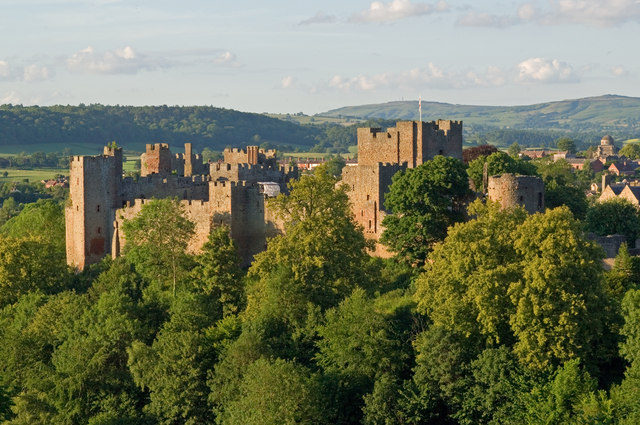
The River Clun, which wends its way through the Shropshire countryside, lends its name to a number of villages as well as the small town of Clun, with its ruined medieval castle (English Heritage), nestling in the Shropshire Hills Area of Outstanding Natural Beauty.  In A Shropshire Lad Housman describes the sleepy nature of these settlements in the following whimsical verse: "Clunton and Clunbury//Clungunford and Clun//Are the quietest places//Under the sun."  Another larger town which features in the work is Ludlow, nowadays known as much as a foodie mecca as for its impressive castle overlooking the River Teme.  Housman writes about the town's fair: "The lads in their hundreds to Ludlow come in for the fair//There's men from the barn and the forge and the mill and the fold."  There is a memorial to Housman outside St Laurence's church in Ludlow and the ashes of the poet, who died in 1936, are buried under the stump of a cherry tree in the church grounds. 

File:Ludlow Castle from Whitcliffe, 2011.jpg
Ludlow Castle from Whitcliffe, 2011. Photo by Ian Capper, via Wikimedia Commons.

Map of Shropshire.