Tuesday, 5 November 2013

AGATHA CHRISTIE COMES HOME WITH POIROT: GREENWAY HOUSE


The edition of the Poirot series shown on ITV at the end of last month was a special one in that the location used for the filming was the real-life holiday home of Agatha Christie, whose work the series is based on.  Greenway House provided the inspiration for the original story Dead Man's Folly as well as a perfect setting for the filming.  The episode was also a sad one for David Suchet, the actor who has played Poirot for the last 24 years, as it involved him being filmed as Poirot for the last time, although two more episodes would be shown following this one.  The makers of the series decided that it would be appropriate for Suchet's final piece of filming as Poirot to take place in the Christie home, hence the timing.  In a recent interview, Suchet revealed that he was looking for a way to imitate the mincing gait of Poirot as described by Agatha Christie, and he ended up nicking a tried and tested technique of Laurence Olivier's: walking with a coin clenched between his buttocks.

In Dead Man's Folly, Greenway House plays the part of Nasse House, recently taken over by a wealthy couple.  A fete is being held at the house, and as part of the festivities a murder hunt is being organised by famous author Ariadne Oliver (Zoe Wannamaker).  However, Oliver has her suspicions about some of the people attending the event, and begins to fear that a real-life murder might take place, so she invites Poirot to the house just in case.  Needless to say a murder does take place...but I'll leave it there in case anyone reading this has not watched the episode yet. 

Greenway House, built on a site originally occupied by a Tudor mansion, lies in an elevated position in an idyllic spot overlooking the east bank of the River Dart in South Devon.  The house itself is ravishing, with its elegant, classic exteriors in a tasteful shade of cream, beautifully set off by the green of the equally exquisite grounds.  Agatha Christie and her husband Max Mallowan bought the house in 1938, and they used it as a holiday home until their respective deaths, which occurred within the space of two years in the 1970s.  During World War II the house was requisitioned by the US military for the D-Day preparations.  The house is filled with reminders of the couple's time there, including the Steinway piano Agatha used to play and artefacts brought back from the Middle East by her husband, who was into archaeology.  The gardens slope towards the banks of the river and are filled with plants such as camellias and rhododendrons.  The property is now owned and operated by the National Trust.  The nicest way to arrive at the house is by taking the Greenway Ferry from Dartmouth, Totnes, Brixham or Torquay.

Map of the area. 

Front of Greenway House

Wednesday, 30 October 2013

HORROR IN ROYAL WINDSOR


Think of Windsor and what words come to mind?  Royalty? River? Castle?  These are the things that Windsor is best known for, but what may be less well known is the role the town has played in the making of some of the best-known horror films, particularly those made by Hammer Films.  The focal point for the filming was the gothic-looking turretted building called Oakley Court on the outskirts of Windsor next to the River Thames.  Oakley Court is currently a hotel, although it was reportedly put up for sale earlier this year.  Because of its dramatic, spooky appearance and its location adjacent to the Bray Studios Oakley Court came to be used for a large number of film productions, some 200 in all. 

In 1957 Peter Cushing was filmed at Oakley Court dabbling in science with monstrous consequences in The Curse Of Frankenstein.  The following year Cushing was joined by the other great horror supremo Christopher Lee in Dracula, in which Oakley Court portrayed Arthur Holmwood's house.  In 1960 the building's entrance became the entrance to Castle Meinster in The Brides Of Dracula.  Then it was a girls' school in Nightmare (1962).  In 1964 Frankenstein made another appearance in The Evil Of Frankenstein, with Oakley Court as the Frankenstein family castle near Karlstad.  The building appeared as Nahum Witley's house in Monstor Of Terror (1965) and Hamilton Manor in The Plague Of The Zombies (1966).  The building's castle-like appearance served it well again in And Now The Screaming Starts (1973) when the exterior of the building depicted Fengriffen Castle.  The musical comedy The Rocky Horror Show made use of Oakley Court in 1975.  At the time of filming the hotel was to all intents and purposes a decrepit shell of a building, with buckets dotted around for catching the rainwater coming through the holes in the roof.  The building was used for the exterior castle scenes, while parts of the interior were used for the criminologist's study, the dining room, Brad's room, Janet's room and Columbia's room. 

However, the making of films in the horror genre in Windsor was not exclusively confined to Oakely Court.  In 1955 The Quatermass Experiment made use of a number of locations around the town.  This horror classic featured a half-man half-monster called Carroon.  While mutating, Carroon steals drugs from a chemist's shop: the building used is the Woods Of Windsor shop on Queen Charlotte Street, incidentally the shortest street in Britain.  The scene featuring the discovery of a trail of slime was filmed in Goswell Hill, beside the railway station.   In 1966 the comedy Carry On Screaming featured a scene involving a police station which was filmed in St Leonard's Road.  The building used for the police station was a former fire station, but is now an arts centre.  Sergeant Bung's house in the film was on Queens Road.

So, on the occasion of Halloween lets turn down the lights, put on one of these classic horror films and give thanks to Oakley Court and to Windsor for their contribution to the horror film industry.

For tourist information on Windsor, follow this link.

Map of the town. 

File:Windsor sceptre.jpg
Windsor sceptre.  Photo by Mark Furney, via Wikimedia Commons

Friday, 18 October 2013

TAKE ME TO THE RIVER: THREE MEN IN A BOAT


I have a great affection for the River Thames.  I came to know every inch of the stretches of the river from the source up to Windsor some years ago when I set about walking sections of the Thames Path.  From the intermittent trickle of the source near the village of Kemble in Gloucestershire, via the wild meanderings beyond Lechlade, the bucolic stretches from Oxford to Reading, Henley to Maidenhead, and finally that amazing moment when Windsor Castle came into view in all its glory.  So it was with great enthusiasm that I embarked on reading Three Men in a Boat by Jerome K. Jerome, which tells the story of a boat trip from Kingston Upon Thames to Oxford made by three friends - the author, Harris and George - and an errant dog called Montmorency (the men were based on real people, the dog was fictional).  Published in 1889, at around the time that leisure boating on the Thames became fashionable, it provides a fascinating insight into the life and mores of the late 19th century, as well as a sense of humour which has stood the test of time.

Kingston Upon Thames, or Cyninges tun as it was known during its early days in the 9th century, got its name from the fact that the Saxon kings were crowned here. It is here that, on a "glorious morning" the three friends arrive by train from London Waterloo, having bribed a train driver to go off his designated route to take them there, and take possession of the boat that is to be their home for the duration of the trip.  Just around the first bend from Kingston is Hampton Court with its maze, which features in one of the most comic scenes in the book, in which Harris leads a group of tourists into the maze and gets them lost in it for hours.  Then on to Moulsey Lock, which the author describes beautifully, capturing the typical boating scene of the day with its "brilliant tangle of bright blazers, and gay caps, and saucy hats".  The trio spend their first night camping at Picnic Point, Runnymede, which is near Magna Carta Island (or Magna Charta Island as named in the book).  This is a location with huge historical significance, being where King John sealed the Magna Carta, hence the name of the island, which is one of the principal contenders for the exact location where this happened.

File:Magna Carta Memorial - geograph.org.uk - 943627.jpg
Magna Carta Memorial - geograph.org.uk - 943627. Photo by Andy Stephenson, via Wikimedia Commons

Windsor, surprisingly, gets short shrift in the book, while Maidenhead is dismissed as "too snobby to be pleasant".  However, the author is much more impressed with Marlow, where Montmorency has an undignified spat with a cat, and where the three friends replenish their supplies in the local stores, resulting in a procession of delivery boys taking baskets of food down to the boat.  Up to this point, the author has been effusive in his praise of the river's beauty, but at Reading the tone changes, describing the river as "dismal and dirty", and with the comment that "one does not linger in the neighbourhood of Reading".  Some may say not a lot has changed, although the day I passed through Reading on my walk the riverside area seemed pleasant enough.  Beyond Reading, the neighbouring villages of Streatley and Goring are described as "a great fishing centre", which still seems to be true to this day. 

File:River Thames at Marlow - geograph.org.uk - 488905.jpg
River Thames at Marlow - geograph.org.uk - 488905. Photo by Nigel Cox, via Wikimedia Commons


Wending their way towards Oxford, the friends arrive at Dorchester (Dorchester-on-Thames that is, not the one in Dorset!) where the countryside "grows more hilly, varied, and picturesque".  Dorchester is another historical highlight along the river: as its name suggests, it has Roman origins, and it was once the capital of Wessex, somewhat hard to believe now, looking at this sleepy little village. Then Abingdon, "a typical country town of the smaller order", and finally the stretch from Iffley to Oxford - "the most difficult bit of the river I know" declares the author, due to the nature of the currents.  Sadly, the trip comes to an abrupt end further back downstream at Pangbourne, where due to the fact that it is pouring with rain the trio decide to cut short their journey and head back by train to London, leaving the boat and its contents with a local boatman who they fool into thinking they will be coming back for it.

File:Iffley Lock - geograph.org.uk - 439741.jpg
Iffley Lock - geograph.org.uk - 439741. Photo by Stephen McKay, via Wikimedia Commons

See here for a guide to the Thames, and if you feel like walking it, check out the Thames Path website.


Wednesday, 18 September 2013

MEDIEVAL MAYHEM AT FRESHWATER WEST: ROBIN HOOD


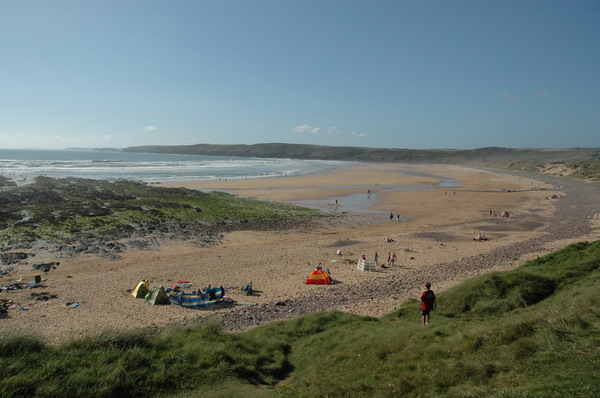
On a fine June day in 2009 the peace and tranquillity of an idyllic beach in south-west Wales was shattered by the sound of charging, whinnying horses, the clashing of swords and yells and shouts from a fleet of longboats out at sea.  The cause of this spectacle, which must have provided a frisson of excitement for both visitors and locals who were allowed to watch from a distance, was the filming of a scene from Ridley Scott's 2010 version of the story of hero of English folklore Robin Hood, starring Russell Crowe and Cate Blanchett.  The scene depicts a battle against French invaders with Robin leading his men into the fray and slaughtering his arch enemy, Sir Godfrey (Mark Strong), who has pledged his allegiance to the French side.  Considering the scene formed only a small part of the film as a whole, there were a staggering number of people and animals involved in making it: 800 actors and 130 horses, not to mention the dozens of boats and the helicopters flying overhead for the shots from the air.  There were also ambulances on hand in the quite likely event that someone might get hurt.  This was the second time that year that Freshwater West had caught the attention of Hollywood: the previous month the beach was used as the backdrop for Dobby's Shell Cottage in Harry Potter and the Deathly Hallows.  

File:Freshwater West - geograph.org.uk - 239022.jpg
Freshwater West - geograph.org.uk - 239022.  Photo by Jeremy Owen, via Wikimedia Commons.


The beach at Freshwater West is just one of many in Pembrokeshire, a county in south-west Wales which has more than its fair share of stunning beaches and coastal scenery.  It feels miles from anywhere, although the town of Pembroke is only about five miles to the east.  Walkers can reach the beach via the Pembrokeshire Coast Path, which passes through here.  The mile-long beach is a diverting mix of sand dunes and rock pools, making it a fun place for families, although swimming is unsuitable for all but the most experienced swimmers and in particular surfers, who flock here to brave the strong waves.  The beach is the venue for regular surfing tournaments, attracting contestants from all over the world.  Further round the coast is the National Trust run area known as Stackpole, with yet more lovely beaches, clifftop walks and a delightful complex of small lakes known as Bosherston Lakes, created 200 years ago for the now demolished mansion of Stackpole Court.  There are walkways around the lakes leading from the car park down to the beach, and the whole area is a haven for birds, dragonflies and even otters.

Bosherston Lakes

Tourist information about Pembrokeshire.

Monday, 26 August 2013

OH MR DARCY! LYME PARK, CHESHIRE


I have always found Sunday evening to be one of the most depressing parts of the week, what with the start of the new working week being just around the corner.  TV therefore has an important role to play by providing viewers with something to cheer themselves up.  Many women like nothing more than to settle down to a good costume drama, and on the evening of Sunday 24 September 1995 female viewers were in for a treat when the BBC's adaptation of Jane Austen's Pride And Prejudice burst onto our screens.  As well as being a jolly enjoyable drama, there was the added bonus of the dashing Colin Firth as Mr Darcy, his brooding good looks providing a much-needed Sunday evening tonic for the nation's women.  However, nothing could prepare them for the delights in store in episode four and the famous "lake scene".

Let us just relive the scene for a moment.  It is a swelteringly hot summer's day.  Mr Darcy strides towards the lakeside, removing his jacket, and sits down, contemplating a lovely cooling swim.  Off comes the scarf and off comes the waistcoat.  All over the country, female hands are fumbling distractedly in chocolate boxes, knocking over cups of tea, their owners unable to take their eyes off the screen.  However, that is all the stripping they are going to get.  Mr Darcy dives in, and we catch a glimpse of him moving through the murky water.  After his swim he is seen in his wet shirt, made slightly see-through by the sun.  Mr Darcy, still in a state of semi-undress and dripping wet, runs into Miss Bennett, who is not expecting him to be there, and a toe-curlingly awkward conversation ensues.

Earlier this year, this scene was voted the most memorable moment in TV drama, beating some of the most dramatic scenes from our beloved soap operas, such as the scene where Dirty Den hands the divorce papers to Angie in EastEnders, the tram crash in Coronation Street and the lesbian kiss in Brookside, among others.  The scene also made it into popular fiction when Bridget Jones and her friends settled down to watch the DVD with the obligatory bottle of wine (in fact the whole premise of the Bridget Jones story is as a modern-day equivalent of Austen's tale).  Apparently, Firth nearly turned the part of Mr Darcy down when originally offered it, believing himself to be a bit old for a romantic lead.  As for the actual dive, a body double was used due to concerns over the risks of Weil's disease from the lake waters.  However, Firth was used for the underwater part, which was filmed in a tank at Ealing Studios.

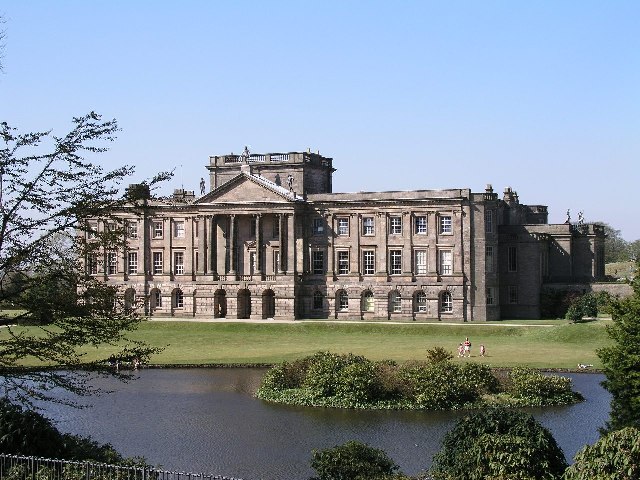
Apart from the undoubted charms of Colin Firth as Mr Darcy and Jennifer Ehle as Miss Bennett, the other star of the scene in question is Lyme Park where it was filmed and which doubled as Darcy's estate Pemberley in the series.  This estate near Disley in Cheshire, on the north-west edge of the Peak District, dates from the 14th century when it was granted to Sir Thomas Danyers.  It then passed to the Legh family, and remained with them until it was transferred to the National Trust in 1946.  The centrepiece of the estate is a large stately pile, the largest house in Cheshire, with a mixture of architectural styles from Elizabethan to Italianate.  Highlights include the Wardrobe Department where visitors can dress up in period costume, a cinefilm made by the last generation of the Legh family to occupy the house, a 15th century prayer book and numerous glimpses into the life of a well-to-do Edwardian household.  As well as the famous lake, the grounds include a deer park, an Edwardian rose garden, Cage Hill with its eponymous tower, a former hunting lodge, and walking trails that take in scenes from Pride and Prejudice.  Visitors to the property will have the chance to relive the lake scene when a statue of the semi-clad, sodden Mr Darcy is installed at Lyme Park following a tour around the country.  The statue, which was created to celebrate the launch of the new Drama TV channel, will remain at the estate until February 2014.

File:Lyme Hall 01.jpg
Lyme Hall 01. Photo by Alan Fleming, via Wikimedia Commons

Map of the area.

Thursday, 8 August 2013

UNMISTAKABLY DORCHESTER: THE MAYOR OF CASTERBRIDGE


There can be few towns in literature as readily identifiable with their real life counterparts as Casterbridge, Thomas Hardy's fictional version of Dorchester.  The town is the focal point of The Mayor Of Casterbridge, the story of a man, Michael Henchard, who drunkenly sells his wife in his youth.  This act comes back to haunt him later in life, by which time he has become the Mayor Of Casterbridge. The story makes numerous references to local landmarks and buildings which can be pinned down to their real-life equivalents.  One of Dorchester's best known features is The Walks, a series of pleasant, tree-lined avenues which follow the line of the original Roman walls.  In Hardy's time, these avenues more or less formed the boundary between the town and the countryside, and there are several references to the way in which the agricultural areas around the town almost encroached on its streets.  Hardy describes the town as "like a chessboard on a green table-cloth", and he talks of how, when an execution took place, the cows had to be moved out of the way from the meadow next to the "drop" to make way for the spectators.  And how the judge, when passing sentence, did so "to the tune of Baa", from the sheep nearby.  Meanwhile, the High Street was colonised by pig-dealers occupying the recesses outside people's houses, and by the sellers of horses who "occasionally nipped little boys by the shoulder who were passing to school".  Needless to say, the present-day Dorchester has spread far beyond the confines of The Walks.

Halfway up Dorchester's High Street is the Kings Arms Hotel (now closed), an inn built in 1720 which has played host to Queen Victoria and King George VI.  The hotel, with the same name, features prominently in The Mayor Of Casterbridge (and also appeared in Far From The Madding Crowd).  Many of the important events of the novel take place in the Kings Arms.  In chapter 5 the Mayor of the title presides over "a great public dinner of the gentlepeople and such like leading volk", with the town band playing outside and lesser townsfolk peering in through the windows at the proceedings therein.  This is the point at which the sold wife first sees her husband after a long separation.  Another prominent pub which features in the story is The Three Mariners - this was based on an inn called The King Of Prussia, which was pulled down at the end of the 19th century.  

The house reputed to have been lived in by Michael Henchard. Photo by Brian Turland

The Kings Arms. Photo by Brian Turland

As well as the town itself, several nearby landmarks play an important part in the story.  As its name suggests, Dorchester had Roman origins, and there are many relics of that time around the town.  Maumbury Rings was the site of a Roman amphitheatre in the 1st century AD.  The site, which is referred to as the Ring in the novel, is where Henchard has a rendezvous with his former wife, and later with the other woman in his life, Lucetta.  There is a road referred to in the story as the Via, so called because it was once a Roman road.  This Via is overlooked by Maiden Castle - or Mai Dun - the largest prehistoric earthwork in the country, which is used as a vantage point by Henchard to observe comings and goings along the Via.  Some of the more rural scenes in the novel are set in "an eastern purlieu" called Durnover.  This is a fictional village on the edge of town, of which the real-life equivalent is Fordington, a former village which now forms part of the built-up area of Dorchester.  Further afield, the seaside town named Budmouth in the novel is Hardy's version of Weymouth, which also appears elsewhere in his work.


Maumbury Ring. Photo by Brian Turland


Fordington, aka Durnover. Photo by Brian Turland


Hardy was well qualified to base a novel around Dorchester: he was born in Higher Bockhampton near the town in 1840, and in 1849 began attending a school in Dorchester.  At 16 he went to work for the architect John Hicks, at 39 South Street.  Later in life, after spending time in London and a variety of locations he returned to live in Dorchester, moving into Max Gate in 1885.  This Victorian house designed by Hardy himself is now run by the National Trust, who also run his Higher Bockhampton birthplace.  Near Dorchester, commanding an elevated position with views out to the coast and inland, is the Hardy Monument, also National Trust.

File:Thomas Hardy's Birthplace (8061936623).jpg
Thomas Hardy's Birthplace (8061936623). Photo by Peter Broster, via Wikimedia Commons

Thomas Hardy's statue. Photo by Brian Turland


For tourist information about Dorchester follow this link.

Map of the town.