Monday, 29 June 2020

THE REAL SOLDIER ISLAND: AGATHA CHRISTIE/BURGH ISLAND, DEVON


In January 2016 I blogged about an Agatha Christie special which aired between Christmas and New Year 2015.  It was a TV adaptation of And Then There Were None, a murder mystery based around an island called Soldier Island.  In the TV version an island off the south coast of Cornwall was used to depict Soldier Island, but Christie’s real inspiration for her crime story was Burgh Island off the south Devon coast.

Unlike the island of the story, Burgh Island is accessible at low tide from the beach at Bigbury-on-Sea.  There is a hotel on the island, and a pub, and visitors can get to the island via a strip of sand stretching from the mainland.  However, even at high tide a boat is not necessary, thanks to the ingenious “sea tractor”, a passenger vehicle which is high enough to stay above the surface of the water as it takes people across.

File:Burgh Island sea tractor.jpg
Burgh Island sea tractor. Photo by DeFacto, via Wikimedia Commons.

It is no surprise that Agatha Christie had Burgh Island in mind when writing her story, as she herself spent a lot of time at the island’s hotel, so much so in fact that a retreat was built for her.  The Beach House was built in the 1930s, and it was here that she wrote And Then There Were None.  The unit is now available as a luxury unit within the Burgh Island hotel complex.

The hotel has a star-studded history, having started life as a wooden house built by the music hall star George H Chirgwin for hosting weekend parties.  Its later incarnation as a more substantial Art Deco building was down to the film-maker Archibald Nettlefold, who bought it in 1927. 

View of the island from Bigbury-on-Sea

During its heyday, Burgh Island was visited by many famous names.  Noel Coward came for a three-night stay, but this turned into three weeks.  Other luminaries who have paid a visit over the years  include the Beatles, who stayed there when playing a concert in Plymouth, and Josephine Baker.  The hotel was even graced by royalty, in the form of Edward Duke of Windsor and Wallis Simpson, and Lord Mountbatten, second cousin once removed of the Queen.  The hotel also hosted a meeting between Churchill and Eisenhower in the run-up to the D-Day landings.

Needless to say, a stay at Burgh Island does not come cheap, but if you are feeling a bit flush and are a fan of Art Deco, a stay at Burgh Island is a must, not only for its sumptuous period decor but also the sea views from the rooms.


Monday, 22 June 2020

ANOTHER DOSE OF CYMRU NOIR: HIDDEN/NORTH WALES


Six years ago I blogged about a Welsh crime series called Hinterland, which was compared at the time to some of the ‘nordic noir’ series from Scandinavia such as The Killing, and was filmed mainly in the West Wales county of Ceredigion.  With Hidden we get another dose of ‘Cymru noir’.  This series, starring Sian Reese-Williams as DI Cadi John and Sion Alun Davies as DS Owen Vaughan, takes us a bit further north to Bangor and Snowdonia, which provides a suitably chilling backdrop to many of the scenes in the series.  For this piece I am concentrating on series 1, first shown in 2018.

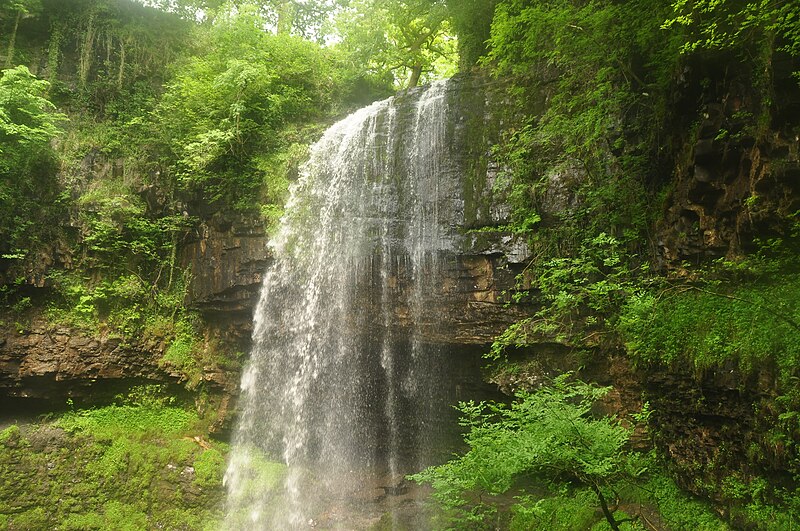
The series kicks off, predictably, with the discovery of a woman’s body, but the locations used for this part are further south than Snowdonia.  The crime which led to this discovery is committed at the scene of the highest waterfall in Wales, Henrhyd Falls, which is further south than the fictional location in the series, in the Brecon Beacons.  The waterfall plunges into the Graig Llech Gorge at the southern edge of the Brecon Beacons National Park in the county of Powys.  The viaduct visible in the scene where the discovery of the body takes place is also further south.  The Pontsarn Viaduct near Merthyr Tydfil was built in the 1860s to carry the Brecon and Merthyr Railway over the Taf Fechan river.

File:Henrhyd falls (9165).jpg
Henrhyd Falls (9165). Photo by Nilfanion, via Wikimedia Commons.

Back in Snowdonia, one beautiful sight which appears again and again in the series is the wonderful Menai Strait with its two bridges.  The Menai Strait, which is 25 Km long, separates the Welsh mainland from the charming island of Anglesey.  The island is linked  to the mainland by two bridges, the Menai Suspension Bridge, opened in 1826, and the Britannia Bridge, opened in 1850.  The city of Bangor lies on the mainland side of the strait, and is the location of a university which was founded in 1884.  The university features heavily in the storyline of Hidden, as one of the main characters, the self-harming Megan Ruddock (Gwyneth Keyworth), is an undergraduate there.   

Interwoven with the crime story is the story of Cadi’s family with its trials and tribulations, including her worries about her terminally ill father.  The location of the house her father lives in is provided by Ynys Castell, a holiday home in real life on a tiny island in the Menai Strait.  For around four hours twice each day the island can only be reached by boat as it is cut off from the mainland.

File:Ynys Castell - geograph.org.uk - 586428.jpg
Ynys Castell - geograph.org.uk - 586428. Photo by Eric Jones, via Wikimedia Commons.

North Wales, like most beautiful and touristy parts of Britain, is an area of haves and have-nots, and this comes across in the series with some of the characters living in poor, run-down looking villages and estates, albeit with the ever-present backdrop of Snowdonia. The Maes Padarn estate in Llanberis is a typical example which features heavily in the series.  The estate is on the outskirts of a touristy town with a number of attractions for visitors, such as the Llanberis Lake Railway and the Electric Mountain hydroelectric power station visitor centre.

However, the most depressing and menacing property seen in the series is the remote cottage surrounded by dark woodland occupied by suspect Dylan Harris (Rhodri Meilir) and his mother Iona (Gillian Elisa).  The house was actually purpose-built for the series and its location is a secret, however Dylan’s workplace was filmed at the Llechwedd Slate Caverns. The cafe where Dylan meets an almost-victim is Eric Jones Cafe and Campsite outside Tremadog in real life.

File:Llechwedd Slate Caverns 002.jpg
Llechwedd Slate Caverns 002. Photo by Matěj Baťha, via Wikimedia Commons.


Tuesday, 9 June 2020

A SLICE OF HEAVEN IN DEVON: SENSE AND SENSIBILITY


Whenever there is an adaptation of a Jane Austen novel on the big or small screen, one thing can be certain: the locations will inevitably feature some of Britain’s finest stately properties. 

The property which kicks off the story in the 1995 film adaptation of Sense and Sensibility, directed by Ang Lee, is the fictional Norland Park in Sussex, which is left by a dying father to his son, but due to the rules of inheritance the three daughters Elinor, Marianne and Margaret and their mother (Emma Thompson, Kate Winslet, Emilie Francois and Gemma Jones) are left with next to nothing.  Worse still, they are forced to move out of their lovely family home, while the son and his wife John and Fanny (James Fleet and Harriet Walter) move in.  The mother and daughters are offered accommodation by a cousin, but it is a bit of a come-down, being just a ‘cottage’ in the depths of Devon, albeit in a heavenly rural setting near the coast.

The real-life version of Norland Park is Saltram House near Plymouth, a Grade I listed George II era mansion, while the cottage, Barton Cottage in the story, is Efford House on the Flete Estate, which actually is in Devon in real life, again near Plymouth.  The waterside scenes set near the cottage were also filmed in Devon, at the mouth of the River Erme.  However, the exterior of Barton Park, the wider estate where the cottage is located, is actually further east in Wiltshire, where the scenes were shot at Trafalgar Park, between the city of Salisbury and the northern edge of the New Forest.


File:Efford House - geograph.org.uk - 292694.jpg
Efford House - geograph.org.uk - 292694. Photo by Derek Harper, via Wikimedia Commons.


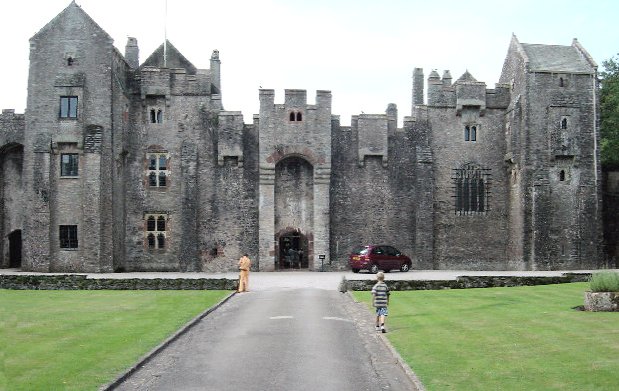
Another striking property in Devon, which is seen at a distance as a large grey mass of architectural splendour surrounded by sloping green fields, is the Combe Magna estate, owned by love interest John Willoughby (Greg Wise).  In real life this is a fortified manor house called Compton Castle near the resorts of Torbay.  The manor house dates from the 1400s and was connected to Sir Walter Raleigh.  Still in Devon, the wedding scene at the end was filmed at St Mary’s Church in the village of Berry Pomeroy near Totnes.

File:Compton Castle in Devon enh.jpg
Compton Castle in Devon enh. Photo by Smalljim, via Wikimedia Commons.

One of the most dramatic scenes in the film comes towards the end, when Marianne suffers a life-threatening illness, to the distress of Captain Colonel Brandon (Alan Rickman), who has developed a soft spot for her.  She falls ill while visiting the estate owned by a couple in the Dashwoods’ social circle called the Palmers (Imelda Staunton and Hugh Laurie).  This magnificent property is the real-life Montacute House near Yeovil in Somerset, a late Elizabethan mansion with manicured lawns and gardens.


                                                                      Montacute House. 

Mid-way through the film we are transported to London, where many well-to-do people in Jane Austen’s time had their “London base” in addition to their country properties.  The London abode of the dreadful Fanny Dashwood and her husband John is represented by a house in Adam Street, WC2, while Chandos House in Queen Anne Street is the home of the Palmers.  However, the Chelsea home of the ebullient Mrs Jennings (Elizabeth Spriggs) is not in London, but in Salisbury, in reality the 18th century Mompesson House in the Cathedral Close.

Most of the properties featured in the film are open to visitors.  Saltram, Compton Castle, Montacute House and Mompesson House are run by the National Trust.  Trafalgar Park is privately owned, but can be used for events and weddings.  Meanwhile, for anyone wanting to immerse themselves fully in the Dashwoods’ idyllic life in Devon, Efford House is available as a holiday let.


Monday, 25 May 2020

THE HEAVENLY HAUNT OF A LINCOLNSHIRE LAD: GUNBY HALL


The poet Alfred Lord Tennyson was born in 1809 in the village of Somersby in Lincolnshire.  Many of the lines in his work were inspired by the local landscape, for example it was a small stream in the vicinity that formed the basis of The Babbling Brook.  He also made frequent references to the woods in the area – “The silent woody places”. 


Being a member of the aristocracy, Tennyson had friends in high places in the locality.  One of them was Algernon Massingberd, the son of a local squire residing at Gunby Hall, a few miles from Somersby.  Tennyson, who by all accounts had a sad family life as well as losing his closest friend at a young age, paid regular visits to the hall, and must have found great solace there.  The hall is now the property of the National Trust, and visitors to the hall may notice a small framed picture above the fireplace in  one of the rooms.  The picture includes a few short lines describing the hall, and it is signed by Tennyson.  


File:Gunby Hall from the west.jpg
Gunby Hall from the west.  Photo by DeFacto, via Wikimedia Commons.


The line forms part of Tennyson’s poem “The Palace of Art”, in which he imagines an art collection in a palace and its gardens constructed by a man who converses with his soul.  One of the pieces in the collection is described thus:


                            And one, an English home – gray twilight pour’d

                            On dewy pastures, dewy trees,

                            Softer than sleep – all things in order stored,

                            A haunt of ancient Peace


This is the verse reproduced in the picture above the fireplace, and it is widely thought to have been inspired by Gunby Hall. 


Another of Tennyson’s most famous poems, Maud, in which Maud is urged to “come into the garden”, makes references to the “musk of the rose”.  This was also probably inspired by the gardens of Gunby Hall, and there are still musk roses growing there today.  Another poem which may well have been inspired by the gardens of Gunby Hall is “The Gardener’s Daughter”. 


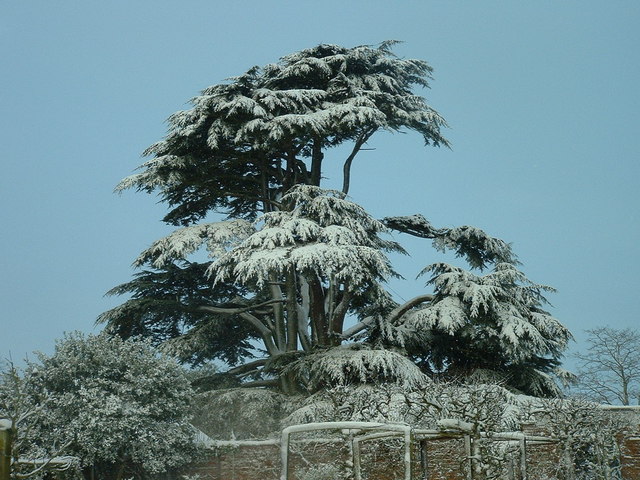
The gardens have changed a bit since Tennyson frequented them, but some features remaining would have been there at that time, such as the pigeon house and the garden seat against the west wall.  As for the plants, there is a cedar of Lebanon which was planted in 1812 by Algernon’s father.

File:Cedar of Lebanon Gunby Hall gardens - geograph.org.uk - 1352099.jpg
Cedar of Lebanon Gunby Hall gardens - geograph.org.uk - 1352099. Photo by Paul Gray, via Wikimedia Commons.


Gunby Hall is a few miles inland from Skegness, at the south-east edge of the Lincolnshire Wolds AONB.  In normal times (not currently, obviously), the hall, estate and gardens are open to visitors, who can visit three floors of rooms full of collections dating from 1700, as well as the eight acres of gardens.

Map of the area.

Friday, 15 May 2020

LONDON WITH A SCOTTISH ACCENT: BELGRAVIA


When Belgravia hit our screens recently, there were inevitable comparisons with Downton Abbey, both series being the work of Julian Fellowes and with the same team behind them.  There have been dark mutterings that Belgravia is “no Downton Abbey”, but in reality there is no reason why it should be.  Personally, I slightly prefer Belgravia,  as I think it has a more interesting storyline.  The one thing the two series do have in common is that they both make use of sumptuous period backdrops, both for the interior and exterior scenes.

Belgravia is a district of Central London where properties routinely sell for multi-million pound sums of money.  The area really began to move up in the world when George III moved into Buckingham House (better known as Buckingham Palace) and construction began of the elegant streets adjacent to the King’s gaff.  The series follows the story of the nouveau riche Trenchards (Philip Glenister and Tamsin Greig) and the upper class Brockenhursts (Harriet Walter and Tom Wilkinson), whose London base is in Belgravia.  The two families find they have something in common due to a secret from the past which has come to light.   

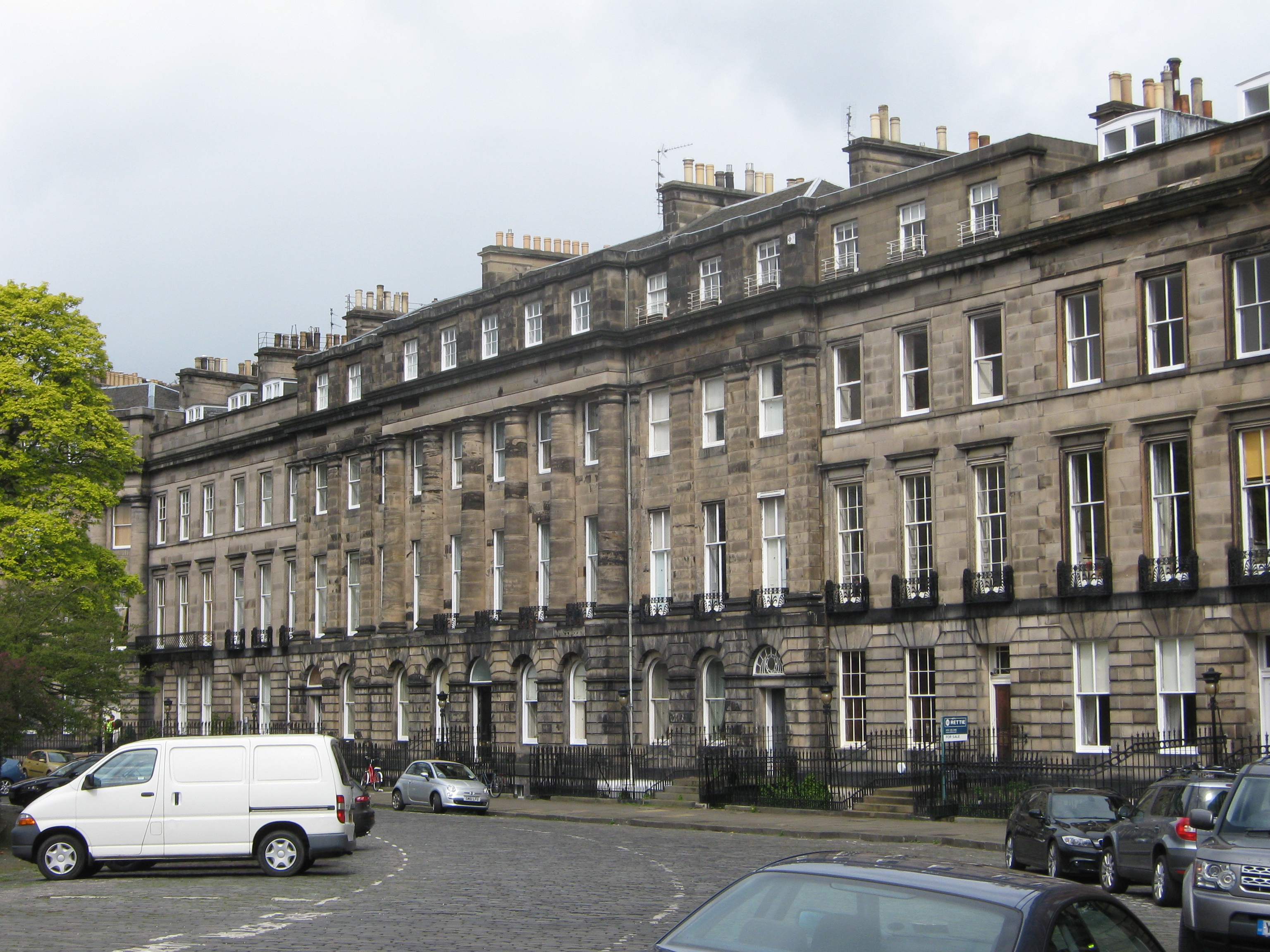
However, fans of the series who want to visit the location where the scenes depicting the streets of Belgravia were filmed will be disappointed if they head to London.  These scenes were in fact filmed in Edinburgh, in the New Town part of the city, in particular Moray Place.  The grand old houses of New Town make a good substitute for their London counterpart except that they are built from the kind of dull grey sandstone associated with this period in the Scottish capital.  The production team behind Belgravia overcame this discrepancy by the use of computer-generated imagery (CGI) to change the sandstone to the white exteriors seen in the real-life Belgravia.

File:Moray Place, Edinburgh 002.jpg
Moray Place, Edinburgh 002. Photo by Brian McNeil, via Wikimedia Commons.


Some of the interior shots featuring the homes of the Trenchards and the Brockenhursts were also filmed north of the border, making use of Manderston House near Duns in the Borders area of Scotland.  This elegant Edwardian country house, built on the site of an earlier house dating from the late 18th century, is now used as a wedding venue, and is open to groups of visitors by appointment.

Meanwhile, heading back down south, one property which particularly stands out is the one used as Lymington Park, Lady Brockenhurst’s country estate, where she and the Earl of Brockenhurst host weekend parties.  The real-life estate is another wedding venue, Wrotham Park, Hertfordshire.  The estate, to the north of Barnet, is a Palladian Mansion built in the 18th century by Admiral John Byng, and features a long, sweeping lawn leading from an ornamental lake to a light grey facade with a grand pillared entrance.

File:Wrotham Park, Middlesex by Brayley (1820).jpg
Wrotham Park, Middlesex by Brayley (1820).  Via Wikimedia Commons.

These are just some of the locations for fans of the series to seek out, demonstrating that there is much more to Belgravia than Belgravia.

Friday, 1 May 2020

LOVELY SETTINGS FOR A LOVELESS MARRIAGE: THE DUCHESS


Lady Georgiana Spencer, an ancestor of Princess Diana, was born in Althorp, where the Princess is buried.  At the age of 17 she was married off to William Cavendish, 5th Duke of Devonshire, whereupon she became the Duchess of Devonshire.  On paper it sounds like a fairy tale for the young Georgiana, but unfortunately the Duke turned out to be a philanderer who was only interested in gaining a male heir.  Georgiana’s first two children, as sod’s law would have it, were female, but she finally managed a son the third time round.  Meanwhile, Georgiana became friendly with Lady Elizabeth Foster from Suffolk while on a visit to Bath.  Predictably, Elizabeth caught the roving eye of the Duke and she ended up in a ‘menage a trois’ with the pair of them, bearing two illegitimate children by him and finally becoming his wife three years after Georgiana’s death in 1806, only for the Duke to die two years later.  This saga is the subject of the 2008 film The Duchess, starring Keira Knightley as Georgiana and Ralph Fiennes as William. 

The scenes depicting Georgiana’s time at Althorp did not make use of the real-life Spencer family seat, but were filmed at Kedleston Hall in Derbyshire.   One twist to this whole sorry tale is that Georgiana fell madly in love with Charles Grey (played by Dominic Cooper), a Whig Party member who would later become Prime Minister, but in spite of William’s own infidelities he would not allow her to continue the liaison (which resulted in an illegitimate daughter).  In the film she is seen flirting with Charles, a scene filmed at the South Front of Kedleston Hall.  The scene in which her mother (Charlotte Rampling) is filmed meeting with William to persuade him of her daughter’s charms was filmed in the Library.  Another scene in which Georgiana’s hair catches fire was also filmed here, this time in the Marble Hall. 

File:Kedleston Hall 04.jpg
Kedleston Hall 04. Photo by Glen Bowman, via Wikimedia Commons.


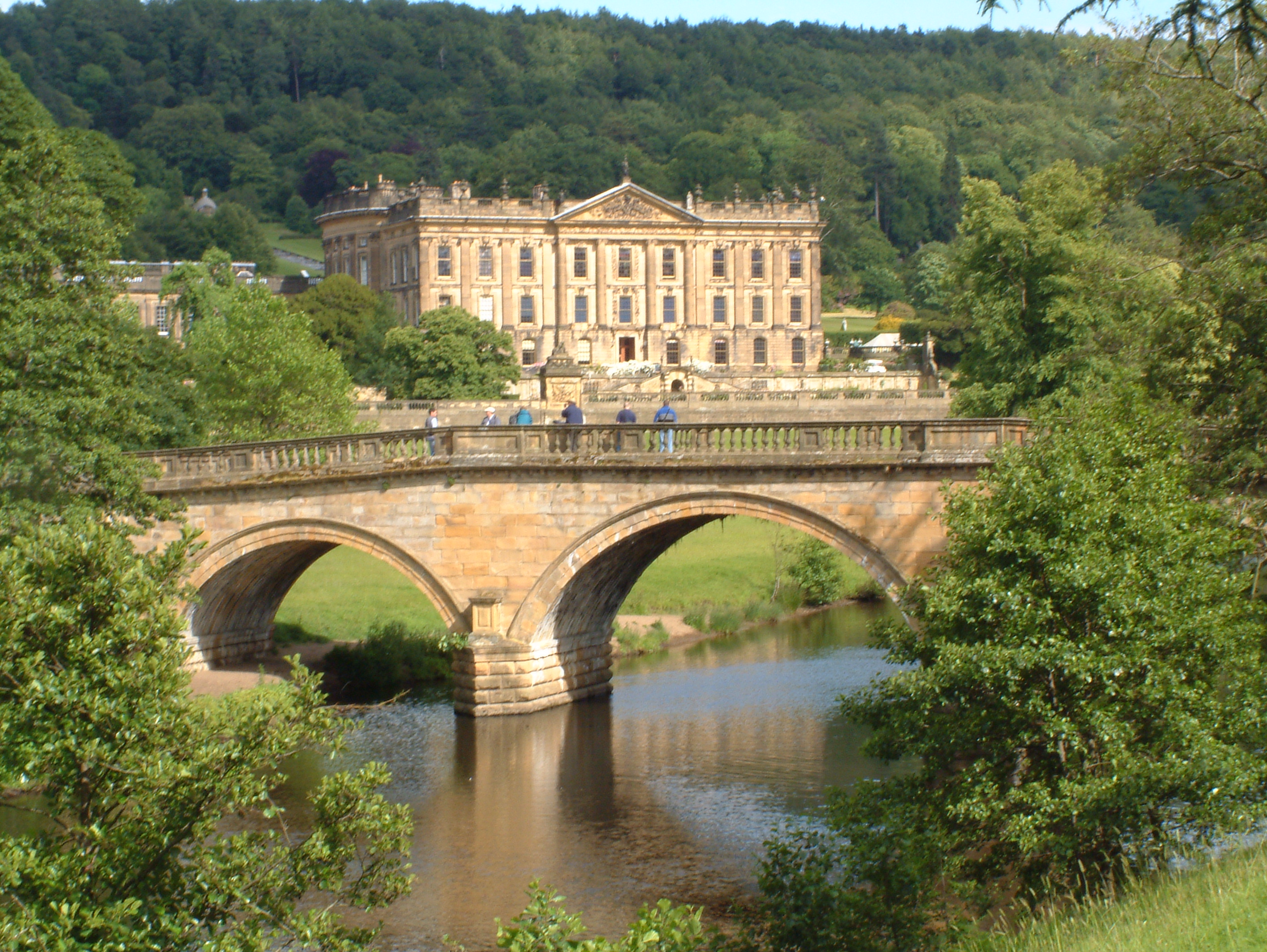
The country estate of the Dukes of Devonshire is Chatsworth House, one of Britain’s best-known stately homes.  Chatsworth played itself in the film when the wedding scenes were filmed there.  However, the Dukes had another base in London called Devonshire House in London’s Piccadilly.  The scenes depicting Devonshire House made use of a number of locations for the interior and exterior shots.  The original building was demolished in 1924, so the film-makers had to find an alternative for the exterior, and Somerset House in The Strand proved the perfect choice.  The interior scenes were all over the place, making further use of Kedleston for some scenes, plus Clandon Hall, Guildford, with Holkham Hall in Norfolk used to depict the dining room. The streets of London, in which the newly-weds are filmed trundling along in their carriage being cheered by crowds of people, are actually the grounds of the Old Royal Naval College in Greenwich.

File:Chatsworth Bridge.jpg
Chatsworth Bridge. Photo by Rob Bendall, via Wikimedia Commons.

In the scenes in which Georgiana goes to Bath to take the waters, this beautiful city gets to play itself, as the graceful Royal Crescent comes into view.  Another famous Bath landmark is the Assembly Rooms in Bennett Street.  The tea room forms the backdrop to the scene where Georgiana is presented to the throng and where she first meets Elizabeth.  However, the river scenes seen in this part of the film were not filmed in Bath, but back at Kedleston.

File:Royal Crescent, Bath 2014 04.jpg
Royal Crescent, Bath 2014 04. Photo by Mike Peel, via Wikimedia Commons.


Kedleston Hall, to the north-west of Derby, is an 18th century neo-classical house designed by Robert Adam and surrounded by sumptuous parkland.  The property is owned by the National Trust.  Chatsworth House, on the banks of the River Derwent near Bakewell, Derbyshire, is privately owned but open to visitors complete with retail and refreshment points.  The house was initially completed in 1708, with later additions the following century.  The extensive grounds include many interesting features, including fountains, a temple and a rectangular lake known as the Canal Pond.

Somerset House is a neo-classical building on the south side of The Strand in London.  It is been used for many purposes over the years, but its current role is principally as an arts centre.  The Old Royal Naval College dominates the banks of the River Thames in Greenwich.  A naval college since 1873, it forms part of the Maritime Greenwich UNESCO World Heritage Site.  The College has been used extensively in filming, proving useful to film-makers as a quieter alternative to Central London for street scenes, Clandon Park, to the north-east of Guildford, Surrey,  is owned by the National Trust, but unfortunately Clandon Hall itself was destroyed by a catastrophic fire in 2015 and still stands as a ruin today.  Holkham Hall is in Holkham in North Norfolk, famous for its vast sandy beach.  An 18th century house in the Palladian style surrounded by extensive parkland, it is privately owned but open to visitors.

The Royal Crescent in Bath was started in 1767 and consists of 30 Grade I listed terrace  houses.  For those wanting to immerse themselves in the Georgian spa town experience, part of the crescent has been given over to Bath’s poshest hotel, the Royal Crescent Hotel and Spa.  The Assembly Rooms, another National Trust property and designed in 1769, were the focal point of Georgian Bath’s social scene.  The building is used for functions and conferences, and can be visited when not in use.  There is also a Fashion Museum on the premises.  Both the Royal Crescent and The Assembly Rooms were designed by the architect John Wood, the Younger.

Monday, 13 April 2020

LOVE LETTERS TO YORKSHIRE: ALAN BENNETT/UNTOLD STORIES


Casting around for something substantial to read to help me through the coronavirus lockdown, I reached for a hefty tome bought some time ago in a charity shop.  Untold Stories, a collection of writings and diary entries by Alan Bennett, has served me well during this difficult time.  As well as being a trip down memory lane, the collection includes some wonderful descriptions of some of the country’s loveliest parts, with Yorkshire looming large as one would expect, with Bennett hailing from that part of the country.


The diaries part of Untold Stories include descriptions of lovely days out in Yorkshire and other places.  The entry for 15th March 1998 describes a drive along a minor road from Hawes to Yockenthwaite to look at a Bronze Age stone circle, with snow drifts still present on the high ground.  The road follows the infant River Wharfe, prompting Bennett to complain about how busy the Wharfe Valley always is.  Then to the village of Hubberholme, where the church (St Michael and All Angels) has some interesting features, including a rood loft and woodwork by Robert ‘Mousey’ Thompson, so called because he used to include a carving of a mouse in many of his woodworkings, including in this case the church pews.  The church is also where J. B. Priestley’s ashes are buried in the church yard, and there is a memorial plaque inside the church.

File:All Angels Church Hubberholme - geograph.org.uk - 1365997.jpg
All Angels Church Hubberholme - geograph.org.uk - 1365997. Photo by SMJ, via Wikimedia Commons.


During the October Half Term week in 2002 Bennett paid a visit to Fountains Abbey on a stormy day.  He describes the tower, marvelling at its height, and his delight at discovering the original greyish white paint overlaid with black lines.  Then he turns his attention to a hill south of the main buildings called How Hill where in the 12th century monks from St Mary’s, York, camped out before founding the abbey.  Bennett is impressed by the fact that the two surviving yew trees here have survived the building of Fountains and its dissolution.  What Bennett does not mention is that there is a tower on the hill and that recent archaeology has unearthed what is believed to be a medieval chapel built by the monks and dedicated to St Michael the Archangel.  Also the fact that there are views from the top of the hill stretching over fifty miles.  This plus other information about the site is available on the website of the National Trust, which runs the property.

File:Fountains Abbey view02 2005-08-27.jpg
Fountains Abbey view 02 2005-08-27. Photo by Klaus with K, via Wikimedia Commons.


One of the latter chapters of Untold Stories turns its attention to Leeds.  Like Bennett, I am often dismayed by the sixties architecture blighting the towns and cities of this country.  However, in some of the larger cities one charming feature resisting the onslaught is the ‘arcade’.  Cardiff, for instance, has some nice examples, while the most famous one is probably the Burlington Arcade in London.  Bennett recalls how on his early trips to Italy he detected something familiar about the architecture, and the reason for this was the elaborate arcades he used to frequent as a child in Leeds city centre.  He singles out the Thorntons Arcade and the County Arcade for particular praise.  The County  Arcade was designed by Frank Matcham, best known for his elaborate theatre designs.

File:County Arcade, Leeds (14th November 2018).jpg
County Arcade, Leeds (14th November 2018). Photo by Mtaylor848, via Wikimedia Commons.


These are just some of the delights of Yorkshire described in Untold Stories.  It is a big read to get through, but for anyone planning to visit the region I can recommend it as a precursor to the experience.